: Artists & Makers

A magnificent Romantic Landscape

6 July 2007

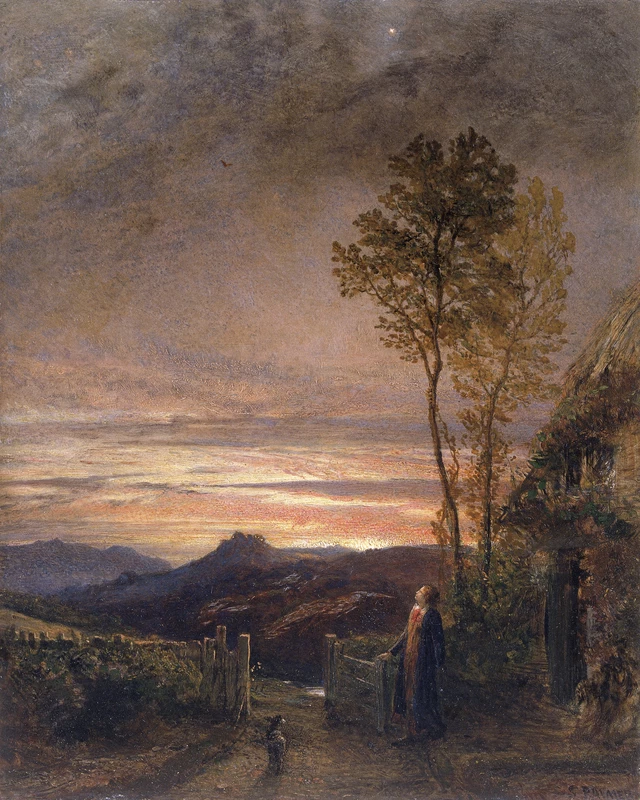
Samuel Palmer ranks among the most important British landscape painters of the Romantic Period. The first of his paintings to enter the collections of Amgueddfa Cymru is a landscape titled The Rising of the Lark.

'The Rising of the Lark' by Samuel Palmer
The Rising of the Lark

by Samuel Palmer.
Acquired 1990; Gift; Sidney Leigh through the National Art Collections Fund

Samuel Palmer (1805–51)

Samuel Palmer was the son of a London bookseller. His early work was profoundly influenced by the visionary poet and painter William Blake (1757–1827), whom Palmer met in 1824.

Palmer settled in the village of Shoreham in Kent. He created a symbolic language, using his pictures to celebrate the rural fruitfulness and pastoral simplicity of the world before the industrial revolution.

Palmer’s later work is more conventional and naturalistic. He travelled to Wales and other parts of Britain in the early 1830s, but no place inspired him as much as Shoreham.

Following his marriage to Hannah, the daughter of the artist John Linnell (1792—1882), his painting became increasingly geared to the requirements of the art market.

Inspired by a poem

The Rising of the Lark is inspired by lines from L’Allegro by the poet John Milton (1608–74), a favourite of the artist:

‘To hear the lark begin his flight,
And, singing, startle the dull night,
From his watch-tower in the skies,
Till the dappled dawn doth rise’

Through the rising sun and the joyful song of the lark, Palmer suggests a new beginning. The shepherd opening the gate through which the lamb will pass into the broad landscape may symbolise the stirrings of new life.

Palmer based this oil painting on a detailed drawing dating from his later time in Shoreham. His son Alfred Herbert Palmer wrote about the picture in his biography, The Life of Samuel Palmer. He suggests that it was painted soon after his father’s return from Italy in 1839.

The Romantic Period

This painting belongs to the Romantic period. At this time many artists, musicians and writers aimed to recapture a rural lifestyle which they felt was being lost to industrialisation.
Discovering the secrets beneath - 18th century paintings under the microscope

30 April 2007

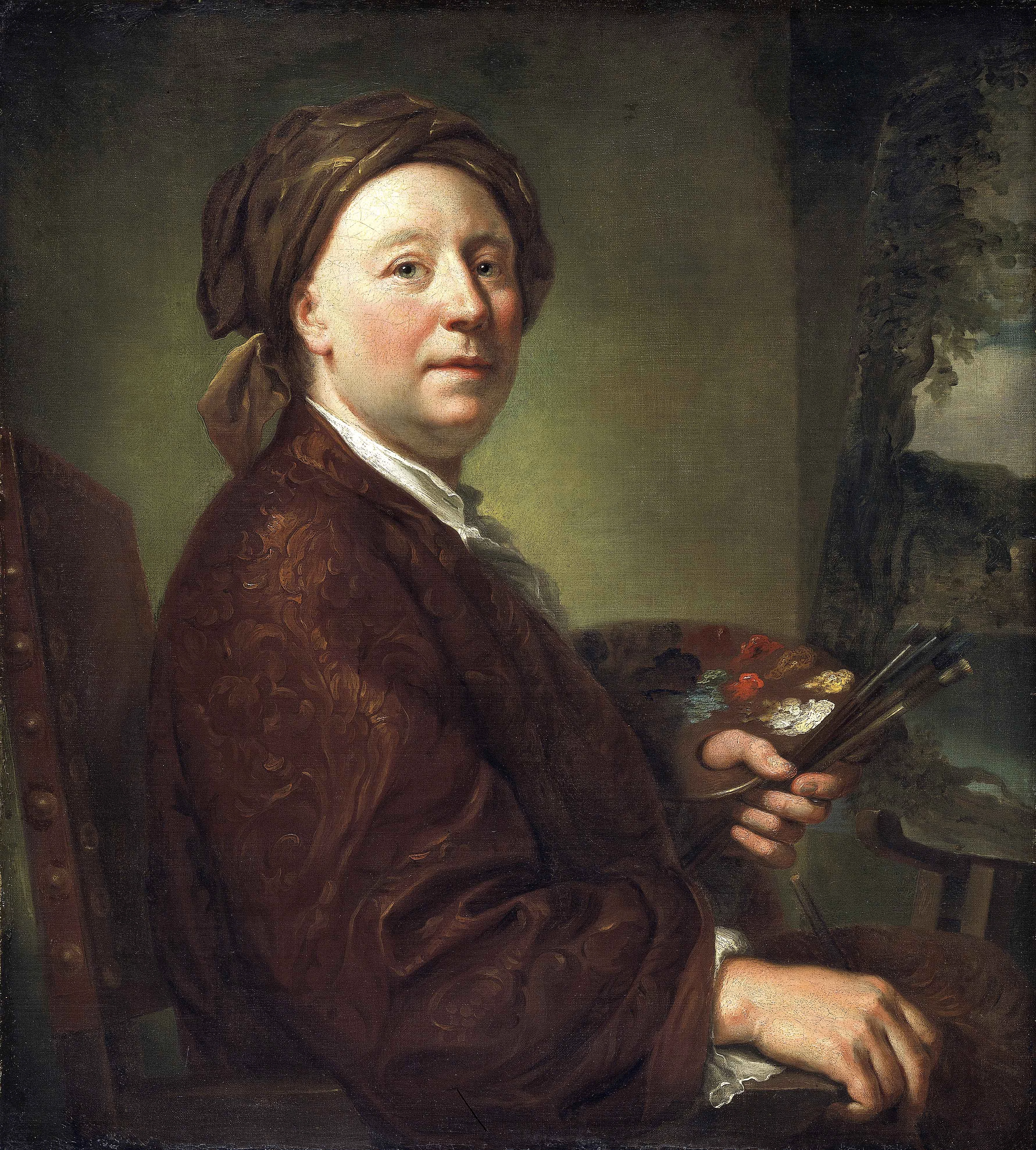
Richard Wilson (1714-1782)

Richard Wilson (1714-1782). This portrait was painted in Rome by Anton Mengs in return for one of Wilson's landscapes - a gesture of friendship and mutual admiration.

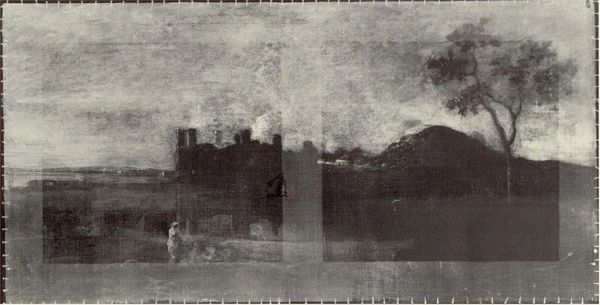
Caernarvon Castle X-ray image

Caernarvon Castle X-ray image (NMW A 73)

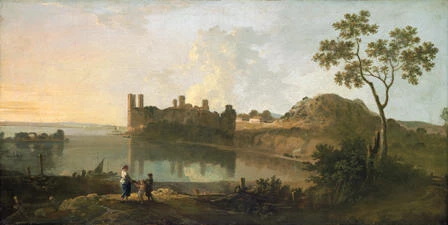
Caernarvon Castle by Richard Wilson

Caernarvon Castle by Richard Wilson

Dolbadarn Castle X-ray image

Dolbadarn Castle X-ray image (NMW A 72)

Dolbadarn Castle in I.R. light

Dolbadarn Castle in I.R. light (NMW A 5203)

Over the past few years, the Museum has been examining a number of paintings in the collections by Richard Wilson. Modern scientific equipment can reveal hidden details about the structure and materials used in these paintings. The results provide a fascinating insight into the artist's working methods and have led to discovering the origin of some of the more doubtful paintings from Wilson's work.

Infra-Red Light

Infra-red light has been used to see whether the paintings have subsequently been altered or painted over by the artist. Infra-red light can penetrate all but the deepest blue pigments to reveal any dark tones overlying a light coloured ground. It has been discovered that there are underdrawings in both the oil sketch of Dolbadarn Castle (NMW A 5203) and the large finished painting of the same subject (NMW A 72). In the oil sketch, the underdrawing includes a bridge across the river in the distance and a fence in the right foreground. Neither of these features were used in the final sketch. Furthermore in the large painted version Mount Snowdon is included in the background and the distant riverside buildings are moved further to the left. His ability to rework his designs brings variety to the many versions he painted of the same subjects and helps explain how he gives his English and Welsh views a grand classical appearance.

Paint Structure and Materials

Subjecting Wilson's work to X-rays has enabled the structure of Wilson's paintings to be examined. X-rays easily penetrate some materials, but are reflected by others. Some pigments traditionally used in oil painting come from heavy metals such as mercury, cadmium and lead. Lead white being one of the most commonly used. X-rays show up the structure of the painting and any changes that may have been made using lead white. Wilson usually painted his skies in a mixture of lead white and a blue pigment only down as far as the horizon, skirting around any trees and foliage silhouetted against the sky. The foreground and trees are painted largely with earth colours, which X-rays easily penetrate. A typical X-ray of a painting by Wilson should show a strong contrast between sky and foreground areas. This is best illustrated by Caernarfon Castle (NMW A 73). Any landscape not showing this characteristic contrast therefore can be assumed to have been produced by someone other than Wilson.

A few of the paintings examined so far show that Wilson sometimes completely reworked a composition. Dinas Bran (NMW A 3277) was originally started as a View of Tivoli (see NMW A 495). The town on the slopes of the hill is clearly visible in X-ray together with a wayside shrine, which occurs in other versions of that subject. He also occasionally reused a canvas. Dolbadarn Castle (NMW A 72) has been painted over a portrait of a woman, and Landscape with Banditti around a Tent (NMW A 69) is painted over a Venetian-style reclining nude.

Powerful microscopes

Tiny paint samples have been taken and looked at under incredibly powerful microscopes.

The pigments found in the paint layers almost exactly match the palette Wilson used. Prussian blue and indigo mixed with lead white are the chief pigments found in his skies, and ochre, Naples yellow, red and yellow lakes, Prussian blue and indigo in his foliage and foregrounds. Ultramarine blue however, which, according to contemporary accounts, Wilson used in finishing his skies, has not yet been found.

Proving Fakes

Although most of Wilson's close followers would have used a very similar palette to that of their master, this type of modern analysis has proved that later imitations were false as the pictures contained pigments that were not known in Wilson's day. These include NMW A 5195 Coast Scene near Naples, which contains cobalt blue, first introduced in 1817 and NMW A 5206 Cilgerran Castle which has a ground containing barytes, introduced at the end of the 18th century.

This research has produced information vital to a deeper historical understanding of individual works by Wilson, as well as some definite conclusions as to the status of paintings of doubtful origin.

An eighteenth-century painter at work: The techniques of Richard Wilson

16 April 2007

Amgueddfa Cymru owns the largest collection of paintings by Richard Wilson outside London, holding over 20 paintings in its stores and on display to the public.

The Artist

Richard Wilson (1714-1782)

Richard Wilson (1714-1782). This portrait was painted in Rome by Anton Mengs in return for one of Wilson's landscapes - a gesture of friendship and mutual admiration.

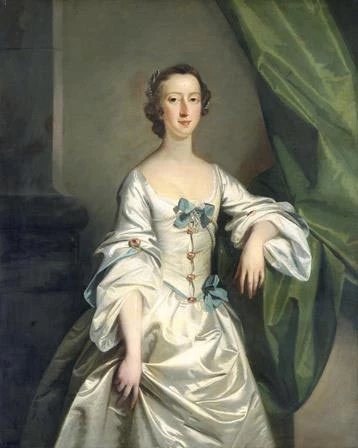
Portrait of a Lady: Maid of Honour. Richard Wilson (1714 - 1782)

Portrait of a Lady: Maid of Honour. Richard Wilson (1714 - 1782)

Richard Wilson was born and brought up in Penegoes , Montgomeryshire and moved to London in 1729 to train as a portrait painter under Thomas Wright. Following his apprenticeship in 1735 he began producing portraits of Welsh and English sitters. In 1750 he left London for Rome where he remained until 1757. During this time he developed new skills as a landscape painter in the grand classical style following the examples of Poussin, Claude and Zuccarelli.

On his return to London he hired several apprentices and paying pupils included Thomas Jones and Joseph Farington who both ended up adopting something of Wilson's studio practice.

Over the next fifteen years he produced large numbers of Italian, English and Welsh landscapes repeating the more popular subjects many times over. Gradually the market for this type of painting disappeared and his income dwindled. The Royal Academy, of which he had been a founder member in 1768, eventually appointed him as Librarian with a salary of £50 per annum. Eventually his health deteriorated and he retired to Colomendy near Mold where he died in 1782.

Portrait Painting Technique

Wilson's initial portraits date from 1740-50 and reflect the taste of his day. Subjects are usually shown bust-length in an oval with a suitable background echoing the aspirations of the sitter. Wilson's loose but masterly handling of paint is visible in the costumes of his subjects, showing details of fastenings and other decorative features. Wilson painted skin tones in three stages. The first colouring established the basics of the face using a shade tint for the darker tones and a light tint for the general flesh tone. The second painting, after the first was dry, consisted in heightening of the lights, glazing the darks and adding carmine to the lips and cheeks. The final or third painting allowed final corrections to the glazing.

A particular hallmark of his portraiture is the grey underpainting left exposed to form a mid-tone of the skin. This is easily visible in the portraits of

Richard Owen (NMW A 5005) and the Maid of Honour (NMW A 67).

Landscape Painting Technique

Wilson decided to abandon portraiture in favour of landscape painting whilst in Italy. His landscape paintings were produced by first applying an underdrawing of brown paint, followed by ‘dead-colouring', a task which was given to the studio apprentices. Thin washes of colour were applied at this stage; Prussian blue and grey-brown for the sky, and a mixture of red and blue pigments for the landscape. The colour was applied to a thickness depending on the depth of tone required, allowing the light tone of the ground to show through more towards the horizon. Once the dead-colouring was dry it was oiled out before the second painting.

For the foreground Joseph Farington records that Wilson 'went over it a second time, heightening every part with colour and deepening the shadows, but still, brown, loose and flat, and left in a state for finishing: the half-tints laid in, without highlights.' In the third and final painting of the foreground Wilson altered the tints, adding the necessary sharpness to the different objects, before glazing them with rich warm tints, and finally adding further solid tints over this.

The sky and distant landscape, on the other hand, were worked wet-in wet after the initial dead-colouring, rather than in two separate stages. This allowed Wilson to achieve easier blending of the clouds with the blue of the sky, apparently using ultramarine rather than Prussian blue for this stage of painting. Last of all the horizon was adjusted and the distance softened with grey-brown again as necessary.

Drawing Practice

Drawing was important to Wilson with the first year of his pupils' training being devoted purely to drawing, which he believed gave them a good grounding 'in the principles of light and shade without being dazzled and misled by the flutter of colours.'

The majority of his surviving drawings date from his visit to Italy (1750-7). These are made up of studies taken directly from nature and designs drawn from his imagination. His preferred medium was black chalk and stump on a grey paper. He used these drawings as an inspiration for his oil paintings but rarely translated them directly into paint. He was constantly reworking the original designs and making adjustments as he painted.

In addition his colours were all derived from his visual memory or his imagination as he disapproved of tinted drawings and never used watercolours to make studies from nature.

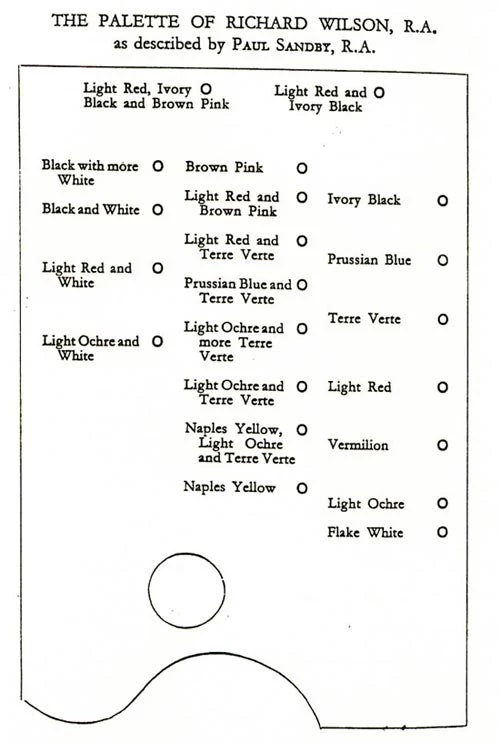
Wilson's palette according to Paul Sandby from Whitley's Artists and their Friends in England 1700-1799. (Medici Society pub. 1928)

Wilson's palette according to Paul Sandby from Whitley's Artists and their Friends in England 1700-1799. (Medici Society pub. 1928)

Wilson's Palette:

Both Joseph Farington, who became his pupil in 1763, and the watercolourist Paul Sandby, one of his friends, recorded Wilson's palette. Their accounts differ slightly but together give the range of pigments we would expect to find in his paintings.

Blues: ultramarine, Prussian blue, indigo
Reds: vermilion, light red, red lake
Yellows: yellow ochre, yellow lake, Naples yellow, brown pink
Browns: Roman ochre, burnt siena
Greens: terre verte
White: lead white
Black: ivory or bone black

At a glance:

  • 1714: Born in Montgomeryshire
  • 1728: Moved to London to take up apprenticeship with Thomas Wright
  • 1735: Became Painter in his own right
  • 1750: Travelled to Rome to developing his painting in the style of Poussin, Claude and Zuccarelli
  • 1757: Returned to London training pupils such as Thomas Jones and Joseph Farington
  • 1768: Founder member of The Royal Academy
  • 1772: Appointed Librarian of The Royal Academy
  • >1782: Died in Mold, Wales

A portrait of a Welsh Squire and his children, by Johann Zoffany, distinguished painter to George III

22 February 2007

There are many portraits of well-known Welsh figures in the art collections of Angueddfa Cymru. However, the Museum also collects portraits of lesser-known people as they can be important works of art in their own right. The study of these portraits often sheds new light on when and how their subjects lived and adds to our understanding of art in the past.

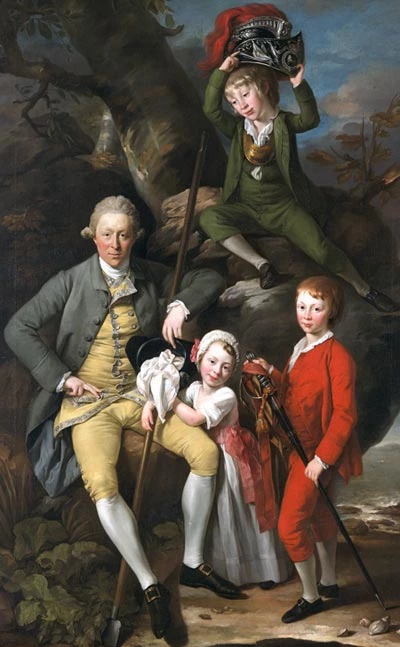
During the past 20 years several distinguished 18th and early 19th century portraits have been acquired by the Museum, including Henry Knight of Tythegston with his three children, painted by Johann Zoffany (1733-1810) in about 1770.

Henry Knight of Tythegston with his three children by Johann Zoffany

Henry Knight of Tythegston (1738-1772) with his Children

Johann Zoffany (1733-1810)
Henry Knight of Tythegston (1738-1772) with his Children.
c.1770 - oil on canvas

The portrait shows the Glamorganshire squire Henry Knight (1738-1772) with his three children Henry, Robert and Ethelreda. Henry was a soldier in the 15th Light Dragoons, and his older son is shown trying on a helmet of that regiment. Henry Knight's father, Robert Knight (1711-1765), inherited the Tythegston estate of the Lougher family through his mother in 1732. Henry divorced from his wife in 1771, then a difficult and expensive process requiring a private Act of Parliament. The painting might have been commissioned to represent Henry Knight's decision to leave the military in order to care for his children. In the picture, he is dressed in civilian clothes, but he holds an infantry officer's spontoon, thrust blade-first into the ground. His sons hold his sword, gorget and helmet. The picture's seaside setting is probably a reference to Tythegston, a couple of miles from the coast, between Bridgend and Porthcawl. The tree motif, frequently used in Zoffany's family groups, allows all the figures to be given equal importance. Showing the boys playing with arms and armour belongs to a tradition that can be traced back to the Renaissance.

Johann Zoffany

This is one of Zoffany's largest family portraits (measuring 240 cm x 149 cm), and is a surprisingly ambitious commission for a Welsh squire of modest means. Zoffany, one of the most distinguished British painters of the reign of George III, was famous for his informal styles. One of his best-known pictures, Sir Lawrence Dundas with his grandson, shows the 17th century Dutch masterpiece The Calm by Jan van de Cappelle, also in the Museum's collections.

Born near Frankfurt and trained in Rome, Zoffany moved to London in 1760. Lord Bute, George III's first prime minister, probably introduced him to the Royal Family, where he became the favourite painter of Queen Charlotte. The King nominated him a member of the Royal Academy in 1769. The appeal of Zofanny's work lies in his ability to catch a likeness and his astonishing attention to detail. His perspective, however, can be faulty, and here the helmet held by the older son is clearly too large.

Purchasing the portrait for the Museum

The picture is in a remarkably good state of preservation. X-ray examination reveals that the artist reworked the head of Robert Knight (the younger son dressed in red), but there are only a few other minor changes to the design, and most of the composition was laid on quite thinly. The picture was loaned to the Museum from 1940 until 1958. When it was offered for sale at Sotheby's in 1999 its acquisition by the Museum was a priority. The purchase was made possible by generous donations from the bequest of June Tiley, the Heritage Lottery Fund and the National Art Collections Fund.

Painting Medieval Myths from Rome and Britain

22 February 2007

Two different medieval myths are represented in two works by the 19th century artist Sir Edward Burne Jones. The Wheel of Fortune (1882) and Arthur at Avalon (1890) are both in the collections of Amgueddfa Cymru.

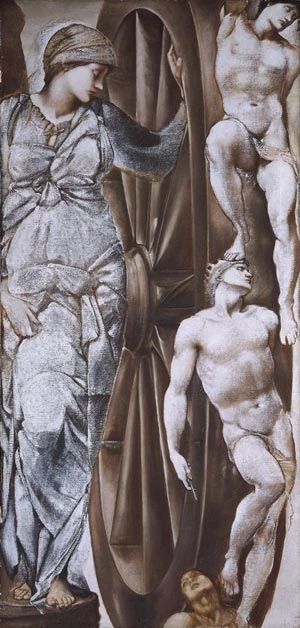
Wheel of Fortune, Burne Jones

This unfinished painting of about 1882 depicts the medieval theme of the wheel of fortune, which lifts or abases man as it is turned by the goddess Fortuna. The drawing of the nudes and the drapery of the goddess reveal the artist's careful study of Michelangelo.
Burne Jones.
Oil on Canvas.

The Wheel of Fortune is based on Roman mythology. For the Romans, the goddess Fortuna represented luck. However during the Middle Ages the idea of the wheel of fortune evolved from the writings of Boethius, a 6th century Christian martyr. In The Consolation of Philosophy, he wrote that the random turns life could take were all part of God's divine will and that man must accept the twists and turns of fortune.

It has long been a tradition in art to show gods as being larger than humans, and here Burne Jones represents Fortune as larger than the humans, who she turns on her wheel. He does show her blindfolded, as was usual, but with her eyes closed. Traditionally, the wheel has four figures on it. They represent four stages of life: "I shall reign", "I reign", "I have reigned" and "I have no kingdom". Burne Jones only depicted three figures on the wheel, but he maintained the idea of a reign by placing a crown on the head of the central figure.

The feminist author Camille Paglia has described this work as a sadomasochistic tableau, with "Fortuna turning her torture wheel of beautiful young men, languid with limbs stretched in sensual suffering". Although the men are accepting of their fate, how much choice do they have? The limbs are not so much stretched in sensuality but as an indication that you ascend by climbing over someone else and this in turn will happen to you. This is something Burne Jones felt personally. In 1893 he wrote "My Fortunes wheel is a true image, and we take our turn upon it, and be broken upon it."

But to wider Victorian society, where industrial fortunes meant one could rise in wealth and class and the British Empire was the most powerful in the world, this notion of rise and fall would have touched a nerve. If you are on top of the wheel, the next turn might place you at the bottom.

Burne Jones painted another myth with Arthur at Avalon. This myth is taken from Thomas Malory's famous poem of 1470 Morte d'Arthur ('The Death of Arthur'). Arthurian legends were popular with artists for many reasons. They were well known to the public and they contained brave knights, thwarted lovers and femmes fatales. Unlike the classical world, these heroes were Christians and, most appealingly, they were rooted in British history. Greece and Rome were all very well but a local hero was more likey to inspire future empire builders.

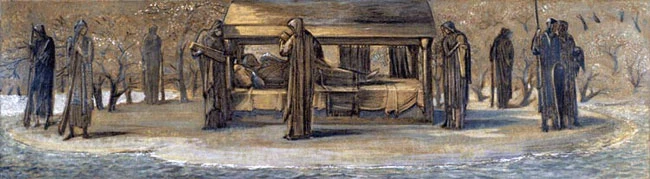
In Arthur at Avalon Burne Jones shows the scene of Arthur's death. After being mortally wounded in battle by Mordred (his son by his half sister), Arthur is taken to the Isle of Avalon in an attempt to heal his wounds. The name Avalon ("Afallon" in Welsh, meaning the isle of apples) perhaps related to the tree of knowledge, and it was believed to be a magical place. In the background of the painting we can see trees with blossom that could be apple trees. Authur ordered Sir Bedivere to give his sword Excalibur to the Lady in the Lake, but when Bedivere returned Arthur was gone. This has been taken to mean that Arthur might not be dead, only sleeping until he is needed again. The Arthurian legend not only continued to be a source of interest to artists throughout the 19th century, but continues to inspire artists, writers and film-makers today.

Arthur At Avalon, Burne Jones, 1890

Arthur At Avalon, Burne Jones, 1890