Now this entry is going to be concise. I had just finished an extended version of the last month, in English and Welsh, pressed publish, and everything disappeared. So, I'm sulking. In brief, this is how last month went:
June 18 - Meeting with National Library of Wales. Discussed collecting websites, TV programmes and records, amongst other things (ephemera, how to record Youtube etc) Very interesting, and a big thanks to all at the Library for the welcome.
June 19 and 20 - Digital Storytelling workshop with the BBC. A technique which is very useful to record contemporary life. Visit website at www.bbc.co.uk/wales/capturewales/
June 21 - Digital Storytelling Conference missed due to illness
June 23 - Family wedding
June 24 to July 1 - Holiday in Caernarfon
July 6 and 7 - Oral History conference in London. Again, a technique which is very useful to record contemporary life.
July 12 (tomorrow) - Meeting with Johnstown History Group to discuss curating for the Community Dresser.
If anybody is interested in learning more about these things, then please contact me. In the original Blog, I managed to mention, Glyn Wise off Big Brother, setting up a virtual museum in Second Life, a Welsh name for Facebook and numerous other fascinating things. But there we go, such is the ficklelessness of the ether.
Today, hardly any rural cottages erected since before the middle of the eighteenth century survive in Wales — it was generally believed that the poor simply could not afford materials good enough to last. New research suggests that this is not the case.
In fact, cottages were built with great ingenuity and attention to detail, using the best materials available locally.
Examination of Welsh cottages and the study of contemporary surviving accounts by Amgueddfa Cymru have concluded that it was a lack of maintenance and, above all, changing fashions brought about by the Industrial Revolution that led to their disappearance.
Sustainable construction
Transporting materials cost money so traditional builders were expert at exploiting their local environment in a sustainable way. Cow dung, for instance, provided fertilizer for the fields, was used in the making of clay flooring, added to help bind cottage walls and also as a fire-retardant for chimneys made of woven wattle.
Earth and turf
As the poor could not afford bricks, cottage walls were built from stone, earth or timber. They used whatever they could most readily and cheaply get. In western lowland areas of Wales — Anglesey, Llŷn and west Wales — that was often earth.
Few earth cottages survive in Wales today; many more can by found in the drier areas of England. In the very wet uplands, many turf-walled cottages were built, as turf lasted much longer than earth.
Thatched roofs
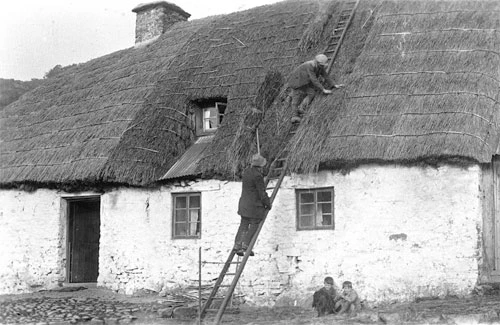
Up until the development of the great slate quarries of north Wales in the 19th century, and the coming of railways, thatch was a very common material. Today, very few thatched roofed buildings survive compared to in England.
Four different thatching techniques were common in Wales; only one still survives today in eastern Wales.
In west and north Wales the top coat of thatch was formed of knotted handfuls of straw thrust with a forked implement into a thick underthatch layer. The underthatch itself was often laid on a woven wattle foundation.
In the most exposed areas, the roof could be held down by a network of ropes pegged to the walltop, or held down by heavy stones.
Chimneys of straw and wattle
Cottage floors were often earth or mud. Partitions could be made of woven wattle or straw rope, covered with daub. The smoke hood above the chimney-stack was also often of daubed wattle, as was the chimney stack itself; no wonder that so many of these cottages were destroyed by fire.
But however sustainable the building materials used in these cottages, they fell prey to changes in society, and to fashion.
Changing fashions
With the growth of the Industrial Revolution, and the importation of food from abroad, more and more people left the countryside, most of them cottage dwellers.
More and more cottages, too, became the property of great estates, who began building larger homes for their workers. It was often easier to demolish the early cottages than it was to give them a second storey or to adapt them.
Today, traditional early cottages are rare survivals, and all the best remaining examples are listed as being of special architectural importance.
The library at Amgueddfa Cymru was established many years before the main museum building in Cardiff was formally opened in 1927.
The library at Amgueddfa Cymru
Miss E. M. Breese, a cataloguer from the adjacent University of Wales, was the first Librarian. Although Miss Breese did not arrive until 1913, the accession books run from 1909.
The beginnings of a collection
The first item to be accessioned was a copy of John Ward's Handbook of objects from the Roman fort of Gelligaer (John Ward, Curator of Cardiff's museum, later became Keeper of Archaeology at Amgueddfa Cymru).
Among the first books purchased in 1909/10 were the Yearbook to learned and scientific societies, Esther Crawford's Cataloguing: suggestions for the small public library and a guide to the House of Commons.
The main Library of the Museum, located in National Museum Cardiff, consists of a central, shelved room with accommodation for staff and readers, along with two wings of heavy 1920s mobile racking that are still in use today.
The only other known example of such racking, suspended from iron girders, is from old library stacks in the British Museum.
The Museum expands
As the Library outgrew its original premises, departmental libraries were created. As well as the libraries at National Museum Cardiff, there is a substantial collection at St Fagans National History Museum.
The library covering industrial history and archaeology is now in the National Waterfront Museum in Swansea, and there are small collections at the National Slate Museum in
Llanberis and the National Roman Legion Museum in Caerleon. All three libraries are administered from National Museum Cardiff.
Important and significant collections
The Library has attracted some major donations. The most important is the Tomlin library of 17th-century and later books on Mollusca, with several volumes of the finest hand-coloured natural history engravings ever produced.
In 1953 the Willoughby Gardner collection arrived, with a number of early printed books on the natural sciences, including herbals and the Museum's only two incunables (books
published before 1501) - two editions of Pliny's writings on natural history from 1481 and 1487.
As well as Museum staff, the Main Library is often used by external students and the Library can be used by the public by appointment.
Special collections
As well as general museological and conservation books, special collections are housed in the Main library at National Museum Cardiff. For example, there is a fine collection of Welsh topographical books - mainly published tours of Wales from the 18th and early 19th century, together with some manuscripts.
On loan to the library is a set of Gwendoline Davies's own copies of the Gregynog Press books in special bindings. The Library has been acquiring examples of other private press books contemporary with the Gregynog Press, as well as modern private presses in Wales, including Gwasg Gregynog, Old Stile Press and Red Hen Press.
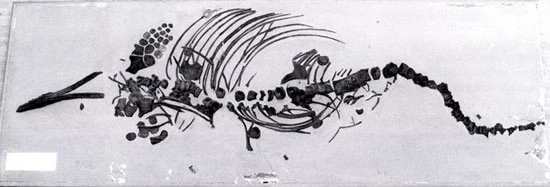
The ichthyosaur specimen before conservation (1750 mm by 720 mm by 70 mm)
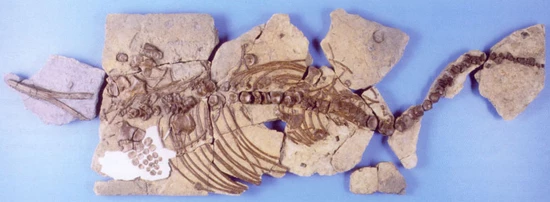
Ichthyosaur after conservation showing head from separate individuals, and paddle bones set in plaster
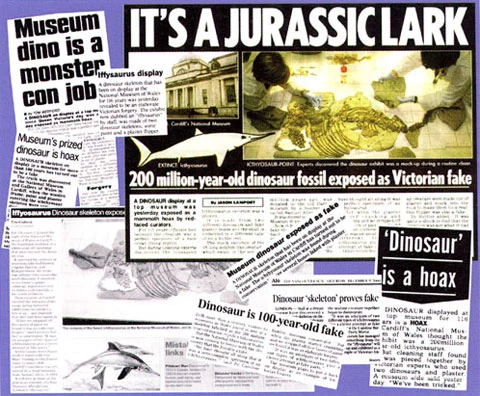
Press coverage of the story
Routine conservation of the fossil collections at Amgueddfa Cymru, revealed a specimen that, on first examination, appeared to need a small amount of remedial work. What was to have been a small job turned into a major conservation project which attracted international media interest.
The ichthyosaur
The specimen in question is an ichthyosaur, a marine reptile that lived during the Mesozoic Era, 65-200 million years ago - the same time as the dinosaurs. They are similar to dolphins, with large eyes and distinctive long jaws with sharp teeth and limbs modified into paddles.
The specimen was donated to the old Cardiff Museum in the 1880s and subsequently became part of the National Museum collections. It was originally mounted in plaster with a surrounding wooden frame and then both the plaster and the specimen were painted.
The specimen was restored several times during the twentieth century, and this included new plaster and repainting. A label identified the species as Ichthyosaurus intermedius, collected from Street, Somerset, and described the skeleton as 'the greater part of a small individual preserved with but little disturbance of the bones' — a statement later found to be rather inaccurate.
A detailed investigation of the specimen was undertaken and extensive damage was discovered, with cracks running through it. The plaster and wooden mount were in poor condition so the decision was made to remove all restoration and paint, and to get back to the original skeleton and rock. It was not a decision made lightly because we knew that the whole appearance of the specimen was going to be radically altered.
Revealing the specimen
Removal of the paint layers revealed that the missing ends of the ribs had been moulded in plaster and then painted to match the rest of the specimen, giving the false impression of actual bones.
Study of X-rays taken of the specimen revealed an inconsistency in one section of the spine of the fossil; a dark shadow surrounded the bones. When the paint from this area was removed, it became clear that a channel had been carved in the rock and individual loose bones had been fixed into it with plaster.
Beneath the paint it was discovered that the bones of the single preserved front paddle were also set in plaster. Holes in the surrounding rock suggest areas from which bones may have been removed before being relocated, but it is possible that some bones had been taken from other specimens.
The biggest surprise came when the paint was removed from around the jaw; the rock was a totally different colour and type to the rest of the skeleton. Not only were there at least two individuals involved, but further study proved that the head and body were two entirely different species of icthyosaur! This was a specimen that had been considerably altered by the Victorian preparators.
Re-displaying the conserved fossil
Although the specimen was made up of two different species, it was decided that the head and the body should be kept together as originally intended. The plaster surrounding the paddle and a part of the ribs made from plaster were also left intact. A new light-weight support system was built. Instead of being displayed simply as a museum specimen, this ichthyosaur will be used to highlight the techniques used by some Victorian enthusiasts to 'restore', display and present fossil specimens and how painstaking conservation work today revealed the true nature of our specimen.
Intense media interest was sparked when the Museum announced a public talk on the conservation of the specimen. This resulted in the story being covered in the national and international press in addition to television, radio and the internet, and included a live interview with ABC Radio in Australia!