
From Blitz to Prefab - How the Second World War altered housing in Wales
26 April 2007

The living room.
The living room.
When a miners' hospital closed in 2001, a working coalface that was used to exercise the patients for work again was dismantled and moved to the collections of Amgueddfa Cymru.
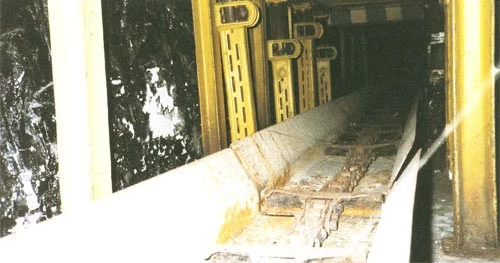
Talygarn House: a view along the full-size model coalface
Talygarn House, Pontyclun, south Wales, was a large stone mansion that became a hospital in 1880. The interior is decorated with wood panelling and painted ceilings. The house is surrounded by extensive parklands on which were grown, according to legend, specimens of every tree that can be cultivated in Britain.
In October 1923, Talygarn House was opened as a miners' convalescent home, and in 15 years of its opening it had more than 41,000 patients.
In 1943, the Miners' Welfare Commission was asked to organise a rehabilitation service for injured mineworkers. Due to a serious shortage of manpower at that time, it was vitally important for injured colliers to return to work as quickly as possible. For this purpose Talygarn House was purchased as a centre for the coalfields of south Wales.
By 1964, 95% of patients treated at Talygarn returned to the mining industry. It continued to serve as a rehabilitation and physiotherapy centre until it was put up for sale in August 2000.
Due to the need to harden the men up to return to the collieries, a carpentry shop was provided where patients cut wood and sawed logs. Miniature stairs and static bicycles were available to exercise unused muscles.
Talygarn House was also equipped with a grand 'Model Mine' in which patients could get used to working back in a mining environment. The structure was a long concrete tunnel supported by arch girders. The roadway was equipped with rails and the metal framework known as 'horseheads', which prevented falls of stone on a real coalface.
In 2001, the contents of the 'Model Mine' were donated to Amgueddfa Cymru as a 'permanent reminder to visitors of the work of the Talygarn rehabilitation centre'.
The coalfaces were dismantled as if they were the real thing. Despite working in only four feet of height, the thirty-foot-long chain conveyor was successfully disassembled and removed.
All the items were safely transported to the Collections Centre at Nantgarw. The Talygarn donation is a unique survival of a complete thirty-foot section of a typical semi-mechanised coalface of the early 1960s.
In 1992 Wales's smallest post office was delivered to Amgueddfa Cymru. Thanks to the generosity of Post Office Counters Ltd, who financed the project, the small brick building was dismantled, transported and then re-built at St Fagans National Museum of History by the Museum's specialist re-erected buildings team.
Village post offices have played an important role in community life throughout Wales for the past 90 years. By the 1950s, virtually every village had its own branch, from which mail was distributed, parcels were collected and people gathered to catch up on all the local news. The country postman/postwoman on their bicycle, and later, in the red-painted Morris Minor or Fordson van, helped to keep people in rural communities in touch with one another by maintaining links and regular contact.
Wales's smallest post office at Blaenwaun, Carmarthenshire
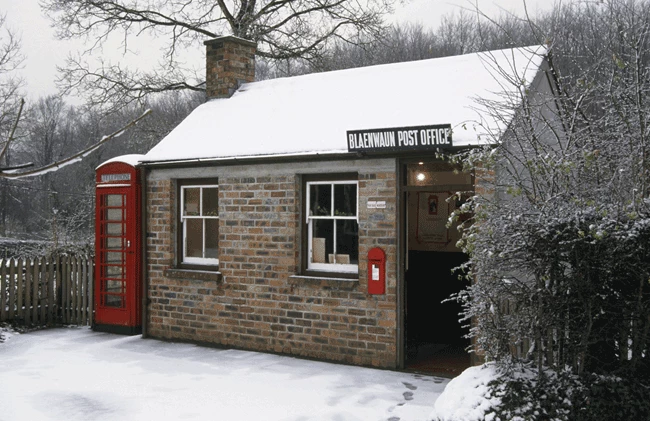
Blaenwaun Post Office at St Fagans National Museum of History
Of course, country post offices were very rarely housed in the impressive buildings of those found in towns. They usually occupied a corner of the village store or the front room of a house. Sometimes these post offices sold a range of items, but some relied on the sale of stamps, postal orders, licences and savings certificates as their only means of income.
Blaenwaun Post Office, located about eight miles north of Whitland in Dyfed, was one such business. It was built in 1936 by Evan Isaac, a stonemason and his cousin David Williams, a carpenter. The Post Office was run by Mrs Hannah Beatrice Griffiths (nee Isaac), Evan Isaac's daughter, who also ran the pub across the road, the Lamb Inn, with her husband.
Mail was brought daily from Whitland and was sorted at the Post Office on a low bench in the back room. It was delivered to the local community by Mrs Griffiths, who completed the eight-mile round journey on her bicycle before going across the road to work in the Inn. Any customers who arrived at the Post Office when the Griffithses were working in the public house could press a button which rang a bell behind the bar.
The Post Office, which measured just 5m long by 2.9m wide, comprised of two rooms: an outer serving room with a counter and an inner office or sorting room with a small fireplace and a bench under the window. A timber partition wall separated the two rooms. The internal walls were painted chocolate brown to a height of about a metre above the floor then cream to the ceiling, with a broad black band between the two.
A painted sign made of heavy tin sheet on a wooden board was fixed outside above the serving room window. It read BLAENWAUN POST OFFICE. A small post box was mounted against the wall between this window and the entrance door.
In the early days, there was a telephone on the counter for the use of the Post Office and, one assumes, the villagers. Later, a public kiosk was erected outside the small building. In the office was a War Department Receiver for receiving urgent messages in times of emergency.
Following Mr Griffiths' death in the early 1960s, the business was relocated to a new bungalow built by his daughter, Mrs Evanna James. The old Post Office stood empty from that time until it was offered to Amgueddfa Cymru in 1991.
It can be visited today at St Fagans National Museum of History in the 'village' section of the open-air museum, near the bakery and the tailor's shop. It has been refurbished to its war-time appearance, and represents a period of Welsh history not covered in any of the Museum's other buildings.
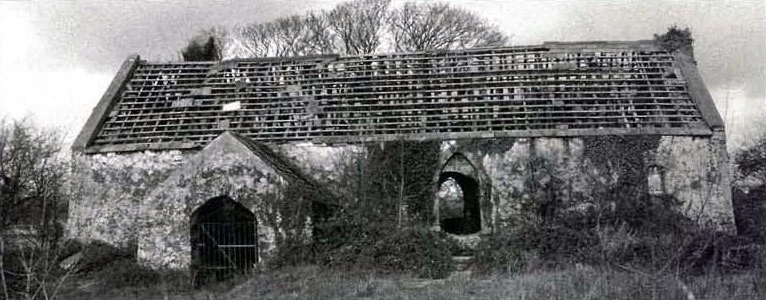
St Teilo's Church, Llandeilo Tal-y-bont, in situ in 1984
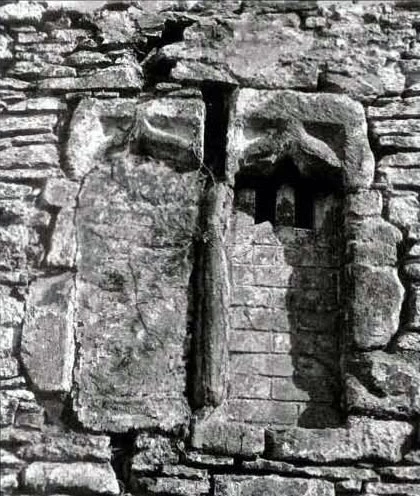
Stone mullioned medieval window uncovered from beneath layers of lime wash and render during the dismantling process
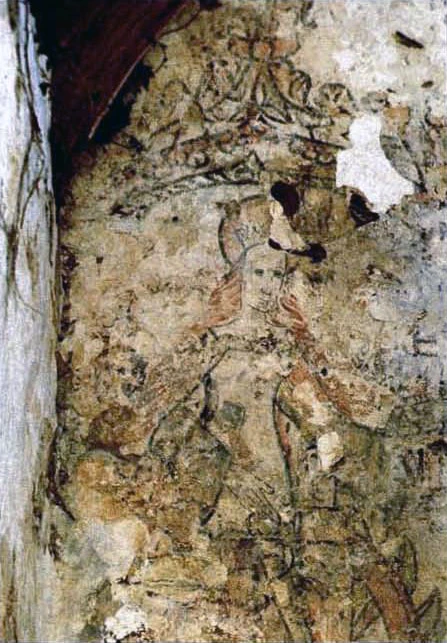
Wall-painting of St Catherine, 'in situ', found on the east wall of the south transept, believed to have been painted c.1400
St Teilo's church was built during the 13th century. There was probably an earlier church on the site. Abandoned in the 1960s, it was scheduled as an Ancient Monument by Cadw: Welsh Historic Monuments in the 1980s. As the decaying church could not be saved at its original site, it was offered to the Museum in 1984 for dismantling and re-erecting at St Fagans.
As the careful process of dismantling the Church began, two amazing wall-paintings from the 15th and 16th centuries were discovered, as well as numerous texts and areas of decorative patterns. These were all carefully recorded, removed and conserved.
The delicate removal of layers of lime-wash from the surface of the wall-paintings provided vital clues to the date of the original building. The removal of mortar from the outside walls enabled any Victorian or later alterations to be filtered out. After dismantling, the foundations were excavated, uncovering further clues to the Church's construction.
The first surviving church was probably a small building consisting of a nave and chancel, a pattern that was standard throughout Wales at this time, thought to be 13th to 14th century. The next addition would have been the north transept, with the south transept probably built shortly after, as both are of similar construction. These probably date from the 14th or early 15th century, which corresponds to the dating of a wall-painting on the east wall of the south transept.
An extension of the south transept to form an aisle probably occurred during the late 15th century, the old south wall being replaced by an arcade of two arches, with another two cutting into both transepts. The final addition was a porch leading to the south aisle.
The Museum decided to rebuild the Church as it could have appeared around 1510-30. Architectural clues from this period can be used to understand the social, religious and political framework within which the Church was constructed and furnished. This closely follows the extension of the south transept to form the south aisle, presumably to accommodate a larger congregation. This could fit in with the economic recovery in Wales, after the Welsh Tudor dynasty became Kings of England in the late 15th century. This brought a period of relative calm after long periods of political and social unrest - including civil war.
Various clues show the nature of worship during the period up to 1530. Most important of these are the pre-Reformation wall-paintings. They show themes from the life of Christ and many saints, including St Catherine and St Christopher. Corbel stones found in the masonry work of the chancel arch show that there were once a medieval rood screen and loft. Both the wall-paintings and the rood screen and loft would have been brightly painted.
Wall-paintings in churches have been described as "the poor man's Bible". They were designed to show scenes from the Bible to a congregation unable to read or write. They were also painted to create a sense of awe, fear and obedience. In some cases, the wall-paintings like the ones found in St Teilo must have been the only means of communicating any religious message at all, as both reading the Bible and preaching were in Latin, which congregations did not understand.
The growing population of the area, the development of other larger churches and frequent acts of vandalism led to St Teilo's falling into disuse. These events reflect the social, religious and political history of the Church just as much as the pre-Reformation wall-paintings do. The re-erection of the Church at the Museum is but another phase in its history, where visitors in the 21st century will be just as valued as its medieval pilgrims! St Teilo's Church now has a good chance of surviving for many more years.
The Social History collections of Amgueddfa Cymru are housed at St Fagans. As it is an open-air museum, the objects range from historic re-erected buildings to small, fragile objects in an air-conditioned store. They vary in size from matches to four-poster beds, and can be as fragile as delicate Victorian shell ornaments or as robust as inscriptions carved on large stone blocks.
A basket from the domestic collections illustrating how simple surface cleaning can have a dramatic affect on an object's appearance.
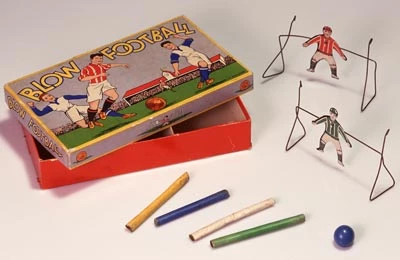
Simple objects can be quite complex. This game is made out of three types of paper as well as metal, plastic, pigments and paints.
Single objects can often be made of more than one material. This means that parts of the objects need different preservation techniques. Conservators have to assess new objects to stablise them, and items in the stores have to be regularly checked.
All objects in the Museum's collections need to be structurally sound and chemically stable if they are to survive. The first stage of treating any object is to examine it closely to see if it is complete. If it is dirty, we have to assess whether the dirt is important to the history of the object. When considering damage, it is important to understand whether the damage happened during manufacture or through use.
These days, visitors do not expect every object to be "perfect". This means that we can focus on preserving what remains rather than restoring what has been lost. It also means that important information about manufacture and use is not hidden or destroyed.
Having recorded an object's condition, we then apply relevant treatments. In some cases, further decay can be prevented or at least slowed by repackaging the object in acid-free materials and storing or displaying it at the correct temperature and relative humidity. When objects sensitive to fading (for example objects with dyes and pigments) are put on display, they can be displayed in reduced light.
Social History objects can be made from almost anything, and nearly always use a variety of materials. Even if an artefact is entirely made out of wood, several different woods might have been used.
Before conserving the object, we have to carry out tests to make sure that none of the solvents we use dissolve any part of the object. Whatever the treatment used, its application is kept to a minimum. Repairs should never obscure any details on the original object. We use a rule that a specimen should appear complete from a distance of 6 ft 6 ins., but the repairs can be seen on close examination.
All aspects of this work are recorded. This means that the full history of the object is always available for reference. It also increases the information we have about the ageing of modern materials, as all treatment dates are recorded.
The final stage of treating any object is to make sure that it enters or returns to a suitable environment, and that anything likely to cause decay or damage is minimised or removed. Monitoring the environment and regularly checking for pests are essential.
As museum collections expand, so does the conservation work required. This has increased the emphasis of preventative conservation, for example, where a large number of objects can benefit from a small change in the environment or working practice. By revisiting the way objects are displayed and stored, we hope to move towards sustainable conservation.
What can you find in the garden?
If you go down to the beach today….
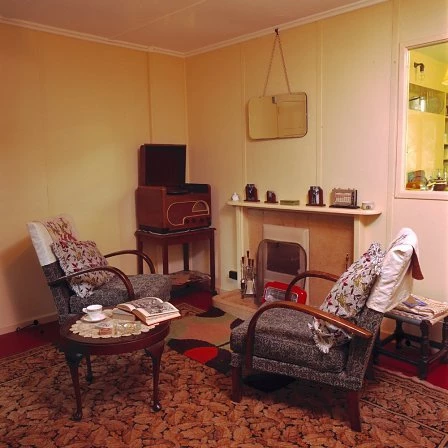
The living room.
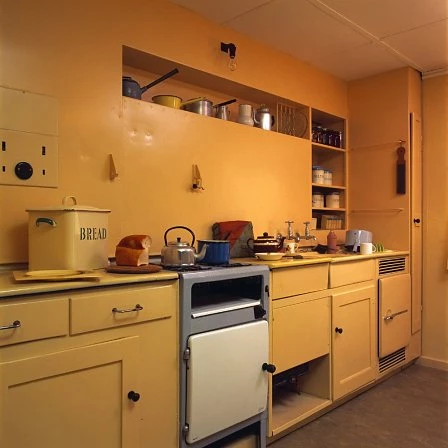
The kitchen.
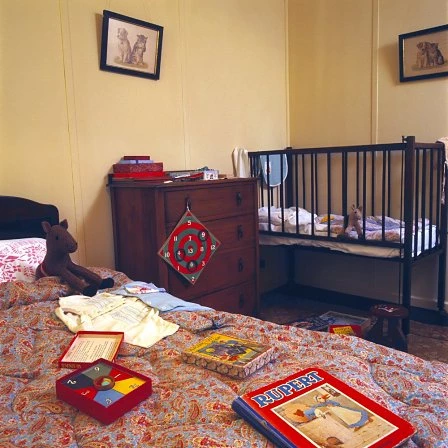
A bedroom.
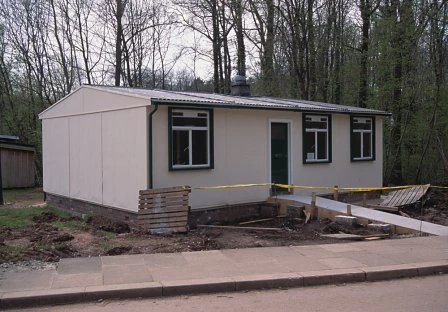
A Type B2 aluminium bungalow, built in 1947, now re-erected and displayed at the Museum of Welsh Life, St Fagans.
Talygarn House: a view along the full-size model coalface

Wales's smallest post office at Blaenwaun, Carmarthenshire
Blaenwaun Post Office at St Fagans National Museum of History
St Teilo's Church, Llandeilo Tal-y-bont, in situ in 1984
Stone mullioned medieval window uncovered from beneath layers of lime wash and render during the dismantling process
Wall-painting of St Catherine, 'in situ', found on the east wall of the south transept, believed to have been painted c.1400

A basket from the domestic collections illustrating how simple surface cleaning can have a dramatic affect on an object's appearance.
Simple objects can be quite complex. This game is made out of three types of paper as well as metal, plastic, pigments and paints.