: Research

Trick or Treat? Ancient collection at Amgueddfa Cymru found to be modern

17 April 2007

At the beginning of the twentieth century, the president of Amgueddfa Cymru, Lord Howard de Walden, formed a remarkable collection of ancient European arms and armour. The collection included a number of classical pieces - helmets, swords, spearheads, belts and armour that were mainly Greek and Roman - or so it was thought until work at Amgueddfa Cymru discovered otherwise...

The collection comes to Amgueddfa Cymru

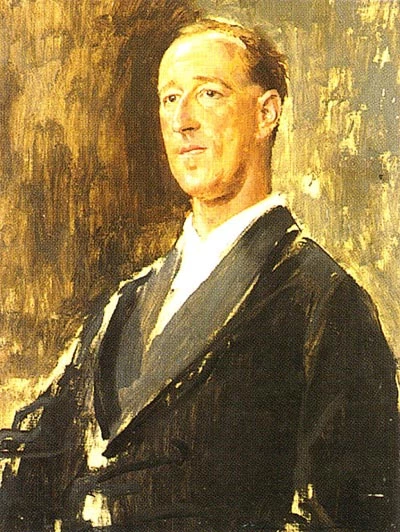
Portrait of Lord Howard de Walden (1880-1946)

Portrait of Lord Howard de Walden (1880-1946)

Etruscan bronze 'helmet' embellished with gold showing half of the false patina removed

Etruscan bronze 'helmet' embellished with gold showing half of the false patina removed

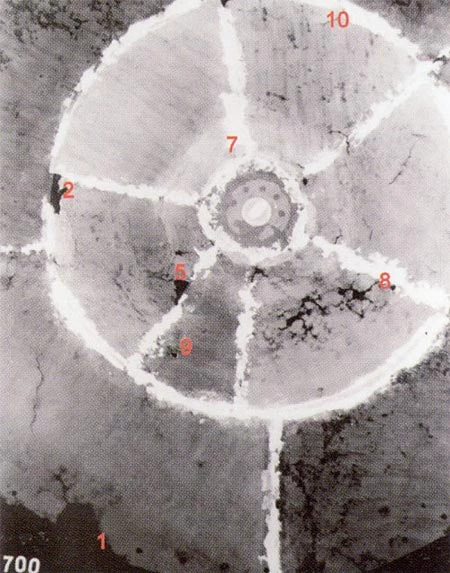
X-Ray of helmet

X-Ray of helmet

In 1945, Lord Howard offered to lend seventy-nine 'antique bronze objects' to the Museum. Following his death in 1946, his son donated the collection to the Museum.

In 1990 research by a Russian scholar had shown that some items from this collection had almost certainly been made in a jeweller's workshop in Odessa, south Russia between 1890 and 1910. Further investigation has revealed some of the objects to be totally genuine, but others reveal signs of being 'improved' or even manufactured more recently from antique metal parts fashioned into classical forms.

In order to meet the demand for classical antiques during this period, it was quite common to produce a particular object using ancient pieces from a number of sources, or in other words, a pastiche (a work of art that imitates the style of some previous work). There are also a number of fakes, where the metal used was wrong for the period of the object. Lord Howard de Walden was well aware of this, for when the loan to the Museum was being organised, he wrote 'there are certain pieces you may not wish to have, such as...several specimens of doubtful authenticity'.

Bronze 'helmet'

One such object that Museum conservators examined was a helmet, made of bronze and decorated with gold, apparently dating from the third century B.C.

The helmet was X-rayed to determine the condition of the metal and the extent of the corrosion, as well as to reveal its construction. However, the X-ray uncovered much more than was originally expected, for dense solder lines could be clearly seen criss-crossing the image. The helmet had undergone considerable restoration work in recent times; cracks had been filled with solder and holes patched with metal. To disguise these recent repairs a fake patina (the sheen on an object produced by age and use) mimicking corroded bronze had been applied over the top.

Analysis of the metal revealed that the bronze helmet was in fact old, and even the patches of metal used to repair the holes were ancient. However, there were indications that the gold was modern.

The investigations concluded that the helmet had been repaired and embellished with gold that would have increased its value and made it more desirable to collectors. This work may have been carried out at the turn of the twentieth century.

Should the modern repair work be removed or conserved?

In the end, it was decided to remove half the false patina in order to reveal the repair work below, for it was felt that the alterations were now part of the history of the object and could shed light on techniques employed at the time the helmet was collected.

Study of this important collection not only throws light on the ancient technology of the genuine pieces of classical arms and armour, but also the practices of the antiquities market a century ago.
Looking after DNA in Natural Science Collections

5 April 2007

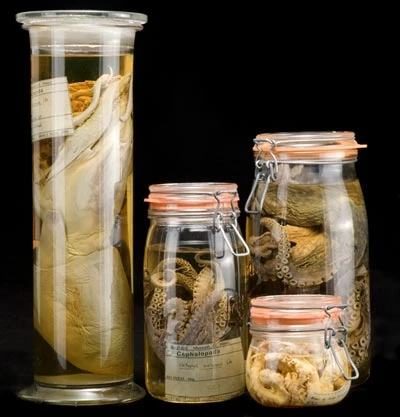
Fluid preserved specimens over a hundred years old and are a potential source of DNA studies.

Fluid preserved specimens over a hundred years old and are a potential source of DNA studies.

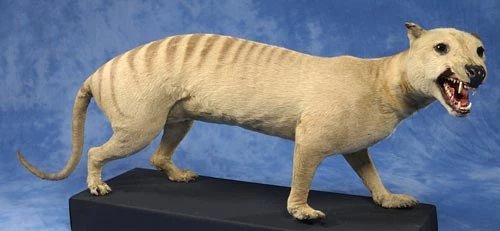
The Extinct Tasmanian Wolf. DNA extracted from the skin of the Museum Specimens has been used to study the relationship of the Tasmanian Wolf to other marsupial animals.

The Extinct Tasmanian Wolf.
DNA extracted from the skin of Museum specimens has been used to study the relationship of the Tasmanian Wolf to other marsupial animals.

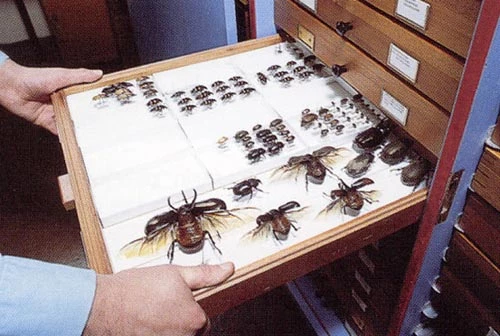
Historic insect collections are a valuable source of future genetic studies.

Historic insect collections are a valuable source of future genetic studies.

The growing crisis in the world's biodiversity has created new demands on the biological collections held in museums. In addition, modern techniques are allowing us to look at our collections in new ways such as analysis of DNA (Deoxyribonucleic acid). It is now possible to extract and read the DNA from museum specimens but this can depend on how they have been stored and preserved.

Irreplaceable collections

Over three million biological specimens are housed at Amgueddfa Cymru. As the pressure on our natural environment increases, these collections are becoming an ever more important resource. Many of the species collected are now either extinct or so highly endangered that further collection is not possible. Many of these specimens are irreplaceable and vital in helping us understand biodiversity and climate change.

Preserving biological material can be very difficult. Biological material, including DNA, decays rapidly. Chemical treatments are aimed at preventing this decay, allowing the long-term preservation of biological specimens.

Early preservation

Preserve museum specimens date back over 300 years. Initially only dry and inert specimens could be preserved. Alcohol was first used in the 17th Century, formaldehyde (formalin) was introduced in the 19th Century. These methods enabled a wide range of specimens to be preserved - but were developed before DNA was known about.

It can be very difficult to obtain DNA from specimens preserved using formalin. Other chemicals, such as ethanol (alcohol), are useful in the preservation of both the specimen and its DNA.

Using DNA from the collections

DNA can be used in many areas of study, such as work on evolution, species identification, and ecology. DNA studies at Amgueddfa Cymru include:

  • Researching Hunter snails from East Africa and using DNA to study how they are related to each other.
  • Freshwater pearl mussels are highly endangered in Wales. Museum researchers are using DNA to look at the genetics of the remaining populations to help in their conservation.
  • Lichens are an important aspect of biodiversity, but difficult to identify. DNA is being used to help identify lichens.

DNA - a fragile resource

Unfortunately DNA can be damaged in many ways. Following the death of an organism, DNA molecules break down very quickly. This means that careful and quick conservation of specimens is needed to ensure the preservation of the DNA as well as the specimen as a whole.

The museum is involved in researching methods of DNA preservation. One method is storage in -80°C freezers or liquid nitrogen. Some museums have already set up frozen-tissue banks, but these methods are expensive.

Ongoing research aims to improve our understanding of the effects of these treatments, helping us keep our specimens DNA intact for the future.