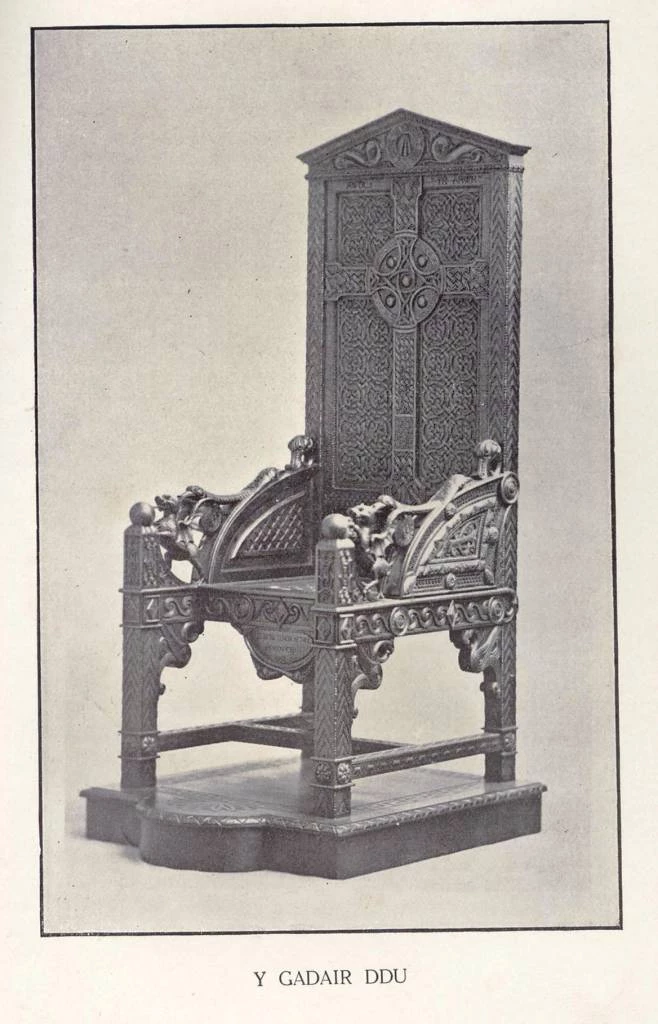
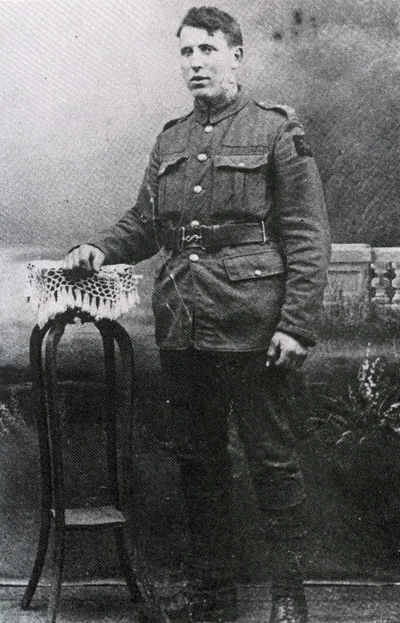
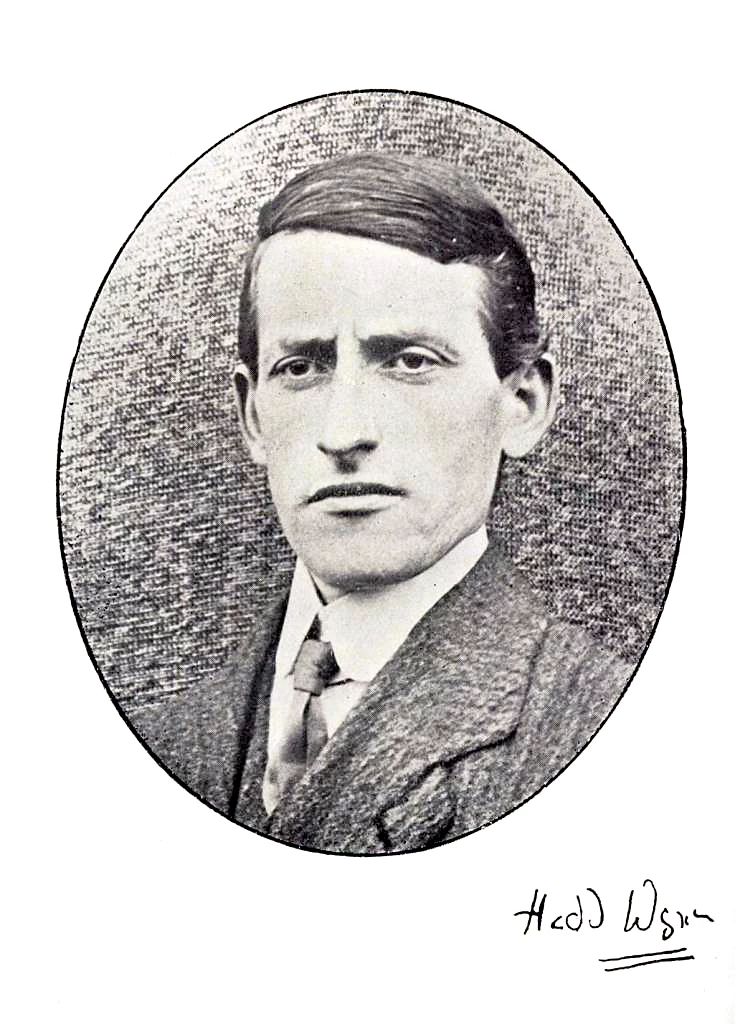
Welsh bard falls in the battle fields of Flanders 25 April 2007 "It was the last day of July, you see. The first day of probably the biggest battle that ever took place. The battle of Passchendaele". (Simon Jones, 1975). Over a quarter of a million Welshmen enlisted to fight in the First World War. Among them was the poet Ellis Humphrey Evans of Trawsfynydd, better known under his bardic name of Hedd Wyn. He was dispatched for active service in 1917. Just a few months later he was dead - killed in battle on the fields of Flanders. The Black Chair Six weeks later he was posthumously awarded the chair at the National Eisteddfod at Birkenhead for his poem Yr Arwr (The Hero) which he had completed shortly before his death. The chair itself was draped in black during the chairing ceremony, and has since been known as the Y Gadair Ddu (The Black Chair). By the age of 28 he had won four Eisteddfod chairs for his poetry. Ellis Humphrey Evans (Hedd Wyn; 1887 - 1917) The Black Chair Witness account Mr Simon Jones of Aberangell, Mid Wales, served in the same regiment as Hedd Wyn, and witnessed his falling on the field of battle. Hear or read his account, as recorded by St Fagans National Museum of History in 1975: AWC 4763. Recorded: 26.9.1975, by Robin Gwyndaf. AWC 4764. Recorded: 26.9.1975, by Robin Gwyndaf. "It was the last day of July, you see. The first day of probably the biggest battle that ever took place. The battle of Passchendaele. And we were going over the top at half past four. We started over Canal Bank at Ypres, and he was killed half way across Pilckem (Ridge). I've heard many say that they were with Hedd Wyn and this and that, well I was with him as a boy from Llanuwchllyn and him from Trawsfynydd. I saw him fall and I can say that it was a nosecap shell in his stomach that killed him. You could tell that. You couldn't stay with him - you had to keep going, you see. When did you see him last, to speak to him? Oh, it's difficult to say. Perhaps I spoke to him that morning, because if I saw him get killed, I must have been near to him. I remember well that we had an officer leading us called Newman, Lieutenant Newman. He was going in front of me, and I saw him fall on his knees and grab two fistfuls of dirt. Well there was nothing but dirt there, you see - the place was all churned up. He was dying, of course. What did you do? Could you do something when you saw Hedd Wyn... ? Nothing at all. No. There were stretcher bearers coming up behind us, you see. There was nothing - well, you'd be breaking the rules if you went to help someone who was injured when you were in an attack. Your business was to keep going. How did you feel when you saw your friend fall? Well I'll tell you straight. To be honest, you had no time to sympathise because you didn't know whether you'd be in the same situation as him in a couple of yards." Simon Jones in the First World War "I saw him fall and I can say that it was a nosecap shell in his stomach that killed him. You could tell that. You couldn't stay with him - you had to keep going, you see". (Simon Jones, 1975). Lost generation Hedd Wyn was one of 32,000 soldiers to be killed in the attack on Pilckem Ridge. The devastated village of Passchendaele itself was not captured until 6 November, 98 days after the start of the battle. This slow advance over little more than five miles of ground was achieved with the loss of 310,000 Allied and 260,000 German lives. The Black Chair remains a potent symbol of the devastating impact of the First World War on communities throughout Wales, and the unfulfilled potential of a whole generation of young Welsh men.
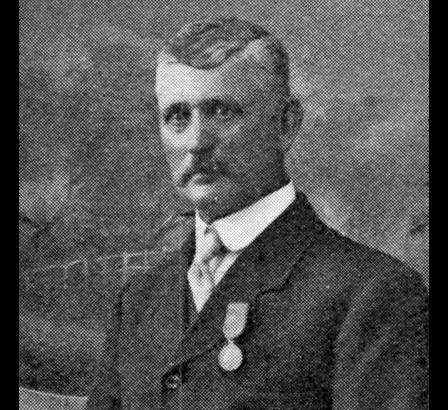
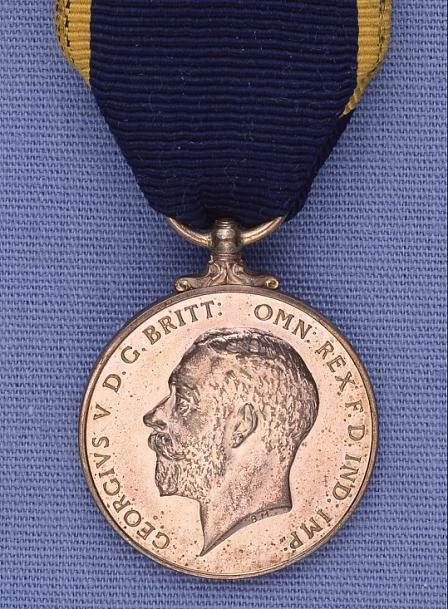
Heroic rescue for man dangling from girder 50 meters high 23 April 2007 Edward Medal for bravery James Dally, wearing the Edward Medal. From the Great Western Railway Magazine, September 1915. In October 1914 James Dally saved a colleague from a 52m fall from a viaduct. He was awarded the Edward Medal for his bravery. On 28 October 1914, the Crumlin viaduct, near Newport, south Wales, was being painted by using a staging of planks timber supports. Around 5:00 pm, one of the supports broke, and the foreman, Mr Skevington, fell 52m (175 feet) to his death into the goods yard below. The second man, Thomas Bond, just managed to grip onto the main bridge structure in time, but was left dangling in mid air... Heroic rescue The Crumlin Viaduct. The location of the rescue is marked with a red dot. Bridgeman James Dally, of Crumlin, was nearby, supervising the operation. He immediately crawled out from the gangway on to the diagonal bracings - which were a mere eight centimetres wide: "I asked him to swing his legs in an upward direction, so as to get them around the stretcher, if possible. This he succeeded in doing. I then got hold of Bond's legs; & told him to move one hand at a time & by that means he was drawn nearer to the gangway & when he was near enough I got a better hold of him, & eventually landed him safely on the gangway." According to the London Gazette, "The man would probably have lost his life had it not been for the courage and presence of mind shown by Dally." Bond himself had no doubts: "I was suspended in the air; but if Mr Dally had not been on the gangway at the time, & taken the action he did I could not have saved myself... I owe a deep debt of gratitude to Mr Dally, for had it not been for the encouragement he gave me, & the prompt effort he made, I would have undoubtedly met the same fate as Mr Skevington." Acts of courage in other industries James Dally's Edward Medal, Industry, Second Class (bronze), front view. In the event, Dally was awarded the Edward Medal, which he received from King George V on 12 July 1916. This medal had been created in 1907 to reward "heroic acts performed by miners and quarrymen" and in 1909 its award was extended to acts of courage in other industries. The Crumlin Viaduct was 512m (1,680 feet) long and rose some 60m (200 feet) above the valley of the Ebbw. The viaduct was opened on 1 June 1857 and by 1863 was part of the Great Western Railway network; it was demolished in 1965-66. Background Reading For Those in Peril, by Edward Besly. Published by the National Museums & Galleries of Wales (2004). Gallantry: its public recognition and reward in peace and war at home and abroad by A. Wilson and J. H. F. McEwen. Published by Oxford University Press (1939).
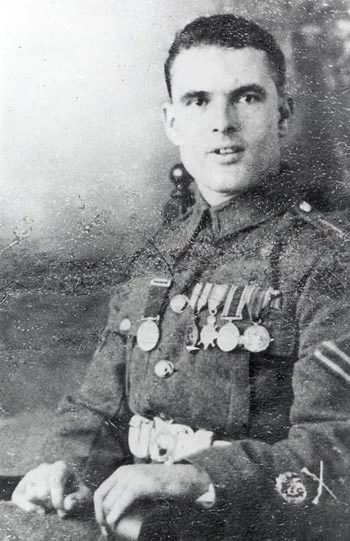
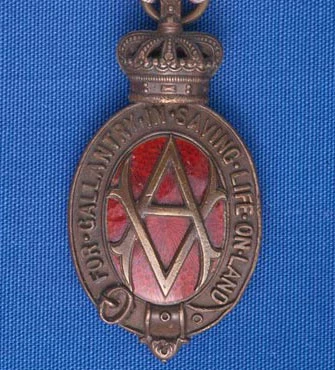
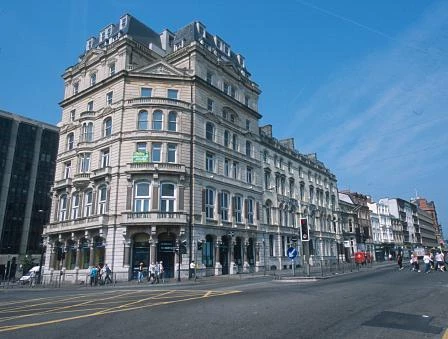
An Albert Medal won in Cardiff 1919 23 April 2007 Walter Cleall, winner of the Albert Medal. Image copyright Kenneth Williams. The Albert Medal (front view) The Royal Hotel, Cardiff (photographed 2003). In 1919 Walter Cleall won the Albert Medal for gallantry in saving the life of Winnie Jones from a fire at the Royal Hotel, Cardiff. On the afternoon of 11 August 1919, an off-duty chambermaid named Winnie Jones found herself trapped in her 6th floor room at the Royal Hotel, Cardiff, by a severe fire. The Fire Brigade's ladders could not reach her. A crowd had gathered and two men - Tom Hill and Walter Cleall - ran into the hotel to try to rescue her. Somehow, Cleall reached the 6th Floor, but to get to the girl he had to smash a window and make his way round a narrow parapet, at places with a drop of nearly 30m (100 feet) to Wood Street, below. He then carried her back by the same route. As they left her room, the roof collapsed. Both the girl and her rescuer were later taken unconscious to hospital. The whole event was witnessed by a London barrister, who happened to be in Cardiff that day. He promptly wrote to the Home Secretary (another barrister) and within two days of the event the Home Office was investigating whether to reward Cleall's bravery. The following March, Cleall was invested by the King with the Albert Medal, then Britain's senior civil gallantry award. The Albert Medal was first awarded in 1866 for gallantry in saving life at sea. In 1877, it was extended to cover incidents on land, following the dramatic rescue of five miners who had been trapped underground for nine days at the Tynewydd Colliery in the Rhondda Valley. It rapidly became known as the 'Civilian Victoria Cross'. The creation of the George Cross in 1940 made the Albert Medal redundant, except as an occasional posthumous award, and in 1971 it was revoked. Its living holders were invited to exchange it for the George Cross. Walter Cleall was one of five who chose to donate their original award to the National Museum of Wales. Background Reading For Those in Peril, by Edward Besly. Published by the National Museums & Galleries of Wales (2004).
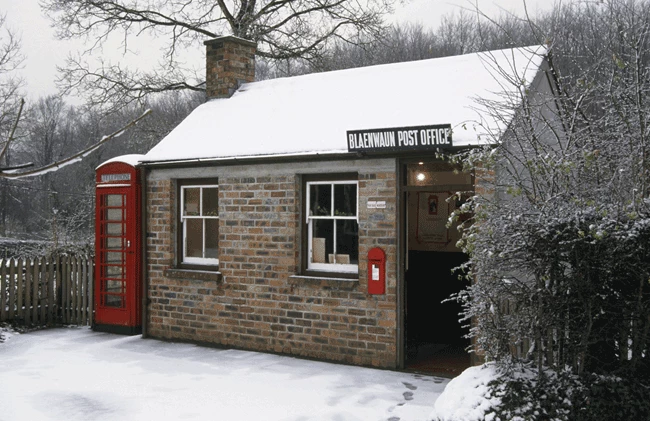
Wales's smallest post office at St Fagans 11 April 2007 In 1992 Wales's smallest post office was delivered to Amgueddfa Cymru. Thanks to the generosity of Post Office Counters Ltd, who financed the project, the small brick building was dismantled, transported and then re-built at St Fagans National Museum of History by the Museum's specialist re-erected buildings team. Village post offices have played an important role in community life throughout Wales for the past 90 years. By the 1950s, virtually every village had its own branch, from which mail was distributed, parcels were collected and people gathered to catch up on all the local news. The country postman/postwoman on their bicycle, and later, in the red-painted Morris Minor or Fordson van, helped to keep people in rural communities in touch with one another by maintaining links and regular contact. Wales's smallest post office at Blaenwaun, Carmarthenshire Blaenwaun Post Office at St Fagans National Museum of History The Country Post Office Of course, country post offices were very rarely housed in the impressive buildings of those found in towns. They usually occupied a corner of the village store or the front room of a house. Sometimes these post offices sold a range of items, but some relied on the sale of stamps, postal orders, licences and savings certificates as their only means of income. Blaenwaun Post Office, located about eight miles north of Whitland in Dyfed, was one such business. It was built in 1936 by Evan Isaac, a stonemason and his cousin David Williams, a carpenter. The Post Office was run by Mrs Hannah Beatrice Griffiths (nee Isaac), Evan Isaac's daughter, who also ran the pub across the road, the Lamb Inn, with her husband. Mail was brought daily from Whitland and was sorted at the Post Office on a low bench in the back room. It was delivered to the local community by Mrs Griffiths, who completed the eight-mile round journey on her bicycle before going across the road to work in the Inn. Any customers who arrived at the Post Office when the Griffithses were working in the public house could press a button which rang a bell behind the bar. The Post Office, which measured just 5m long by 2.9m wide, comprised of two rooms: an outer serving room with a counter and an inner office or sorting room with a small fireplace and a bench under the window. A timber partition wall separated the two rooms. The internal walls were painted chocolate brown to a height of about a metre above the floor then cream to the ceiling, with a broad black band between the two. A painted sign made of heavy tin sheet on a wooden board was fixed outside above the serving room window. It read BLAENWAUN POST OFFICE. A small post box was mounted against the wall between this window and the entrance door. In the early days, there was a telephone on the counter for the use of the Post Office and, one assumes, the villagers. Later, a public kiosk was erected outside the small building. In the office was a War Department Receiver for receiving urgent messages in times of emergency. Following Mr Griffiths' death in the early 1960s, the business was relocated to a new bungalow built by his daughter, Mrs Evanna James. The old Post Office stood empty from that time until it was offered to Amgueddfa Cymru in 1991. It can be visited today at St Fagans National Museum of History in the 'village' section of the open-air museum, near the bakery and the tailor's shop. It has been refurbished to its war-time appearance, and represents a period of Welsh history not covered in any of the Museum's other buildings.
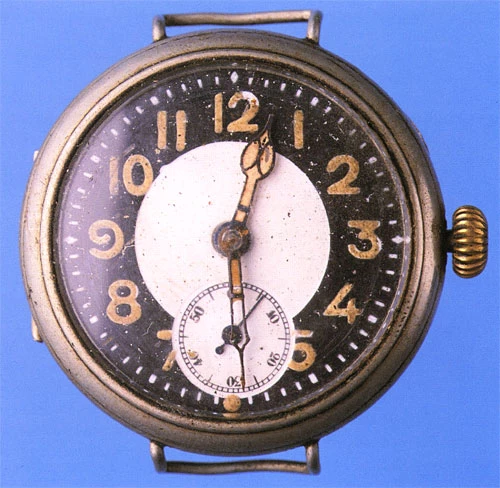
Radioactive Watches at Amgueddfa Cymru 2 April 2007 A number of items in the collection of watches at Amgueddfa Cymru 'glow-in-the-dark'. The material that causes this glow (luminescence) is radium. As radium is radioactive, the watches in question now have to be treated with care, making their conservation, accessibility and display a big challenge. Radium 1918 gent's wristwatch showing degraded and missing areas of radium paint Marie Curie discovered Radium in 1898, and was the wonder of the new century - ironically thought to cure everything from arthritis to cancer. Mixing materials such as zinc sulphide and radium produces the glowing effect. In 1902, this luminescent material was first used to paint on the dials and hands of watches and clocks, allowing them to be seen in the dark. Marie Curie eventually died from exposure to radium in 1934. Her notebooks, in which she was recording all her experiments are still too radioactive to handle today. The Radium Girls Glow-in-the-dark watches soon became popular with the mass market, and in the 1920s, production factories were set up where women would mix together glue, water, and radium powder into a glowing greenish-white paint that was then put onto the watches. In order to paint neat and sharp numbers on the dials, the brushes needed a very fine tip. After a few strokes, the brushes would lose their shape, so the women "sharpened" the fine brushes by rolling the brush tips on their tongues to straighten the bristles, sometimes up to 6 times for every watch dial. Some even painted their teeth or applied glowing "makeup" as a novelty to show their friends. Many of these women would later die from cancer. Testing for radioactivity at the museum A radioactive contamination monitor (Geiger counter) was used to measure the radiation given off by the clocks and watches held in the collections housed at the museum. The highest readings showed dials to have a reading of 3000 counts per second against a naturally occurring level of 8 - 10 counts per second. The measurable dose of Radium in a watch is apparently about 5 times the dosage from a standard chest X-ray. The readings confirmed that the dials could be hazardous if exposure was not limited in some way. To combat this, the radioactive items were: Enclosed in a sufficiently dense material; Confined to a little used area of the stores; Warning signs displayed as to the nature of the hazard. All objects containing radium that were on public display were identified and withdrawn and put into safe storage. Radioactive Dust Although the storage of these items can be controlled and managed properly, the conservation of these objects is of concern. Since the dials are anything up to 100 years old, the paint breaks down into dust resulting in an increased risk of contamination from exposure to the radioactive dust. There is the possibility of breathing in this dust by carrying out work on the dials, such as working on the mechanism, cleaning the dial, hands or covers. As a result, all items in the Museum that pose a radioactive risk are handled with suitable precautions taken to prevent any harm done to the conservator. Radioactive decay Interestingly, tests show that the brightness of the dials is not related to the level of radioactivity. Even if the dial paint is dim or invisible in the dark, it could still give a high reading of radioactivity, since although the reactive luminous chemical might have broken down, the radioactive element, radium will continue to be hazardous for many generations to come.