: The 19th Century

Mission accomplished

Ceri Thompson, 19 June 2012

The team of rescuers

The team of rescuers

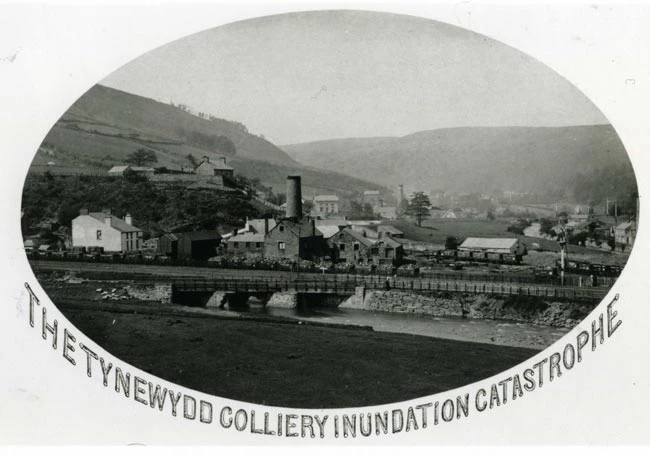
Postcard commemorating the disaster

Postcard commemorating the disaster

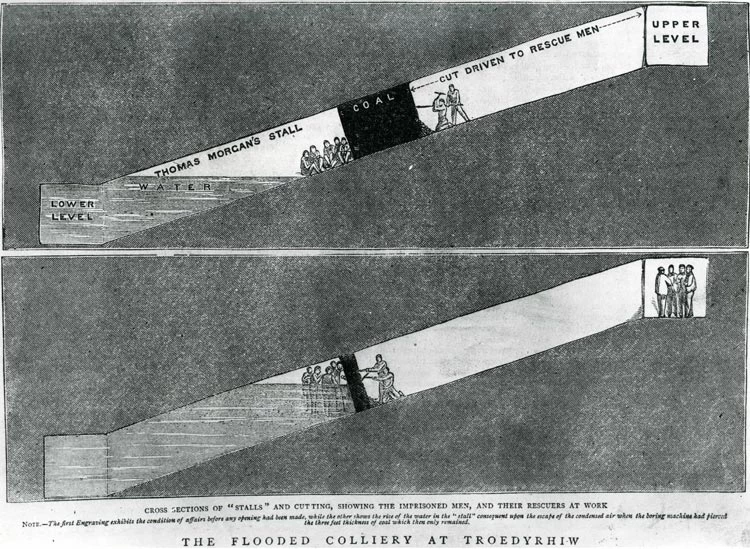
Cross section of

Caption reads:
'Cross section of "stalls" and cutting, showing the imprisoned men, and their rescuers at work. Note: The first engraving exhibits the condition of the affairs before any opening had been made, while the other shows the rise of the water in the "stall" consequent upon the escape of the condensed air when the boring machine had pierced the three feet thickness of coal that only then remained.'

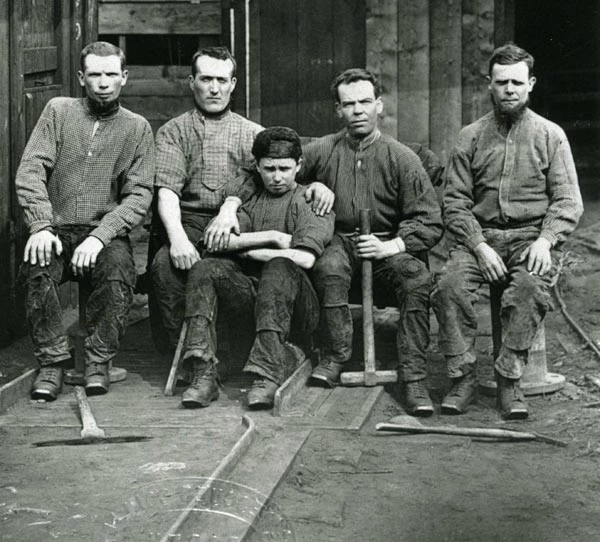
Five of the survivors

Five of the survivors

In August 2010 a roof fall at the San Jose copper/gold mine in Chile trapped 33 miners 700 metres underground. After 69 days underground and a massive rescue operation, which involved NASA and more than a dozen international corporations, all 33 men were rescued over a 24 hour period. After winching the last trapped miners to the surface the rescue workers held a placard up for the cameras reading "Mission accomplished Chile". This was seen by an estimated television audience of more than a billion viewers around the world.

Tynewydd disaster

The Chilean rescue reminded many of a similar incident which occurred in the Rhondda Valleys over 130 years before. On the 11th April 1877 Tynewydd Colliery in Porth became flooded by water from the abandoned workings of the nearby Cymmer Old Colliery. At the time of the inundation fourteen miners were underground at Tynewydd and rescue attempts were begun to find them.

Five of the survivors were located after sounds of knocking were heard and rescuers had to cut through 12 yards of coal to reach them. Unfortunately, when the area was broken into, one of the trapped men was killed by the force of the air rushing out through the rescue hole. There were now nine men unaccounted for.

Desperate rescue attempts

Further sound of knocking were heard from working places beneath the water line which led to the rescuers assuming that there were other survivors trapped in an air pocket. An attempt was made by two divers from London to reach the men but the amount of debris blocking the roadways made this impossible. It was decided that the only way now was to cut a rescue heading through 38 yards of coal.

During the ten days it took to reach the five trapped men, the rescue attracted the attention of the world's press and telegrams were even sent by Queen Victoria who was concerned about the men's plight. The trapped miners were reached on Friday, April 20th; they had been without food and had only mine water to drink for ten days. The five rescued miners were found to be suffering from 'the bends' because of the rapid decompression of their air pocket and had to spend time in hospital but otherwise recovered fully. The four other missing miners were all drowned.

Brave and heroic rescues

Although the incident was a minor one in terms of loss of life (an explosion at Cymmer Colliery had killed 114 men and boys in 1856), the perseverance of the rescue teams attracted great press and public interest. Twenty four First and Second Class

and other presentation items were awarded to the rescuers in a ceremony held at the Rocking Stone above Pontypridd. It was estimated that up to forty thousand people attended.

The Tynewydd rescue was the first time that Albert Medals had been awarded for bravery on land. Five of these medals are now held by Big Pit National Coal Museum along with examples of presentation silverware and other items connected with the rescue.

Article by: Ceri Thompson, Curator, Big Pit National Coal Museum

Coal seams and copper: W.E. Logan and the geological map

7 February 2012

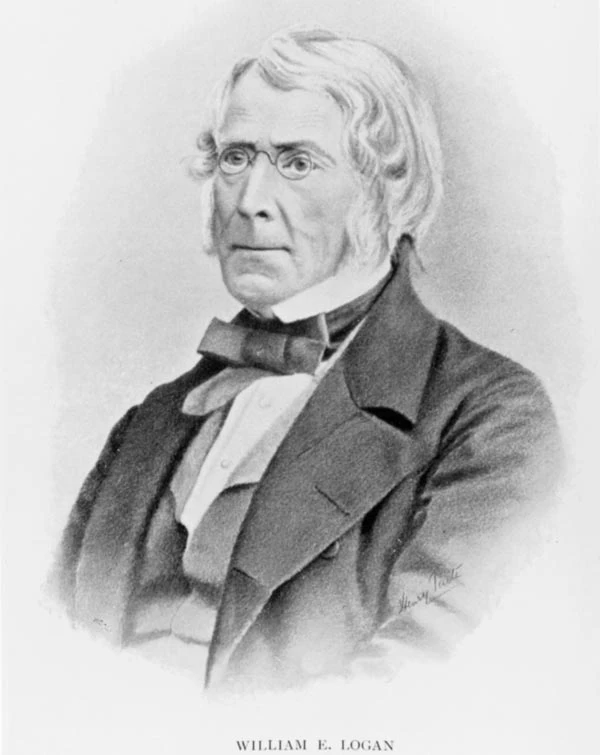
William Logan, 1856

William Logan, 1856

Henry Thomas De la Beche (1796-1855), founder of the British Geological Survey, about 1841.

Henry Thomas De la Beche (1796-1855), founder of the British Geological Survey, about 1841.

"I worked like a slave all summer on the gulph of St Lawrence, living the life of a savage, inhabiting an open tent, sleeping on the beach in a blanket and sack, with my feet to the fire, seldom taking my clothes off, eating salt pork & ship's biscuit, occasionally tormented by mosquitoes".

Letter from Logan to De la Beche, 20 April 1844.


Logan in Canada

With his geological skills honed on the coal rocks of Swansea, in 1841 Logan applied for the post of first Director of the Geological Survey of Canada. His application was supported by many of the leading British geologists, including Henry De la Beche, and he was appointed in April 1842.

By 1849 he and four staff had mapped the area between the St Lawrence River and the Great Lakes, worked on the coal deposits of Nova Scotia, and found copper ore to the east of Montreal. In 1851, he prepared a display of ore minerals from Canada for the Great Exhibition in London.

In 1863, Logan and his staff published the first major study of the geology of Canada. It is regarded as the pinnacle of Canadian scientific publishing in the 19th century. This was followed by the publication of maps in 1865 and 1869.

Logan returns to Wales

Logan was knighted in 1856, the first native-born Canadian to receive a knighthood. He was also honoured by France, the Royal Society, the Geological Society, Bishop's University in Quebec, and McGill University in Montreal, as well as by the citizens of Toronto and Montreal.

Although Logan officially retired in 1869, he continued summer fieldwork around Montreal and spent winters at his sister's house in west Wales. He died there in June 1875 and is buried in the churchyard at Cilgerran in Pembrokeshire.

Today, William Edmond Logan is recognized as Canada's most important scientist of all time. And it was in Wales that his geological career began.

External links

Swansea Museum

The fabulous mineral collection of Lady Henrietta Antonia Clive, Countess of Powis.

Tom Cotterell, 31 January 2012

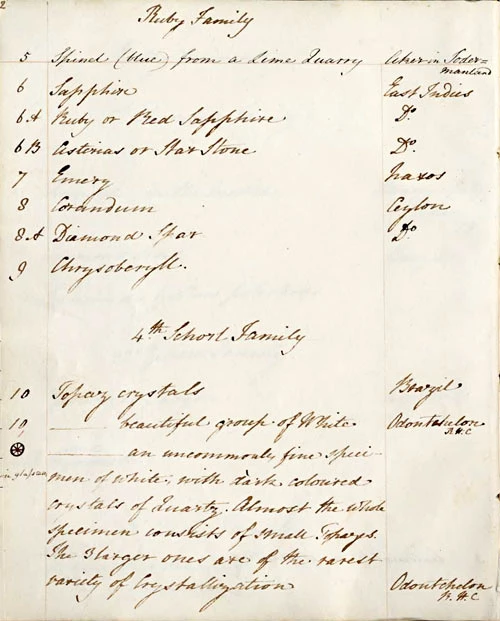
<em>Catalogue of Metallic Minerals in the Possession of the Countess of Powis</em> Vol II, 1817: The original collection catalogues.
Catalogue of Metallic Minerals in the Possession of the Countess of Powis

Vol II, 1817: The original collection catalogues.

Catalogue page from Vol. 1. <em>Earthy Minerals</em>.

Catalogue page from Vol. 1. Earthy Minerals.

Olivenite on quartz from Cornwall, given to Henrietta by the Countess of Aylesford. Specimen 9 cm long. NMW 29.311.GR.80.

Olivenite on quartz from Cornwall, given to Henrietta by the Countess of Aylesford. Specimen 9 cm long. NMW 29.311.GR.80.

One of the most important historic mineral collections at Amgueddfa Cymru was formed in the early nineteenth century. Assembled by Lady Henrietta Antonia Clive (1758-1830), Countess of Powis, and donated to the museum by the 4th Earl of Powis in 1929, the collection of minerals is one of the earliest mineral collections with links to Wales.

Lady Henrietta, Countess of Powis

Lady Henrietta was born into a titled and landed family, the Herberts, descended from the Earls of Pembroke of the fifteenth century. Her father, Henry Arthur Herbert (c.1703-1772), 1st Earl of Powis, owned large estates in Shropshire and Mid-Wales as well as property in London. Henrietta was born at their principal residence, Oakly Park, at Bromfield, near Ludlow, but following its sale to Lord Robert Clive (Clive of India), in 1771, she spent her formative teenage years at the Herbert’s ancestral home, Powis Castle.

Clive of India

Henrietta married the late Lord Clive's eldest son and heir, Edward, in 1784, in a marriage that was mutually beneficial - the Herbert family had accrued significant debts, but their name was prestigious, while the Clive family had become enormously wealthy through Lord Robert Clive's military campaigns in India. Henrietta and Edward lived at Walcot Hall near Bishop’s Castle, where they had four children, Edward, Henrietta Antonia, Charlotte Florentia and Robert Henry.

Edward Clive became Governor of Madras at the end of the eighteenth century and while Henrietta was in India she began assembling a collection of rocks and minerals. Later she purchased and exchanged minerals with prominent collectors and mineral dealers of the time including, James Sowerby, Dr John MacCulloch and the Countess of Aylesford. She also recorded many specimens having been given to her by her children.

Earthy and metallic minerals

Henrietta's collection is typical of the style of collections dating from the early nineteenth century, with the minerals arranged systematically by chemistry. Henrietta organised her collection into two handwritten catalogues: Volume 1 - Earthy Minerals and Volume 2 - Metallic Minerals. She used a numbering system to identify each specimen, with small numbered labels affixed to the specimens. Although many of these labels have long since fallen off, her detailed catalogue entries have allowed many of her specimens to be matched up with their correct number.

Henrietta's collection comprised over one thousand specimens. Of these, several hundred samples have been identified in the museum collection. Despite the missing specimens, considering its age, Henrietta's collection is remarkably complete. It is now considered to be one of the most important historic mineral collections at Amgueddfa Cymru.

Children in Mines

11 April 2011

Children in mines

All alone in the dark

Mary Davis was a 'pretty little girl' of six years old. The Government Inspector found her fast asleep against a large stone underground in the Plymouth Mines, Merthyr. After being wakened she said: "I went to sleep because my lamp had gone out for want of oil. I was frightened for someone had stolen my bread and cheese. I think it was the rats."

Susan Reece, also six years of age and a door keeper in the same colliery said: "I have been below six or eight months and I don't like it much. I come here at six in the morning and leave at six at night. When my lamp goes out, or I am hungry, I run home. I haven't been hurt yet."

In Harm's Way

A coal mine was a dangerous place for adults, so it is no surprise that many children were badly injured underground.

"Nearly a year ago there was an accident and most of us were burned. I was carried home by a man. It hurt very much because the skin was burnt off my face. I couldn't work for six months."

Phillip Phillips, aged 9, Plymouth Mines, Merthyr

"I got my head crushed a short time since by a piece of roof falling..."

William Skidmore, aged 8, Buttery Hatch Colliery, Mynydd Islwyn

"...got my legs crushed some time since, which threw me off work some weeks."

John Reece, aged 14, Hengoed Colliery

Child Colliers and Horse Drivers

Some children spent up to twelve hours on their own. However, Susan Reece's brother, John, worked alongside his father on the coalface:-

"I help my father and I have been working here for twelve months. I carry his tools for him and fill the drams with the coal he has cut or blasted down. I went to school for a few days and learned my a.b.c." John Reece, aged 8, Plymouth Mines, Merthyr

Philip Davies had a horse for company. He was pale and undernourished in appearance. His clothing was worn and ragged. He could not read:-

"I have been driving horses since I was seven but for one year before that I looked after an air door. I would like to go to school but I am too tired as I work for twelve hours." Philip Davies, aged 10, Dinas Colliery, Rhondda

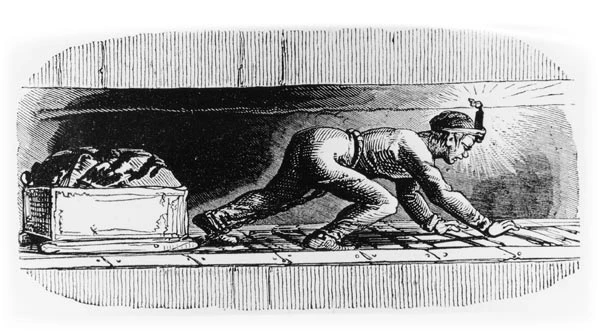
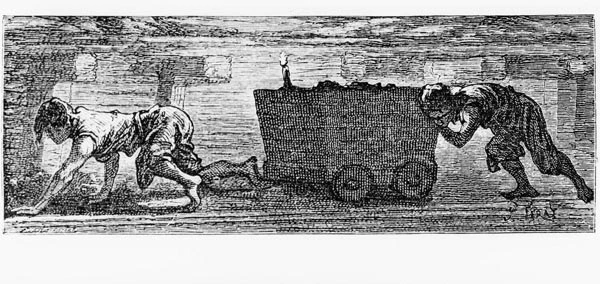
Drammers pulled their carts by a chain attached at their waist. They worked in the low tunnels between the coalfaces and the higher main roadways where horses might be used. The carts weighed about 1½cwt. of coal and had to be dragged a distance of about 50 yards in a height of about 3 feet.

"My employment is to cart coals from the head to the main road; the distance is 60 yards; there are no wheels to the carts; I push them before me; sometimes I drag them, as the cart sometimes is pulled on us, and we get crushed often."

Edward Edwards, aged 9, Yskyn Colliery, Briton Ferry

For this a drammer would earn about 5p a day.

Three Sisters

The Dowlais iron works also owned iron and coal mines; they were the largest in the world at this time and supplied products to many parts of the world. However, they still relied on children for their profits. Three sisters worked in one of their coal mines:-

"We are doorkeepers in the four-foot level. We leave the house before six each morning and are in the level until seven o’clock and sometimes later. We get 2p a day and our light costs us 2½p a week. Rachel was in a day school and she can read a little. She was run over by a dram a while ago and was home ill a long time, but she has got over it."

Elizabeth Williams, aged 10 and Mary and Rachel Enoch, 11 and 12 respectively, Dowlais Pits, Merthyr

After the Act

The publication of the Report and the ensuing public outcry made legislation inevitable. The Coal Mines Regulation Act was finally passed on 4 August 1842. From 1 March 1843 it became illegal for women or any child under the age of ten to work underground in Britain.

There was no compensation for those made unemployed which caused much hardship. However, evasion of the Act was easy - there was only one inspector to cover the whole of Britain and he had to give prior notice before visiting collieries. Therefore many women probably carried on working illegally for several years, their presence only being revealed when they were killed or injured.

The concept of women as wage earners became less acceptable in the mining industry as the years went by. However, a small number of female surface workers could be found in Wales well into the twentieth century. In 1990 the protective legacy was repealed and after 150 years women are once again able to work underground.

Working Abroad - Welsh Emigration

9 February 2010

Welsh industrial emigration: The legacy

In the nineteenth and twentieth centuries, millions of people across the world moved to different countries looking for work. They wanted to improve their lives, try new working practices, or have adventures in different lands.

Many people left Wales and took traditional Welsh industrial skills with them. Some helped create continuing economic success in the countries they moved to. Some made huge fortunes, finding fame. Others led more quietly successful lives, settling down and raising families. Some returned to Wales after time abroad, others were never to see this country again.

Here we look at the various industries from Wales that supplied workers and expertise around the world. What were those industries and skills? Where did the workers go? What values and traditions did they take with them? What impact did their leaving have on the country they left behind?

Welsh coal mine, Kentucky

Welsh coal mine, Kentucky

Coal

"Wales experienced a spectacular boom in coal mining in the late 19th and early 20th centuries. The world looked to the Welsh mining industry for expertise and advice."

[see more]

Burra Burra copper mine, 1874.

Burra Burra copper mine, 1874.

Copper

"The world of copper smelting was led by Wales in the 19th century. The works around Swansea and Holywell supplied over 50% of the world's copper."

[see more]

 
John Davies of Talsarnau, Gwynedd, with his brother and friend seeking gold during the Australian Gold Rush

John Davies of Talsarnau, Gwynedd, with his brother and friend. They are seeking gold in Queensland, Australia in the 1880s

Gold

"Gold has been mined intermittently in Wales for thousands of years, but the industry never employed huge numbers of workers. Despite this, many Welsh emigrants joined the famous 'Gold Rushes' of the 19th century."

[see more]

Welsh workers in the ironworks at Hughesovka

Welsh workers in the ironworks at Hughesovka, John Hughes is second from the right in the front row

Iron

"Wales was at the forefront of the development of the iron industry in Britain and it is therefore not surprising to find Welsh people leading the industry across the world in the nineteenth century."

[see more]

 
Bangor, Pennsylvania

Bangor, Pennsylvania

Slate

"Slate was used in Europe as a roofing material. Welsh slate was exported across the world for prestigious building projects. The discovery of slate deposits in different countries became one of a number of economic factors that influenced Welsh workers to move to those areas."

[see more]

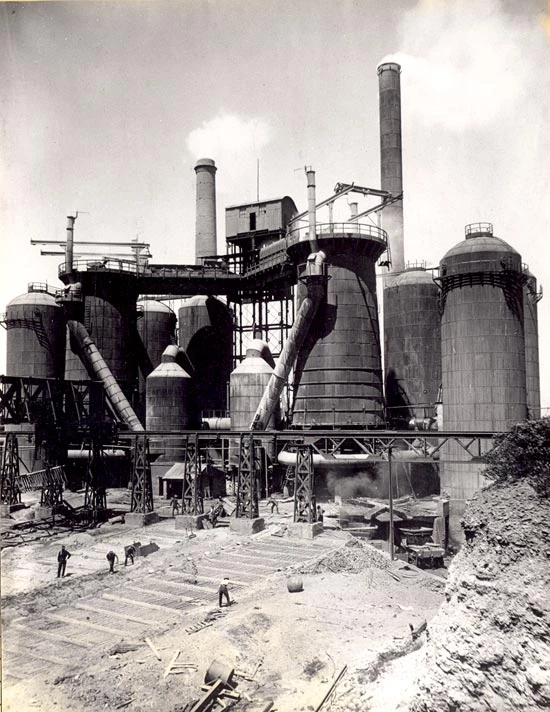
Lithgow Steelworks, New South Wales, Australia, 1920s

Lithgow Steelworks, New South Wales, Australia, 1920s

Steel

"Iron working centres often adapted themselves to the creation of steel, a stronger, more versatile material. Unsurprisingly Welsh workers played an important part in this change."

[see more]

 
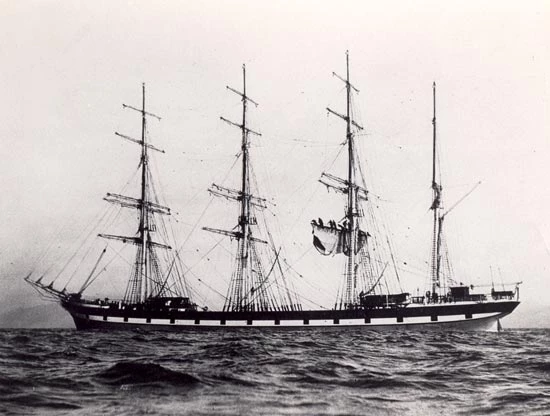
<em>Metropolis</em> built for William Thomas in 1887
Metropolis

built for William Thomas in 1887

Shipping

"Wales has a 1,200km (750 mile) coastline and a long tradition of seafaring. Welsh sailors travelled around the world, exporting Welsh goods and importing raw materials for industry. Welsh shipping lines were among the best-known in maritime trade and the company owners were amongst the richest."

[see more]

Quarrying stone, Randolph, Wisconsin

Quarrying stone, Randolph, Wisconsin

Metal Mining

"Wales has a 1,200km (750 mile) coastline and a long tradition of seafaring. Welsh sailors travelled around the world, exporting Welsh goods and importing raw materials for industry. Welsh shipping lines were among the best-known in maritime trade and the company owners were amongst the richest."

[see more]

 
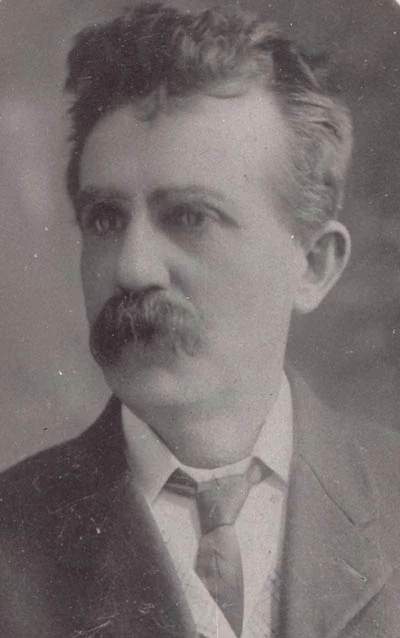
John Williams

John Williams

Tinplate

"The manufacture of tinplate was another area where Wales held a virtual monopoly in the world. South Wales accounted for over 80% of world production in the early 1890s."

[see more]

Morgan C. Jones, (on the right), nephew of Morgan Jones and working for the same company

Morgan C. Jones, (on the right), nephew of Morgan Jones and working for the same company

Other Industries

"Not all Welsh people worked in the 'traditional' heavy industries of Wales of course. Many worked in other industries and many transferred the skills they learnt in mines, foundries and works to other places of work."

[see more]

 
Cartoon from the Western Mail, 1928

Cartoon from the Western Mail, 1928

Migration Patterns

"Not everyone who left Wales for a new life abroad stayed away. Many people returned home for various reasons. This is called back migration."

[see more]

Breaker boys in Pennsylvania.

Breaker boys in Pennsylvania. Many Welsh boys in the USA began work in this way at an early age.

Radicalism

"Welsh industrial workers came from areas that had well organised unions. They had a reputation for standing up for their rights, safe working conditions and decent pay."

[see more]

 
Old Saron Church, the first Welsh church in Minnesota, 1856

Old Saron Church, the first Welsh church in Minnesota, 1856

Welsh Culture

"Like many emigrants, Welsh people took their culture with them to the new countries. In a strange, new place, keeping the songs, stories, languages and traditions of home alive helped emigrants to deal with the unfamiliarity."

[see more]

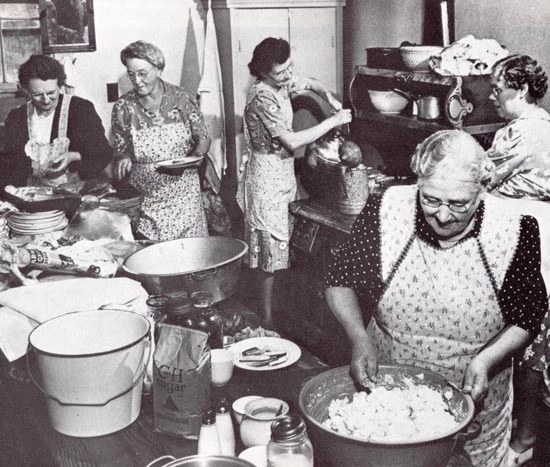
 Preparing food for a Gymanfa Ganu (singing festival), Peniel Church, Pickett, Wisconsin,1946.

Preparing food for a Gymanfa Ganu (singing festival), Peniel Church, Pickett, Wisconsin,1946.

Women

"The majority of industrial workers were men but women of course formed an important part of migrant communities."

[see more]

 
California, USA

California, USA

Place names

"It was common for emigrants of all nationalities to name their new settlements after places in their home countries. This provided a sense of identity and a link with home."

[see more]