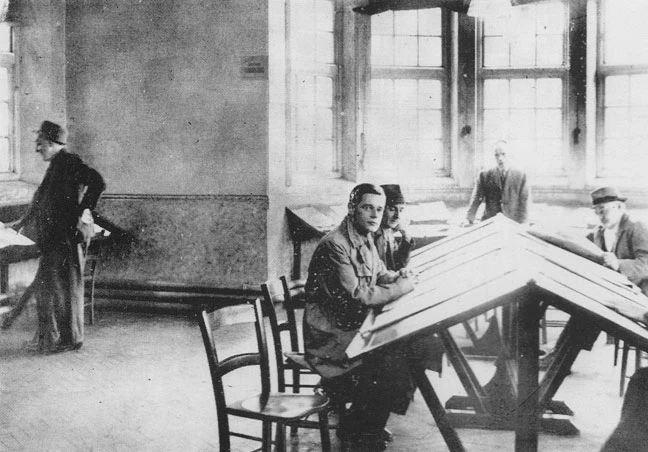
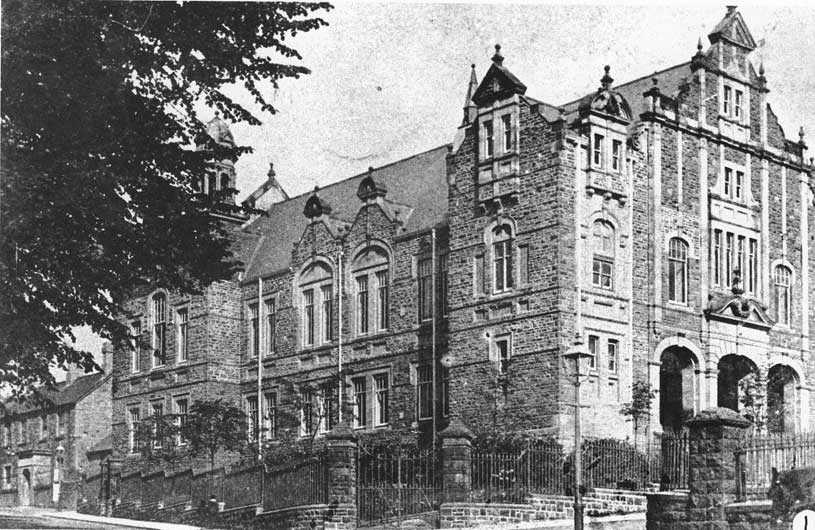
Laying foundations: Workmen's Institutes 10 February 2010 Workmen's Institutes Blaenavon Working Men's Institute, early 20th century Between the 1880s and the 1930s a number of Workmen's Institutes were built in the industrialized townships of south and north-east Wales. Their aim was to provide educational and recreational facilities for workers and their families. They usually housed libraries and reading rooms where daily newspapers were available, but might also include theatres, cinemas and games rooms (snooker, billiards and dominoes were particularly popular). Used for public lectures, political rallies, concerts, dances and eisteddfodau (competitive music and recitation competitions), the Institutes also provided venues where groups and societies could meet and local bands could practise and perform. Some Institute buildings were four or five storeys high and even contained swimming pools! Oakdale The Reading Room, Oakdale Institute about 1946 The Oakdale Workmen's Institute served the community based around Oakdale Colliery in Monmouthshire. The first shaft had been sunk in this hitherto relatively unspoilt part of the Sirhowy valley in 1906, and a second — the Waterloo shaft — was sunk four years later. The coal seams proved to be outstanding both in terms of quality of coal and thickness of the seams. Accommodation for the workers and their families was provided in a purpose-built ‘model village’ named Oakdale. Laying foundations At the heart of the new village was a Workmen's Institute. Construction work began in 1917 and on 3 July that year a ceremony was held at which two foundation stones were laid. Specially engraved trowels were presented to the two main participants: Harry Blount, on behalf of the workers, and Alfred S. Tallis, Managing Director of the Tredegar Iron and Coal Company, which owned the Oakdale mine. The building was finished the following year when, presumably, a 'topping out' ceremony would have been held to mark the completion of building works. The building was officially opened on 10 September 1917, and a special key was presented to A S Tallis, representing the mine owners, as a token of the building committee's appreciation for the loan of £10,000 given by the company towards the cost of erecting the building. A new life at St Fagans The Oakdale Institute was donated to St Fagans National Museum of History (then called the National Folk Museum of Wales) in 1987. It was dismantled, re-erected and refurbished to its late 1930s appearance and opened to the public in 1995. The two trowels used at the ceremony to mark the laying of the foundation stones were donated to the Museum in the months leading up to the opening by relatives of their original recipients. (One trowel had found its way to the Isle of Wight, while the other was in Swansea.) The building was officially opened by the Rt. Hon. Neil Kinnock, then European Commissioner for Transport, but formerly leader of the Labour Party and MP for the constituency of Bedwellty within which Oakdale was situated. Days before the opening, the engraved key given to the Tredegar Iron and Coal Company was also donated to the Museum. The 'Stute The 'Stute is a prize-winning animation made by the animation company Cinetig with pupils from two South Wales schools. It celebrates the crucial role Oakdale Workmen's Institute, Gwent, had in the mining community and draws on oral testimony from the archives at St Fagans. The 'Stute is a prize-winning animation made by the animation company Cinetig with pupils from two South Wales schools. It celebrates the crucial role Oakdale Workmen's Institute, Gwent, had in the mining community and draws on oral testimony from the archives at St Fagans.
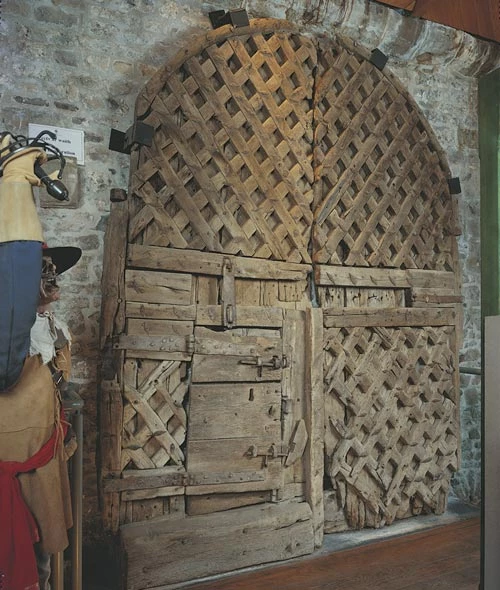
Castle Studies in Wales (and beyond) John R. Kenyon, 1 April 2009 Chepstow Castle © Cadw, Welsh Assembly Government (Crown Copyright) Wooden gates at Chepstow Castle dating from the 1190s, making them probably the oldest castle doors in Europe. © Cadw, Welsh Assembly Government (Crown Copyright) Dolforwyn Castle from the air. © Cadw, Welsh Assembly Government (Crown Copyright) The ruins of Dolforwyn Castle. © Cadw, Welsh Assembly Government (Crown Copyright) Dolwyddelan Castle. © Cadw, Welsh Assembly Government (Crown Copyright) The development of medieval studies was a significant aspect of archaeology after World War 2, and work on castles was a prominent feature of these studies. For those wanting to discover the facts about medieval castles in Wales, then a book that was published in 2008 is for you. This is Castles, Town Defences and Artillery Fortifications in the United Kingdom and Ireland: a Bibliography 1945-2007 (Donington: Shaun Tyas), compiled by John R. Kenyon. However, much work had been done on castles long before 1945, although our understanding of these monuments has altered over the years. Because of the fine examples of castles to be seen in Wales, castle studies in this country have played an important role in the way that our research on these buildings has evolved over the last 150 years or so. The great stone castles of Wales George Thomas Clark has been described as the founding father of the castle studies. He was an engineer who worked under the great I. K. Brunel on both the Great Western and the Taff Vale railways in the 1830s. From the 1850s he was managing the Dowlais ironworks in Glamorgan, and well placed to indulge himself in examining the castles of Wales, on which he wrote numerous papers, later collected in book form. His theories on the origin of the earthworks of the first Norman castles in England and Wales, notably the castle mounds or mottes, such as that can be seen at Cardiff Castle, were soon shown to be wrong by later researchers, such as Ella Armitage. Nevertheless, a considerable amount of his work on the great stone castles of Wales and elsewhere is still of value. The Bibliography 1945-2006, with its 740 pages, indicates just how popular castle studies, both academic and popular, have been since 1945. Worth noting is the excavation of the first Montgomery castle, known as Hen Domen [Old Mound], from 1960 to 1992, as this has given us a fascinating picture of what this earth-and-timber castle in the Welsh Marches would have looked like in the twelfth century. The oldest castle doors in Europe Other recent research has helped us change our understanding of the development of certain features to be found at some of the great stone castles. One of the best examples of this concerns Chepstow in south-east Wales. The introduction of rounded twin-tower gatehouses, such as the outer gate at Chepstow, has in the past been seen as a development from the about the 1220s. However, the wooden gates that hung in the gatehouse until 1962, and which are now on display inside the castle, have been dated through the analysis of the tree rings (dendrochronology) to the 1190s, making them probably the oldest castle doors in Europe. Elsewhere, excavation and conservation of a number of the castles of native Welsh lords have been undertaken, for example at Dinefwr and Dryslwyn in Carmarthenshire. Dolforwyn in Powys, the last castle to be built by Llywelyn ap Gruffudd, prince of Wales (d. 1282), has been totally uncovered, and the results of the work at all three castles have appeared in popular guidebooks and academic reports.
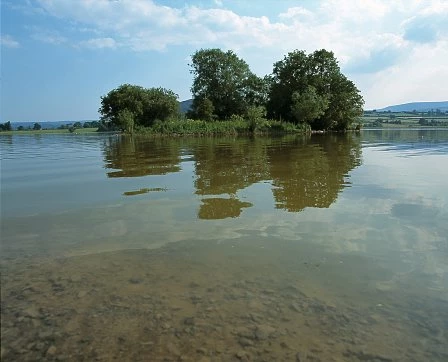
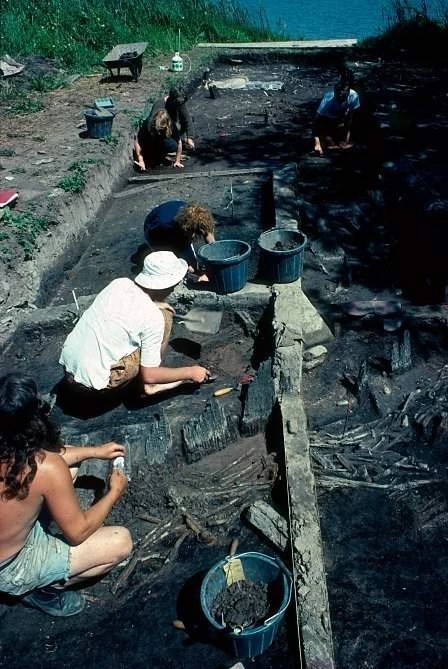
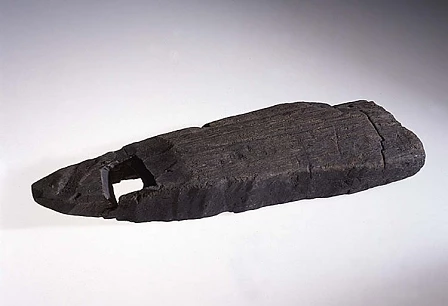
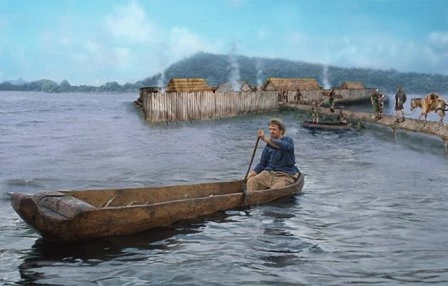
The Palace in the Lake 13 September 2007 Llan-gors Lake, with crannog in background. Image: Cadw (Crown Copyright). Llan-gors crannog during excavation. This image of the 1991 excavations shows planks from the crannog's palisade wall. Oak plank from Llan-gors, 60cm (2 foot) long. Submerged oak planks like this formed part of the palisade around Llan-gors crannog. Reconstruction of Llan-gors crannog, based on the excavation. Excavations at the artificial island or crannog in Llan-gors Lake, near Brecon, have provided a unique glimpse of a royal Welsh court. Excavations between 1989 and 1993 by the National Museum Wales and Cardiff University have revealed that the crannog, the only one known in Wales, was an early medieval royal site of the ruler of the inland kingdom of Brycheiniog. The small early kingdom of Brycheiniog (Brecheiniauc) corresponded approximately to the historical county of Brecknockshire in south Wales. The territory took its name from Brychan, dynastic founder of the royal line according to later legend.. Irish influence The crannog was carefully constructed of brushwood and sandstone boulders, reinforced and surrounded by several lines of oak plank palisade. Tree-ring dating of the well-preserved timbers has established that they were felled between AD889 and AD893. The site seems to have been influenced by Irish building techniques, and was possibly constructed with the assistance of an Irish master craftsman. The kings of Brycheiniog claimed to be descended from a part-Irish dynasty, and their use of such an unusual and impressive construction may have enhanced their political standing and strengthened their claims to Irish ancestry. Objects of high quality As a royal site Llan-gors crannog would have been a centre of administration, as well as a place for hospitality, where the ruler seasonally held court, received tribute and indulged in hunting and fishing. The artefacts uncovered, which include embroidered textile and parts of a portable shrine, confirm the site's aristocratic status. The crannog is attacked The Anglo-Saxon Chronicle records that in AD916 Æthelflaed, 'Lady of the Mercians', sent an army into Wales three days after the murder of Abbot Ecgberht and his companions. The army destroyed Brecenanmere (the Anglo-Saxon name for Llan-gors Lake) and captured 'the king's wife and thirty-three other persons'. This record of an attack probably refers to the crannog, and the capture of the wife of king Tewdwr ap Elisedd. During excavation, a charred, burnt layer was uncovered - probably representing this attack. The site gives an unique glimpse of life on a royal site in the late 9th and early 10th-centuries. Timeline 880s: Elise ap Tewdwr, ruler of Brycheiniog forced by the aggressive actions of Gwynedd to seek overlordship of Alfred the Great. 889-93: Llan-gors crannog constructed by the ruler of Brycheiniog. 894: Vikings ravaged Brycheiniog. 916: Brecenanmere (probably Llan-gors crannog) destroyed by Mercian (Anglo-Saxon) army. Background Reading 'On a crannoge, or stockaded island, in Llangorse Lake, near Brecon' by E. N. Dumbleton. In Archaeologia Cambrensis (4th series) vol. 1, p2-98 (1870). 'The early medieval crannog at Llangorse, Powys: an interim statement on the 1989-1993 seasons'. In The International Journal of Nautical Archaeology vol. 23, p189-205 (1994).
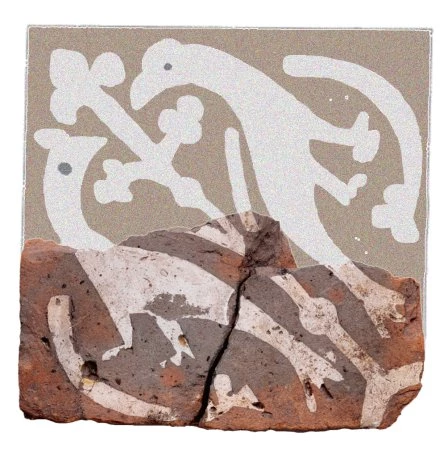
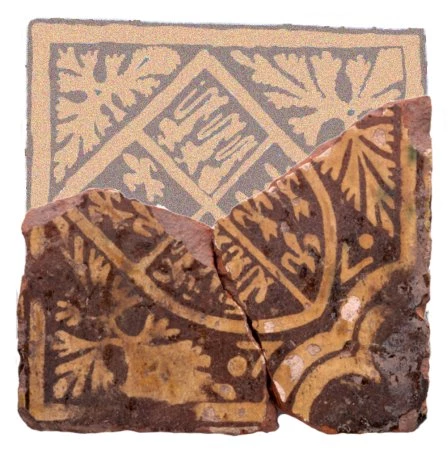
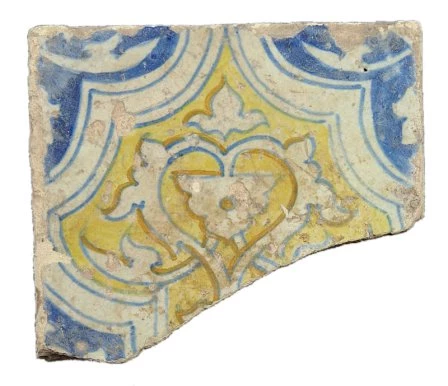
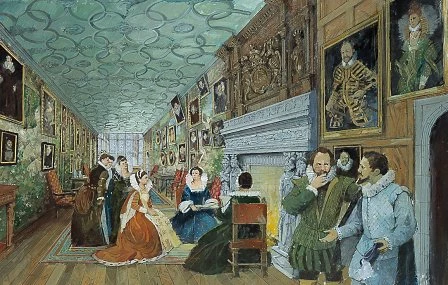
The decorated floor tiles from Raglan Castle 6 September 2007 Raglan Castle. The castle's fortifications, including the Great Tower shown at the centre of this view, were established in the 15th century. Image: Cadw (Crown copyright). Late 13th to early 14th-century tile of the Wessex School from the chapel at Raglan. 15th-century Malvern-school tile used at Raglan. 16th-century maiolica tile from the chapel floor laid by Earl William, probably before 1572. Reconstruction of life at Raglan Castle in the 16th century, at the time of the Third Earl of Worcester. Image: Cadw (Crown copyright). Three centuries of fashion and design can be seen in a collection of decorated floor tiles found during building works at Raglan Castle in 1947. In 1549 William Somerset (1526-1589) succeeded to his father's position as third Earl of Worcester and owner of Raglan Castle. From this base in south-east Wales he launched a career that was to see him thrive at the courts of Edward VI (1547-53), Mary (1553-58) and then Elizabeth I (1558-1603). He is buried in Raglan parish church. Such a prominent figure lived a lifestyle that suited his high social standing, and we can see this aspiration in the extensive remodelling that he undertook of the fortress-mansion he had inherited. He set about an extensive programme of modernisation that affected all parts of the castle and its grounds: the hall and accommodation were improved, kitchen and service areas upgraded, a long gallery was introduced and gardens created in Renaissance style. The Castle's furnishings were also updated with items that reflected contemporary European fashion. This is illustrated in the chapel at Raglan. Raglan Chapel The chapel at Raglan dates from at least the 13th century. It had a floor of thick red earthenware tiles with decoration inlaid into its surface using a contrasting colour. Such two-colour tiles often had designs of shields and monograms, over which a clear glaze would be fired. These tiles were the height of fashion in the mid-14th century. About 1460, these tiles were replaced with two-colour tiles of bright yellows and golden browns. This must have provided a rich backcloth for the treasures of the chapel. However, these designs were not to the taste of Earl William. He preferred the fashionable products of the Spanish Netherlands, and used his considerable wealth to purchase tin-glazed earthenware tiles painted in a polychrome style that was popular in the Renaissance period. The result was a dramatic transformation of the chapel, lightening its interior and adding delicacy to its decoration. Sadly, the abandonment of Raglan in the wake of the English Civil War has left few traces of the other changes that Earl William made to the interior furnishings of his castle. We are left instead to speculate on the luxury he must have brought to it, and to reflect on the transient nature of that wealth, surviving as it does in a small collection of painted floor tiles and a handful of other items. Guide to the Tiles Late 13th- to early 14th-century tile of the Wessex School from the chapel at Raglan. It shows two birds feeding from a central tree. Tiles with this design were also used at nearby Tintern Abbey and White Castle. 15th-century Malvern-school tile used at Raglan. The Latin text reads 'May the peace of Christ be amongst us always. Amen'. 16th-century maiolica tile from the chapel floor laid by Earl William, probably before 1572. These tiles were probably imported from the Spanish Netherlands, perhaps Antwerp, where maiolica production had been established in the early 16th century. Background Reading Raglan Castle by J. R. Kenyon. Cadw (2003). 'The chapel at Raglan Castle and its paving tiles' by J. M. Lewis. In Castles in Wales and the Marches by J. R. Kenyon and R. Avent, pp.143-60. University of Wales Press (1987). The medieval tiles of Wales by J. M. Lewis. Amgueddfa Cymru (1999).
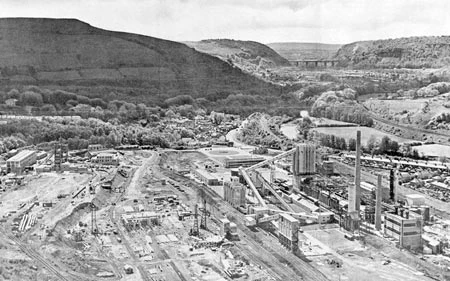
Nantgarw Colliery - once the deepest coal mine in South Wales 2 September 2007 Parc Nantgarw Nantgarw Colliery under construction May/June 1951 Anyone visiting Amgueddfa Cymru's Collections Centre at Parc Nantgarw, north of Cardiff, might not realise that this was once the site of one of the most famous collieries in south Wales. All that now remains are two small concrete pyramids marking the sites of the shafts and a commemorative winding wheel.The deepest mine in south WalesNantgarw Colliery was one of the flagships of the National Coal Board. It was the nearest deep mine to Cardiff, and a reminder to travellers that they had entered the south Wales coalfield.Opened in 1911, it boasted two large shafts and, at a depth of 782.73m (856 yards), was the deepest mine in south Wales. However, despite appearing as a fine example of a clean and efficient modern coal industry, the colliery was abandoned in 1927 due to lack of manpower, poor industrial relations and, above all, being located above very complex underground geology.The war yearsThe mine re-opened in 1937 after a major reorganization, but work was suspended when war broke out in 1939. A later project to re-open the colliery was approved by the Ministry of Fuel and Power in 1946. It was the first major scheme to be operated by the new NCB in the south-west district.A new state-of-the-art colliery Nantgarw in 1974 In order to construct a model colliery at Nantgarw, all traces of the original were demolished and new surface buildings were designed with state-of-the-art facilities. Appliances were installed to reduce smoke and fumes, and all waste was placed underground keeping the surface clear of unsightly spoil heaps. The entire underground network was designed to minimise the risk of accidents. Great care was taken to minimise any dust produced both underground and on the surface, in order to protect the workforce from contracting illnesses such as pneumoconiosis.Not enough miners to mineDuring the 1940s there was a marked decline in the number of men willing to consider a coal mining career, even in the traditional mining strongholds such as the Rhondda.The Nantgarw Colliery posed a specific manpower problem, with the working population choosing employment elsewhere. The workforce had to be recruited from new entrants or from closed collieries outside the area. By 12 March 1954 the total cost of the project had increased to £5.25 million. Labour relations were also a cause for concern. During 1958 alone there were 65 stoppages, go-slows and walk-outs in the collieryDeclining fortunesNantgarw survived the mass pit closures of the 1960s and, in 1975, merged with Windsor Colliery (near Abertridwr). By 1979, the combined Nantgarw / Windsor Colliery employed around 650 men, producing over 4,000 tons of coal per week. During 1979–80 they made a profit of just over £0.5 million. Despite development difficulties, the pit's future looked reasonably secure.However, by the early 1980s the colliery's fortunes were again hit by low manpower and poor geological conditions. The colliery lost £7 million in 1981, and in 1982 output declined steeply as a major coal seam became unworkable. A year later, an overtime ban led directly to the twelve-month strike of 1984-5. Within eighteen months of the strike ending, the mass pit closures took place in south Wales. This time, Nantgarw Colliery was included. Nearly 80 years of coal mining history at Nantgarw ended.