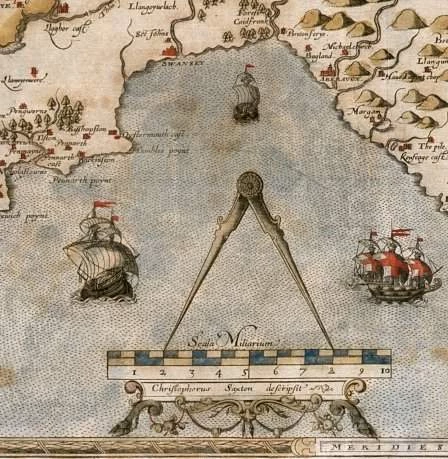
The wreck of the Ann Francis 8 May 2007 A detail of Christopher Saxton's Map of Glamorgan, 1578, showing the coastline from Oxwich on Gower (left) to Margam (upper right). Spanish gold and silver coins of Ferdinand and Isabella (1479-1504). Coins continued to be minted in their names long after their deaths, until the 1550s. Talers: large silver coins from Germany. This group includes issues of the Electors of Saxony, Counts of Stolberg, Langraves of Leuchtenberg and the cities of Cologne and Herford. The modern word 'Dollar' originates from Talers A gold San Vicente of John III of Portugal (1527-57); the reverse (right side of image) depicts the saint holding a martyr's palm and a model ship. Navigational dividers from the wreck of the Ann Francis. Spanish coins, navigational tools and a whistle- are these the remains of the 16th-century vessel, the Ann Francis?For many years, coins and other objects have been found on Margam Beach in Glamorgan. Many are of relatively recent date, but there is a noticeable concentration of coins dating from the middle of the 16th century.Most of these coins are silver: of Ferdinand and Isabella of Spain and from a number of states of the German Holy Roman Empire. There are a few copper coins of John III of Portugal (1521-57) and even two spectacular gold coins - one Spanish and one Portuguese. Throw in sets of navigational dividers, lead sounding weights and a bosun's call (whistle) and what have you got? A shipwreck.Most of the coins date from the 1530-1557. It is known that a French ship was lost in December 1557 at Oxwich on the Gower, 21km (14 miles) to the west - but is there no suitable wreck closer to Margam?Well, a 16th-century wreck is known at Margam, but not in 1557. On 28 December 1583, the Ann Francis, the newest and biggest ship belonging to the King's Lynn merchant Francis Shaxton, ran aground on Margam Beach.The ship was promptly plundered by the local inhabitants, until agents of the local landowners restored order and themselves laid claim to the goods. In due course Shaxton learnt of his ship's fate and after lengthy legal battles recovered some of his goods - anchors, cannon, cables and money.Usually, coins are a good pointer to the dates of wrecks, so why do they suggest a much earlier date here? One answer, of course, may be that there really was a separate wreck at Margam in 1557, though we have no other evidence for one. But it is known that the Ann Francis carried a lot of money, probably the proceeds of selling a cargo of grain in Spain and/or Portugal.The coins, of types that were by now obsolete, acted simply as silver bullion, which in normal circumstances would have been taken to the Mint in London to be converted into coin of the British realm. The ship lost its way on the return leg of the voyage and the silver never made it to London.Background Reading'Wreck de Mer and dispersed wreck sites: the case of the Ann Francis (1583)' by M. Redknap and E. Besly. In Artefacts from Wrecks edited by M. Redknap, p191-208. Published by Oxbow Books (1997).
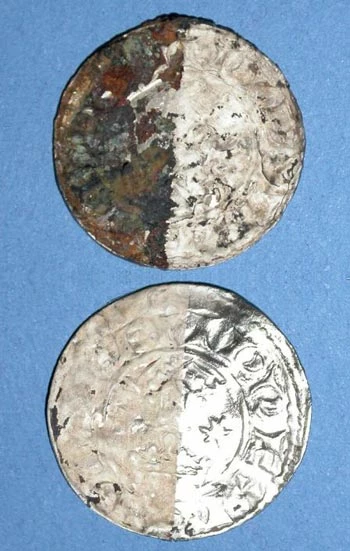
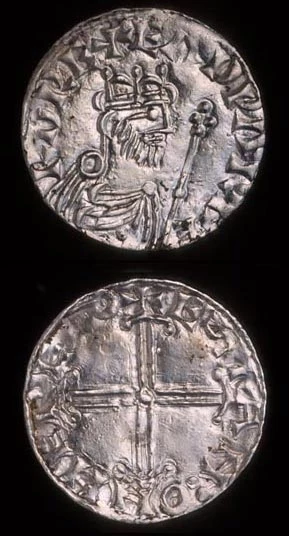
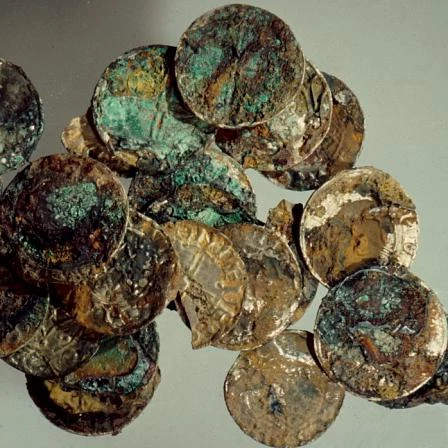
Coins from Edward the Confessor and William the Conqueror found in Monmouth field 4 May 2007 Part-cleaned and fully-cleaned coins. Each coin measures about 2cm (0.75 inches) across. Penny of Edward the Confessor struck by Estan at Hereford, around 1060. Measures 1.9cm (0.75 inches) across. Part of the Abergavenny hoard as discovered. Traces of the cloth bag, preserved in the mineralization. This image shows some of the stitching. An updated version of this article has been published. In April 2002 three metal-detectorists had the find of their lives in a field near Abergavenny, Monmouthshire: a scattered hoard of 199 silver pennies. The hoard included coins of the Anglo-Saxon king Edward the Confessor (1042-66) and the Norman king William the Conqueror (1066-87). The hoard probably pre-dates the founding of Abergavenny near by in the 1080s. The hoard was heavily encrusted with iron deposits, including traces of fabric, suggesting that the coins had originally been held in a cloth bag. It is not clear whether they had been deliberately hidden, or simply lost. Either way their owner was the poorer by a significant amount: sixteen shillings and seven pence (16s 7d, or £0.83p) would for most have represented several months' wages. Minting coins Anglo-Saxon and Norman coins form an unique historical source: each names its place of minting and the moneyer responsible. People had easy access to a network of mints across England (there were none in Wales) and every few years existing money was called in to be re-minted with a new design. The King, of course, took a cut on each occasion. The Abergavenny hoard includes 36 identifiable mints, as well as some irregular issues which cannot at present be located. Coins from mints in the region, like Hereford (34 coins) and Bristol (24), are commonest, outweighing big mints such as London (19) and Winchester (20). At the other end of the scale there are single coins from small mints such as Bridport (Dorset), or distant ones such as Thetford (Norfolk) and Derby. Hoards from western Britain are rare, so the Abergavenny Hoard has produced many previously unrecorded combinations of mint, moneyer, and issue. We shall probably never know quite why these coins ended up in the corner of a field in Monmouthshire but, as well as expanding our knowledge of the coinage itself, they will cast new light on monetary conditions in the area after the Norman Conquest. Conservation The coins were found covered in iron concretions and many of them were stuck to each other. This disfigured the coins and obscured vital details. Removing this concretion with mechanical methods, such as using a scalpel, would have damaged the silver, and chemicals failed to shift the iron. The solution to the problem was found in an unexpected, but thoroughly modern tool - the laser. A laser is a source of light providing energy in the form of a very intense single wavelength, with a narrow beam which only spreads a few millimetres. As laser radiation is of a single colour (infrared light was used in this case) the beam will interact intensely with some materials, but hardly at all with others. This infrared source was absorbed better by the darker overlying iron corrosion than by the light silver metal. The laser was successful at removing much of the iron crust, but initially left a very thin oxide film on the surface. When this was removed, the detail revealed on the underlying coin was excellent; it was possible to see rough out and polishing marks transferred to the coin from the original die, as well as the inscribed legend. Background Reading Conquest, Coexistence, and Change. Wales 1063-1415 by R. R. Davies. Published by Oxford University Press (1987). The Norman Conquest and the English Coinage by Michael Dolley. Published by Spink and Son (1966).
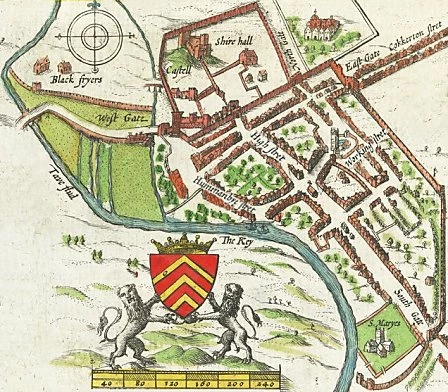
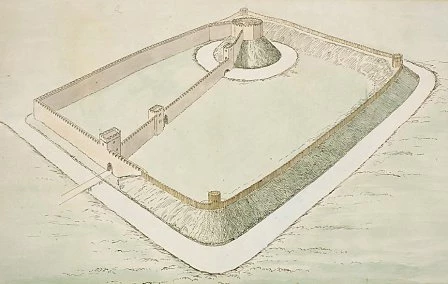
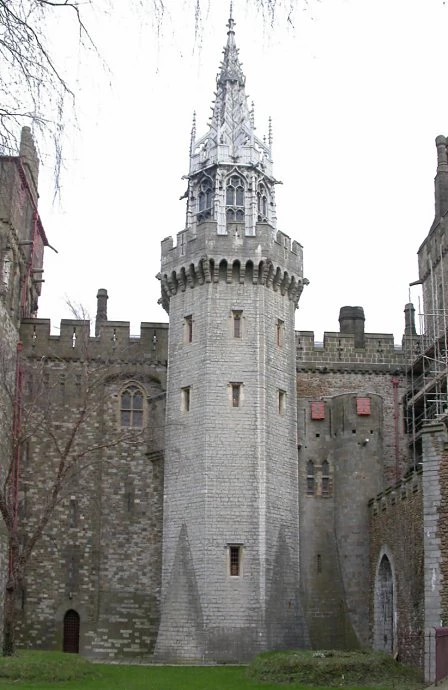
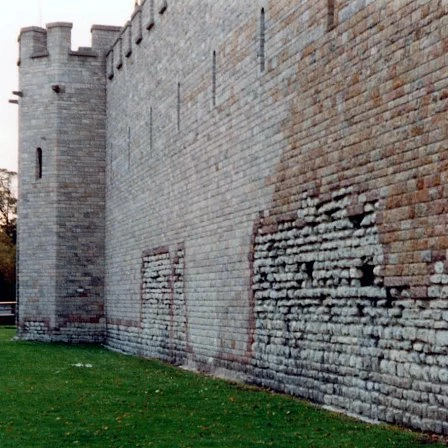
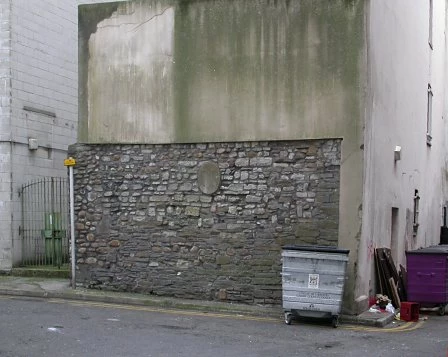
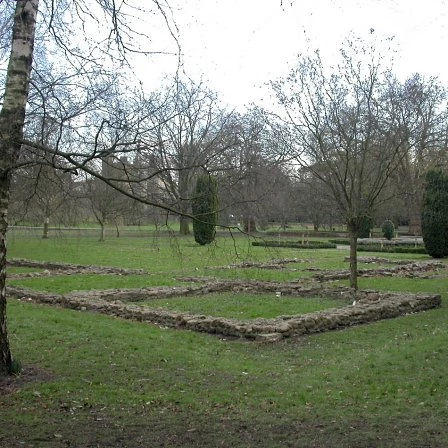
Medieval Cardiff 4 May 2007 Capital city of Wales John Speed's map of 1610. Speed's plan of Cardiff reveals many aspects of the city's development, including the majority of features described in this article. Travelling around Cardiff, capital city of Wales, it is easy to forget that this modern city's origins were laid many centuries ago. The heart of the city was formed during the medieval period and many traces from this time survive today, especially close to the castle. Cardiff lies at the centre of three river systems, the Taff, the Ely and the Rhymney. Its location allowed its first residents to control trade and movement along these rivers, giving them power over a large area. Roman Cardiff Cardiff Castle as it might have appeared in the 14th century. The inner face of the medieval bank still survives within the castle grounds and on close inspection the foundations for the medieval east wall can still be seen on the top of the bank. The first people to take advantage of this location were the Romans who set up a fort here about AD55-60. This dominating fort protected its inhabitants until about AD350-375 when it was abandoned at the end of Roman rule in Britain. The stone walls of the fort provided later generations with a massive source of building materials, while a further legacy from the Romans was a network of roads linking Cardiff with neighbouring areas. The medieval castle Beauchamp's tower, Cardiff castle. Richard Beauchamp, Earl of Warwick, built this tower in the 15th century, to protect the castle's west gate. Openings at the top of the tower allowed stones or burning objects to be dropped on attackers. The unusual spire was added in the 19th century. Today, much of Cardiff's Roman remains are lost beneath the medieval castle. The castle dates from the 11th century, when the Normans conquered Glamorgan. It was begun by William the Conqueror on his return from St David's in Pembrokeshire, in 1081. This is supported by an inscription on a coin found within the castle grounds which suggests that William may have established a mint at the castle. Cardiff Castle was originally built in wood. In the 12th century, Robert Consol, Duke of Gloucester, rebuilt it in stone. At this time, the Castle's west and south walls were raised, building upon the ruined walls of the Roman fort. Owain Glyndŵr The castle wall, Cardiff. In 15th century, town was destroyed by Owain Glyndŵr's Welsh army. The Castle lay in ruin until Richard Beauchamp, Earl of Warwick, restored the defences and castle buildings in 1423. Beauchamp also constructed the octagonal tower, now known as Beauchamp's tower. Much of the rest of the castle and walls dates to the 19th century, when the third Marquis of Bute employed William Burges to restore, refurbish and rebuild it. The medieval town Medieval town wall, Cardiff. Sadly, this is the best preserved section of Cardiff's town walls. It is now hidden behind retail developments along Queen's Street. Cardiff's Shire Hall was built inside the castle's walls in the 15th-century. It was in use as the town's administrative centre until the 17th century. The medieval town spread out from the castle's South Gate. Interestingly the High Street lines up with the Roman rather than the medieval south gate, suggesting it dates from this earlier period. The Medieval town probably developed in two stages. The first stage was within a relatively small enclosure marked out by Working Street and Womanby (Hummanbye) Streets' both names are linked to old Norse. In the second stage of its development, Cardiff expanded south. The town was then enclosed and defended to the east by a bank and ditch and eventually a stone gate. To the west, the town was protected by the meandering river Taff. Remains of the medieval wall Only two sections of the medieval wall are known to survive. The first supports a flower bed just east of the Roman fort wall, while the larger surviving piece is across the road behind retail outlets. Much of the surviving foundations of the wall were destroyed by the large shopping centres which swallowed up many of the small medieval alleyways of the city. Remains of the castle wall The remains of Blackfriars, Cardiff, in Cooper's Field beside the castle. The lower section of the castle wall belonged to the Roman fort, while the upper section was added in the 1920s. During the medieval period, building plots were packed so tight against the Roman wall, that some of the inhabitants were forced to extend their homes backwards through it. This can be seen in the undulating profile of peaks and troughs along the surviving length of the Roman wall. Religion In the centre of Cardiff stands St John's church. Its earliest surviving stonework is mid 13th century and its tower was added around the 1470s. Much of the church we see today was rebuilt during the 18th century. To the east of the castle lay the monastic settlement of Greyfriars, while to the west lay the Blackfriars, both were established around 1256-80. The friars were an active part of Cardiff life until the 1530s when Henry VIII dissolved their monasteries. By 1610, the Blackfriars buildings was in ruins, while the Greyfriars building was converted into a mansion of the Herbert family. The ruins of this mansion survived into the 20th century until they were pulled down to be replaced by a multi-storey car park and tower block. The foundations of Blackfriars were revealed during the 19th century, while the Marquis of Bute was renovating his gardens. These were opened to the public as a park in the 1940s. Background Reading 'Cardiff Castle excavations, 1974-1981' by Peter Webster. In Morgannwg, vol. 25, p201-11 (1981). Cardiff Castle: its history and architecture by J. P. Grant. Published by William Lewis (1923). Medieval Town Plans by B. P. Hindle. Published by Shire Archaeology (1990). The Cardiff Story. A history of the city from its earliest times to the present by Dennis Morgan. Published by Brown and Sons (1991).
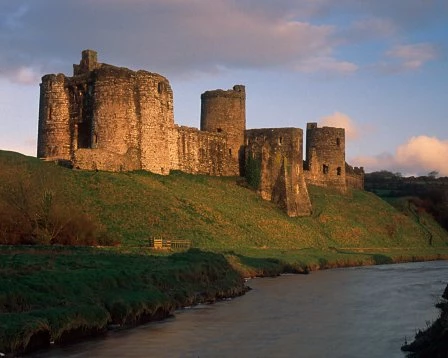
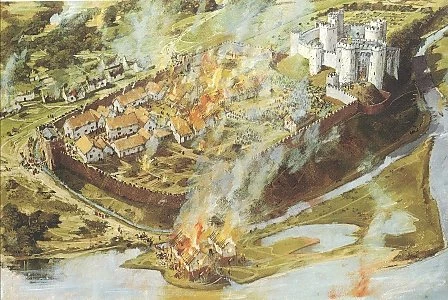
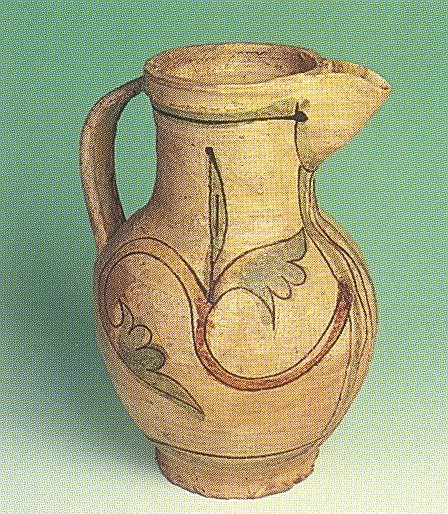
Kidwelly Castle 4 May 2007 The conquest of Wales Kidwelly Castle is perched on a prominent ridge above the River Gwendraeth. The south gatehouse (left of image) dates to between 1390 and 1402, with major modifications undertaken between 1408 and 1422. Much of the curtain wall seen here dates from between 1270 and about 1300. Castles are perhaps the most striking legacy of the Anglo-Norman conquest of Wales, with Kidwelly Castle ranking as one of the finest. Kidwelly was built soon after King Henry I granted the Welsh lands of Cydweli to Bishop Roger of Salisbury in 1106. At first it consisted of an earthen bank and a timber palisade, with one or more gates. Inside, there would have been wooden domestic buildings and perhaps a stone-built hall. The castle was one of several established by the Normans to assert control over the kingship of Deheubarth in south-west Wales. It was situated both to control coastal traffic, and also to protect the important River Gwendraeth. Welsh princes and Norman lords Kidwelly town and castle under attack during the Glyndŵr rebellion of 1403. During the 12th century, Kidwelly was contested by Welsh princes and Norman lords, most notably in 1136 when the Welsh princess Gwenllian was killed in battle near it. Gwenllian's son, the Lord Rhys, enjoyed more success at Kidwelly, capturing and holding the castle until his death in 1197 - one of two occasions on which Kidwelly was held by the Welsh. However, for much of its history the castle remained firmly Anglo-Norman. By the early 13th century, a stone wall had replaced the outer timber defences, but it was the work of the Chaworth family towards the end of the 13th century that transformed the castle, giving it much of the form we see today. Modern castle design Early 14th-century wine jug, 25cm (9.8 inches) tall, found at Kidwelly - possibly imported directly from south-west France. Kidwelly benefited from the latest thinking in castle design. It has a concentric design with one circuit of defensive walls set within another to allow the castle to be held even if the outer wall should fall. The inner wall was also taller, allowing archers on both sets of walls to fire simultaneously - increasing their effect. In 1403 the defences of the castle were put to the test during the rebellion of Owain Glyn Dŵr. The town of Kidwelly fell to the attackers with the loss of several lives, but the castle held out through a siege that lasted until the winter. The old town, set up against the side of the castle, never recovered from the attack and, in 1444, was described as 'waste and desolate'. In its place a new town grew up on the far side of the river. In the centuries that followed, the castle's fortunes also declined and, in 1609, it was described as 'greately decayed and rynated'. From the 18th century, Kidwelly has been a popular tourist attraction, first as a picturesque ruin, and then, through the work of Cadw, as an important reminder of Wales's often turbulent history. Background Reading Kidwelly Castle by J. R. Kenyon. Published by Cadw (2002).
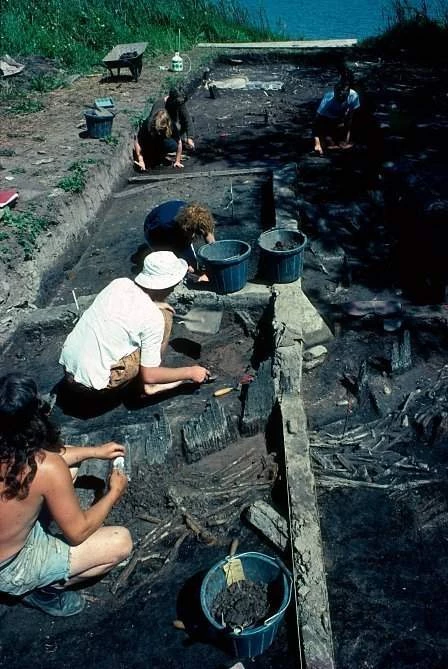
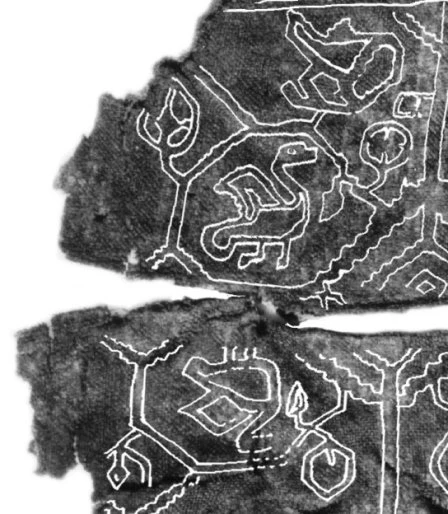
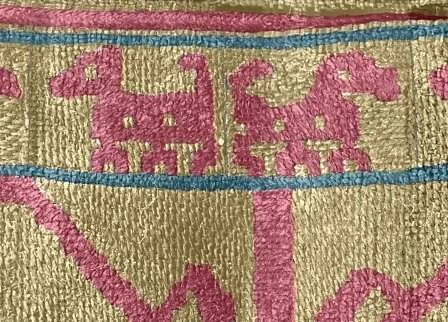
The Llan-gors textile: an early medieval masterpiece 3 May 2007 Excavations at Llan-gors Lake in 1991. The textile was discovered in the silts beyond the oak palisade visible in this trench. The lump of charred textile, as found lying on a piece of wood. Part of the decoration preserved on the textile, showing a group of birds framed by vines. Unfortunately none of the original colour was preserved in the textile, making the design very difficult to see without assistance. It is picked out here with superimposed white lines. The total area shown is roughly 9cm tall by 7cm wide (3.5 x 2.8 inches). Digital-simulation of colour on a photograph of the original textile. In 1990, archaeologists working at a site on Llan-gors Lake, near Brecon, made an unexpected discovery - the remains of a magnificently decorated textile, over a thousand years old. Just off the northern shore of Llan-gors Lake lies a crannog (a man-made island) built as a royal site for the ruler of Brycheiniog in the 890s - a turbulent period in the kingdom's history. At this time, Brycheiniog was under pressure from several neighbouring kingdoms, and Llan-gors must have seemed a safe retreat. However, excavations of the site have shown that this haven was short-lived, being destroyed by fire in the early 10th century. Much of the archaeological work at Llan-gors focused on the waterlogged silts that surrounded the crannog. It was here that the textile was discovered, badly charred and very fragile. Through careful conservation treatment it was possible to separate and clean its many layers revealing this unlikely lump to be among the most important finds of early medieval textile yet found in Britain. The base material of the textile was a very fine plain-weave linen. Silk and linen threads have been used to decorate the textile with birds and other creatures within a framework of vines, and with borders containing repeating patterns or lions. The skill with which this work has been accomplished continues to be a source of wonder. The linen has 23 threads to the centimetre - a magnificent achievement given the equipment available in the 9th and 10th centuries AD. The textile appears to be part of a garment, perhaps a tunic or dress - it has a hem and a belt loop - but unfortunately too little survives to indicate its detailed shape. Its owner was a person of considerable status since the silk that decorates it must have been imported to Britain, while the quality of the needlework suggest that it was produced in a specialist workshop. So how did this fine textile come to be lost? A clue can be found in the Anglo-Saxon Chronicle for AD916, which records that in this year a Mercian army from England destroyed a site called Brecenanmere (Brecknock-mere = Llan-gors Lake) and captured 'the wife of the king and 33 other persons'. Was this the event that saw the burning of Llan-gors and the loss of the textile? It is tempting to believe so. Background Reading 'A fine quality insular embroidery from Llangors Crannog, near Brecon' by H. Granger-Taylor and F. Pritchard. In Pattern and Purpose in Insular Art edited by M. Redknap, S. Youngs, A. Lane and J. Knight, p91-99. Published by Oxbow Books (2001). 'Worn by a Welsh Queen?' by L. Mumford and M. Redknap. In Amgueddfa, vol. 2, p52-4 (1999). 'The Llangorse textile; approaches to understanding an early medieval masterpiece' by L. Mumford, H. Prosser and J. Taylor, in C. Gillis and M.-L. B. Nosch (eds), Ancient Textiles: Production, Craft and Society, 158-62. Published by Oxbow Books (2007).