: Conflict & Invasion

Welsh bard falls in the battle fields of Flanders

25 April 2007

"It was the last day of July, you see. The first day of probably the biggest battle that ever took place. The battle of Passchendaele".

(Simon Jones, 1975).

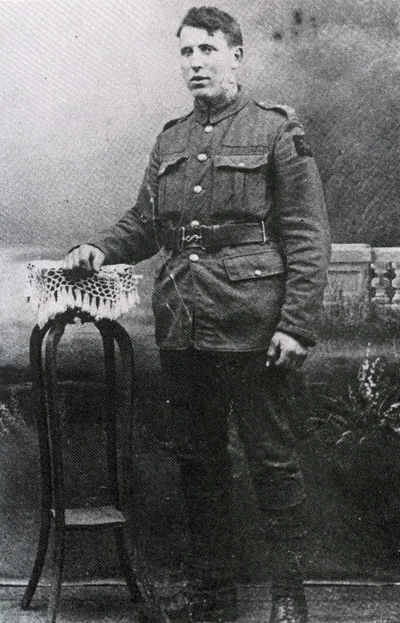
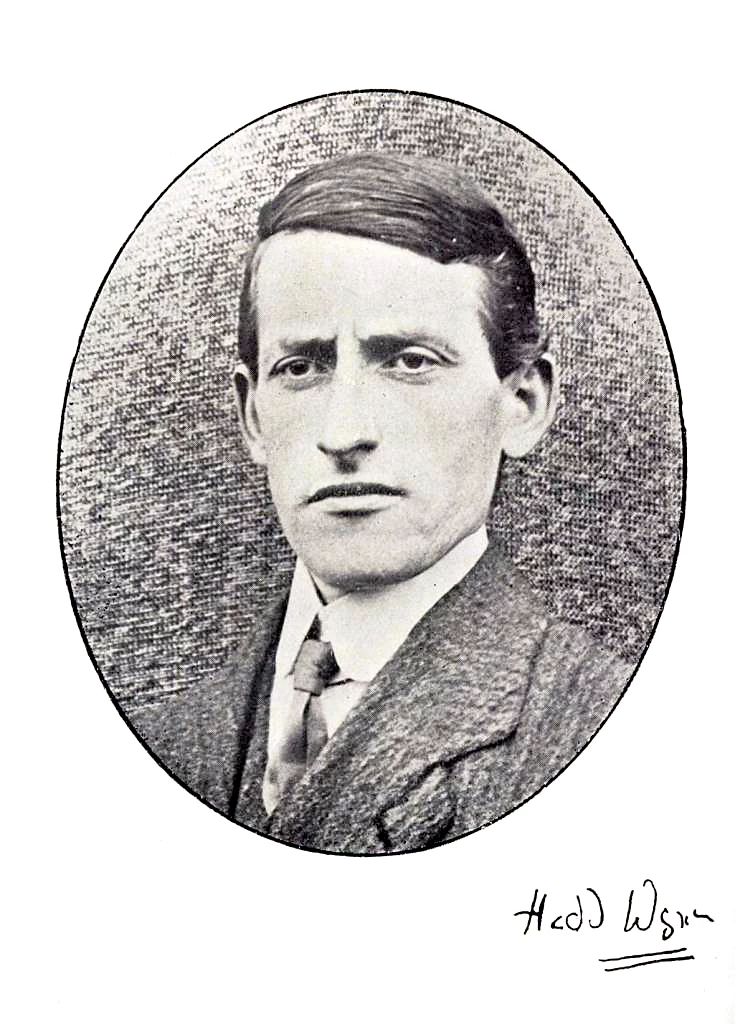
Over a quarter of a million Welshmen enlisted to fight in the First World War. Among them was the poet Ellis Humphrey Evans of Trawsfynydd, better known under his bardic name of Hedd Wyn. He was dispatched for active service in 1917. Just a few months later he was dead - killed in battle on the fields of Flanders.

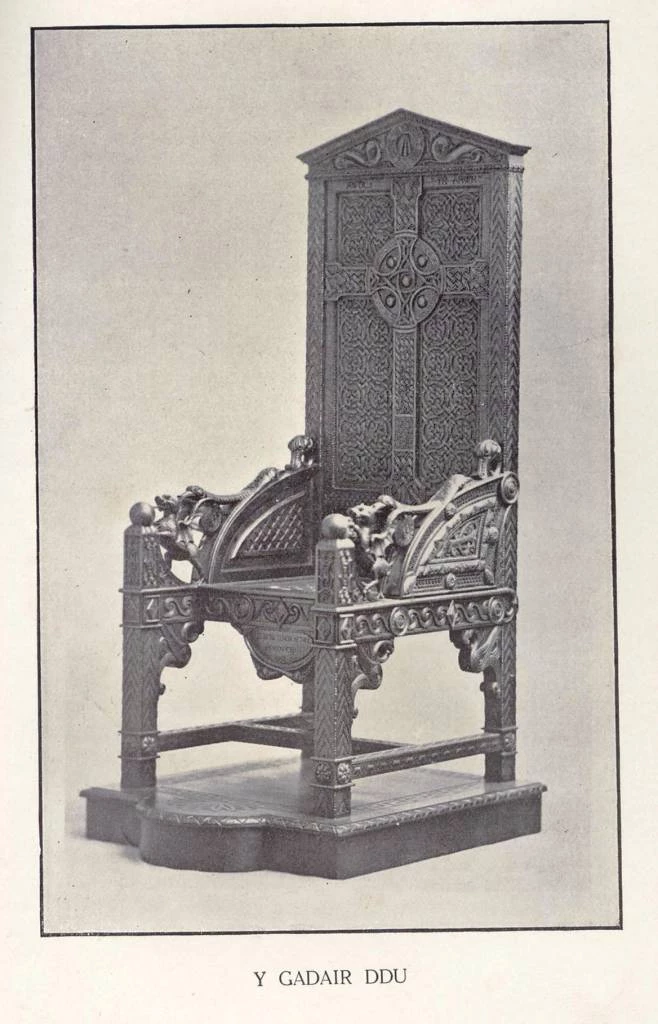
The Black Chair

Six weeks later he was posthumously awarded the chair at the National Eisteddfod at Birkenhead for his poem Yr Arwr (The Hero) which he had completed shortly before his death. The chair itself was draped in black during the chairing ceremony, and has since been known as the Y Gadair Ddu (The Black Chair). By the age of 28 he had won four Eisteddfod chairs for his poetry.

Ellis Humphrey Evans (Hedd Wyn; 1887 - 1917)

Ellis Humphrey Evans (Hedd Wyn; 1887 - 1917)

The Black Chair

The Black Chair

Witness account

Mr Simon Jones of Aberangell, Mid Wales, served in the same regiment as Hedd Wyn, and witnessed his falling on the field of battle. Hear or read his account, as recorded by St Fagans National Museum of History in 1975:

AWC 4763. Recorded: 26.9.1975, by Robin Gwyndaf.
AWC 4764. Recorded: 26.9.1975, by Robin Gwyndaf.
 

"It was the last day of July, you see. The first day of probably the biggest battle that ever took place. The battle of Passchendaele. And we were going over the top at half past four. We started over Canal Bank at Ypres, and he was killed half way across Pilckem (Ridge). I've heard many say that they were with Hedd Wyn and this and that, well I was with him as a boy from Llanuwchllyn and him from Trawsfynydd. I saw him fall and I can say that it was a nosecap shell in his stomach that killed him. You could tell that. You couldn't stay with him - you had to keep going, you see.

When did you see him last, to speak to him?

Oh, it's difficult to say. Perhaps I spoke to him that morning, because if I saw him get killed, I must have been near to him. I remember well that we had an officer leading us called Newman, Lieutenant Newman. He was going in front of me, and I saw him fall on his knees and grab two fistfuls of dirt. Well there was nothing but dirt there, you see - the place was all churned up. He was dying, of course.

What did you do? Could you do something when you saw Hedd Wyn... ?

Nothing at all. No. There were stretcher bearers coming up behind us, you see. There was nothing - well, you'd be breaking the rules if you went to help someone who was injured when you were in an attack. Your business was to keep going.

How did you feel when you saw your friend fall?

Well I'll tell you straight. To be honest, you had no time to sympathise because you didn't know whether you'd be in the same situation as him in a couple of yards."

 
Simon Jones in the First World War

Simon Jones in the First World War

"I saw him fall and I can say that it was a nosecap shell in his stomach that killed him. You could tell that. You couldn't stay with him - you had to keep going, you see".

(Simon Jones, 1975).


Lost generation

Hedd Wyn was one of 32,000 soldiers to be killed in the attack on Pilckem Ridge. The devastated village of Passchendaele itself was not captured until 6 November, 98 days after the start of the battle. This slow advance over little more than five miles of ground was achieved with the loss of 310,000 Allied and 260,000 German lives.

The Black Chair remains a potent symbol of the devastating impact of the First World War on communities throughout Wales, and the unfulfilled potential of a whole generation of young Welsh men.
An Albert Medal won in Cardiff 1919

23 April 2007

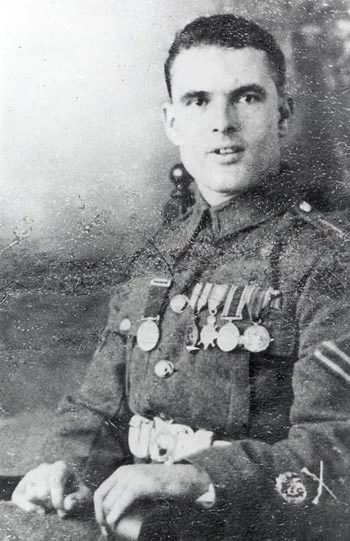
Walter Cleall, winner of the Albert Medal. Image copyright Kenneth Williams.

Walter Cleall, winner of the Albert Medal. Image copyright Kenneth Williams.

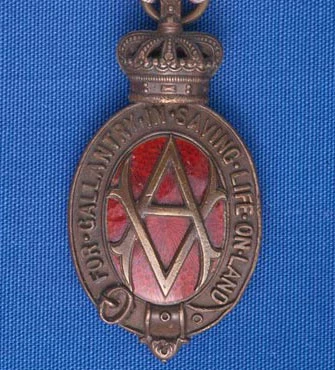
The Albert Medal (front view)

The Albert Medal (front view)

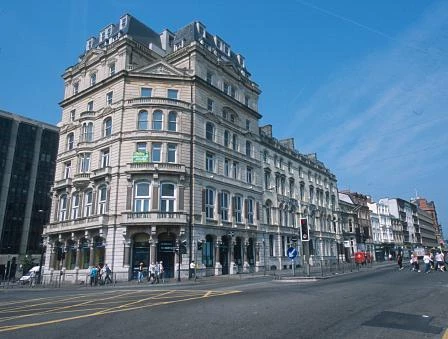
The Royal Hotel, Cardiff (photographed 2003).

The Royal Hotel, Cardiff (photographed 2003).

In 1919 Walter Cleall won the Albert Medal for gallantry in saving the life of Winnie Jones from a fire at the Royal Hotel, Cardiff.

On the afternoon of 11 August 1919, an off-duty chambermaid named Winnie Jones found herself trapped in her 6th floor room at the Royal Hotel, Cardiff, by a severe fire. The Fire Brigade's ladders could not reach her. A crowd had gathered and two men - Tom Hill and Walter Cleall - ran into the hotel to try to rescue her.

Somehow, Cleall reached the 6th Floor, but to get to the girl he had to smash a window and make his way round a narrow parapet, at places with a drop of nearly 30m (100 feet) to Wood Street, below. He then carried her back by the same route. As they left her room, the roof collapsed. Both the girl and her rescuer were later taken unconscious to hospital.

The whole event was witnessed by a London barrister, who happened to be in Cardiff that day. He promptly wrote to the Home Secretary (another barrister) and within two days of the event the Home Office was investigating whether to reward Cleall's bravery. The following March, Cleall was invested by the King with the Albert Medal, then Britain's senior civil gallantry award.

The Albert Medal was first awarded in 1866 for gallantry in saving life at sea. In 1877, it was extended to cover incidents on land, following the dramatic rescue of five miners who had been trapped underground for nine days at the Tynewydd Colliery in the Rhondda Valley. It rapidly became known as the 'Civilian Victoria Cross'. The creation of the George Cross in 1940 made the Albert Medal redundant, except as an occasional posthumous award, and in 1971 it was revoked. Its living holders were invited to exchange it for the George Cross. Walter Cleall was one of five who chose to donate their original award to the National Museum of Wales.

Background Reading

For Those in Peril, by Edward Besly. Published by the National Museums & Galleries of Wales (2004).

Where Gladiators Fought - Discoveries at Caerleon's Roman Amphitheatre

18 April 2007

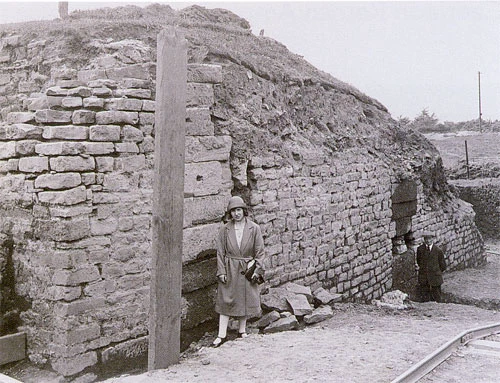
Mrs T. V. Wheeler standing in entrance B of the amphitheatre during its excavation.

Mrs T. V. Wheeler standing in entrance B of the amphitheatre during its excavation.

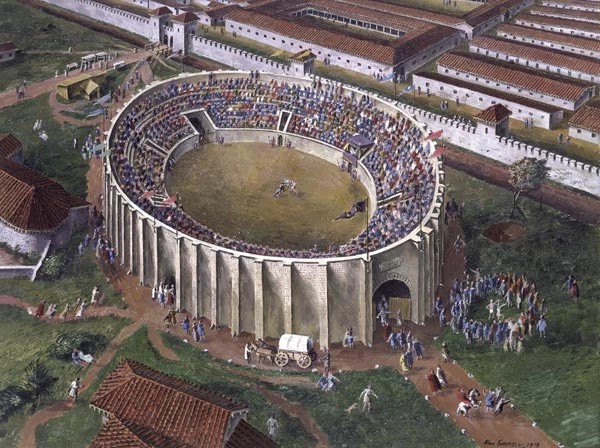
Reconstruction of the Caerleon amphitheatre

Reconstruction of the Caerleon amphitheatre by Alan Sorrell. The amphitheatre is shown as a masonry structure to its full height.

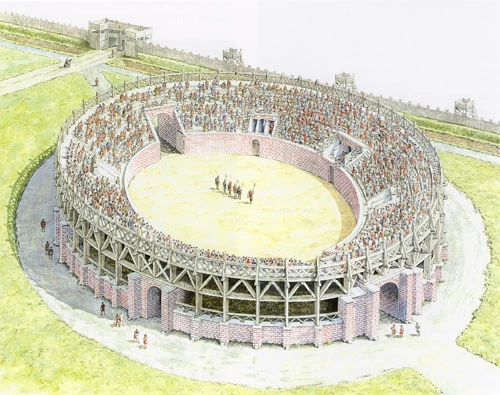
How the amphitheatre may have actually looked. Illustration by Dale Evans (1988) after the reconstruction by R. A. Anderson (1981). Cadw: Welsh Historic Monuments, Crown Copyright.

How the amphitheatre may have actually looked. Illustration by Dale Evans (1988) after the reconstruction by R. A. Anderson (1981). Cadw: Welsh Historic Monuments, Crown Copyright.

Re-enactment at Caerleon.

Re-enactment at Caerleon.

Next to the Roman fortress at Caerleon, near Newport (south Wales), lies the remains of a well-preserved oval amphitheatre, known to local folklore as King Arthur's Round Table. The amphitheatre was excavated in the 1920s by Dr. Mortimer Wheeler, then Director at Amgueddfa Cymru - National Museum Wales. Wheeler's reconstruction of how the amphitheatre may have looked has since been revised as subsequent discoveries have led to a re-think as to how it was constructed.

Securing funds for excavation

Wheeler exploited the connections with King Arthur to drum up sponsorship. The Daily Mail agreed to provide £1,000 for exclusive rights and daily reports on the excavation. The paper eventually trebled its original offer and presented the excavated remains to the then Office of Works (a predecessor of Cadw: Welsh Historic Monuments) as a national monument.

Planning and excavating

In 1926, Wheeler took up the post of Keeper of the London Museum meaning he could not continue his direct involvement with the excavations, but the sponsorship from the Daily Mail made the project binding and urgent, so his wife, Tessa, took over the direction. Every evening a newsworthy story had to be sent to the Daily Mail on the day's discoveries, with 'sensational' headlines such as 'Where Gladiators Fought'.

A structure of earth and masonry

After the excavations were complete and nearly 30,000 tons of soil had been examined and removed from the site, the excavators concluded that the amphitheatre had been constructed around AD 80, several years after the initial foundation of the main fortress at Caerleon. In the report on the findings, published in 1928, the amphitheatre was reconstructed as an earth and masonry structure with the auditorium supported by a bank of earth retained by inner and outer walls of masonry supported and strengthened by buttresses. It was calculated that the original arena wall must have risen to a height of four metres while the external wall must have reached a height of about ten metres. The seats were almost certainly of wood, as no evidence of stone seats was discovered.

In 1939, Alan Sorrell, a well-known painter of archaeological reconstructions shows the amphitheatre built in masonry to its full height.

A new theory

In 1962, George Boon (from the Museum's Department of Archaeology) excavated a small trench in the bank of the amphitheatre, and caused a fundamental re-think of how the superstructure was constructed.

The original surface of the bank was uncovered not far below the turf, this meant that the banks were never higher than they are today. Cut into the surface of the bank were pits, a metre square and deep. Boon concluded that these pits had held large wooden beams forming an openwork timber grandstand. Since this discovery, reconstructions of the amphitheatre have been re-drawn showing its lower part in stone, but with a timber superstructure.

An amphitheatre of similar construction is shown on Trajan's Column at Dobreta, the Roman base on the Romanian side of the Danube bridge.

It has been estimated that the timber grandstand at Caerleon contained 6,000 seats, approximately the full complement of the legion. Events at the amphitheatre, although undoubtedly less bloody, continue to attract large audiences today with exiting re-enactments and other events staged regularly.

Background reading

  • Caerleon Roman Fortress by J.K. Night. published by Cadw (2003)
  • Isca: The Roman Legionary Fortress at Caerleon, Mon. by G.C. Boon. Published by the National Museum of Wales (1972)
  • 'The Roman amphitheatre at Caerleon, Monmothshire' by T.V. -d R.E.M. Wheeler. In Archaeologica vol.78, p.111-218.

Trick or Treat? Ancient collection at Amgueddfa Cymru found to be modern

17 April 2007

At the beginning of the twentieth century, the president of Amgueddfa Cymru, Lord Howard de Walden, formed a remarkable collection of ancient European arms and armour. The collection included a number of classical pieces - helmets, swords, spearheads, belts and armour that were mainly Greek and Roman - or so it was thought until work at Amgueddfa Cymru discovered otherwise...

The collection comes to Amgueddfa Cymru

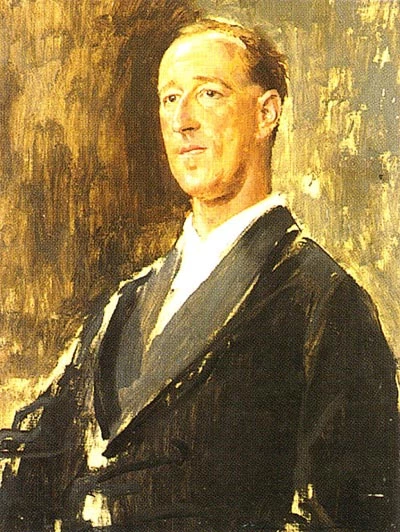
Portrait of Lord Howard de Walden (1880-1946)

Portrait of Lord Howard de Walden (1880-1946)

Etruscan bronze 'helmet' embellished with gold showing half of the false patina removed

Etruscan bronze 'helmet' embellished with gold showing half of the false patina removed

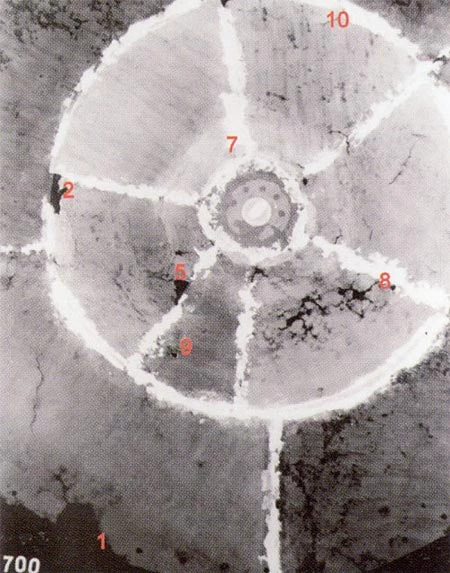
X-Ray of helmet

X-Ray of helmet

In 1945, Lord Howard offered to lend seventy-nine 'antique bronze objects' to the Museum. Following his death in 1946, his son donated the collection to the Museum.

In 1990 research by a Russian scholar had shown that some items from this collection had almost certainly been made in a jeweller's workshop in Odessa, south Russia between 1890 and 1910. Further investigation has revealed some of the objects to be totally genuine, but others reveal signs of being 'improved' or even manufactured more recently from antique metal parts fashioned into classical forms.

In order to meet the demand for classical antiques during this period, it was quite common to produce a particular object using ancient pieces from a number of sources, or in other words, a pastiche (a work of art that imitates the style of some previous work). There are also a number of fakes, where the metal used was wrong for the period of the object. Lord Howard de Walden was well aware of this, for when the loan to the Museum was being organised, he wrote 'there are certain pieces you may not wish to have, such as...several specimens of doubtful authenticity'.

Bronze 'helmet'

One such object that Museum conservators examined was a helmet, made of bronze and decorated with gold, apparently dating from the third century B.C.

The helmet was X-rayed to determine the condition of the metal and the extent of the corrosion, as well as to reveal its construction. However, the X-ray uncovered much more than was originally expected, for dense solder lines could be clearly seen criss-crossing the image. The helmet had undergone considerable restoration work in recent times; cracks had been filled with solder and holes patched with metal. To disguise these recent repairs a fake patina (the sheen on an object produced by age and use) mimicking corroded bronze had been applied over the top.

Analysis of the metal revealed that the bronze helmet was in fact old, and even the patches of metal used to repair the holes were ancient. However, there were indications that the gold was modern.

The investigations concluded that the helmet had been repaired and embellished with gold that would have increased its value and made it more desirable to collectors. This work may have been carried out at the turn of the twentieth century.

Should the modern repair work be removed or conserved?

In the end, it was decided to remove half the false patina in order to reveal the repair work below, for it was felt that the alterations were now part of the history of the object and could shed light on techniques employed at the time the helmet was collected.

Study of this important collection not only throws light on the ancient technology of the genuine pieces of classical arms and armour, but also the practices of the antiquities market a century ago.

Rare Viking object rescued after 900 years underwater

17 April 2007

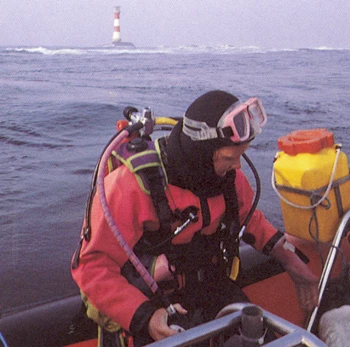
Diving operations on the Smalls Reef (1992)

Diving operations on the Smalls Reef (1992)

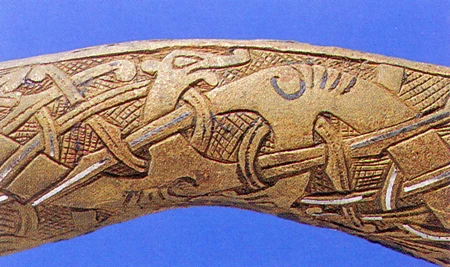
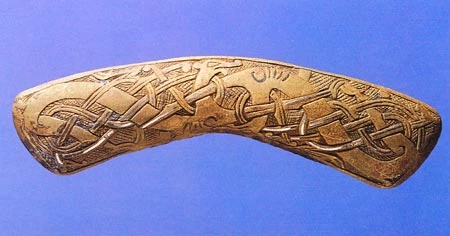
Detail of an animal in profile depicted on one side of the Smalls sword guard.

Detail of an animal in profile depicted on one side of the Smalls sword guard.

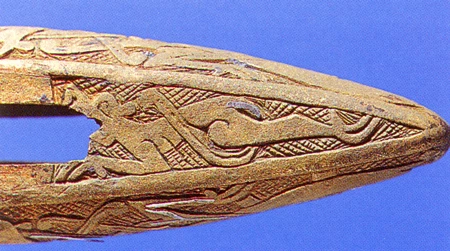
Detail of beast on the top of the Smalls guard.

Detail of beast on the top of the Smalls guard.

The Smalls Sword, ca. AD 1100.

The Smalls Sword, ca. AD 1100.

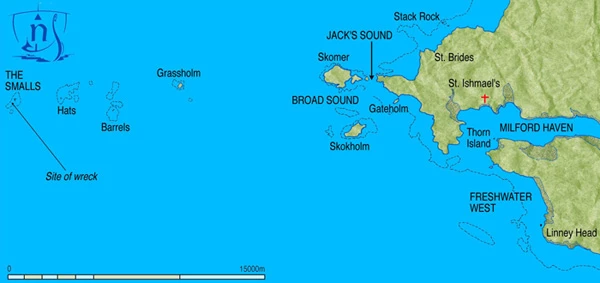
Location map of the Smalls Reef

The location of the Smalls Reef in South-west Wales

Amgueddfa Cymru holds one of the most remarkable examples of late Viking art ever to be found in Wales. The discovery of the lower guard of a Viking sword, dated to about AD 1100, was made by a sports diver in August 1991. The findspot lies off The Smalls Reef - some 13 miles due west of Skomer island (Dyfed), the nearest landfall being the island of Grassholm, approximately 7 miles due east. This makes it one of the most remote archaeological sites in Wales.

Cast in brass and finely decorated

The sword guard is cast in brass, each side being finely decorated with a pair of stylised animals in profile, interwoven with thin, snake-like beasts. On the top of the guard two animals with open jaws bite the position of the grip which once projected through the guard, but has now perished. The main areas of ornament are inlaid with silver wire, and the background was originally filled with a black inlay called niello, to form a handsome design of gold, black and silver appearance.

Urnes style decoration

This decoration is in a style known as Urnes, which took its name from the decoration of a small wooden church built at Urnes in western Norway in about AD1060. The new find, with its elegant, refined animal profiles, reminds us that the Vikings were not only pirates and raiders, but also craftsmen and creators of art which, based on animal forms, were full of vigour and vitality. Its ornament is related to metalwork produced in Ireland from the second half of the 11th century, where it caught native imagination, as can be seen in the famous Cross of Cong (dated about 1123) and St Manchan's Shrine (12th century).

Following the identification of the find, the site was designated under the Protection of Wrecks Act 1973, which aims to prevent unauthorised interference on wreck sites considered to be of archaeological, historic or artistic importance. Such was the rarity of the discovery that the Museum was granted a licence to survey the site.

The logistics of such an investigation were formidable, with large swells frequently rolling in from the Atlantic and smashing onto the exposed rocks. In spite of these difficulties, it was possible to inspect the area and make complete video and photographic records of the underwater environment of the reef, and the likely context of the find.

The discovery of a prized possession in such a location is unlikely to represent a casual single loss, but rather the capsize and loss of a vessel, probably Viking, on one of the long-distance sea-routes at some point during the period of frequent attacks by the Dublin fleet on wealthy centres such as St. David's and Bristol. The ship was a dramatic symbol of Viking culture, and to judge from other Viking finds, the vessel carrying the sword may have measured between 13 and 28 metres in length - either a large, slender, fast ship for warfare, or a broader, sturdier vessel for the long-distance transport of people and cargoes.

Many ships were lost on the Smalls before the advent of navigational aids such as radar and lighthouses, and any vessels wishing to travel to Ireland from the south coast of Wales still need to keep a course well to the south of the 'Hats and Barrels' to be sure of clearing the hazardous rocks, inbetween the islands of Skockholm, Skomer and Grassholm, themselves all being Scandinavian names.

The rarity of this find, the quality of workmanship and the nature of the findspot are all factors which help shed light on the ancient operations of Norsemen around the Welsh coast.