: Death & Burial

The megalithic tombs of Stone Age Wales

14 May 2007

Megalithic Tombs

Pentre Ifan

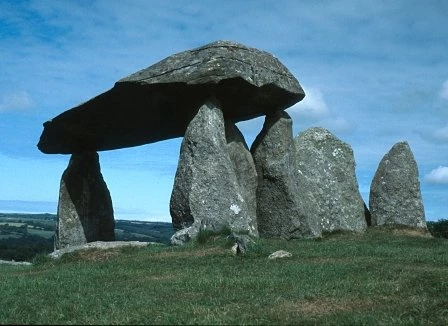
Pentre Ifan (Pembrokeshire), one of the most dramatic megalithic tombs in Wales. It would originally have been covered by a stone mound.

Wales is home to one of the best collections of megalithic tombs in the UK. As well as being visually dramatic, they provide an important source of information about life, and death, from over five thousand years ago.

The landscape of Wales is filled with ancient monuments. A thousand years ago castles were the most impressive features, a thousand years before that it was Roman forts and before that Iron Age hillforts. But the earliest monuments to survive to the present day are megalithic tombs - stone burial chambers, built almost six thousand years ago.

Megalithic tombs were built at a time when the population of Wales lived in small communities, using stone tools, and experimenting with the newly introduced ways of farming and herding. Today such a life sounds simple and unsophisticated compared to our own. However, the evidence of the megalithic tombs tells us that life was not completely uncomplicated at this time.

Wales's megalithic tombs consist, for the most part, of stone chambers composed of a large capstone perched on top of a number of uprights. These would once have been covered with a mound of earth or stone. Often they have a forecourt area in which ceremonies would have been performed.

The scale of the megaliths is their most striking feature. At Arthur's Stone on the Gower peninsula a rock over 4m (14ft) long and 2m (7ft) thick was lifted to create the chamber. At Tinkinswood (Vale of Glamorgan) a slab weighing over 36 tonnes (39 tons) was used.

Community crypts

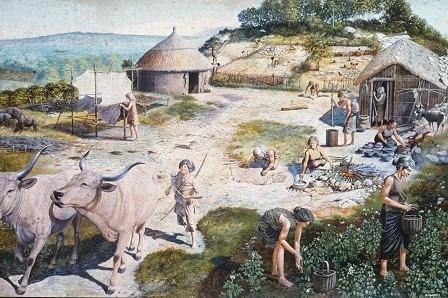
Reconstruction of daily life in Wales 6,000 years ago

Reconstruction of daily life in Wales 6,000 years ago, based on excavations at Clegyr Boia (Pembrokeshire). For most people the daily routine focused on farming crops, gathering wild plants, and herding sheep and cattle.

That Stone Age people went to such lengths to build their tombs indicates their importance for communities at this time.

When completed the tomb functioned like a modern crypt, being slowly filled over the generations with the dead. The result was, in effect, a home for the ancestors.

South East Wales

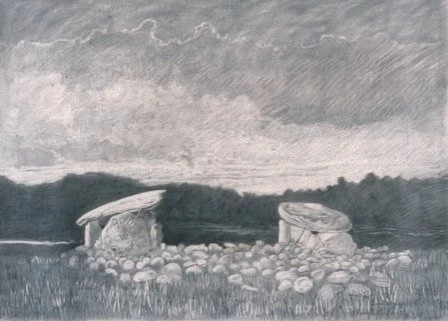
Dyffryn Ardudwy

Drawing of Dyffryn Ardudwy (Gwynedd), by David Gunning. This monument was constructed in stages with the chamber on the right being the first to be built.

Tombs like these can be found in many parts of Wales. In south-east Wales there is an important group of tombs centred on the Black Mountains as well as in the Vale of Glamorgan. In south-west Wales, there are clusters in Pembrokeshire and Carmarthenshire. Most impressive of all are the tombs of Anglesey, which are notable for their number and variety.

These tombs are the few that have survived agricultural clearance and robbing for building works - doubtless there were once many more in Wales, and perhaps there are a few more still waiting to be discovered.

Background Reading

Arthur's Stone, on the Gower peninsula.

Arthur's Stone, on the Gower peninsula. The massive stone that caps this chamber was set atop several smaller uprights in an impressive feat of Stone Age engineering.

The Tomb Builders: In Wales 4000-3000BC by Steve Burrow. National Museum Wales Books (2006)

Megalithic tombs and long barrows in Britain by F. Lynch. Shire Publications (1997).
Britain's only surviving Roman will

10 May 2007

Roman Trawsfynydd

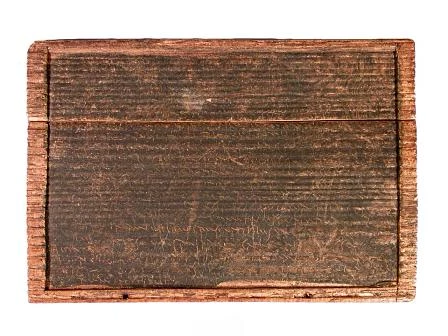
The first 'page' of a Roman will found near Trawsfynydd in the 19th century. The tablet was already broken in two.

The first 'page' of a Roman will found near Trawsfynydd in the 19th century. The tablet was already broken in two.

Britain's only surviving Roman will was found in the 19th century near Trawsfynydd, Merionethshire. Two letters written at the time shed light on its history.

The first letter describes a 'wooden book', consisting of 10 or 12 leaves, as being found by farm servants cutting peat 5km to the south-east of the Roman fort at Tomen-y-Mur. The letter reads:

"I saw the book a few days after it was first found – only 2 or 3 of the leaves then contained the inscription perfect – On the rest it had been partly obliterated by the carelessness of the farm servants. The work is, probably, a relic of the Ancient Druids, who may have employed a modification of the Roman alphabet to write their own language."

The author of the letter was mistaken in linking the text to the Druids, but did well to identify it as Roman, since at this time Roman 'cursive' (joined characters) writing was unknown.

TV show prompts artefact to be identified

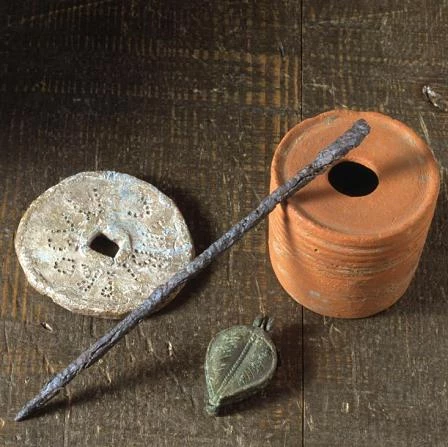
Pottery inkwell, an iron stylus for writing on waxed tablets, a seal box and a lead property marker.

Pottery inkwell, an iron stylus for writing on waxed tablets, a seal box and a lead property marker.

The second letter records the delivery, probably in the mid 19th century, of one leaf to George Carr Pearson in London. Pearson studied the tablet, but never returned it. Eventually, the tablet was found again when clearing a house in West Kensington. In 1991 it came into the possession of Mr Stafford Ellerman, who in 2003 saw a television programme about the writing tablets discovered at the Roman fort of Vindolanda on Hadrian's Wall. He realised he too owned a Roman writing tablet and took it to the British Museum for identification. He generously donated it to Amgueddfa Cymru.

The will

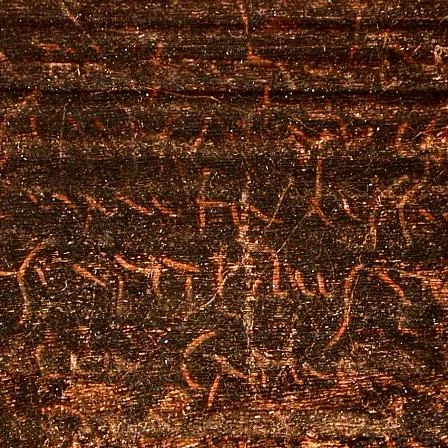
Detail of the tablet revealing the Roman writing preserved on its surface.

Detail of the tablet revealing the Roman writing preserved on its surface.

The tablet is a thin rectangular slab of wood from a silver fir tree, which was not native to Britain. The wax coating on one side is now degraded. Originally this would have been a smooth dark coating made of beeswax and a colouring agent, probably soot, in which the scribe wrote with his 'stylus' (a pointed metal writing tool) to expose the pale wood underneath. Some 300 stylus tablets have now been found on sites in Britain.

With careful photography and meticulous study of the original, it is possible to discern a ghost of writing in many places. The writing is in 'lower-case' Roman cursive script. The tablet forms the first page of a Roman will, written in Latin.

Its author names an heir to his estate, possibly his wife or daughter, and charges them with responsibility for accepting it within 100 days of becoming aware of their inheritance. The identity of the author and the extent of his estate were presumably detailed on the other tablets, now lost.

Considering that Roman wills were regularly written on waxed tablets, with good reason to preserve them and millions of Roman citizens to write them, it is surprising that the actual tablets should be so rare; four are known from Egypt and now this example from Wales.

The text translates as:

"[The name and status of the testator] ... before I die, I order that [name] be my sole heir...

Let all others for me be disinherited [...] on no other terms than that as much as I shall give, have given, shall have ordered to be given [...] and you [enter upon, accept my estate [... within] the next hundred [days] after my death in which you know or can know that you are my legitimate heir, in the presence of witnesses [...] let the heirs be those who know that they are [...] of this property.

But if you do not thus accept my estate, if you refuse to enter upon it, be thou disinherited [...], whom I have instituted as my sole heir."

Background reading

‘A Roman Will from North Wales’ by R. S. O. Tomlin. In Archaeologia Cambrensis, 150 (2004) pp. 143–56

Life and Letters on the Roman Frontier by A. K. Bowman. Published by British Museum Press (1994).

Exquisite Roman treasure gives up its secrets

9 May 2007

The leopard cup.

The leopard cup. 11.5cm (4.5 inches) tall.

Detail of the leopard handle

Detail of the leopard handle, showing its finely worked features and silver spots.

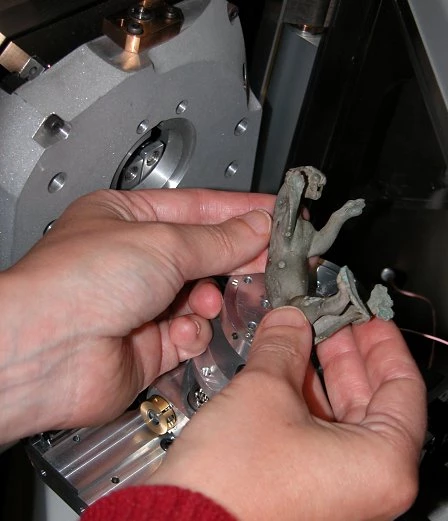
Leopard cup being placed in the Scanning Electron Microscope.

Leopard cup being placed in the Scanning Electron Microscope.

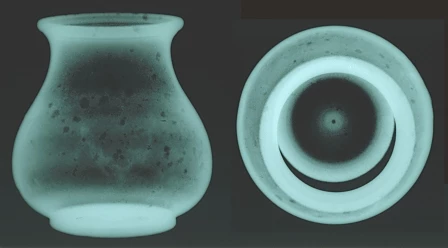
X-rays of the cup.

X-rays of the cup.

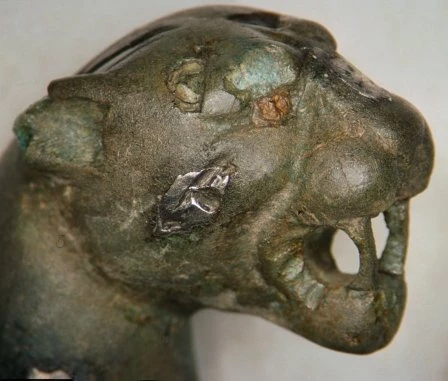
Microphoto of the leopard's face.

Microphoto of the leopard's face.

Discovered in 2003, this exquisite Roman vessel has been the subject of detailed study at Amgueddfa Cymru - National Museum Wales.

The bronze cup is one of the finest Roman vessels to have been found in Wales. It was discovered by Mr Gary Mapps near Abergavenny (Monmouthshire). It was reported to the Portable Antiquities Scheme, enabling the finds spot to be investigated.

Excavation of the site revealed that the cup had been placed upside down in a small pit containing a cremation. This cremation was part of a cemetery beside a Roman Road some distance from the mid 1st to early 2nd century fort at Abergavenny (Roman Gobannium). There is also a growing amount of evidence for a civilian settlement dating from the 2nd to 4th centuries in the neighbourhood of this cemetery.

The cup displays craftsmanship of a high standard and it was almost certainly manufactured in Italy during the 1st century AD. Very similar cups have been found at the doomed city of Pompeii, which was destroyed after the eruption of Vesuvius in AD79.

X-rays of the cup revealed that it was first cast in a mould using leaded bronze. Lead was added to help the molten bronze (principally copper and tin) flow more easily and improve the quality of the casting. Once this casting had been made the vessel was turned on a lathe with the use of a sharp cutting tool to produce its final shape.

The cup's decorative handle depicts a leopard which, in Roman mythology, appears as the draught-beast and companion of Bacchus, the god of wine. His worship involved feasting, drinking, music and dancing. Leopards, captured in both Africa and Asia, were also popular with the Romans for display and fighting in the amphitheatre arena.

The leopard handle was made separately using 'lost wax' casting. The first process was to make a wax model of the leopard. A clay mould was formed around the model and then heated to run off the wax. Leaded bronze was poured in to fill the space left by the wax and, after cooling, the mould was broken to remove the bronze handle.

Further work was undertaken on the finished casting: for example the tail and canine teeth, originally cast thicker, were cut away to form finer features. The spots were also chiselled out from the body after casting and inlaid with silver. The leopard was then attached to the cup using solder. The leopard's eyes, measuring about a millimetre in diameter, were also inlaid. Analysis of the remaining traces of inlay indicate that the eyes may have been of amber.

It is unknown whether the cup belonged to a member of the Roman army, or a native Briton from the nearby civilian settlement. Whichever is the case, this 1st century cup was a costly import and probably belonged to someone of status, who cherished it sufficiently to want it buried with them on their death.

Background Reading

Things Fall Apart: museum conservation in practice. National Museum Wales Books, 2006

The suffering of burial 631

2 May 2007

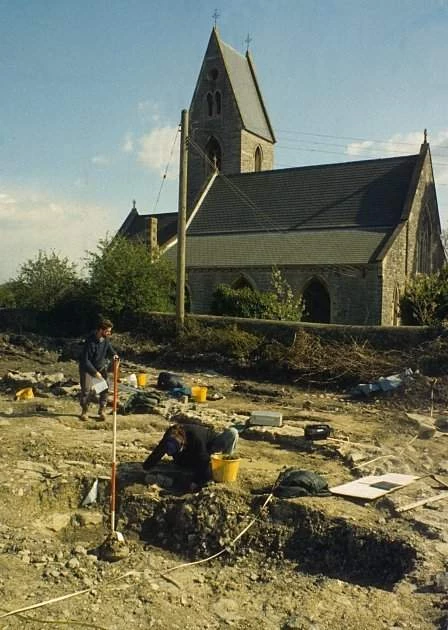
Excavations in progress in 1994 in part of the cemetery of St Dochdwy's monastery.

Excavations in progress in 1994 in part of the cemetery of St Dochdwy's monastery.

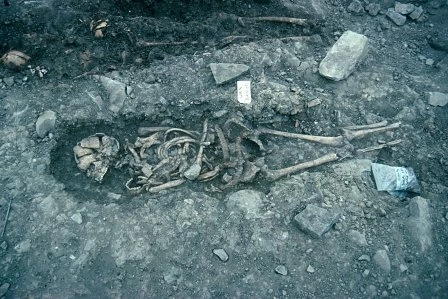
Burial 631

Burial 631 as discovered.

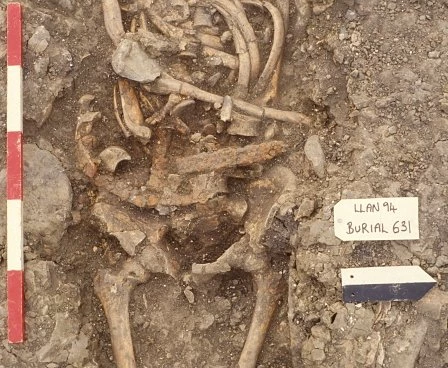
Detail of the iron belts around the waist of burial 631.

Detail of the iron belts around the waist of burial 631.

The iron belts during conservation work undertaken by a team at Amgueddfa Cymru

The iron belts during conservation work undertaken by a team at Amgueddfa Cymru.

In 1994 archaeologists excavated the largest collection of early medieval burials yet found in Wales, as well as evidence for an unusual burial practice.

Ideal Homes Wales Ltd had contracted archaeologists from Cotswold Archaeology to excavate land earmarked for a new housing development in Llandough (Vale of Glamorgan).

The site was situated just outside the churchyard of the present parish church - reputedly the site of the early medieval monastery of St Dochdwy - the excavation discovered over 800 burials dating from the 4th- to the 11th-century AD.

Careful study of the skeletons has shed fresh light on the population of Wales at this time. One grave in particular was exceptional.

Burial 631

Burial 631 lay in the middle of the cemetery. The skeleton was that of a young man, aged between 25 and 35, and about 1.75m tall (5.75 feet). Radiocarbon dating of the bone suggested that he died between AD340-660. However, it was not his antiquity that made him special, but rather the two iron straps he wore around his waist.

The ends of these straps were secured behind his back. The tapered iron ends passed through lugs and were hammered over by a second person, making it impossible for the wearer to remove the straps unaided. Clearly this was more than a fashion accessory, but what other functions could it have served?

It has been suggested that the straps may have been worn as an act of penitence - a fitting purpose in the context of a monastic community. Similar cases are certainly known in the Middle Ages. For example, there was a visionary monk at the monastery of Much Wenlock (Shropshire) in the early 8th century called Begga, who wore 'an iron girdle about his loins for the love of God'.

An alternative explanation is that the iron bands served as a hernia belt. Roman texts first record the use of hernia belts on the Continent. Examples have also been excavated from 6th- and 7th- century burials in France, Germany, Switzerland and Spain.

So which interpretation is correct - penitent's belt or hernia truss? The answer is likely to be a little of both. During the early medieval period the endurance of suffering was seen as a path to heaven. So enduring the pain of a hernia may in itself have been in part an act of penitence from which the wearer of these two belts hoped to reap a reward in the afterlife.

Background Reading

'Llandough' by A. Thomas and N. Holbrook. In Current Archaeology, vol. 146, p73-7 (1996).

'An early-medieval girdle from burial 631', by M. Redknap. In N. Holbrook and A Thomas 'An early-medieval monastic cemetary at Llandough, Glamorgan: excavations in 1994', Medieval Archaeology 49 (2005), 53-64.

Science brings to life the witnesses to the Viking-age in North Wales

1 May 2007

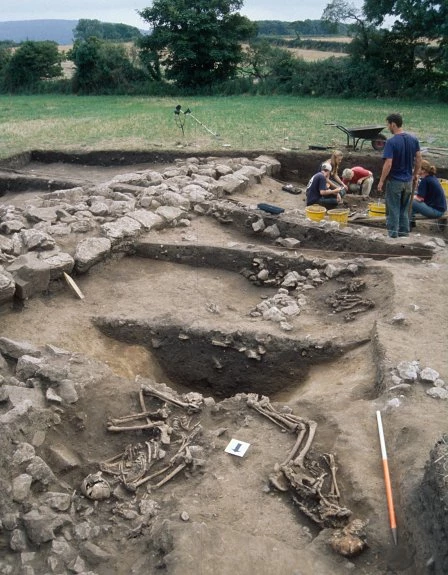
Cloddio'r ffos amgâu a'r sgerbydau yn Llanbedr-goch (Ynys Môn).

Excavating the enclosure ditch and skeletons at Llanbedrgoch (Anglesey). To the left of the image are the lower courses of the settlement's defensive wall. Two of the skeletons can be seen lying in the upper levels of the ditch that lay outside this wall.

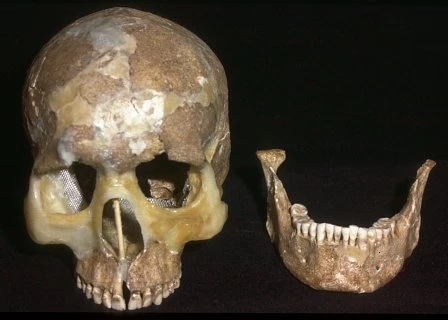
The skull of burial 5.

The skull of burial 5. This skull was in pieces when discovered and has since been reconstructed. Photo by the School of Art and Medicine, University of Manchester.

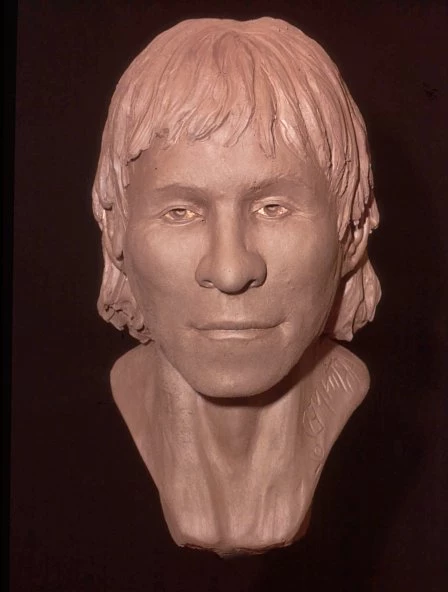
The face of burial 5 after recreation.

The face of burial 5 after recreation. Photo by the School of Art and Medicine, University of Manchester.

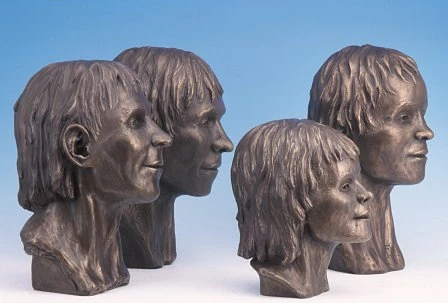
Four of the five faces from Llanbedrgoch, cast in brass.

Four of the five faces from Llanbedrgoch, cast in brass.

Excavations by the National Museum of Wales on the early medieval settlement at Llanbedrgoch on Anglesey, North Wales, have unlocked details of life in 9th- and 10th-century Wales. Scientific techniques have allowed the faces of four of those that lived there to be recreated from their skulls.

A puzzling discovery

In 1998, an unexpected discovery was made on the west side of the settlement. Five human skeletons were found in the upper level of a filled-in ditch immediately outside a defensive wall that surrounded the settlement. Contrary to usual Christian practice, all skeletons were aligned with their heads either to the north or south rather than to the east possibly influenced by the position of the wall.

They appear to have been casually buried in shallow graves. Three of the bodies had been buried individually, but there was one double burial in which an adult male (approximately 23-35 years old) had been thrown directly on top of a child (approximate age 10-15 years old). The adult male's arms may have been tied behind his back and he may have suffered a blow to the left eye with a sharp object. Another older adult male (35-45 years old) appears to have been placed face down, turned to left, body slightly twisted, and he may have had his wrists fastened in front of his body.

In the case of three of the burials, the bodies were covered by scattered limestone blocks and smaller rubble, probably derived from the collapse of the enclosure wall. This suggests they were buried shortly before the abandonment of the site.

The Llanbedrgoch skeletons date to the second half of the 10th century, a period when Vikings on the Isle of Man effectively controlled Gwynedd, and may have had bases on Anglesey. The circumstances of burial and lack of Christian orientation have led to speculation that these individuals were victims of raiding. The precise circumstances of their deaths may never be known, but they may have been the victims of military activity by Vikings in their search for wealth, perhaps in the form of hostages or slaves.

The Llanbedrgoch skulls show a number of similar features, including horizontal eye fissures, square jaws and adherent ears (they were lacking ear-lobes). Some of these features suggest a genetic relationship between the individuals. Either they belonged to the same families or the individuals came from a small gene pool.

Not only has the site produced a wealth of evidence for settlement layout, buildings, artefacts and standards of living on a high status site - it has also provided the remains of people who once breathed and walked there.

Background Reading

Vikings in Wales: an archaeological quest by Mark Redknap. Published by the National Museums & Galleries of Wales (2000).