Keeping and caring for collections

From a complete farmhouse to a tiny matchstick: looking after the Social History collections at St Fagans

22 February 2007

The Social History collections of Amgueddfa Cymru are housed at St Fagans. As it is an open-air museum, the objects range from historic re-erected buildings to small, fragile objects in an air-conditioned store. They vary in size from matches to four-poster beds, and can be as fragile as delicate Victorian shell ornaments or as robust as inscriptions carved on large stone blocks.

A basket from the domestic collections

A basket from the domestic collections illustrating how simple surface cleaning can have a dramatic affect on an object's appearance.

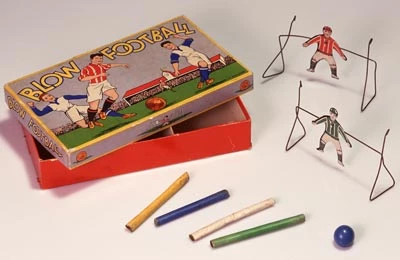
A game is made out of three types of paper as well as metal, plastic, pigments and paints

Simple objects can be quite complex. This game is made out of three types of paper as well as metal, plastic, pigments and paints.

Single objects can often be made of more than one material. This means that parts of the objects need different preservation techniques. Conservators have to assess new objects to stablise them, and items in the stores have to be regularly checked.

Conserving for the future

All objects in the Museum's collections need to be structurally sound and chemically stable if they are to survive. The first stage of treating any object is to examine it closely to see if it is complete. If it is dirty, we have to assess whether the dirt is important to the history of the object. When considering damage, it is important to understand whether the damage happened during manufacture or through use.

Conserve the old original or display a fully restored object?

These days, visitors do not expect every object to be "perfect". This means that we can focus on preserving what remains rather than restoring what has been lost. It also means that important information about manufacture and use is not hidden or destroyed.

Having recorded an object's condition, we then apply relevant treatments. In some cases, further decay can be prevented or at least slowed by repackaging the object in acid-free materials and storing or displaying it at the correct temperature and relative humidity. When objects sensitive to fading (for example objects with dyes and pigments) are put on display, they can be displayed in reduced light.

Social History objects can be made from almost anything, and nearly always use a variety of materials. Even if an artefact is entirely made out of wood, several different woods might have been used.

Before conserving the object, we have to carry out tests to make sure that none of the solvents we use dissolve any part of the object. Whatever the treatment used, its application is kept to a minimum. Repairs should never obscure any details on the original object. We use a rule that a specimen should appear complete from a distance of 6 ft 6 ins., but the repairs can be seen on close examination.

All aspects of this work are recorded. This means that the full history of the object is always available for reference. It also increases the information we have about the ageing of modern materials, as all treatment dates are recorded.

The final stage of treating any object is to make sure that it enters or returns to a suitable environment, and that anything likely to cause decay or damage is minimised or removed. Monitoring the environment and regularly checking for pests are essential.

As museum collections expand, so does the conservation work required. This has increased the emphasis of preventative conservation, for example, where a large number of objects can benefit from a small change in the environment or working practice. By revisiting the way objects are displayed and stored, we hope to move towards sustainable conservation.

Sir Charles Jackson’s unique collection of silver

19 February 2007

In 2000, Amgueddfa Cymru learned that hundreds of pieces of rare silver, which had been on loan to the Museum since it first opened its doors, were to be sold.

The items, some of which date back to the 16th century, are from the collection of Sir Charles Jackson (1849-1923), a Welsh lawyer and businessman. Luckily, after much negotiation and fundraising, they were finally secured for the Museum with considerable help from the National Heritage Memorial Fund, the National Art Collections Fund and the Worshipful Company of Goldsmiths.

So why is this collection so important?

Sir Charles Jackson (1849-1923)

Sir Charles Jackson (1849-1923)

Sir Charles Jackson

Sir Charles Jackson was born in Monmouth. He became part of a group of collectors and antiquarians that included Robert Drane, T. H. Thomas and Wilfred de Winton. Together they influenced the development of the Cardiff Museum. They also played a role in making sure the National Museum of Wales would be located in Cardiff.

Remarkable treasures

Some of the objects collected by Jackson are of outstanding aesthetic quality. Rare items include an early 14th century acorn-top spoon, which is one of the very first hallmarked pieces of English silver, and a complete set of 'apostle' spoons (twelve apostles and the 'Master') from 1638.

The most important item is probably a two-handled cup in the 'auricular' style (a 17th century ornamental style based on parts of the human anatomy, particularly the human ear, after which the style is named) associated with the Dutch silversmith Christian van Vianen, who worked for the court of Charles I. Hallmarked 1668, this cup is one of a handful of London-made pieces in this distinctive style. The maker's mark remains unread, but could be either George Bowers or Jean-Gerard Cooques, both goldsmiths to the court of Charles II.

Inspirational rarities

Two-handled cup and cover, London 1668

Two-handled cup and cover, London 1668

Unusual, inspirational pieces in the collection include one of the earliest known silver wine tasters, a 17th century Catholic chalice made in Cork that can be taken apart for concealment, and an inkstand in the form of a library globe. The collection's range of more common objects, such as salt cellars and cream jugs, shows the evolution of shapes over time, and tells us a lot about social customs, particularly relating to dining. The astonishing sequence of spoons contains almost every type made over a period of 400 years.

Unique academic value

Although the collection contains many rare and beautiful objects, the principal reason for keeping it intact is its unique academic value.

Jackson's two principal publications, English Goldsmiths and their Marks (1905) and The Illustrated History of English Plate (1911), are the foundation of modern silver scholarship. In them Jackson relied heavily on his own collection to illustrate marks and the development of styles over time. He corresponded with all the major collectors of his day, and his collection sums up knowledge of historic silver in Britain in the early 1900s. It is therefore a unique reference source and remains the subject of regular enquiries from silver specialists all over the world.

The Jackson collection also complements and enriches the Museum's own outstanding collection of historic silver, much of which is associated with the historic governing families of Wales. The acquisition, after eighty years of display, of half the Jackson collection, and the likelihood that the rest will one day follow, helped the Museum develop its role as the home of one of Britain's principal study collections of historic silver.

Background Reading

Andrew Renton, 'Sir Charles Jackson (1849-1923)' in Silver Studies - the Journal of the Silver Society, vol 19 (2005), 144-6

Elaborate embroidered suit surviving from the 1770s

19 February 2007

Velvet suit dating from 1770

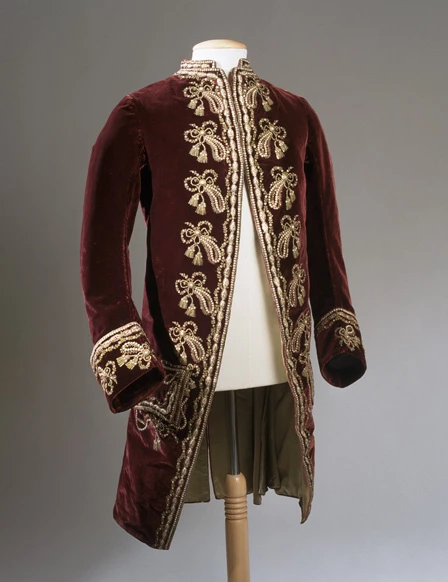
Velvet coat embroidered with silks and gold sequins.

Velvet coat embroidered with silks and gold sequins.

One of the most important piece of 18th century men's clothing in Amgueddfa Cymru's collections is a velvet suit dating from 1770. It belonged to Sir Watkin Williams-Wynn of Wynnstay, an extremely rich and well-known patron of the arts. His clothes reflected his lifestyle.

Sir Watkin Williams-Wynn

Sir Watkin Williams-Wynn (1749-1789) of Wynnstay bought elaborate velvet suits in France and Italy while making the Grand Tour in 1768-9. During the 1770s he bought clothes from many London tailors, hosiers and lace-makers, spending around £1,000 a year on suits alone - a huge sum at the time.

Gold sequins and silver thread

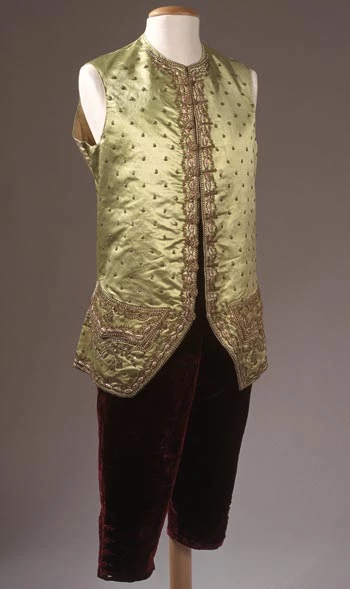
The plum-coloured velvet coat is embroidered with silks and gold sequins. The matching waistcoat and breeches were made at a slightly later date. The Museum also bought a fine red wool coat of similar date, decorated with silver thread embroidery.

Sir Watkin put on a considerable amount of weight as he grew older, and perhaps this is why the suit survived in such excellent condition.

Lavish embroidery

The suit coat has a cutaway front and short stand-up collar. It is lined with green silk satin to match the fabric of the waistcoat. The waistcoat has green silk satin fronts and a paler silk plain weave lining and back. Like the suit, the embroidery is of gold purl, metal sequins and floral ribbon. The work is very fine.

The suit was probably produced in a London tailor's workshop. This would have employed the best craftsmen, with a number of professional, male, embroiderers.

It is very likely that the red wool coat was made in the same workshop, as the embroidery also consists of gold and silver sequins and metal purl and silk threads, with similar motifs of bows, swags and tassels.

Grand clothes for grand occasions

Matching waistcoat and breeches

Matching waistcoat and breeches

These clothes were so expensive that they could have been worn at the royal court. In Wales, Sir Watkin could have worn such clothes at his coming of age party in 1770. This was legendary in its lavishness and size, with 15,000 guests and three coaches of cooks sent from London. A hall was built especially for the occasion, later incorporated into the main building at Wynnstay, with bedrooms added on above. The food eaten at the party included some 30 cows, 50 pigs, 50 calves, 80 sheep, 18 lambs, 37 turkeys and 421 pounds of salmon. This could help explain Sir Watkin's later size! Five years later, in 1735, King George III appointed Sir Watkin to be Lord Lieutenant (the King's representative) for Merioneth.

The Edwinsford Sofa - spectacular embroidery spends a month in deep freeze

19 February 2007

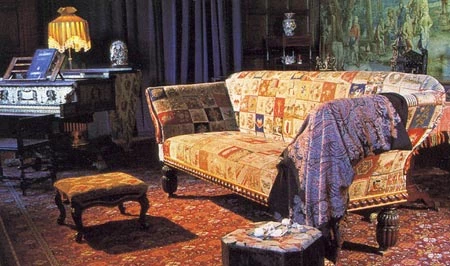
In 1998 Amgueddfa Cymru purchased furniture from the Edwinsford estate, near Talley, Llandeilo. The largest and most spectacular piece is a unique embroidered sofa from 1845. Conserving this proved to be a fascinating and challenging project, included dismantling, rebuilding and even freezing the object for a month.

The sofa contains several individually embroidered squares of wool and silk decorated with metal threads and beads, illustrating original Berlin wool-work designs. The squares form four separate panels along with carved wooden mouldings around the lower edge and carved scroll panels over the arm fronts.

Conserving the sofa

The Edwinsford sofa - The reverse side of the back panel before removal of the labels and cleaning.

The reverse side of the back panel before removal of the labels and cleaning.

At first glace, it was clear that a lot of repair would be needed if the sofa was to be displayed, as it was dirty, worn and shabby. Many seams had ripped and a moth infestation had destroyed much of the delicate embroidery. In order for each panel of canvas-work to be conserved properly, it had to be removed from the framework.

The mouldings were removed easily. However, instead of the usual upholstered technique, the sofa was made up of four individually upholstered sections, covered in the canvas work panels, and then screwed and bolted together. Approximately 300 tacks had to be carefully removed without ripping the canvas work — although they had already made rusty holes in the fabric.

A sofa decorated by guests

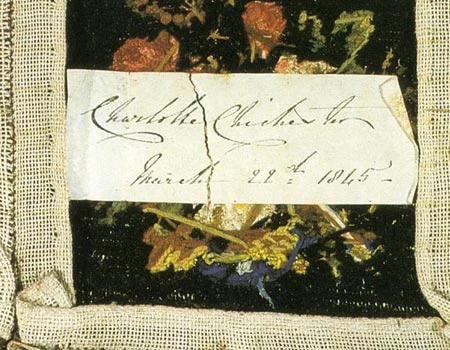
The Edwinsford sofa - One canvas square was dated on the reverse 'Charlotte Chichester March 22nd 1845'

One canvas square was dated on the reverse 'Charlotte Chichester March 22nd 1845'

The dismantling process uncovered a fascinating story. As the tacks were removed, paper labels started to drop out from behind the canvas work, each label bearing a someone's name. The names showed who had embroidered each square. Apparently, visitors to Edwinsford had embroidered the squares, and the sofa was designed to display this work.

After careful documentation of the labels, each canvas-work square was cleaned with washing solutions and solvents according to the dyes present. Each panel was then supported on undyed linen to strengthen the fabric and make the finished sofa more stable. Fine nylon net was applied around the frayed edges.

A month in deep freeze

In case there might be still live moth eggs in the sofa, each section was double-wrapped and sealed in polythene, and then frozen for a month.

Putting the sofa back together

The Edwinsford sofa

Much of the upholstered furniture on display in the withdrawing room of St Fagans Castle comes originally from Edwinsford Estate, Camarthenshire.

A method of re-attaching the cleaned canvas panels had to be found. It was important not to staple directly through the canvas-work, and to limit the number of staples put into the already damaged wooden carcass. It was equally important to be able to remove the panels without damage, should this be necessary in the future.

To achieve this, cotton tape was stapled to the wooden frames along the original tack hole lines. Staples were positioned approximately every 15cm to provide a rigid base to which the panels could be sewn using a curved needle. The inner edges of the arms and back had to be stitched first and then screwed and bolted back in position. The outer edges could then be stitched in place.

After treatment, the remaining sections of the sofa were replaced, using the original screws and nails wherever possible. Treatment of the paper labels will allow future study and display.

The sofa is on display in St Fagans Castle.