: Keeping and caring for collections

Madness not to stay safe around Mercury

Dr Victoria Purewal, 5 November 2013

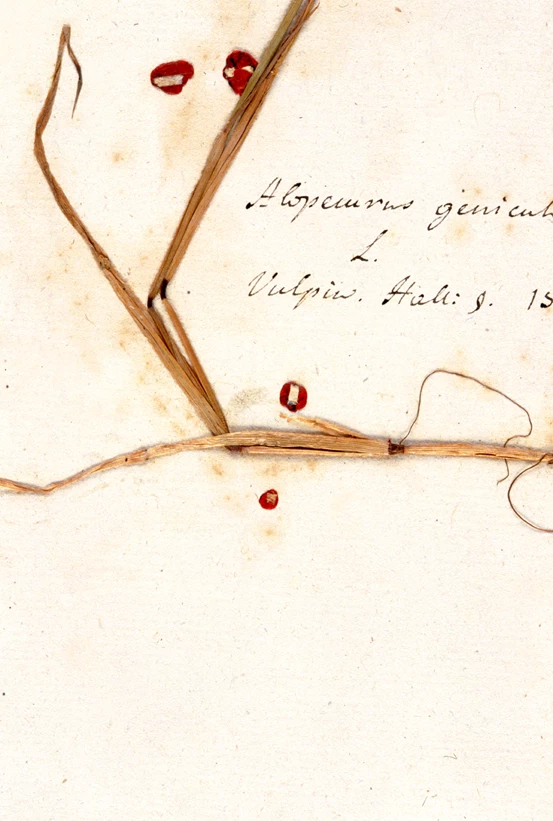
Herbarium specimen sheet from 3rd Earl of Bute’s herbarium c. 1770.

Figure 1 Image of a section of a specimen sheet belonging to the 3rd Earl of Bute’s herbarium c. 1770. The paper sheet is not providing any clues as to whether this sheet has been treated or not. The brown stains are natural breakdown products of the plant.

Herbarium specimen sheet from 3rd Earl of Bute’s herbarium c. 1770. under UV exposure

Figure 2 The same herbarium sheet under UV exposure. The grey discolouration is typical of mercury and the bright splashes are indicative of aqueous mercury applications.

Using a UV scanning device on old herbarium specimen sheets

Figure 3 Using the UV scanning device.

Natural history collections are susceptible to deterioration from pests and moulds and so historically, chemicals have been applied to safeguard these collections for the future. The most common chemical application to botanical specimens was Mercuric chloride (Corrosive sublimate). Mercury has helped to preserve specimens up until the present day, but these treatments leave a legacy - salts of mercury are not only toxic to pests, but also to people.

'Mad as a hatter'

In the 19th century, the felt-hat industry commonly used mercuric nitrate to cure the felt. The wearer and the hat maker were then exposed to mercury which is now known to attack the central nervous system and affect the brain. The unusual behaviour attributed to hat makers, due to the mercury poisoning, gave rise to the term ‘Mad as a hatter’ and probably fuelled Lewis Carroll’s imagination for his ‘mad tea party.’

The main problem encountered with these treatments is that they are hazardous to health but largely imperceptible to the human eye (Fig. 1).

Research conducted at the National Museum Wales department of Conservation, uncovered that some of the 600,000 herbarium specimens housed within the collections were contaminated with mercury. This could pose a potential risk to the health of staff members and visitors to the collections, unless addressed. It was important to be able to establish which sheets had been treated, what the chemical was and how much was present. To do this in the usual way would have involved specialist chemists, expensive analytical equipment and years of work; an expensive and timely process.

Continuing research into this issue by Dr Vicky Purewal, the botanical conservator at the National Museum Wales, uncovered that chemical processes are accelerated by mercury in the ageing papers, providing tiny clues to the presence of mercury. By devising a specific novel technique, these tiny clues can be translated into real information. This technique does not require expensive analytical equipment, all it needs is a simple hand held UV-A lamp. The Ultra violet radiation causes certain chemical processes in the paper to fluoresce a definite colour providing a positive response to the presence of mercury (Fig.2).

This research by the museum has been vital in developing a rapid technique in identifying contaminated collections (Fig.3). It has helped provide information on the historic treatments that the specimen has undergone and as a result helped to safeguard the health of staff members and visitors to the herbarium. As a result the collections can be separated into treated and non-treated material. The contaminated collections can then be handled appropriately and re-mounted removing a large amount of the contamination from the herbarium environment. DNA analysis currently carried out by researchers within the NMW herbarium; also find the UV technique extremely efficient at helping to determine whether the collections have been subjected to mercury applications which may interfere with extraction of genetic information.

The impact of this research is two-fold: on professional conservation and curatorial practice; and on the health and safety of the collection users when working within the herbarium. Key institutions such as the Royal Botanic Gardens, Kew, the Natural History Museum, London and the Royal College of Physicians are just a few of the other organisations that have benefitted from this simple and rapid identification tool developed by Vicky Purewal at the National Museum Wales.
The fabulous mineral collection of Lady Henrietta Antonia Clive, Countess of Powis.

Tom Cotterell, 31 January 2012

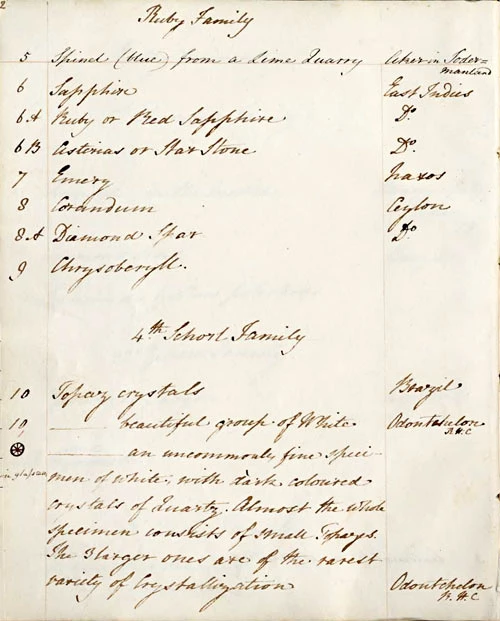
<em>Catalogue of Metallic Minerals in the Possession of the Countess of Powis</em> Vol II, 1817: The original collection catalogues.
Catalogue of Metallic Minerals in the Possession of the Countess of Powis

Vol II, 1817: The original collection catalogues.

Catalogue page from Vol. 1. <em>Earthy Minerals</em>.

Catalogue page from Vol. 1. Earthy Minerals.

Olivenite on quartz from Cornwall, given to Henrietta by the Countess of Aylesford. Specimen 9 cm long. NMW 29.311.GR.80.

Olivenite on quartz from Cornwall, given to Henrietta by the Countess of Aylesford. Specimen 9 cm long. NMW 29.311.GR.80.

One of the most important historic mineral collections at Amgueddfa Cymru was formed in the early nineteenth century. Assembled by Lady Henrietta Antonia Clive (1758-1830), Countess of Powis, and donated to the museum by the 4th Earl of Powis in 1929, the collection of minerals is one of the earliest mineral collections with links to Wales.

Lady Henrietta, Countess of Powis

Lady Henrietta was born into a titled and landed family, the Herberts, descended from the Earls of Pembroke of the fifteenth century. Her father, Henry Arthur Herbert (c.1703-1772), 1st Earl of Powis, owned large estates in Shropshire and Mid-Wales as well as property in London. Henrietta was born at their principal residence, Oakly Park, at Bromfield, near Ludlow, but following its sale to Lord Robert Clive (Clive of India), in 1771, she spent her formative teenage years at the Herbert’s ancestral home, Powis Castle.

Clive of India

Henrietta married the late Lord Clive's eldest son and heir, Edward, in 1784, in a marriage that was mutually beneficial - the Herbert family had accrued significant debts, but their name was prestigious, while the Clive family had become enormously wealthy through Lord Robert Clive's military campaigns in India. Henrietta and Edward lived at Walcot Hall near Bishop’s Castle, where they had four children, Edward, Henrietta Antonia, Charlotte Florentia and Robert Henry.

Edward Clive became Governor of Madras at the end of the eighteenth century and while Henrietta was in India she began assembling a collection of rocks and minerals. Later she purchased and exchanged minerals with prominent collectors and mineral dealers of the time including, James Sowerby, Dr John MacCulloch and the Countess of Aylesford. She also recorded many specimens having been given to her by her children.

Earthy and metallic minerals

Henrietta's collection is typical of the style of collections dating from the early nineteenth century, with the minerals arranged systematically by chemistry. Henrietta organised her collection into two handwritten catalogues: Volume 1 - Earthy Minerals and Volume 2 - Metallic Minerals. She used a numbering system to identify each specimen, with small numbered labels affixed to the specimens. Although many of these labels have long since fallen off, her detailed catalogue entries have allowed many of her specimens to be matched up with their correct number.

Henrietta's collection comprised over one thousand specimens. Of these, several hundred samples have been identified in the museum collection. Despite the missing specimens, considering its age, Henrietta's collection is remarkably complete. It is now considered to be one of the most important historic mineral collections at Amgueddfa Cymru.

William Goscombe John (1860-1952)

Oliver Fairclough, 10 December 2011

Morpheus
Morpheus

Sir William Goscombe John (1860 - 1952)

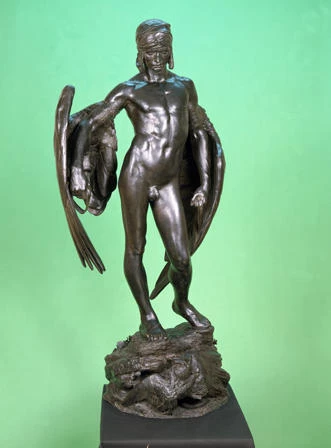
Icarus
Icarus

Sir Alfred Gilbert (1854 - 1934)

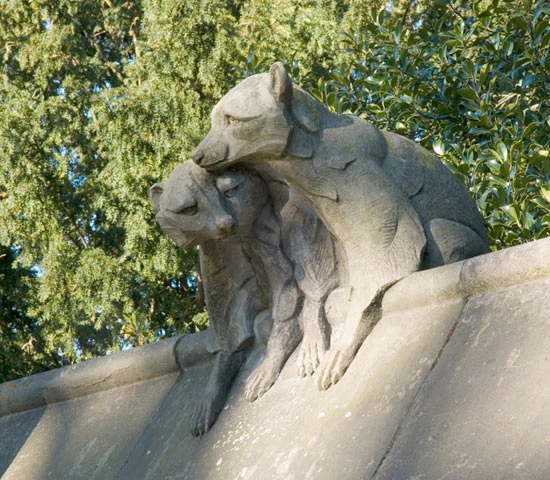
Cardiff Castle's Animal Wall

In 1881, William Goscombe John assisted in creating the sculptures for Cardiff Castle's Animal Wall

Edwardian Wales, newly wealthy from coal, iron and steel, provided rich opportunities for a sculptor. William Goscombe John's public monuments can be found all over Wales, but nowhere more than in his native Cardiff. He also modelled the prize medals still awarded by the National Eisteddfod today.

Making his way

He was born William John in Cardiff in March 1860. He assumed the name Goscombe from a Gloucestershire village near his mother's old home. His father Thomas John was a woodcarver in the workshops set up by Lord Bute for the restoration of Cardiff Castle. William joined his father at the age of 14, while also studying drawing at Cardiff School of Art.

In 1881 he went to London as a pupil assistant to Thomas Nicholls, the sculptor responsible for the Castle's Animal Wall. He continued his studies at the Kennington School of Art and, from 1884, at the Royal Academy Schools, where he was taught naturalistic modelling in clay in the French manner introduced in London in the 1870s by Jules Dalou.

He was an outstanding student, and travelled widely. He spent a year in Paris, including a period in Rodin's studio. In 1890 he returned to London and settled in St John's Wood.

His sculpture Morpheus, shown in the Paris Salon of 1892, clearly shows Rodin's influence.

The 'New Sculpture'

British sculptors of John's generation were trying to make sculpture more dynamic through the vigorously naturalistic representation of the human body. They represent the final flowering of a sculptural tradition that had its roots in the Renaissance, and was revitalised by Rodin and his contemporaries in mid nineteenth-century France. John followed the success of Morpheus with a statue of John the Baptist for Lord Bute, and by a group of life-size nudes including Boy at Play and The Elf. These show complete mastery of anatomical form.

By the end of the 1890s Goscombe John had firmly established himself, exhibiting his work both nationally and internationally. He was beginning to win big public commissions and in the years leading up to the First World War he was extremely busy.

Wales and the Empire

Although based in London, John was careful to position himself as Wales's national sculptor. In 1916 he contributed the central marble figure St David Blessing the People to a group of ten figures made for Cardiff City Hall. He also received commissions for portraits from the leading Welshmen of the day. John may have built his career on local patronage, but he attracted work from across the Empire, such as his tomb in Westminster Abbey to Conservative Prime Minister Lord Salisbury, and his equestrian statue of King Edward VII in Capetown.

His first major public sculpture was the King's Regiment memorial (1905) in the centre of Liverpool, incorporating soldiers from the regiment's history, including the vast Drummer Boy, which is his best-known work.

The Welsh and the Imperial came together in the commission for the regalia for the investiture of the future Edward VIII as Prince of Wales at Caernarfon Castle in 1911. John designed a crown, a ring, a sceptre and a sword that contained a 'Welsh' iconography of dragons, daffodils and Celtic interlace.

John had little sympathy with what he termed the 'Easter Island' style of modern sculpture, with its emphasis on direct carving in stone. Critical opinion was already beginning to leave him behind by 1914, but the First World War tragically brought new commissions for memorials, including many in Wales.

Goscombe John and the National Museum

Goscombe John was one of the founding fathers of Amgueddfa Cymru. He served on the governing Council for over forty years, and played a major role in establishing the future direction of the art collection. As well as a complete representation of his own work, his gifts to the Museum included work by many of his fellows in the New Sculpture movement, among them the primary cast of Alfred Gilbert's Icarus, and by many other artists he admired.

William James Tatem, 1st Baron Glanely (1868-1942)

David Jenkins, 30 November 2011

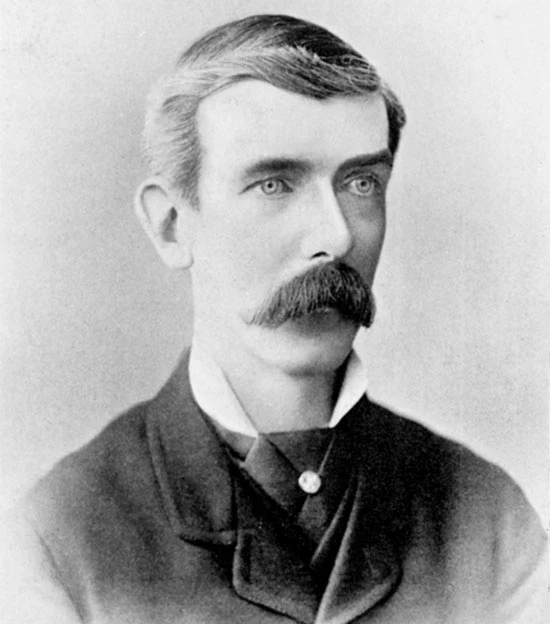
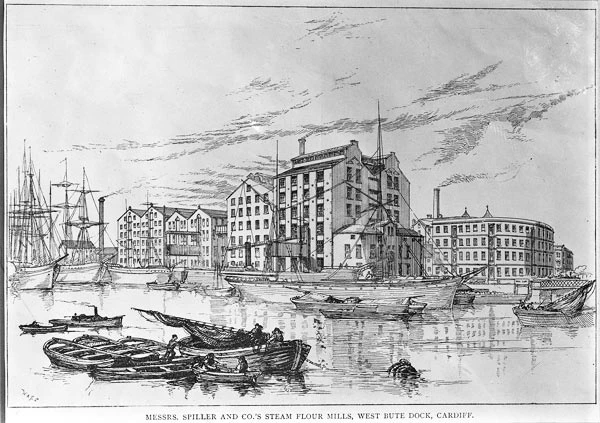
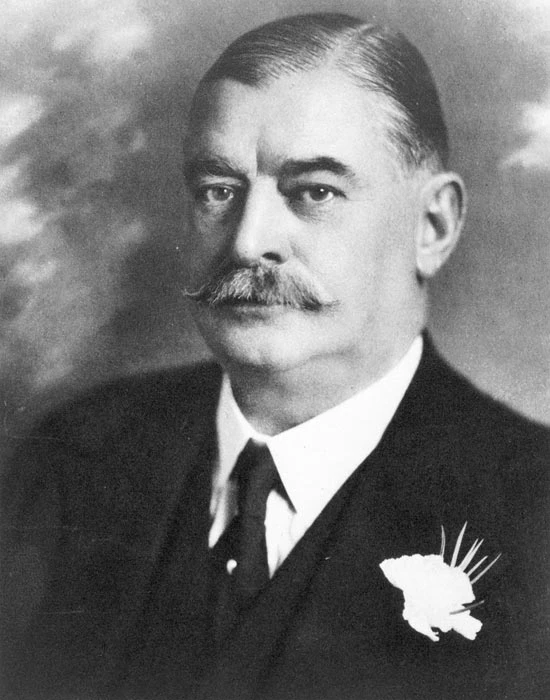
William James Tatem, 1st Baron Glanely of St Fagans.

William James Tatem, 1st Baron Glanely of St Fagans.

Lord Glanely is probably best remembered today as a noted racehorse owner, whose horses won all five Classic races of the British turf. However, he made his money in shipping, and was generous in his support of numerous worthy causes in south Wales, particularly Amgueddfa Cymru and Cardiff University.

Tatem was not Welsh at all; he was born at Appledore in north Devon in 1868, and the early death of his father Thomas led his mother to move her family to Cardiff when Tatem was eighteen. He joined the shipping company Anning Brothers as a clerk and became thoroughly familiar with all aspects of the shipping business. Armed with this knowledge he ventured into shipping on his own account in 1897, and the master of one of his first ships was a fellow-native of Appledore, William Reardon Smith.

A substantial fleet

By 1914 Tatem had built up a substantial fleet of sixteen ships. He was knighted in 1916 and in 1918 was elevated to the peerage, taking the title Baron Glanely of St Fagans. A perceptive and far-sighted shipowner, he sold off his entire fleet for a vast sum at the height of the post-First World War boom in 1919, only to re-enter shipowning with the purchase of six new ships, obtained at bargain prices, a few years later. This enabled him to survive the depression years far better than many of his contemporaries.

Exning, Lord Glanely's palatial Newmarket house.

Exning, Lord Glanely's palatial Newmarket house.

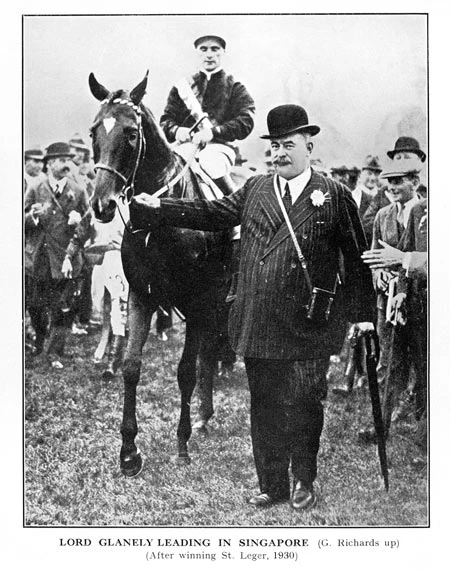
Lord Glanely leads in <em>Singapore</em>, victorious in the 1930 St Leger; the jockey was Gordon Richards

Lord Glanely leads in Singapore, victorious in the 1930 St Leger; the jockey was Gordon Richards

'Sporting Bill'

His horse-racing interests expanded considerably after the First World War. In 1919-20 he bought the fine house Exning in Newmarket, together with the nearby Lagrange stables. His first major win came at Royal Ascot in 1919 when his Grand Parade won the Derby. This win caused some controversy, as he had another horse running in the same race, the favourite, Dominion. At the finishing post Dominion was far down the field, while Grand Parade came home first at 33:1 — and all of Glanely's money was on the latter horse! He was a familiar figure at all the major race meetings and was popularly known as "sporting Bill".

Philanthropy and charitable causes

He was generous in his financial support of the National Museum, and this is recalled by the Glanely gallery in National Museum Cardiff. He was twice president of the University College of South Wales and Monmouthshire, in 1920-25 and 1934-42, where he had funded the construction of new scientific laboratories.

During the Spanish Civil War he employed two of his own ships to transport a large number of Basque refugees to south Wales, and he also endowed a charity to support them thereafter.

Despite his success in so many endeavours, personal happiness eluded him. His only son Shandon died aged just six in 1905, and Lady Glanely died following injuries sustained in a car accident in 1930. He was killed in an air-raid on Weston-Super-Mare on 24 June 1942.