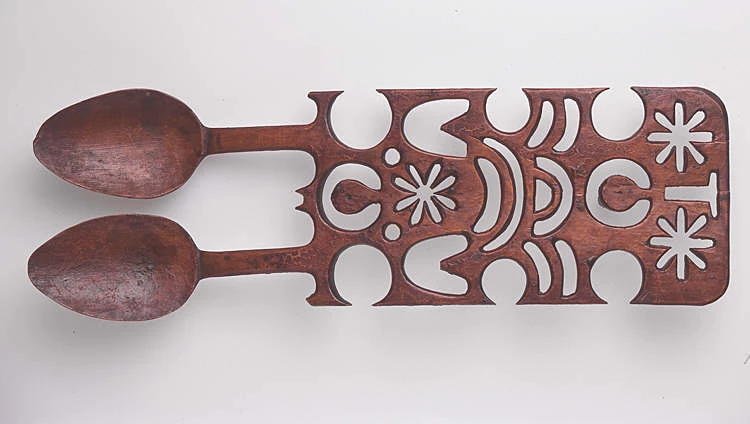
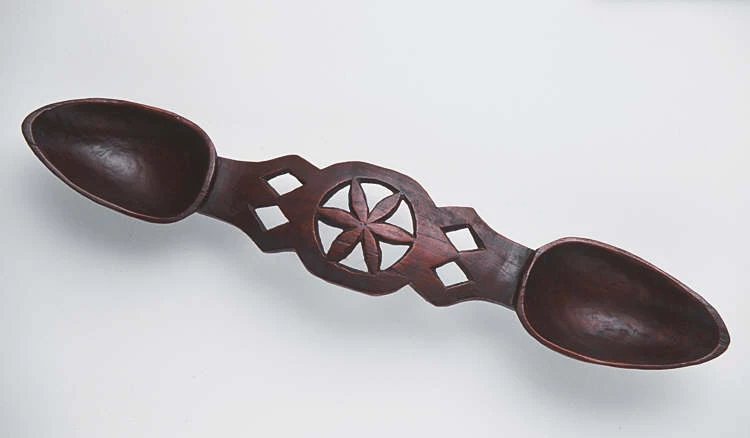
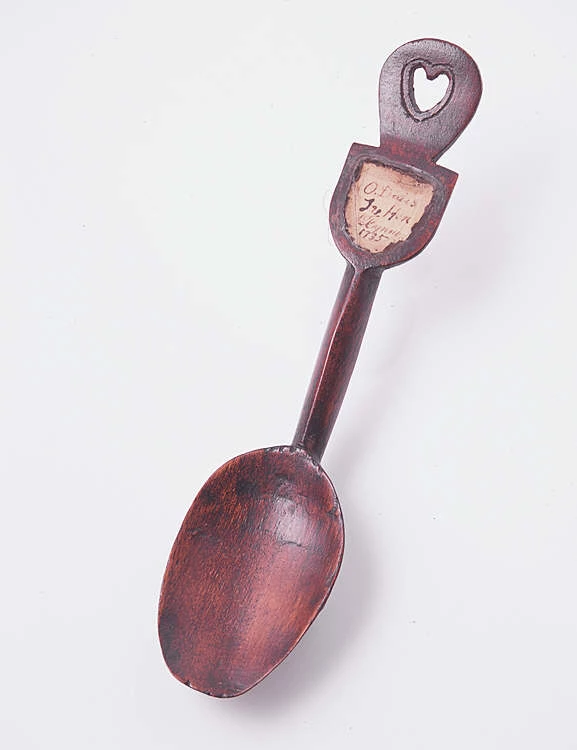
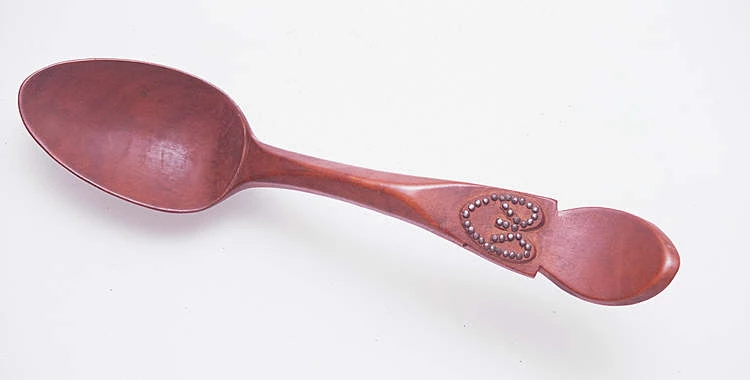
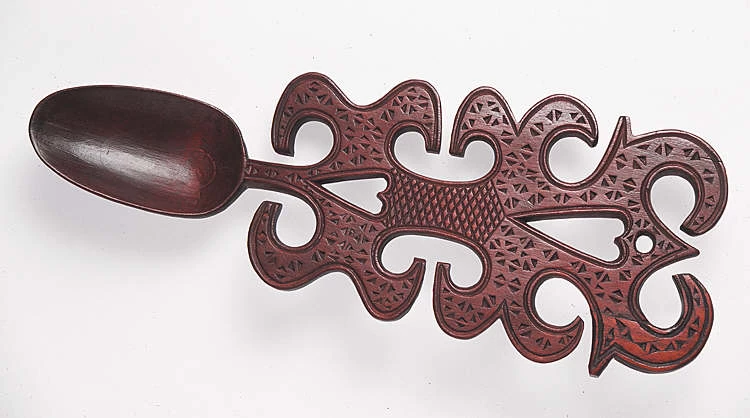
Although the exact origins of lovespoon-making in Wales are unclear, we know that such spoons would have been shaped with great care and devotion by their carvers. Lovespoons were given as a token of love and affection and each spoon was unique.
The lovespoon collection at Amgueddfa Cymru contains beautifully ornamented examples both historical and modern. It conveys the changing nature of the art through time and encompasses a wide variety of styles and designs all carefully handcrafted to the highest quality.
Presenting a decoratively carved spoon to a loved one as a token of affection has long been popular in Wales. From the Museum's oldest dated spoon of 1667 to contemporary examples by renowned present-day carvers, the calibre of the spoons is testimony to the makers' skill and devotion in creating objects intended to be treasured by their recipients.
Young men traditionally made a lovespoon from a single piece of wood, as a love token for their sweethearts.
Romantic gifts to maidens
Despite the lack of historical sources, it is generally believed that lovespoons were formerly crafted by male suitors and then presented as romantic gifts to the maidens they admired. The eighteenth- and nineteenth- century examples which form the basis of the Museums collection were driven by the emotion and passion of carvers who sought to produce works of art worthy of their beloveds.
The simplest of tools, such as small pocket knives, were traditionally used to to create the spoons, if possible, from a single piece of wood. Close-grain woods, such as sycamore, box and fruit woods were particularly popular.
Although the popularity of lovespoons has fluctuated over time, lovespoon carving has survived intact and continues thanks to a new breed of craftsmen determined to preserve the art.
Traditionally, lovespoons were given as romantic gifts, but today they are frequently given as gifts to commemorate events such as weddings, birthdays, anniversaries and christenings. Their function has significantly altered over time - particularly from the mid-twentieth century onwards when the fashion for mass-produced examples became increasingly prominent.
What do love spoons mean?
The symbolism on the spoons has also changed in recent years, with the introduction of Celtic and national emblems, such as daffodils and dragons, a means of expressing Welsh identity. This contrasts with the previously romantic sentiment, such as hearts, diamonds and wheel motifs.
Lovespoons continue to represent an expression of one's thoughts and emotions and carvers remain who honour the folk origins, either by creating spoons on commission or as presents for their family and friends.
Lovespoon carving is an ever-evolving craft and one which is sure to continue to delight and inspire for many generations to come.
Judging by the exquisite array of designs in the Museums collections, carvers have always felt free to decorate their lovespoons as they saw fit. Although each spoon is unique and often features initials or dates personal to the recipient, over time a series of symbols were employed to depict romantic thoughts and feelings. Such symbolism can, of course, be interpreted in many ways, and we can only imagine the true emotions of the carver as he prepared the spoon.
Hearts
The heart is the universal symbol of love and is frequently seen on Welsh lovespoons. It is a sign of passion and strong emotion - surely signifying the carver's depth of feeling for his beloved. A lovespoon showing twin hearts might well indicate a mutual love between sender and recipient.
Double bowls
Occasionally, lovespoons are carved with two or more bowls, possibly to indicate the union of the souls when joined together, or perhaps the number of children desired.
Comma or paisley shape
Often visible on historic Welsh lovespoons, this shape is said to represent the soul and deep affection.
Balls in cage
Balls carved within cages are commonly thought to represent the number of children desired by the carver, but could equally be a sign of a man held captive by his love.
Chain links
Generally considered to indicate loyalty and faithfulness, chain links might also symbolise a couple bound together in their love and loyalty.
Diamonds
Diamonds are believed to represent a wish for prosperity and good fortune and a promise to provide well for a loved one.
Keys and keyholes
In addition to the house images that sometimes appear on Welsh lovespoons appearing to represent domestic contentment, key and keyhole carvings are also used frequently, perhaps symbolizing security or, more romantically, the key to one's heart.
Wheel
Wheel symbols often feature in Welsh lovespoons and are said to represent a vow by the carver to work hard and to guide a loved one through life.
Try your hand at designing your very own virtual lovespoon to send to a loved one.
Image Gallery: Welsh Lovespoons
Lovespoon, with heart-shaped opening on handle
Lovespoon, with panel handle and geometrical designs
Lovespoon, inscribed 'MI 1721'
Lovespoon, with hearts and other geometrical designs
Lovespoon, with panel handle and covered with chip-carving
Two heavy lovespoons hanging from two-looped panel
Lovespoon, with panel handle and two bowls
Lovespoon, with bowl at each end
Lovespoon, dated 1735
Lovespoon with narrow panel handle with the name 'John' in fretwork
Lovespoon, with handle carved to depict serpent and bird
Lovespoon with ridged stem and curved terminal
Inscribed wooden fork, 19th century
Lovespoon, with chip-carved handle fretted with various designs
Lovespoon, with fretted heart devices and chip-carving
Take a look at our online shop for the perfect St Dwynwen's day gift
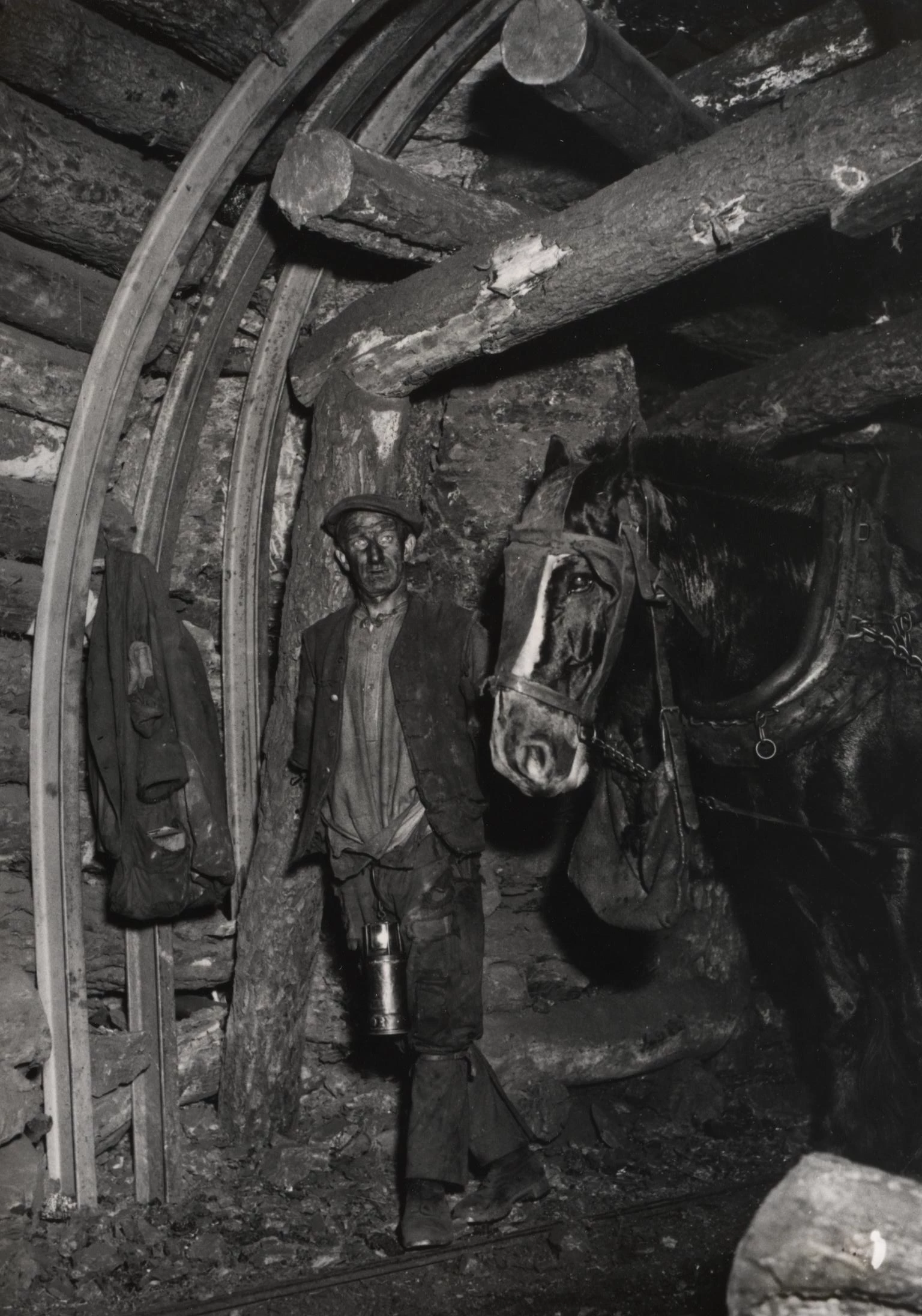
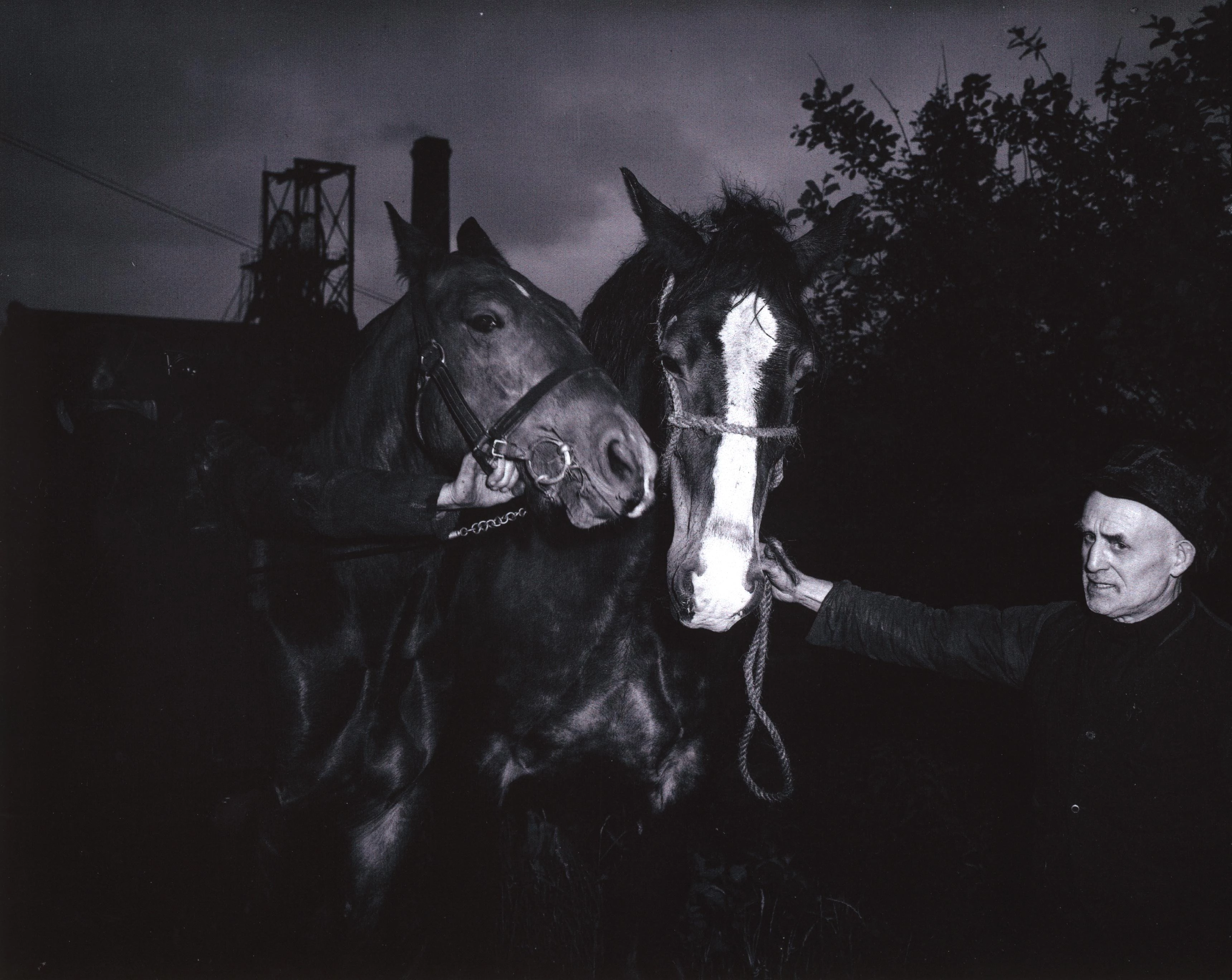
Horses have been closely connected with coal mining since the early days of the industry. They have been used to transport coal from the collieries to the customer, have been used to power winding and pumping engines and, most importantly to move coal from the coalface to the shaft.
In 1878 the RSPCA calculated that there were over 200,000 horses at work in British mines. The numbers decreased as mechanisation became more common, but they continued to be used throughout the twentieth century. The last Welsh colliery horse was probably Robbie who retired from Pant y Gasseg Mine in 1999.
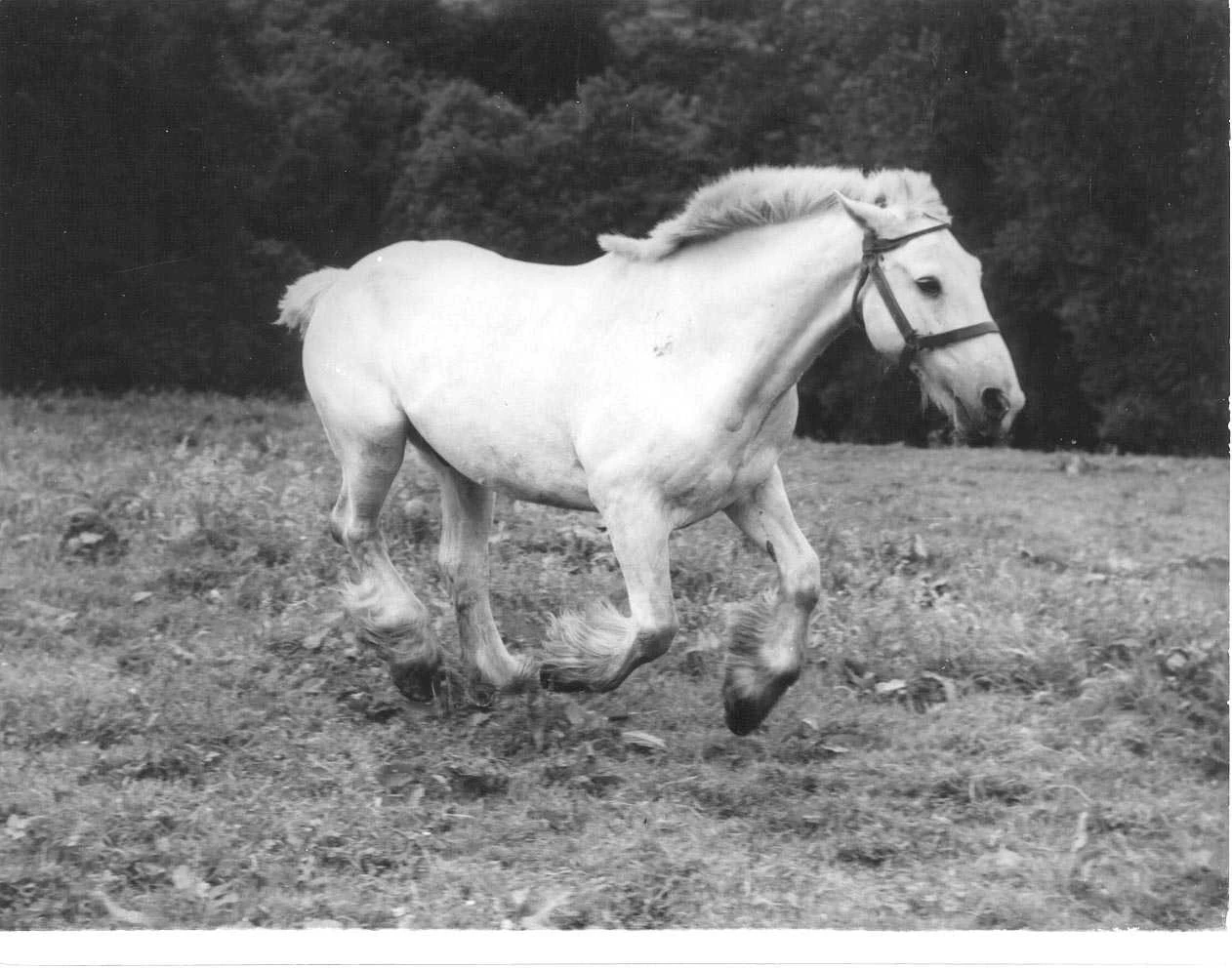
Most commonly known as ‘pit ponies’ by the general public but Welsh colliery horses were usually around 15 hands high – the same size as Henry VIII’s warhorses. It is often claimed that they went blind, but a blind horse would not have been very useful underground and any animal which did lose its sight was usually brought to the surface as soon as possible.
Although they were essential for the production of coal before introduction mechanised haulage, use horses in industry has often been highly controversial. The owners argued that vital economic process winning while animal lovers regarded their as inhuman.
In between these opposing sides were the mineworkers, who may have felt sympathy for these animals. However, they could turn a blind eye to any callousness, or even be cruel themselves, if their pay packets were under threat.
Welsh colliery horses were usually around 15 hands high and males, mostly geldings but some stallions were kept. The majority were of the Welsh Cob type but larger horses such as Shires and imported Belgian horses were also kept, especially on the surface or in main haulage roads. When stocks of horses were low, they could be obtained from as far away as America and Russia. Smaller ponies, around 13 hands, were sometimes used for light haulage duties.
They had to be at least 4 years old before being accepted into colliery work. In 1893, the average life expectancy of a horse was between eight and nine years, with around 6% killed in accidents. By 1950s this risen ten fifteen although there were some on ‘light jobs’ still employment over twenty age.
By the 1930s, most horses worked between forty-five and sixty hours a week. After 1949 the maximum working hours were to be not more than forty-eight hours, and no more than seven shifts, per week. They were also entitled to the same twenty-minute break as the men.
In 1938, colliers were entitled to an annual week’s paid holiday and the horses were usually allowed above ground as well. By 1948 both the colliers and horses got a two-week annual holiday.
By 1878, the RSPCA estimated that there were around 200,000 horses working in British mines. By 1913 this had decreased to 70,000, because of improved mechanical haulage methods. In 1930 it was reported that 25 Welsh collieries had no horses at all. In 1947 there were some 8,000 Welsh colliery horses, by 1967 there were only 417. By the 1980s National Coal Board horses were being retired but, in smaller, ‘private mines’ horses were in use for a few years to come.
The last Welsh colliery horses, ‘Gremlin’ and ‘Robbie’ retired from Pant y Gasseg (‘Horses’ Hollow’) Mine, Pontypool, in 1999. They were sent to a RSPCA rest home in Milton Keynes, but Robbie found that boring and was loaned to the National Coal Mining Museum for England in Wakefield where he pulled light tubs of visitors around the site. Robbie died on the 27th April 2009, probably the last working Welsh colliery horse.
For many visitors to Big Pit, the most memorable parts are the underground and surface stables, still bearing the names of the horses that worked there. By the start of the 20th century, there were around 300 horses working in Blaenafon coal mines with 72 working in Big Pit alone.
The last underground horse at Big Pit was brought up in 1972, but two horses continued to work on the surface until 1974.
Whether he was a ‘willing pet’ or ‘wretched pit pony’ the colliery horse shared the same conditions and dangers as the coalminer. They died in their hundreds from mistreatment, accident and explosion. We owe them a great deal, including the success of the industrial revolution.
Miniature hats from 1860’s by Welsh hatter, John Evans. The Welsh Hat is in middle row, centre.
Hats are often political. Though it would be understandable for someone to assume that they are made to protect someone from inclement weather, it does not take a lot of thought to see that they are often much more. From a red ‘Make America Great Again’baseball cap, to the bonnet rouge of the French Revolution, to any number of military hats, hats are regularly used to indicate which side you are on. Hats, along with all fashion, are used in a huge variety of ways to communicate with others and can tell us a variety of information: nationality, gender, interests, and identity. The hat specifically is often associated with group identity; in a crowd of people the hat can be a key identifier and if worn collectively can create a striking vision. The Welsh Hat does just this, its tall black crown and stiff brim, traditionally worn by Welsh woman creates a distinct and eye-catching look that has long been used as a symbol of Welshness.
Before The Welsh Hat
There is a prevailing myth that the Welsh hat and national costume was a Victorian invention, as part of imagined Welsh heritage and yet there are plenty of accounts going back a century earlier that tell us otherwise. The Victorians may have curated a specific version of Welsh dress and cemented the idea of it as ‘Welsh National Costume’ but the clothes themselves, including the hat, had indeed been around for much longer.
Before the Welsh Hat was Welsh, it was just a hat. High crowned styled hats made of felt or beaver fur were once popular across many countries. Men and woman across Britain in the latter half of the Elizabethan period, wore such hats for travelling and riding, and a wider brimmed version of the hat, ‘cavalier style’, was then adopted by the middle class in the mid-part of the 17th century. At this time hats were an important status symbol. Beaver fur was the quality material used to felt hats, but felting the fur was difficult and costly and from 1670, the product was often imported from America. Samuel Pepys notes in his diary, in 1661, that a beaver hat had cost him 45 shillings. From around 1640 to 1660 a version of the beaver hat with a tall, tapered crown known as a ‘sugarloaf’ became popular and looked very similar to what we would think of as the Welsh hat today. Today hats of this style are heavily associated with the Puritans and pilgrims to America, for its simple, unadorned design. Thus, even 400 years ago, the hat was steeped in meaning, from wealth and class, to political and religious leanings.
Us and Them
While the black Sugarloaf hat, along with other features that we today associate with Welsh National costume, were common across Europe and America in the 17th century, it is in the 18th century that we see a divergence in style. While elsewhere fashion trends moved on, these older looks appear to be retained by the Welsh peasantry. As fashion changed rapidly in the later half of the 18th century, this rejection of the new styles (be it intentional or through financial necessity) resulted in a notable difference in dress by the Welsh lower classes, from their English counterparts. This is documented through numerous accounts of English travellers that commented on the difference in clothing between the English and Welsh, among which are descriptions of a tall black hat worn by women.
Painting by Julius Caesar Ibbetson, Newcastle Emlyn Costumes, 1792
Julius Caesar Ibbetson was an English painter who created a number of works depicting scenes of Welsh life at the end of the 18th century. Through these works, a distinct image of Welsh working-class women can be seen. The paintings depict an attire which is different from what was fashionable dress throughout Europe during the 1790s, and almost all the works include women wearing what we can think of as an early variation of the Welsh hat.
In the work Newcastle Emlyn Costumes from 1792, all 14 women from the scene, as well as 2 children, are depicted wearing almost identical, black brimmed hats. While the hats may be shorter and less rigid from what we think of today as the Welsh hat, there is still a clear resemblance in style. In the inscription beneath the watercolour, Ibbetson writes “peculiar drefs and costume of the peasantry, in the district around Newcastle Emlyn in Pembrokeshire.” Here the English painter highlights that to him, the dress of women in Wales is distinctly different “peculiar” from English standards of dress. These outfits also have clear similarities to what one would think of as the Welsh national costume today, with their striped and checked patterns, and their shawls and aprons. In addition to its distinctive look, what is remarkable is the hats uniformity across all the wearers. At this time there was a large variety of styles in hats, bonnets, caps, turbans, hair accessories, wigs and hair styles and a huge choice in frippery to be added including flowers, ribbons and feathers. However in the works of Ibbetson, we see a singular black and unadorned style.
The striking uniformity of the Welsh dress was not lost on the Welsh, rather it became a strategic symbol of collective power. Famously it is even said to have helped defeat invading military powers. In 1797, French warships descended on Pembrokeshire in what is known as the Battle of Fishguard. Numerous reports document how hundreds of Welsh women in red shawls and black beaver hats, flanked the coastline behind the British military; creating the illusion from afar that they too were soldiers, and so leading to the unconditional surrender of the invading force. Thus the Welsh national dress as a symbol of strength and unity, and part of proud Welsh heritage, was embedded into the nation’s history.
National Costume
1931 Postcard reproductions of "Dull-wisgoedd Cymru/Cambrian Costumes" by Lady Llanover in 1834 (cropped)
Over the course of the 19th century, the Welsh hat along with the rest of the Welsh dress, would shift into an even more defined style. Previously, the Welsh hat was by no means the only hat being worn, partially as they were more expensive than other felt or straw hats.There were also many local variations on the Welsh hat; the tall hat was popular in larger towns such as Cardiff, Bangor and Carmarthen, while lower, flat-topped straw hats were popular in the Gower, as they allowed woman to carry cockle-baskets on their head and were better suited to the windy climate. But over the century, the hat would be consolidated into the more singular, standardised and uniform look that we think of today as the Welsh hat.
Lady Llanover (1802 to 1896) was the influential philanthropist who greatly influenced the uptake of traditional Welsh dress and worked tirelessly to promote Welsh language and culture. She wrote extensively on the matters of Welsh costume, as well as producing a series of illustrations on the subject and it is from her that we get the tradition of wearing the national costume on St David’s Day. While Lady Llanover certainly did not invent the Welsh national dress, she worked hard to bring it from the confines of the working class, into upper class society, even so far as to insist that guests to her parties were to wear the national costume.
In 1832 the then Princess Victoria (not yet queen) and her mother visited North Wales and on their carriage ride wore Welsh hats, when passing through Bangor ‘in compliment to the fair maids of Cambria'. Thus by this point we can see the complete transition from the traditional working wear of the peasantry, to the fashionable National costume for all classes. It is in that century then, that the hat and national dress becomes smart formal wear. Women chose to wear their best costume when selling their goods at market, as well as on Sunday to Church and Chapel. Throughout the 19th century, manyEisteddfod competitions would even have a prize for best Welsh hat. In this century, the Welsh hat has become a point of national pride. The 19th century writer, Marie Trevelyan, writes in an account of West Wales in 1893,“There the tall beaver hat is still worn by some of the prettiest and most handsome woman of the principality. Very spick and span these woman look”.
It is hard to pinpoint when the Welsh hat fell out of authentic regular use, due to the tremendous popularity of the image of the ‘Welsh Lady’. By the mid 19th and 20th century there was a transition from genuine regular attire, to a costume of Welshness for public events and in the tourism trade. The Image of Welsh National Dress became a prolific theme in postcards, souvenirs, and tourism in the Welsh seaside towns. Thus people continued to wear the Welsh Hat but its meaning had once again shifted.
A Hat For Everyone
Throughout the centuries, the use of the Welsh hat, like a swinging pendulum, shifted backwards and forwards in style from peasantry to royalty. Class was not the only cultural boundary that the hat crossed. The hat has also defied the boundaries of gendered clothing. During the 17th and 18th century, this style of hat was largely considered to be a man’s hat, socially acceptable for women only in the context of riding and traveling (acts which themselves were often seen as male activities) and yet in Wales, this binary was seemingly being ignored. In the 18th century, there were many English accounts of Welsh women described dressing in a ‘peculiar’manner, and stating that they wore ‘men’s hats’. Mary Yorke, a traveler to Wales in 1774, attended a service at St David’s Cathedral and noted seeing an old woman with a “kerchief over her head and a hat like a man’s”. Despite this, during the following 19th and 20th century, the Welsh hat had become an item strongly associated with Welsh womanhood.
Despite the Welsh hats’ tradition as a piece of Welsh women’s clothing, more and more it is a piece which defies the binary, with contemporary queer artists in particular using the hat in their work as a national symbol, that can be worn by anyone. Thus, the hat that likely originated as a man’s hat in the 17th century, and was subsequently adopted by women, once again alludes a gender binary in its wearers today. And so as the pendulum of fashion swings from one end of the spectrum to the other, so today we see it starting to swing back.
This dynamic relationship between the Welsh, clothing, and gender is nothing new. In the 1800’s, girls who worked in the mines dressed in boys clothing, including trousers, to be able to crawl through the mines. While the infamous Rebecca Riots saw men dressed in women’s clothing in violent protest, and as mentioned previously, Welsh women were mistaken as British military at the Battle of Fishguard. The Hat itself is in many ways is an androgynous item, its smooth black and angular features are much closer to many typical male items of dress such as a suit and top-hat, then much traditional female attire. Its angular features often sit juxtaposed with the frilly and lacy white cap underneath. This is perhaps partly why it makes for such an interesting subject for many queer artists today.
Photograph of performers from the Contemporary Dance group Qwerin. Photograph credited to Sioned Birchall.
In the contemporary dance performance group Qwerin,directed and choreographed by Osian Meilir, performers fuse traditional Welsh folk dance with the energy of the queer nightlife. The performers wear an adapted form of the national dress, complete with exaggeratedly large Welsh hats, which hang over and obscure much of the performers face, leaving them to peer out through cut out holes in the crown of the hat. These costumes, designed by Becky Davies, tell a striking visual story. In a quote from Meilir on the performance they say:
“The hat creates a looming presence, making our appearance sinister and mysterious. The hats, a symbol of Welsh culture, become the very things that restricts us from physically moving forward into more vigorous and joyful dancing. By removing these hats we shed away the years of shame, burden and oppression, cutting ties with social expectations and constrictions. However, reuniting and greeting the hats towards end of the work is an act of acceptance, an acceptance of our own identity. We welcome these hats back into our arms as a symbol of progression, unity, harmony and change; moving together into a new future, a queer Wales.”
In other words, the hat has become a symbol of an old Welsh Culture, but a symbol that rather than being allowed to slip away, can be reinvigorated with the zeitgeist of a new era of Welsh identity.
The Psychology of Hats
The Hat sits in a prominent position on the wearer, it frames the face and is often seen in the peripheries of the wearer’s view. This means they can become powerful tools in the way we view ourselves. The Fashion editor and prolific hat wearer Isabella Blow said on the subject of hats"Fashion is a vampiric thing, it's the hoover on your brain. That's why I wear the hats, to keep everyone away from me.” Blow touches on the sometimes oppressive societal demands of fashion and conformity and how it can play on the mind; as an antidote to this, the hat performs the role of a mental and physical shield. The brimmed hat creates and demands a physical distance between people, while psychologically doing the same, creating a distinct difference between wearer and non-wearer. In essence, a hat has the potential to create a sense of separation and independent identity between the wearer and the other. This may provide some insight into the success of the Welsh hat, like a protective shield, it symbolises the protection of one’s Welsh culture and heritage.
Finally In another quote from Blow, the intrinsic sense of identity associated with the hat is reinforced. “I don't use a hat as a prop, I use it as a part of me. If I am feeling really low, I go and see Philip (Treacy), cover my face, and feel fantastic”. Thus how one dresses effects not just how others view you, but how we view and feel about ourselves. If clothing is an extension of ourselves, then loving the clothing we wear has the potential to help us view ourselves differently. For the Welsh hat it can be a symbol of strength, nationality, and pride. For wearers of the Welsh Hat today, whether it be a St David’s Day celebration, as part of dance costume, at Eisteddfod, or just for fun, allow wearing the Hat to help you feel fantastic and to connect you with 400 years of history and Welsh heritage.
Reference / Further Reading
British Vogue, Isabella Blow, Bibby Sowray.4 November (2011)
Folk life, Welsh Peasant Costume, F. G. Payne. volume II (1964)
Textile history, Welsh peasant dress-workwear or national costume?, Christine Stevens. 33 (I) (2002)
The costume accessories series, Hats, Fiona Clark. (1982)
Welsh Costume, Ken Ethridge. (1958)
Women in Welsh History, Derek Draisey.(2004)
Women's Headdress and Hairstyles in England from A.D.600 to the Present Day, Georgine de Courtais.(1986)
This is the second part of a look at some of Gwen John’s work in the Amgueddfa Cymru collection. Part one looked at how the largest collection of Gwen John works in the world came together as well as an important example of her early painting technique.
From the mid-1910s onwards, we see this technique change quite dramatically. John moves almost exclusively to female portraits and to applying paint much more sparingly, and with no upper layers or varnishes. Brush strokes become visible and compositions are flatter and less smooth. Again, we see John shift with the artistic movements around her as other artists in Europe were working with similar techniques.
John’s portraits are perhaps what she is best known for. There is something intangible about the mood that these works impart; they are highly emotive, yet elusive. What really highlights John’s genius is how complex these compositions are; how technique is the foundation for the feeling that these portraits exude.
A good way of highlighting this is to look at an unfinished work…
The flatness and tonal harmony of John’s portraits has been discussed often – how the sitter and background often blend together so that they appear as the same surface. What is extraordinary about the way that John worked was that she painted from the edges - often with no preparatory sketching. She would start at a corner of the canvas and work inwards, as we can see here with this work. The facial features become almost secondary in the construction of the painting, as they are painted last, or not at all in this case. Any painters out there will appreciate how hard this is to do – the spatial awareness to be able to form a cohesive work by starting at its extremity is extraordinarily difficult. Also, what this does is heighten the sense that background and sitter are the same thing – the figure, and particularly the facial features, are not given any particular importance over the rest of the structure of the painting.
On the reverse of this painting is another work of the same sitter, clothed this time, and nearer completion. You can see that the features are almost the last part of the painting to be worked on.
We’re now going to come back to Girl in a Blue Dress. From 1915 onwards John’s work changed and this is one of the earliest examples of this dry technique. This is an extraordinary painting and is one of the most popular works in the Museum.
Here John applies a chalk and animal glue ground which contains small bubbles made as the warm glue and chalk are stirred together; creating a textured surface to the canvas. This ground layer and the subsequent oil paint layers are both applied very dryly and thinly, with brush marks left visible.
In these details the brown paint layers can be seen to have skipped over the white ground, leaving much of the ground showing through. This gives the work the appearance of a fading fresco and adds to the sense of fragility of the sitter. The paint is applied so dryly and so evenly to both background and sitter, that they appear the same – they blend into one surface.
Looking at the painting in differing lights shows us some more interesting things.
Light shone from the side shows how uneven the canvas is and very different from a smooth, commercially prepared canvas. This is almost certainly deliberate, adding to that sense of texture.
Infra-red light shows a small amount of preparatory sketch work, outlining the basic elements of the composition prior to painting.
We also know that John came back to rework this painting, as shown here under UV light. This shows that she made changes with a white paint containing more zinc, which shows up under UV. Even as reworking, these are still the slightest of touches.
Most extraordinary though is this…
Shining light through the back of the canvas shows just how little paint has been applied. This highlights John’s skill to produce a work so affecting without really using any paint at all, there’s barely anything there.
The Little Interior (1926)
Oil on canvas Bequeathed by Gaynor Cemlyn-Jones, 2003
22.2 x 27.3 cm
This work from 1926 shows the interior of John’s home in the Paris suburbs and was one of the paintings shown at John’s only solo exhibition held during her lifetime. It shows the sparsest use of colour, predominantly subtle tonal differences of the background with a small focal point of the teapot at the centre of the canvas.
After the horrors of the First World War, many artists rejected avant-garde ideas – returning to more traditional approaches to art. Futurism and Vorticism, for example, which celebrated technology and automation prior to the War, were abandoned as those very things were key contributors to the slaughter. Known as the ‘Return to Order’ this saw artists such as Picasso and Braque largely abandon Cubism for more traditional methods. There was a resurgence of classicism, of order and realism in painting. Alicia Foster writes in her biography of Gwen John that her work seen through the prism of the ‘Call to Order’ is complex, but where John’s work chimes with the movement is through the precise measurement and organisation of colour – as we can see here with The Little Interior.
John described using an extremely complicated numbered disc which denoted colour and tone relationships to any other colour and tone. She also developed her own notation system to sketch out and record planned compositions. This ‘code’ has proved incredibly difficult to crack and her notes have a poetic quality that, while beautiful, makes decoding even harder. For example, what colour do you think this is? ‘April faded pansies on the sands at night’
As well as colour notes, Gwen used a numbering system. She made rapid sketches of everything around her – objects in her room, places she went to, people on trains and in church. This numbering along with colour notations were a way for her to remember the tones or colours of the subjects she’d captured in pencil and charcoal.
She then later reworked the images in watercolour, gouache and sometimes oil, experimenting with the composition and colours.
From around 1913, John converted to Catholicism. Her faith would become hugely important to her and described herself as ‘God’s little artist’. From this point, many of her drawings are of people in church – largely shown from the side or the back.
In Figure in Church, the colour of the dress is a thinner wash of the same colour as the hat and the hair colour is a mixture of the background and the hat. This is key to her harmonious use of colour – that everything is blended together. Simplicity does not necessarily mean that something is simple.
With thanks to Amgueddfa Cymru colleagues past and present from whose research this blog post has been based; particularly David Fraser Jenkins, Beth McIntyre, Kate Lowry and Oliver Fairclough. Moreover, Alicia Foster’s short biography, published by Tate, is an excellent overview and reappraisal of important aspects of John’s career.
Gwen John is one of the most important artists of the 20th century. Her work is held in collections worldwide, including Tate, Musée Rodin and the Metropolitan Museum of Art in New York. Fortunately for us, the largest and most important collection of her work is here in Wales at Amgueddfa Cymru. We’re going to take an overview of that collection and pick out a number of key works that can tell us about Gwen John, her technique and why her work resonates so much today.
Gwen John was born in Haverfordwest in 1876, the second of four children and the older sister by 18 months of Augustus John. Both Gwen and Augustus moved to London to study at the Slade School of Art, where she studied from 1895 to 1898. The Slade was one of the first Art Schools to admit female students, so Gwen was part of the first generation of women artists to receive a formal art education.
From the Slade, John moved to France where she was to spend the majority of her life, primarily in and around Paris. There, she studied under James McNeill Whistler; both her education and experiences in Paris had a profound impact on her work as she found herself at the centre of the art world. She supported herself by being an artist’s model, famously for Rodin, with whom she had a passionate affair.
While being visited by her brother Augustus in Paris, he made comment to the great Whistler that Gwen’s work showed good character. Whistler is said to have replied;
“Character? What’s that!? It’s tone that matters. Your sister has a fine sense of tone.”
This quote is our starting point, from which we will look at some of John’s pieces in the collections of Amgueddfa Cymru – the sense of tone, how it developed and how simplicity does not necessarily mean something is simple.
The Amgueddfa Cymru Collection
Gwen John exhibited rarely in her lifetime; holding only one solo show of her work at the New Chenil Galleries in London in 1926. She sold few works, often giving them away as gifts, and most pieces were collected after her death. The American patron John Quinn was a great supporter and did acquire many pieces (39 in total) – which is partly the reason there is good representation of John’s work in the U.S.A. This crucially gave her some financial security to pursue her practice.
National Museum Wales acquired its first Gwen John work in 1935, Girl in a Blue Dress, for £20 after its appearance in an exhibition of Contemporary Welsh Artists at the Deffett Francis Art Gallery in Swansea. On its acquisition, John wrote this short note to the Museum:
Letter from Gwen John to David Kighley Baxandall, Assistant Keeper of Art, 21/11/1935
“I am very happy and honoured that you have bought one of my little paintings for the Museum, and I thank you for your praise and criticism of it. In an article on the exhibition your competent and intuitive appreciation of my brother’s work has given me pleasure. Believe me, yours very sincerely Gwen John”
While Girl in a Blue Dress remains one of the most important paintings in the Museum’s collection, representation of John’s work did not greatly increase during her lifetime nor in the decades after her death. In fact, even in 1959, she is only listed in the Penguin Dictionary of Art & Artists as an appendix to her brother – she does not have an entry of her own.
It was not until 1976 that this picture changed for the collection at Amgueddfa Cymru collection – and it changed dramatically. In that year, the centenary of her birth, the Museum acquired a collection of more than 900 drawings along with sketchbooks and paintings; acquired from Gwen’s nephew Edwin John. The collection comprised the bulk of the material in her studio after her death 40 years earlier and represented almost the entirety of her later-career output.
Suddenly, Wales had the largest collection of Gwen John work in the world.
Technique
Let’s take a look at some of that collection – particularly John’s later work – and see what it can tell us about her technique, its development and to perhaps understand how John employed a deceptively complex method to produce the beguiling work that we know so well today.
A Corner of the Artist’s Room in Paris(1907–9) Oil on canvas 31.2 × 24.8 cm Purchased with the assistance of the Derek Williams Trust and the Estate of Mrs J. Green
John’s oil technique can be divided quite neatly into an early traditional technique and later dry technique. The Museum’s collection has predominately later work, but this is a good example of that earlier style. This painting dates from 1907-09 and depicts John’s small attic apartment in Paris, modestly furnished with a single wicker chair. An open book sits on a small table, itself sitting beneath a half-opened window. The work was acquired by the Museum in 1995 – so a relatively recent acquisition.
Many have read John’s depiction of interiors as a representation of her reclusive lifestyle; and this work, with its sparse furnishings, certainly plays to the thought that the empty interior represents her own solitude. Some have drawn conclusions that this work, painted around the time of the breakdown of her relationship with Rodin, is a portrait of absence. However, Alicia Foster and others have argued that this also places John’s work within the context of her contemporaries in Paris; far from showing a recluse, cut off from the movements of the art world around her, you can see this work as highlighting that John was plugged into what was happening artistically at the time.
In the early 20th century, many artists had turned to The Interior as a subject of study, and Gwen John was no different in this regard. The wicker chair seen here appears in a number of her works from the period; wicker chairs were light, inexpensive and appeared in many artists’ studios and apartments. So much so, that the wicker chair itself became something of a fashionable symbol of an artist’s identity in early 20th century Paris.
Let’s take a closer look at the technique and materials used in this painting; colleagues in Conservation at the Museum have done a great deal of work looking into the structure of some of John’s paintings – and this gives us some very interesting insights into how she worked, and how that changed over time.
A Corner of the Artist’s Room in Paris is one of two versions of this subject, both paintings dating from the same time, with the other work in the collection of Sheffield Museums. At this time Gwen is painting with fluid oil paint built up in layers over a white ground. Brush marks are disguised and the work appears smooth and glossy due to the varnish layer on the top. This is typical of the traditional Old Master technique of painting, and shows John’s formal training. The image on the left is a cross-section through the paint layers and is taken from the left side of the picture, near the top of the chair.
Pictured on the right, the pink layer gives a warm glow to the work, and thinner top layers of paint appear in a number of areas, allowing the pink to show through. This is what gives the work a tangible sense of the late afternoon/early evening – with the lace curtain billowing in the breeze.
In part two we’ll look at John’s later technique and see how much it changed. We’ll also see one of the Museum’s most important paintings in a new light. Lots of new lights actually…
With thanks to Amgueddfa Cymru colleagues past and present from whose research this article has been based; particularly David Fraser Jenkins, Beth McIntyre, Kate Lowry and Oliver Fairclough. Moreover, Alicia Foster’s short biography, published by Tate, is an excellent overview and reappraisal of important aspects of John’s career.