"Here comes the Devil": Welsh Suffrage and the Suffragettes Elen Phillips, 1 February 2018 At precisely 8:00pm, February 6th, 1918, The Representation of the People Act was passed by Royal Assent in Westminster. After decades of campaigning, some women were now allowed to vote. The Equal Franchise Act, passed in 1928, gave all women over 21 the right to vote. We're used to seeing photos of 'Suffragettes' protesting in London, but what about the campaign in Wales? Non-Violent Protest Even though the press at the time concentrated on the trials and tribulations of the Suffragettes, there were far more Suffragists in Wales. Suffragists believed in peaceful action, and changing things through constitutional means. Among them were members of the Cardiff District Women's Suffrage Society - the largest branch of the National Union of Women's Suffrage Societies outside London. At their helm was Rose Mabel Lewis (Greenmeadow, Tongwynlais) – or 'Mrs Henry Lewis' as she is described in our museum documentation. The most prominent members of the branch tended to be the city's well-connected, middle-class women. Their annual report for 1911 shows they held a whole host of activities to raise awareness of their campaign, including a fancy dress dance, whist drive and jumble sale. That year, their membership doubled to 920. Banners: The Craft of Activism Banner of the Cardiff Cardiff & District Women's Suffrage Society. Made by Rose Mabel Lewis, President of the Society Rose Mabel Lewis made the silk banner now held in the Museum's collection - a powerful example of how the Suffragists and Suffragettes used craft to communicate and express themselves. The exact date of the banner is unknown, but evidence shows it was used in a protest in 1911. During that year, on the 17th of June, Rose Mabel led the women of south Wales in the Women's Coronation Procession in London. The banner's accession documents contain a note of explanation from one of the branch's former members: The banner was worked by Mrs Henry Lewis… [she] was also President of the South Wales Federation of Women’s Suffrage Societies + she led the S. Wales section of the great Suffrage Procession in London on June 17th 1911, walking in front of her own beautiful banner… It was a great occasion, some 40,000 to 50,000 men + women taking part in the walk from Whitehall through Pall Mall, St James’s Street + Piccadilly to the Albert Hall. The dragon attracted much attention – “Here comes the Devil” was the greeting of one group of on lookers. Banners like this were an incredibly important part of the visual culture of activists campaigning for women's right to vote. A number of these banners can be found today in museums and archives, including the Cardiff University Special Collections and Archives. Organisers of the 1911 march expected over 900 banners on the day! Two years later, in July 1913, the banner appears again on the streets of Cardiff, as part of a march in the city to raise awareness of the Great Suffrage Pilgrimage. In the museum's collection, we find amazing pictures of Rose Mabel Lewis, and the branch's other members, gathering with the banner in front of City Hall in Cathays Park: According to the annual report for 1913-14, some of the members were worried about the march, but were emboldened after receiving a positive response on the day: It was with misgivings that some members agreed to take part in the procession, but afterwards their enthusiasm aroused and the desire to do something more in the future. The march was useful in drawing the attention of many people to the existance of our society. Making History: St Fagans and the centenary In 2018, the banner will be on display in Cardiff once more - not in a protest, but in a display of iconic objects from Wales at St Fagans National Museum of History. The display, which is part of the Making History project to redevelop St Fagans, will mark the first time the banner is displayed since it was donated in 1950 by the Cardiff Women Citizen's Association. At that time, their treasurer wrote a letter to Dr Iorwerth Peate, Keeper of St Fagans, to express their great pride in seeing the banner preserved for the future at St Fagans: A cordial vote of thanks was accorded to you for realising how much the Suffrage Cause meant to women and for granting a memorial of it in the shape of the banner to remain in the Museum. In addition to the banner, the museum also holds a number of objects relating to campaigns for women's right to vote, including letters and reports from the NUWSS, as well as an unusual hand-made anti-suffragette doll from west Wales. Anti-suffrage voodoo doll sent anonymously to a woman in west Wales, early 1900s Primary Sources: National Union of Women's Suffrage Societies: Cardiff & District Annual Report, 1911-12 (St Fagans National Musuem of History). National Union of Women's Suffrage Societies: Cardiff & District Annual Report, 1913-14 (St Fagans National Musuem of History). Accession Documents 50.118 (St Fagans National Museum of History). Secondary Sources: Kay Cook a Neil Evans, 'The Petty Antics of the Bell-Ringing Boisterous Band'? The Women's Suffrage Movement in Wales, 1890 - 1918' yn Angela V. John (gol.), Our Mothers' Land Chapters in Welsh Women's History 1830 - 1939 (Cardiff: University of Wales Press, 1991). Ryland Wallace, The Women's Suffrage Movement in Wales 1866 - 1928 (Cardiff: University of Wales Press, 2009).
Welsh National Dress (FAQ) 14 June 2014 What does Welsh national dress look like?The popular image of Welsh ‘national’ dress, of a woman in a red woollen cloak and tall black hat, is one which largely developed during the nineteenth century. It was part of a conscious revival of Welsh culture during a period when traditional values were under threat.Where did the style come from?The costume regarded as national dress is based on clothing worn by Welsh countrywomen during the early nineteenth century, which was a striped flannel petticoat worn under a flannel open-fronted bedgown, with an apron, shawl and kerchief or cap. Style of bedgown varied, with loose coat-like gowns, gowns with a fitted bodice and long skirts and also the short gown, which was very similar to a riding habit style. Did Welsh women really wear tall black hats?The hats generally worn were the same as hats worn by men at the period. The tall ‘chimney’ hat did not appear until the late 1840s and seems to be based on an amalgamation of men’s top hats and a form of high hat worn during the 1790–1820 period in country areas. Who made the Welsh ‘national’ style popular?Augusta Hall, known as Lady Llanover, was the wife of an ironmaster in Gwent, and was very influential in encouraging the wearing of a ‘national’ dress, both in her own home and at eisteddfodau. She considered it important to encourage the use of the Welsh language and the wearing of an identifiable Welsh costume. She succeeded in her aim mainly because people felt that their national identity was under threat and the wearing of a national costume was one way to promote that identity.A further influence was the work of artists producing prints for the rising tourist trade, which had the effect of popularising the idea of a typical Welsh costume, and later the work of photographers who produced thousands of postcards. This contributed to the stereotyping of one style of costume, as opposed to the various styles which were worn earlier in the century. Where did the patterns on a ‘Welsh shawl’ come from?Shawls were the most fashionable of accessories between 1840 and 1870. The most popular were the Paisley shawls whose pattern originally came from Kashmir in India.At first plain shawls with a woven patterned border attached were the most common. Later many fine examples with allover and border patterns were woven in Norfolk, Scotland and Paris. Shawls of the middle of the century were very large and complemented the full skirts of the period.Shawls were made in other fabrics and patterns, including Cantonese silk and fine machine lace, though it was the paisley pattern which became very popular in Wales, along with home-produced woollen shawls with checked patterns.Did Welsh women really wear a shawl?In later years, although fashionable women no longer wore shawls, smaller shawls were still made and worn by countrywomen and working women in the towns. By the 1870s, cheaper shawls were produced by printing the designs on fine wools or cotton. Even during the early years of the twentieth century woollen, knitted and paisley shawls were widely worn in rural Wales. The paisley shawl even became accepted as part of ‘Welsh’ costume, though there is nothing traditionally Welsh about it at all.Was the Welsh shawl used in babywearing? One tradition of shawl-wearing which is truly Welsh is the practice of carrying babies in a shawl. Illustrations showing this have survived from the late eighteenth century when Welsh women wore a simple length of cloth wrapped around their body. When shawls became popular, they were adapted to the same use, and some women even today still keep up the tradition. Read more about Welsh Women’s History.
A 'Real' Welsh Costume? 6 July 2007 The image of the 'Welsh Lady', in a tall black hat, red shawl and flannel skirt is very well known. It has become the national costume of Wales. But how does it compare with what was really worn in the past? Watercolour sketch of Welsh woman knitting, showing footless stockings, mid-19th century What is a national costume? Historians have to use a variety of different information to piece together what people actually wore every day. The created a national costume from clothing worn by women in the countryside. This image has ensured the survival of many elements of real Welsh dress. Early sources of information In order to discover the true nature of rural dress within Wales during the 18th and 19th centuries, it is necessary to investigate sources from the time. For the earlier period, the main sources are manuscript and published accounts, diaries and letters of travellers to Wales, together with paintings produced by artists who journeyed through Wales. From the 1830s, there are more frequent accounts from those who lived in Wales, and who had an interest in the Welsh language and traditional ways of life, not only artists and historians, but also enthusiasts such as Augusta Hall, Lady Llanover. Mass tourism Later in the century, the arrival of the railways brought the beginning of mass tourism, which generated souvenir prints, china and, finally, postcards. Fortunately, there were also numerous photographers with a real interest in traditional culture, rural crafts and agriculture. They have recorded a lost society, and, incidentally, their clothing. Finally, there is material culture; most of the existing garments in museum collections date from the middle of the 19th century onwards. Approach with caution All of these sources must be used with great caution. Most of the literary sources are outsiders' accounts which concentrate on the quaint and unusual. Paintings can be romanticised and photographs often staged. The huge interest in national identity at the beginning of the 19th century within Wales, which resulted in the creation of an artificial 'standard' national dress, has for many years hidden the true, varied image of the rural population. Rural costume Careful analysis however can provide evidence for the actual garments worn in everyday life, particularly with regard to working clothes. It is certainly possible to identify elements of rural dress, such as the general use of woollen fabric and the wearing of aprons, kerchiefs and men's hats. Some of this survived as part of rural dress even into the twentieth century. Workwear or national costume? Only aprons and shawls have survived in any number. Dresses and skirts were usually worn out or re-used as rags. This is hardly surprising when one considers the condition of some of those depicted in photographs. A number of flannel petticoats, however, have survived, perhaps because, as undergarments, they were protected by skirts. Many of these are kept in museum collections as examples of 'Welsh costume'. They are in fact not garments belonging to a conscious 'national' dress at all, but real 'peasant' or rural dress, part of the flannel-wearing tradition.
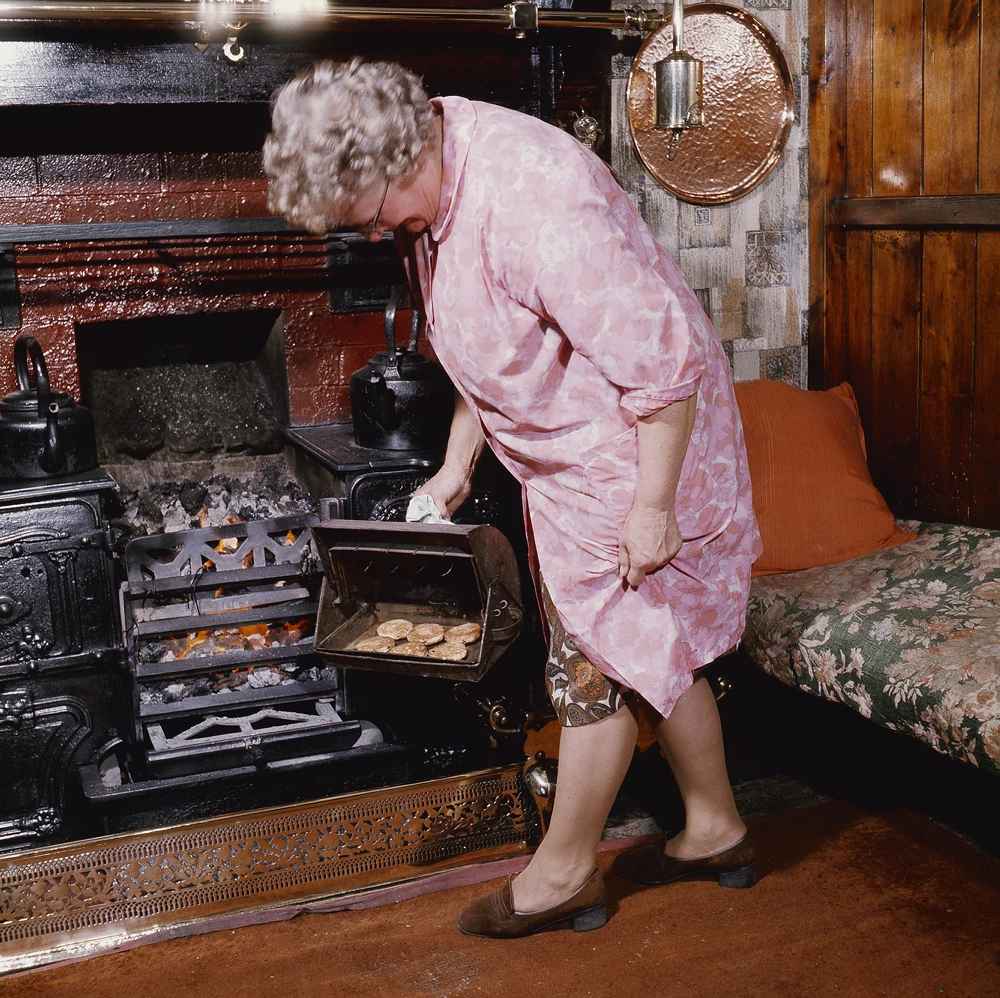
Traditional Welsh foods 23 April 2007 Margaret Maddocks baking round cakes in a Dutch oven, North Cornelly, Glamorgan.
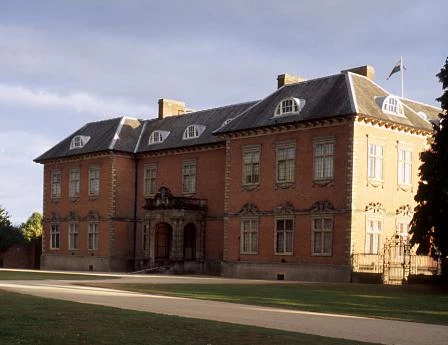
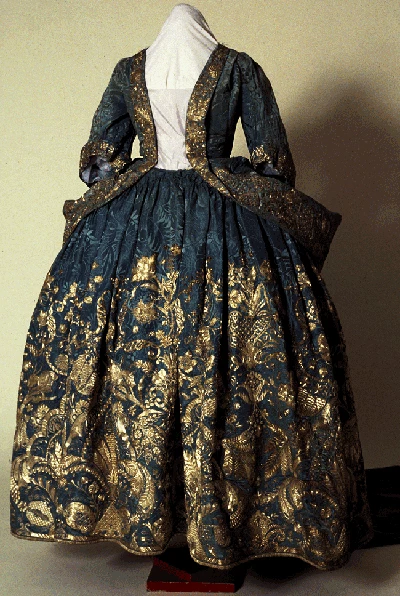
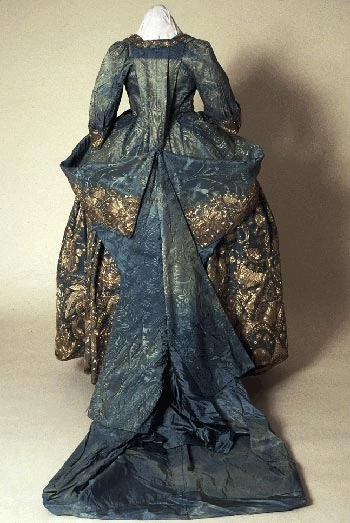
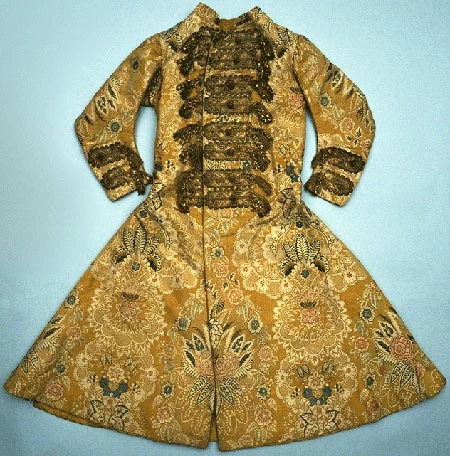
Glitz and glamour - the outstanding costumes of the the Tredegar Collection 11 April 2007 Tredegar House and Park. The house and grounds are now in the ownership of Newport County Council. Many rooms have been restored and are open to the public. Image © Steve Burrow. Silver embroidered blue damask court mantua (an open fronted gown with an elaborate train), made between about 1730-40. This is a very grand robe which would have been worn for presentation at court. This coat was probably worn by Sir William Morgan. It is of yellow lace pattern silk, dated to about 1725, and is of either English or French origin. For glitz and glamour, look no further than the Tredegar Collection. This impressive collection of 18th century costume was presented to the Museum in 1923 by Courtenay Morgan, also known as Lord Tredegar. The items belonged to his rich ancestors who wanted to flaunt their wealth and power. Each garment was designed to dazzle. Although the Morgans owned Tredegar House near Newport, they spent most of their time in London. For the gentry, the capital was the place to be. Pleasure gardens, operas and assemblies - their lives revolved around socializing. A royal debut The Tredegar costumes were probably made in London, using the finest woven damasks and brocaded silks you could buy. The most elegant dress in the collection dates from around mid-1720s. The grandness of this open fronted blue gown - often called a mantua - suggests that it was made for a young lady's royal debut. The detailing is elaborate and elegant, both on the front and the back.The gown was much longer originally, but a large section was cut off during the 1800s, supposedly for a fancy dress party. Whalebone corsets Gowns like this one were very awkward to wear. To achieve the exaggerated look, women wore wide hoop petticoats to increase the width of their skirts. They also wore tight corsets stiffened with whalebone under their dresses. Corsets encouraged good posture by squeezing the upper body into shape. Style was more important than comfort. This yellow brocaded frockcoat was made in the early 1720s. The floral design is typical of the period, so is the bright yellow colour. Further reading: M. R. Apted, 'Social Conditions at Tredegar House, Newport, in the 17th and 18th Centuries', The Monmouthshire Antiquary 3:2 (1972-3), pp. 124-54. Janet Arnold, 'A Court Mantua of c. 1740', Costume: Journal of the Costume Society 6 (1972), pp. 48-52. Avril Hart & Susan North, Historical Fashion in Detail: The 17th and 18th Centuries (London: V & A Publications, 1998).