
Portuguese Man-of-War Navigator
21 May 2007

A colourful model of the Portuguese Man-of-War sea creature - Physalia arethusa.
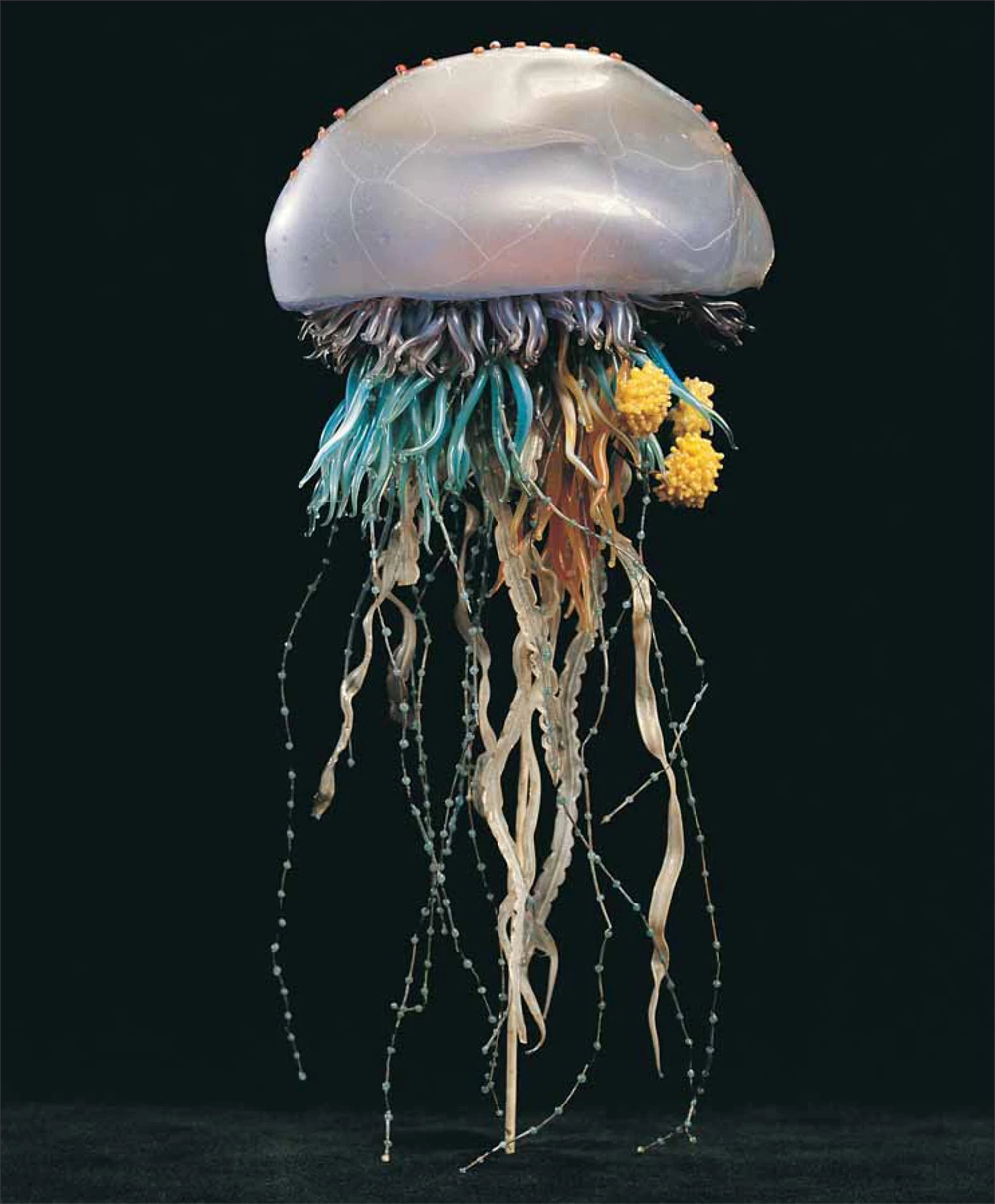
A colourful model of the Portuguese Man-of-War sea creature - Physalia arethusa.
Auctions are usually fairly discreet affairs attended by a few dozen people. This was not the case in the sale of the late Sir Leslie Joseph's collection of Welsh pottery and porcelain held by Sotheby's in 1992. Over 2,000 objects were sold in some 900 lots and made in excess of £1.1 million. The success of the sale was no surprise, for this was the largest and richest collection of Swansea and Nantgarw porcelain in the world.
A Swansea porcelain plate from the Garden Scenery service, a large Nantgarw porcelain dish from the Vernon service, a Nantgarw porcelain inkwell, painted for Caroline Goodrich of Caerphilly, and a Swansea porcelain set pattern plate, all of c. 1816-25, and presented by the Friends of Amgueddfa Cymru.
Sir Leslie Joseph was born in Swansea and had a long business career, which saw him eventually becoming vice-chairman of the Trusthouse Forte group. He had bought his first piece of Welsh porcelain before the Second World War. In the 1950s he began to assemble a collection that would eventually fill the display cabinets that lined five attic rooms in his house near Porthcawl.
His aim was to secure examples of every shape and pattern made at the Swansea and Nantgarw potteries. Unlike many collectors he was prepared to buy damaged pieces if they helped him learn more about the variety of porcelain produced at the two factories. Over the years he built up a vast knowledge of Welsh ceramics and, in particular, of the script marks used on Swansea porcelain. In 1988 he published the book Swansea Porcelain: Shapes and Decoration with A.E. Jones, which is an invaluable record of that factory's achievements.
Sir Leslie, who served on Amgueddfa Cymru's Art Committee for several years, was very generous and allowed many collectors and scholars access to the collection and his vast knowledge.
The sale of the Joseph collection represented both a challenge and an opportunity for Amgueddfa Cymru. The Museum has the largest public collection of Welsh pottery and porcelain in the world, with over 3,000 pieces. In recent years the Museum has tried to make the ceramics collection as comprehensive as possible. There were many objects in the Joseph collection of interest to the Museum, but the budget meant that choices had to be made about which were more important to the collection.
Prices at the sale were very high. Amgueddfa Cymru acquired 33 lots, at a total cost of £98,000. Nearly a third of the costs were paid for by external grants, and the three most expensive individual pieces were paid by other buyers on behalf of the Museum.
A small number of other rare and beautiful objects were bought at a high cost. One was an ice-cream pail from the Gosford Castle service. This was a well-known Swansea dessert service decorated in London with botanical specimens. The Museum also purchased a Nantgarw plate, exquisitely painted with doves perched on the edge of a basin of water, also decorated in London.
The Welsh Ceramics Gallery, at National Museum Cardiff, is named the Joseph Gallery in memory of Sir Leslie, one of Amgueddfa Cymru's great benefactors.
Crescentic plaque from Llyn Cerrig Bach, Anglesey.
Celtic coin from Tintern, Monmouthshire.
Plaque from Tal-y-Llyn, Gwynedd, thought to date to the 1st century AD.
Ox-head bucket fittings found at Little Orme, Conwy.
Celtic art reflects the way Iron Age people interpreted the world around them. The designs they used help us understand how they viewed themselves, their environment and their gods.
The Celtic art found in Wales is part of a much wider tradition in Britain and Europe, often called La Tène art, which developed during the Iron Age from about 500BC.
The earliest example from Wales is the Cerrig-y-Drudion bowl which was found in 1924 in a stone-lined grave in the county of Conwy. It is one of the few decorated artefacts from Britain to date to the 4th century BC and was probably made by British craftsmen influenced by Continental traditions.
Many more decorated objects are known from about 200BC, by which time Britain had developed its own distinctive style. British craftsmen continued to produce swords, daggers, spears, brooches and horse equipment, but also other objects such as tankards, mirrors and spoons.
Particular motifs and designs are introduced and often repeated, reinforcing their meaning. Archaeologists interpret these as symbolic and powerful with religious connotations. For example the three-fold character of the triskele (a three-legged design radiating from a centre) may represent the relationships between the living, the dead and the gods or the ongoing cycle of birth, life and death.
The crescentic plaque from Llyn Cerrig Bach (pictured) is decorated with an elaborate triskele, each limb ending with a trumpet and raised circle that suggests a stylised bird head.
Stylised representations of people and animals become more common after 100BC with faces often hidden within complex patterns. Human heads surrounded by a flowing plant-like design can be seen on plaques from the Tal-y-Llyn hoard while a variety of cows, horses, boars and birds adorn a wide range of other artefacts. Ox head escutcheons (bucket-fittings) have been found in Wales (pictured - the Little Orme (Conwy) hoard also contained two Roman trumpet brooches, indicating that this Celtic style continued in use after the Roman conquest), showing the stylised characteristics and flowing lines of native British artistic styles.
Mythical beasts are also hinted at, for example in the imaginatively constructed horse-cow heads that ornament the Capel Garmon firedog.
Celtic designs did not disappear with the Roman conquest, but continued to influence art. A bronze trulleus (saucepan) from Coygan Camp in Carmarthenshire was repaired with a sheet of metal sometime in the 3rd century AD. It was not decorated with a typical Roman design, but with a triskele motif, showing a continuing appreciation of Celtic art.
Early Celtic art in Britain and Ireland by Ruth and Vincent Megaw. Published by Shire Archaeology (1986).
Richard Wilson (1714-1782). This portrait was painted in Rome by Anton Mengs in return for one of Wilson's landscapes - a gesture of friendship and mutual admiration.
Caernarvon Castle X-ray image (NMW A 73)
Caernarvon Castle by Richard Wilson
Dolbadarn Castle X-ray image (NMW A 72)
Dolbadarn Castle in I.R. light (NMW A 5203)
Over the past few years, the Museum has been examining a number of paintings in the collections by Richard Wilson. Modern scientific equipment can reveal hidden details about the structure and materials used in these paintings. The results provide a fascinating insight into the artist's working methods and have led to discovering the origin of some of the more doubtful paintings from Wilson's work.
Infra-red light has been used to see whether the paintings have subsequently been altered or painted over by the artist. Infra-red light can penetrate all but the deepest blue pigments to reveal any dark tones overlying a light coloured ground. It has been discovered that there are underdrawings in both the oil sketch of Dolbadarn Castle (NMW A 5203) and the large finished painting of the same subject (NMW A 72). In the oil sketch, the underdrawing includes a bridge across the river in the distance and a fence in the right foreground. Neither of these features were used in the final sketch. Furthermore in the large painted version Mount Snowdon is included in the background and the distant riverside buildings are moved further to the left. His ability to rework his designs brings variety to the many versions he painted of the same subjects and helps explain how he gives his English and Welsh views a grand classical appearance.
Subjecting Wilson's work to X-rays has enabled the structure of Wilson's paintings to be examined. X-rays easily penetrate some materials, but are reflected by others. Some pigments traditionally used in oil painting come from heavy metals such as mercury, cadmium and lead. Lead white being one of the most commonly used. X-rays show up the structure of the painting and any changes that may have been made using lead white. Wilson usually painted his skies in a mixture of lead white and a blue pigment only down as far as the horizon, skirting around any trees and foliage silhouetted against the sky. The foreground and trees are painted largely with earth colours, which X-rays easily penetrate. A typical X-ray of a painting by Wilson should show a strong contrast between sky and foreground areas. This is best illustrated by Caernarfon Castle (NMW A 73). Any landscape not showing this characteristic contrast therefore can be assumed to have been produced by someone other than Wilson.
A few of the paintings examined so far show that Wilson sometimes completely reworked a composition. Dinas Bran (NMW A 3277) was originally started as a View of Tivoli (see NMW A 495). The town on the slopes of the hill is clearly visible in X-ray together with a wayside shrine, which occurs in other versions of that subject. He also occasionally reused a canvas. Dolbadarn Castle (NMW A 72) has been painted over a portrait of a woman, and Landscape with Banditti around a Tent (NMW A 69) is painted over a Venetian-style reclining nude.
Tiny paint samples have been taken and looked at under incredibly powerful microscopes.
The pigments found in the paint layers almost exactly match the palette Wilson used. Prussian blue and indigo mixed with lead white are the chief pigments found in his skies, and ochre, Naples yellow, red and yellow lakes, Prussian blue and indigo in his foliage and foregrounds. Ultramarine blue however, which, according to contemporary accounts, Wilson used in finishing his skies, has not yet been found.
Although most of Wilson's close followers would have used a very similar palette to that of their master, this type of modern analysis has proved that later imitations were false as the pictures contained pigments that were not known in Wilson's day. These include NMW A 5195 Coast Scene near Naples, which contains cobalt blue, first introduced in 1817 and NMW A 5206 Cilgerran Castle which has a ground containing barytes, introduced at the end of the 18th century.
This research has produced information vital to a deeper historical understanding of individual works by Wilson, as well as some definite conclusions as to the status of paintings of doubtful origin.
Amgueddfa Cymru owns the largest collection of paintings by Richard Wilson outside London, holding over 20 paintings in its stores and on display to the public.
Richard Wilson (1714-1782). This portrait was painted in Rome by Anton Mengs in return for one of Wilson's landscapes - a gesture of friendship and mutual admiration.
Portrait of a Lady: Maid of Honour. Richard Wilson (1714 - 1782)
On his return to London he hired several apprentices and paying pupils included Thomas Jones and Joseph Farington who both ended up adopting something of Wilson's studio practice.
Over the next fifteen years he produced large numbers of Italian, English and Welsh landscapes repeating the more popular subjects many times over. Gradually the market for this type of painting disappeared and his income dwindled. The Royal Academy, of which he had been a founder member in 1768, eventually appointed him as Librarian with a salary of £50 per annum. Eventually his health deteriorated and he retired to Colomendy near Mold where he died in 1782.
Wilson's initial portraits date from 1740-50 and reflect the taste of his day. Subjects are usually shown bust-length in an oval with a suitable background echoing the aspirations of the sitter. Wilson's loose but masterly handling of paint is visible in the costumes of his subjects, showing details of fastenings and other decorative features. Wilson painted skin tones in three stages. The first colouring established the basics of the face using a shade tint for the darker tones and a light tint for the general flesh tone. The second painting, after the first was dry, consisted in heightening of the lights, glazing the darks and adding carmine to the lips and cheeks. The final or third painting allowed final corrections to the glazing.
A particular hallmark of his portraiture is the grey underpainting left exposed to form a mid-tone of the skin. This is easily visible in the portraits of
Richard Owen (NMW A 5005) and the Maid of Honour (NMW A 67).Wilson decided to abandon portraiture in favour of landscape painting whilst in Italy. His landscape paintings were produced by first applying an underdrawing of brown paint, followed by ‘dead-colouring', a task which was given to the studio apprentices. Thin washes of colour were applied at this stage; Prussian blue and grey-brown for the sky, and a mixture of red and blue pigments for the landscape. The colour was applied to a thickness depending on the depth of tone required, allowing the light tone of the ground to show through more towards the horizon. Once the dead-colouring was dry it was oiled out before the second painting.
For the foreground Joseph Farington records that Wilson 'went over it a second time, heightening every part with colour and deepening the shadows, but still, brown, loose and flat, and left in a state for finishing: the half-tints laid in, without highlights.' In the third and final painting of the foreground Wilson altered the tints, adding the necessary sharpness to the different objects, before glazing them with rich warm tints, and finally adding further solid tints over this.
The sky and distant landscape, on the other hand, were worked wet-in wet after the initial dead-colouring, rather than in two separate stages. This allowed Wilson to achieve easier blending of the clouds with the blue of the sky, apparently using ultramarine rather than Prussian blue for this stage of painting. Last of all the horizon was adjusted and the distance softened with grey-brown again as necessary.
Drawing was important to Wilson with the first year of his pupils' training being devoted purely to drawing, which he believed gave them a good grounding 'in the principles of light and shade without being dazzled and misled by the flutter of colours.'
The majority of his surviving drawings date from his visit to Italy (1750-7). These are made up of studies taken directly from nature and designs drawn from his imagination. His preferred medium was black chalk and stump on a grey paper. He used these drawings as an inspiration for his oil paintings but rarely translated them directly into paint. He was constantly reworking the original designs and making adjustments as he painted.
In addition his colours were all derived from his visual memory or his imagination as he disapproved of tinted drawings and never used watercolours to make studies from nature.
Wilson's palette according to Paul Sandby from Whitley's Artists and their Friends in England 1700-1799. (Medici Society pub. 1928)
Both Joseph Farington, who became his pupil in 1763, and the watercolourist Paul Sandby, one of his friends, recorded Wilson's palette. Their accounts differ slightly but together give the range of pigments we would expect to find in his paintings.
Blues: ultramarine, Prussian blue, indigo
Reds: vermilion, light red, red lake
Yellows: yellow ochre, yellow lake, Naples yellow, brown pink
Browns: Roman ochre, burnt siena
Greens: terre verte
White: lead white
Black: ivory or bone black
What can you find in the garden?
If you go down to the beach today….
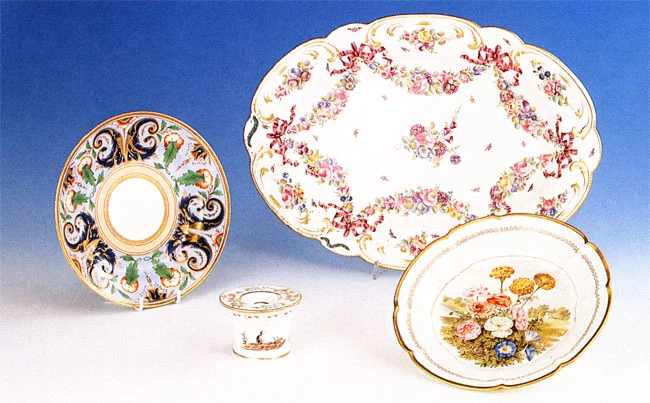
A Swansea porcelain plate from the Garden Scenery service, a large Nantgarw porcelain dish from the Vernon service, a Nantgarw porcelain inkwell, painted for Caroline Goodrich of Caerphilly, and a Swansea porcelain set pattern plate, all of c. 1816-25, and presented by the Friends of Amgueddfa Cymru.
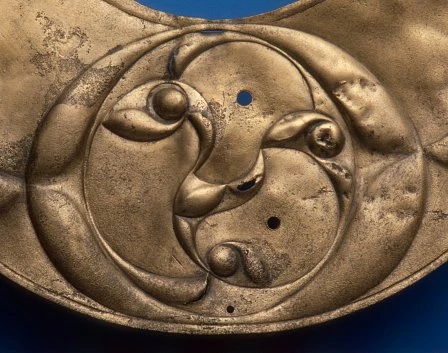
Crescentic plaque from Llyn Cerrig Bach, Anglesey.
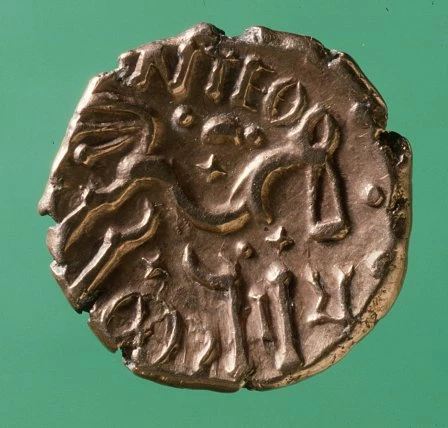
Celtic coin from Tintern, Monmouthshire.
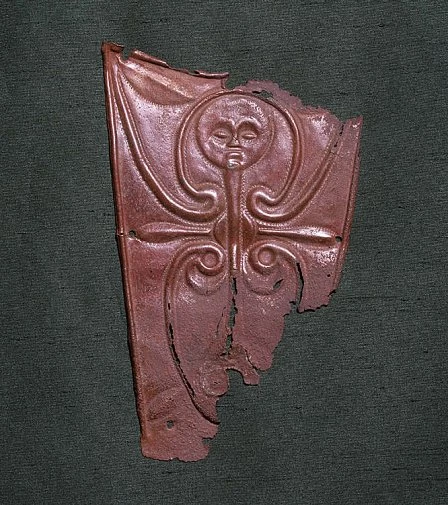
Plaque from Tal-y-Llyn, Gwynedd, thought to date to the 1st century AD.

Ox-head bucket fittings found at Little Orme, Conwy.
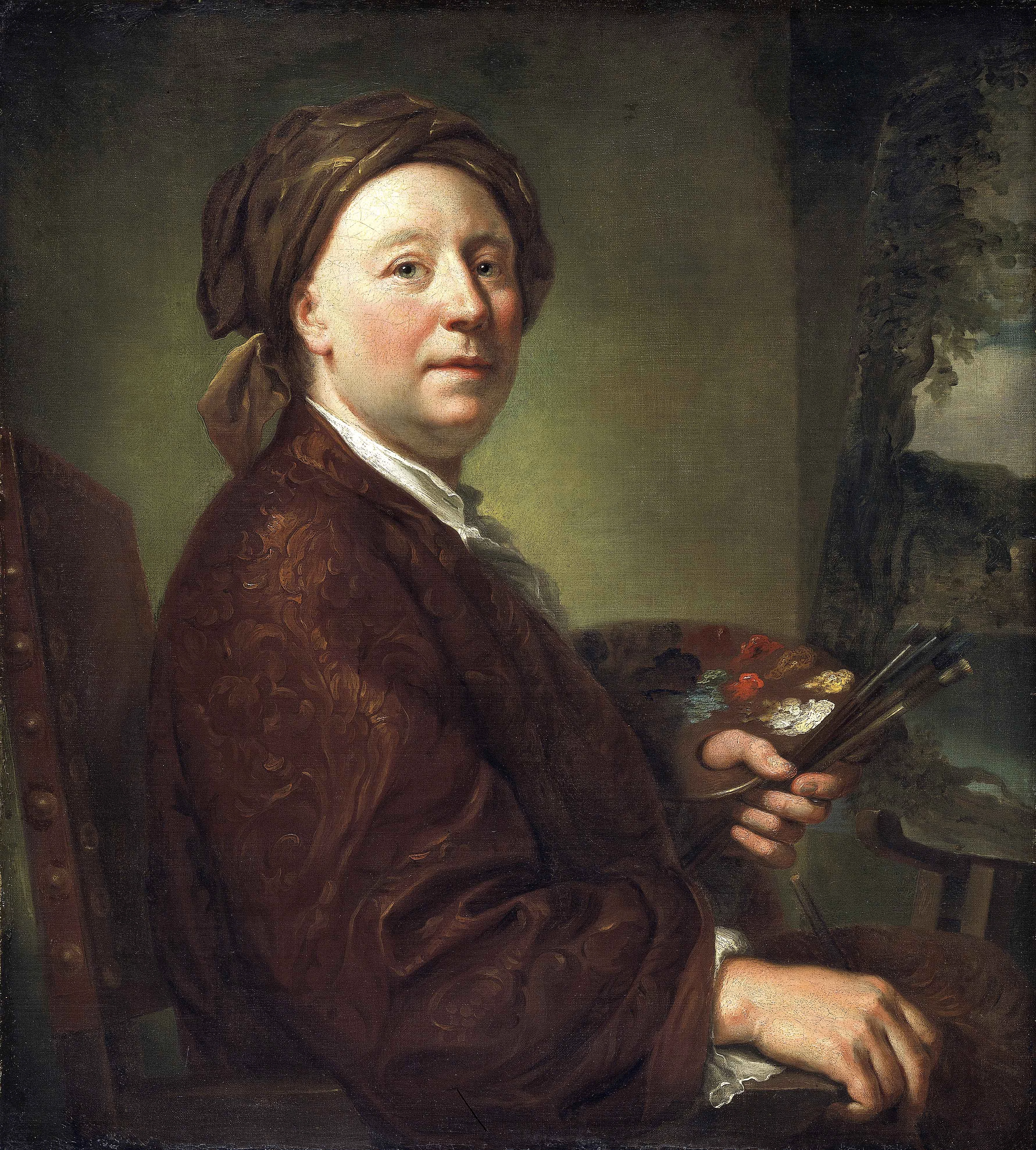
Richard Wilson (1714-1782). This portrait was painted in Rome by Anton Mengs in return for one of Wilson's landscapes - a gesture of friendship and mutual admiration.
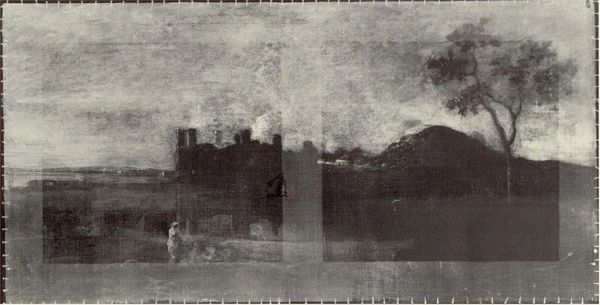
Caernarvon Castle X-ray image (NMW A 73)
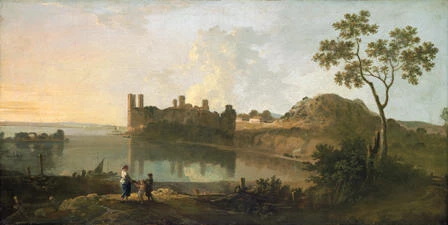
Caernarvon Castle by Richard Wilson

Dolbadarn Castle X-ray image (NMW A 72)

Dolbadarn Castle in I.R. light (NMW A 5203)
Richard Wilson (1714-1782). This portrait was painted in Rome by Anton Mengs in return for one of Wilson's landscapes - a gesture of friendship and mutual admiration.
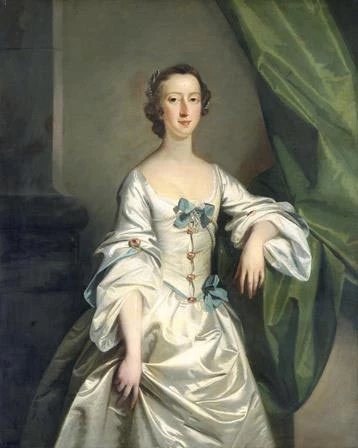
Portrait of a Lady: Maid of Honour. Richard Wilson (1714 - 1782)
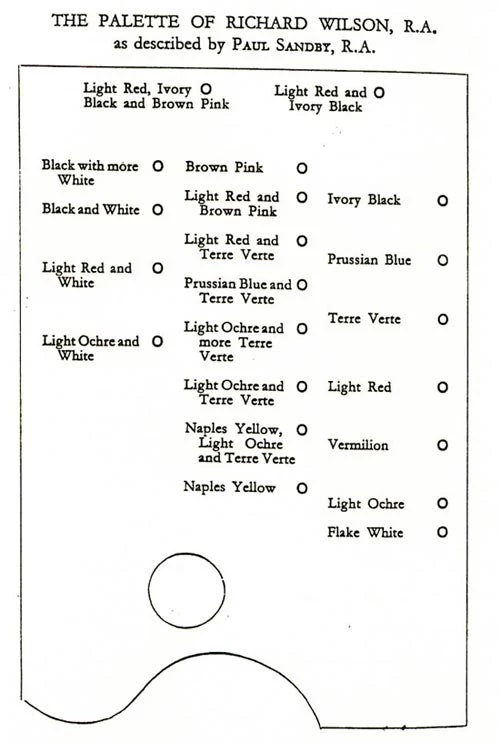
Wilson's palette according to Paul Sandby from Whitley's Artists and their Friends in England 1700-1799. (Medici Society pub. 1928)