: Natural History

A Victorian fossil mystery

5 July 2007

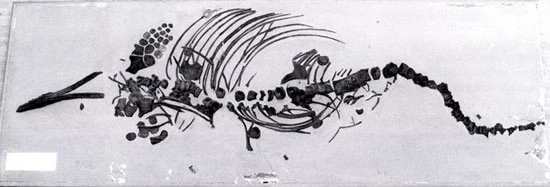
The ichthyosaur specimen before conservation (1750 mm by 720 mm by 70 mm)

The ichthyosaur specimen before conservation (1750 mm by 720 mm by 70 mm)

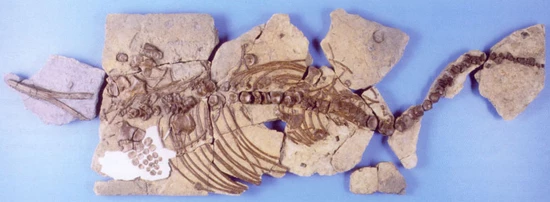
Ichthyosaur after conservation

Ichthyosaur after conservation showing head from separate individuals, and paddle bones set in plaster

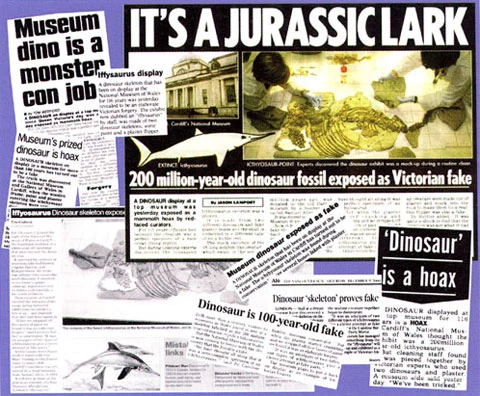
Press coverage of the story

Press coverage of the story

Routine conservation of the fossil collections at Amgueddfa Cymru, revealed a specimen that, on first examination, appeared to need a small amount of remedial work. What was to have been a small job turned into a major conservation project which attracted international media interest.

The ichthyosaur

The specimen in question is an ichthyosaur, a marine reptile that lived during the Mesozoic Era, 65-200 million years ago - the same time as the dinosaurs. They are similar to dolphins, with large eyes and distinctive long jaws with sharp teeth and limbs modified into paddles.

The specimen was donated to the old Cardiff Museum in the 1880s and subsequently became part of the National Museum collections. It was originally mounted in plaster with a surrounding wooden frame and then both the plaster and the specimen were painted.

The specimen was restored several times during the twentieth century, and this included new plaster and repainting. A label identified the species as Ichthyosaurus intermedius, collected from Street, Somerset, and described the skeleton as 'the greater part of a small individual preserved with but little disturbance of the bones' — a statement later found to be rather inaccurate.

A detailed investigation of the specimen was undertaken and extensive damage was discovered, with cracks running through it. The plaster and wooden mount were in poor condition so the decision was made to remove all restoration and paint, and to get back to the original skeleton and rock. It was not a decision made lightly because we knew that the whole appearance of the specimen was going to be radically altered.

Revealing the specimen

Removal of the paint layers revealed that the missing ends of the ribs had been moulded in plaster and then painted to match the rest of the specimen, giving the false impression of actual bones.

Study of X-rays taken of the specimen revealed an inconsistency in one section of the spine of the fossil; a dark shadow surrounded the bones. When the paint from this area was removed, it became clear that a channel had been carved in the rock and individual loose bones had been fixed into it with plaster.

Beneath the paint it was discovered that the bones of the single preserved front paddle were also set in plaster. Holes in the surrounding rock suggest areas from which bones may have been removed before being relocated, but it is possible that some bones had been taken from other specimens.

The biggest surprise came when the paint was removed from around the jaw; the rock was a totally different colour and type to the rest of the skeleton. Not only were there at least two individuals involved, but further study proved that the head and body were two entirely different species of icthyosaur! This was a specimen that had been considerably altered by the Victorian preparators.

Re-displaying the conserved fossil

Although the specimen was made up of two different species, it was decided that the head and the body should be kept together as originally intended. The plaster surrounding the paddle and a part of the ribs made from plaster were also left intact. A new light-weight support system was built. Instead of being displayed simply as a museum specimen, this ichthyosaur will be used to highlight the techniques used by some Victorian enthusiasts to 'restore', display and present fossil specimens and how painstaking conservation work today revealed the true nature of our specimen.

Intense media interest was sparked when the Museum announced a public talk on the conservation of the specimen. This resulted in the story being covered in the national and international press in addition to television, radio and the internet, and included a live interview with ABC Radio in Australia!
Early herbals - The German fathers of botany

John R. Kenyon, 4 July 2007

Amgueddfa Cymru has a number of pre-1701 books in the Museum's Library, including two incunables (books printed before 1501) of Pliny's writings on natural history from 1481 and 1487.

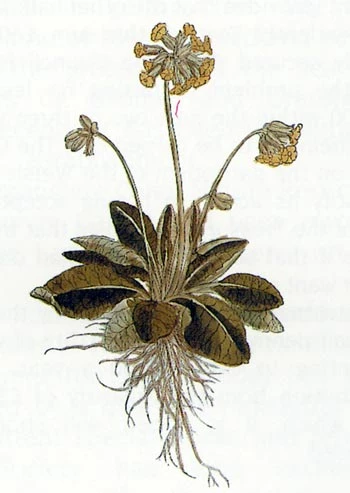
The cowsip as depicted in Fuchs's De Historia Stirpium

The cowsip as depicted in Fuchs's De Historia Stirpium

Part of an early German herbal annotated in Welsh and English, once in the possession of Morris Owen

Part of an early German herbal annotated in Welsh and English, once in the possession of Morris Owen.

There are also a number of 16th- and 17th-century 'herbals' in the collection. Among these are examples of the works of three men who have been described as the 'German fathers of botany', namely Hieronymous Bock (1498-1554), Otto Brunfels (1489-1534) and Leonhard Fuchs (1501-1566).

Herbals

Printed herbals give details of plants along with what illness each one could cure. What made the work of these three men stand out in particular is that many of the descriptions and illustrations of the flowers in their books were, on the whole, based on first-hand evidence in the field, and not copied from other writers.

Hieronymous Bock (1498-1554)

As Bock's herbal of 1539 was unillustrated, it forced him to provide detailed and accurate descriptions. The Museum holds a later, illustrated edition, from 1552. Although the opening pages are missing, the main body of the text is complete, along with fine hand-coloured illustrations.

Most of the woodcuts simply show the plants themselves, but occasionally birds and man are shown, such as the rather crude depiction of the effects on eating a fig!

Otto Brunfels (1489-1534)

The work of Otto Brunfels in the Library is the second volume of Herbarum Vivae Eicones (1531). The title translates as 'living picture of plants' and the author was one of the first to turn to nature itself as the source of his illustrations for a book.

Leonhard Fuchs (1501-1566)

The Library holds two books compiled by Fuchs, namely De Historia Stirpium (1542) and Plantarum Effigies (1549). Although only some of the descriptions of the plants are by Fuchs, the majority being taken from other books, it is the quality of the illustrations that makes this herbal one of the great books of the 16th century.

The Plantarum Effigies is a pocket-sized version of the 1542 volume to be used in the field; it has very little text, apart from an index to the plants depicted, and with each woodcut the name of the plant is given in three or more languages, usually five (Greek, Latin, French, Italian and German).

Other great herbals of the same period are housed in the Library of Amgueddfa Cymru, notably the works of Rembert Dodoens (1516-1585) and John Gerard (1545-1612).

Rembert Dodoens (1516-1585)

Dodoens' herbal was published in Flemish in 1554. The Museum holds the first English edition of 1578 translated by Henry Lyte, including new material which Dodoens himself had sent to Lyte for incorporation in the new edition.

John Gerard (1545-1612)

One of the most famous herbals written in English is Gerard's The Herball (1597). Head gardener to many properties in and around the London area, Gerard was also responsible for the gardens of William Cecil, Lord Burghley, Elizabeth l's Secretary of State and Lord Treasurer, and it was to Cecil that Gerard dedicated his great work.

The Library has a copy of the 1633 edition, along with the original work itself.

Other herbals in the collection include an incomplete German example dating to the first half of the 16th century. It was once in the possession of a Morris Owen of Caernarfonshire who added in ink, around 1767, the names of the various plants in Welsh; the English equivalents are also given in most cases.

This book, and the other herbals, remain of great interest to this day, and are examined in particular by those who study the history of botany and pharmacy, as well as by students of the history of the printed book.

A passion for plants: botanical illustration by women artists

16 June 2007

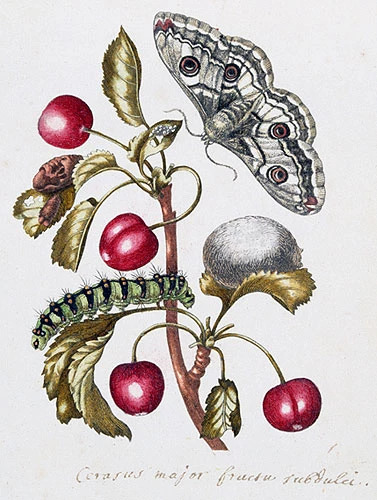
Cerasus Major
Maria Sibylla Merian

'Raupenbucher' (Book of Caterpillars) - 1679
Cerasus Major

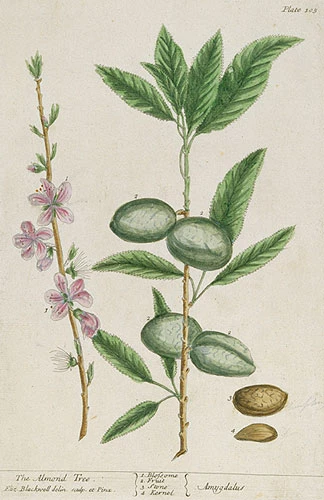
Prunus Amygdalus
Elizabeth Blackwell

'The Curious Herbal' 1737-39
Prunus Amygdalus

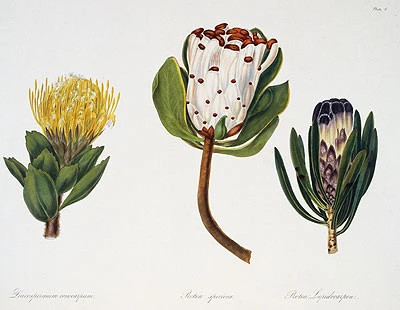
Protea
Lady Arabella Roupell
Protea
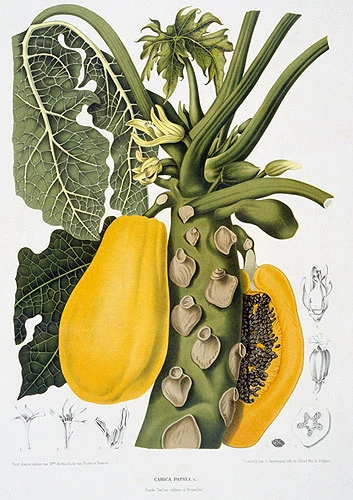
Carica Papaya
Berthe Hoola van Nooten
Carica Papaya
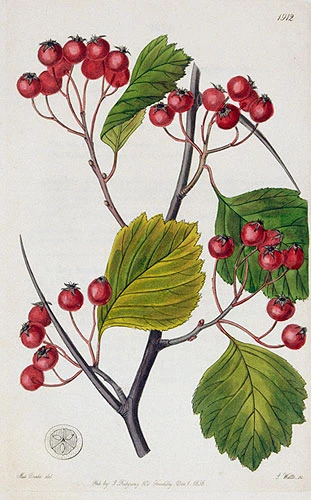
Crateagus Macrantha
Miss Sarah Anne Drake
Crateagus Macrantha
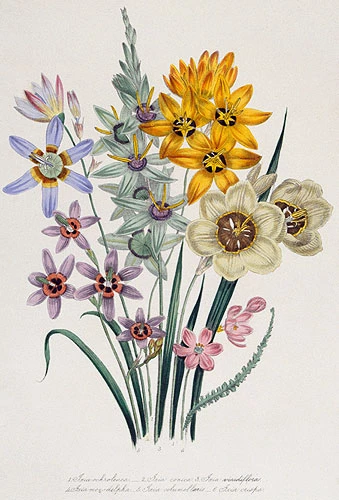
Romulea
Jane Webb Loudon
Romulea

(Sand Crocus)

The Museum's collection of botanical illustrations consists of more than 9,000 prints and drawings. Many of the works in the collection have fascinating and courageous stories linked to them. In particular, there are stories of the women artists who took part in scientific discovery.

A combination of neglect and dismissal of these women artists has undermined their achievements and their contribution to the science and art of botanical illustration.

Women's role in botanical illustration

It was sometimes thought that botanical illustration was only for women with time on their hands, who dabbled in a spot of watercolours before ordering afternoon tea! This might have been true for some, but not all. Several intrepid and independent women emerged as accomplished botanical illustrators.

The 17th century

Maria Sibylla Merian (1647-1717) was one of the finest botanical artists of her time.

From an early age, Maria was interested in insects and caterpillars, and the plants on which they fed. It is believed that her uncle had a silk factory that led to her fascination in the life cycle of the silk worm.

In 1679, she published the first of three volumes on European insects illustrated with her own engravings. Her careful and deliberate portrayal of insect and host plant together established a precedent in scientific literature.

After 17 years of marriage, Maria left her husband and joined an exclusive sect called the Labadists in a castle in the Netherlands. In 1698 Maria sold her collection to fund an expedition to study and describe insects in their native habitat.

For two years she devoted all her time to discovering and drawing many new plants and insects. Eventually she returned to Europe due to ill health and was working on some drawings when she died of a stroke aged seventy.

The 18th century

Elizabeth Blackwell (1700-1758) was recognised as an accomplished artist. Her husband was sent to debtors prison for two years after he opened a print shop in London without the required apprenticeship.

Looking for a way to save them from their financial difficulties, Elizabeth was encouraged by Sir Hans Sloane, President of the Royal Society, to produce a definitive herbal of medicinal plants. Elizabeth embarked on this major project, engraved her own images on copper plates and then hand-coloured the prints herself.

This prodigious task was entitled A Curious Herbal. The first volume included 500 plates and was published in 1738.

Although her drawing is not exceptional, it was an excellent record for its time and its success lay in fulfilling a need for identification.

The 19th century

The Victorian era was a time of great progress. The expansion of the British Empire meant that many new and exotic plants were being sent to Britain.

Upper class women often published books anonymously, since it was considered shameful to link a woman's name to any commercial venture.

An excellent illustration of this point is an 1849 book entitled Specimens of the Flora of South Africa by a Lady . This 'Lady' was visiting South Africa with her husband and to amuse herself she painted the exotic flora of the region. She published the volume anonymously until it became known the author was Lady Arabella Roupell.

Berthe Hoola van Nooten (fl. late 1800s) also published her work to make ends meet. Her husband died while they were travelling in Java, leaving her alone to bring up two daughters. In 1863, she published The fruits and flowers of Java, which has vibrant and strong illustrations.

In accordance with the social traditions of the day, Berthe writes an apologia in the introduction, explaining she has been forced to utilize her talents as a botanical artist as a buffer against 'penury and a refuge in sorrow.'

This is an illuminating insight into the expectations and status of women in the 19th century.

Miss Sarah Anne Drake (1803-1857) became an accomplished botanical artist and produced an enormous body of work. Her specialism was orchids and she contributed magnificent plates to Bateman's Orchidaceae of Mexico and Guatemala — one of the most famous orchid books ever published. Perhaps the most esteemed results of her career were the 1,100 splendid plates she executed for Sydenham Edwards' Botanical Register. The Australian orchid 'Drakea' is named in her honour.

Jane Webb Loudon (1807—1858) was orphaned at the age of 17. In order to support herself, she wrote a novel set in the 21st century called The Mummy.

This caught the attention of John Loudon, a well-respected landscape gardener who Jane later married. Finding many of her husband's gardening books too technical, she wrote Instructions in Gardening for Ladies (1840) in clear simple language. This book proved extremely popular, selling more than 20,000 copies.
She went on to write The Ladies Flower-Garden in 1840 and Botany for Ladies in 1842.

Anna Maria Hussey's (1805—1877) most important work was Illustrations of British Mycology, published in 1847-9 in two volumes. The book includes a series of colour plates accompanied by biological information and general commentary, blending science, anecdote and literary reference. The puffball Husseia is named in her honour.

Brambles, blackberries, jam and jargon

12 June 2007

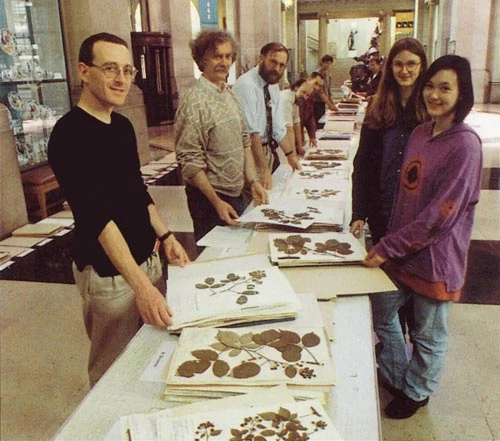
Bramble Jam - botanists sorting the collection during the reorganisation.

Bramble Jam - botanists sorting the collection during the reorganisation.

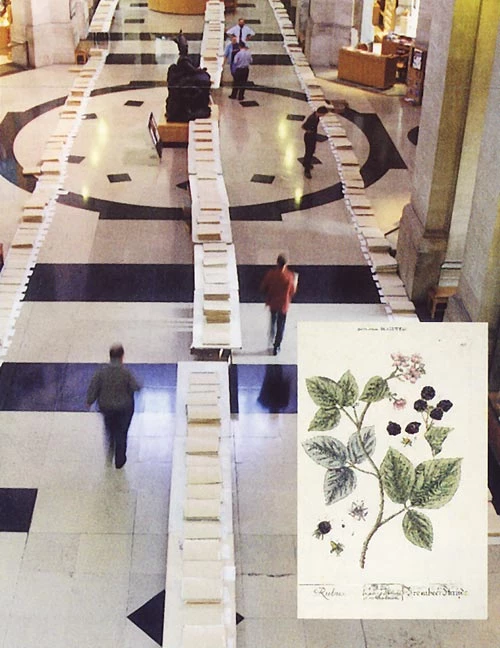
Bramble specimens laid out along the length of the Main Hall of the National Museum, Cardiff.

Bramble specimens laid out along the length of the Main Hall of the National Museum, Cardiff.

The bramble collection held at Amgueddfa Cymru is recognised as a major scientific reference tool for the study and naming of plants worldwide.

The Bramble and Blackberry or Rubus collection held in the Museum herbarium is one of the major British reference collections for naming plants. The collection holds 15,000 specimens and includes all of the 325 species known from Britain and Ireland. As the classification of brambles is being revised continuously, the management, conservation and continued use of the collection is of utmost importance.

Brambles are a particularly difficult group of plants to identify as there are often only small differences between each species and bushes of different species often grow tangled together, making the gathering of individual species very difficult. Due to the sheer number of species of bramble in Britain, many specimens in the collection remain unnamed.

When a new species is discovered, the specimen that is used to identify the species in which it belongs is known as a type specimen. Type specimens are vitally important for solving identification problems and the Museum collection contains type specimens of at least 100 species.

There is also a significant historical aspect to the collection as it contains the personal collections of several important collectors from the late 19th to the early 20th century.

European specimens are also of value and through these it has been discovered that a number of French and German bramble species have remained undetected in the British Isles until very recently. It is hoped that the European specimens could be of future use linking some as yet unnamed specimens in the herbarium to continental species.

Stunning plant portraits donated

12 June 2007

Common Fritillary

Common Fritillary (Fritillaria meleagris) by E.F. Crowley.

Common primrose

Common primrose (Primula vulgaris) by E.F. Crowley.

Botany was a popular and fashionable activity in 18th and 19th century Britain. It was a safe recreation for women of leisure in the middle classes and was encouraged as an exercise that taught moral and religious lessons and prevented idleness.

In April 1927, two months after King George V officially opened the National Museum of Wales, Miss Gwendolen Crowley of Eastbourne wrote to the new museum's Keeper of Botany offering a collection of 200 botanical watercolour drawings.

Included with Miss Crowley's drawings were similar paintings by her mother, Mrs Curtis Crowley, her sister, Marion and an aunt, Mrs E. F. Crowley, bringing the total number of watercolours donated to 367.

Some years before, Gwendolen and Marion had started a Botanical Painting Club to illustrate as many wild flowers as possible and this collection was the result of that interest.

An inscription on the back of one of Marion's paintings of a Grape Hyacinth (Muscari comosum) states,

"Known also as Tassel-Hyacinth. See Curtis's Botanical Magazine."

This reference alludes to William Curtis (1746-1799), who taught at the Chelsea Physic Garden in London. Curtis wrote one of the earliest illustrated floras in England, Flora Londinensis (1775-87), which includes all the wild flowers growing within 10 miles of London.

Part of the work undertaken by the Museum is to maintain and conserve these delicate illustrations. The drawings have all been cleaned with vinyl erasers, stored in polyester envelopes to prevent abrasion and acid migration, before being rehoused in archival boxes designed specially for delicate material. The paintings are all original watercolours, measuring approximately 25cm by 18cm.