: Housing & The Home

The Palace in the Lake

13 September 2007

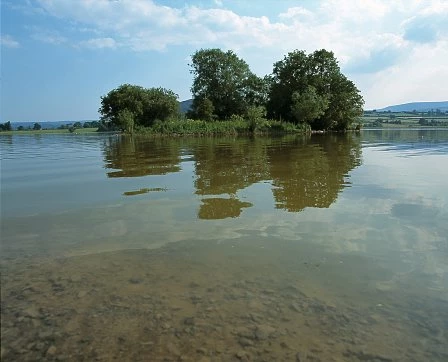
Llan-gors Lake

Llan-gors Lake, with crannog in background. Image: Cadw (Crown Copyright).

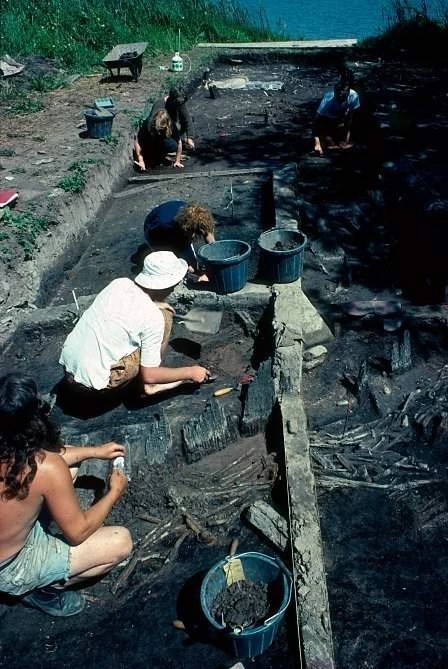
Llangors crannog during excavation.

Llan-gors crannog during excavation. This image of the 1991 excavations shows planks from the crannog's palisade wall.

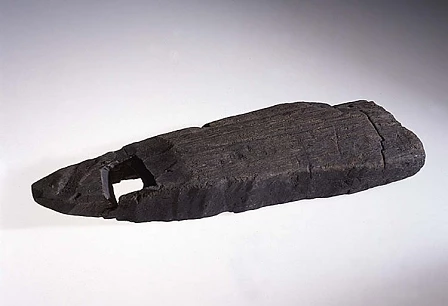
Oak plank from Llangors, 60cm (2 foot) long.

Oak plank from Llan-gors, 60cm (2 foot) long. Submerged oak planks like this formed part of the palisade around Llan-gors crannog.

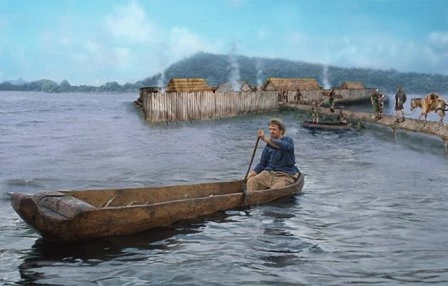
Reconstruction of Llangors crannog, based on the excavation.

Reconstruction of Llan-gors crannog, based on the excavation.

Excavations at the artificial island or crannog in Llan-gors Lake, near Brecon, have provided a unique glimpse of a royal Welsh court.

Excavations between 1989 and 1993 by the National Museum Wales and Cardiff University have revealed that the crannog, the only one known in Wales, was an early medieval royal site of the ruler of the inland kingdom of Brycheiniog.

The small early kingdom of Brycheiniog (Brecheiniauc) corresponded approximately to the historical county of Brecknockshire in south Wales. The territory took its name from Brychan, dynastic founder of the royal line according to later legend..

Irish influence

The crannog was carefully constructed of brushwood and sandstone boulders, reinforced and surrounded by several lines of oak plank palisade. Tree-ring dating of the well-preserved timbers has established that they were felled between AD889 and AD893. The site seems to have been influenced by Irish building techniques, and was possibly constructed with the assistance of an Irish master craftsman.

The kings of Brycheiniog claimed to be descended from a part-Irish dynasty, and their use of such an unusual and impressive construction may have enhanced their political standing and strengthened their claims to Irish ancestry.

Objects of high quality

As a royal site Llan-gors crannog would have been a centre of administration, as well as a place for hospitality, where the ruler seasonally held court, received tribute and indulged in hunting and fishing. The artefacts uncovered, which include embroidered textile and parts of a portable shrine, confirm the site's aristocratic status.

The crannog is attacked

The Anglo-Saxon Chronicle records that in AD916 Æthelflaed, 'Lady of the Mercians', sent an army into Wales three days after the murder of Abbot Ecgberht and his companions. The army destroyed Brecenanmere (the Anglo-Saxon name for Llan-gors Lake) and captured 'the king's wife and thirty-three other persons'. This record of an attack probably refers to the crannog, and the capture of the wife of king Tewdwr ap Elisedd. During excavation, a charred, burnt layer was uncovered - probably representing this attack.

The site gives an unique glimpse of life on a royal site in the late 9th and early 10th-centuries.

Timeline

  • 880s: Elise ap Tewdwr, ruler of Brycheiniog forced by the aggressive actions of Gwynedd to seek overlordship of Alfred the Great.
  • 889-93: Llan-gors crannog constructed by the ruler of Brycheiniog.
  • 894: Vikings ravaged Brycheiniog.
  • 916: Brecenanmere (probably Llan-gors crannog) destroyed by Mercian (Anglo-Saxon) army.

Background Reading

'On a crannoge, or stockaded island, in Llangorse Lake, near Brecon' by E. N. Dumbleton. In Archaeologia Cambrensis (4th series) vol. 1, p2-98 (1870).

'The early medieval crannog at Llangorse, Powys: an interim statement on the 1989-1993 seasons'. In The International Journal of Nautical Archaeology vol. 23, p189-205 (1994).
The decorated floor tiles from Raglan Castle

6 September 2007

Raglan Castle.

Raglan Castle. The castle's fortifications, including the Great Tower shown at the centre of this view, were established in the 15th century. Image: Cadw (Crown copyright).

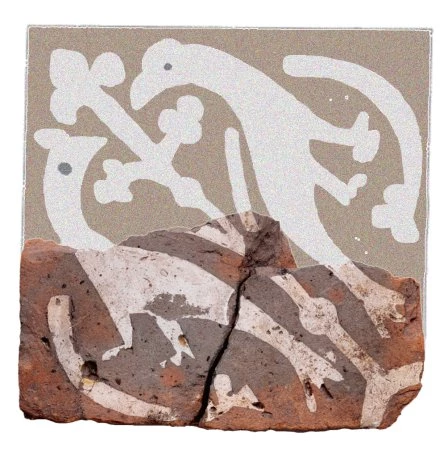
Late 13th to early 14th-century tile of the Wessex School from the chapel at Raglan.

Late 13th to early 14th-century tile of the Wessex School from the chapel at Raglan.

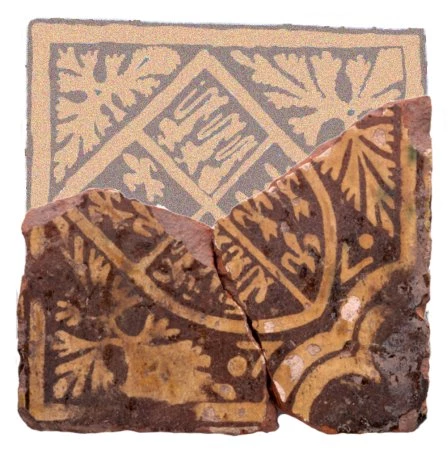
15th-century Malvern-school tile used at Raglan.

15th-century Malvern-school tile used at Raglan.

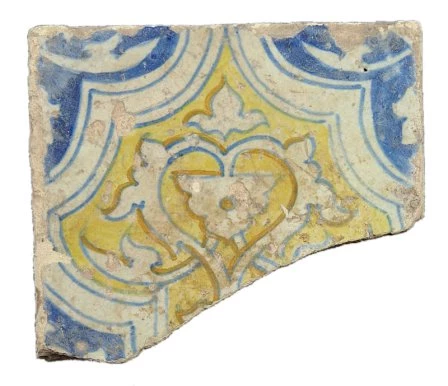
16th-century maiolica tile from the chapel floor laid by Earl William, probably before 1572.

16th-century maiolica tile from the chapel floor laid by Earl William, probably before 1572.

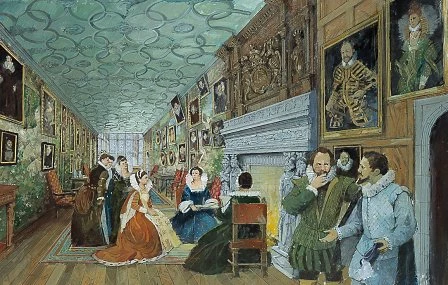
Reconstruction of life at Raglan Castle in the 16th century, at the time of the Third Earl of Worcester. Image: Cadw (Crown copyright).

Reconstruction of life at Raglan Castle in the 16th century, at the time of the Third Earl of Worcester. Image: Cadw (Crown copyright).

Three centuries of fashion and design can be seen in a collection of decorated floor tiles found during building works at Raglan Castle in 1947.

In 1549 William Somerset (1526-1589) succeeded to his father's position as third Earl of Worcester and owner of Raglan Castle. From this base in south-east Wales he launched a career that was to see him thrive at the courts of Edward VI (1547-53), Mary (1553-58) and then Elizabeth I (1558-1603). He is buried in Raglan parish church.

Such a prominent figure lived a lifestyle that suited his high social standing, and we can see this aspiration in the extensive remodelling that he undertook of the fortress-mansion he had inherited.

He set about an extensive programme of modernisation that affected all parts of the castle and its grounds: the hall and accommodation were improved, kitchen and service areas upgraded, a long gallery was introduced and gardens created in Renaissance style.

The Castle's furnishings were also updated with items that reflected contemporary European fashion. This is illustrated in the chapel at Raglan.

Raglan Chapel

The chapel at Raglan dates from at least the 13th century. It had a floor of thick red earthenware tiles with decoration inlaid into its surface using a contrasting colour. Such two-colour tiles often had designs of shields and monograms, over which a clear glaze would be fired. These tiles were the height of fashion in the mid-14th century.

About 1460, these tiles were replaced with two-colour tiles of bright yellows and golden browns. This must have provided a rich backcloth for the treasures of the chapel.

However, these designs were not to the taste of Earl William. He preferred the fashionable products of the Spanish Netherlands, and used his considerable wealth to purchase tin-glazed earthenware tiles painted in a polychrome style that was popular in the Renaissance period.

The result was a dramatic transformation of the chapel, lightening its interior and adding delicacy to its decoration.

Sadly, the abandonment of Raglan in the wake of the English Civil War has left few traces of the other changes that Earl William made to the interior furnishings of his castle. We are left instead to speculate on the luxury he must have brought to it, and to reflect on the transient nature of that wealth, surviving as it does in a small collection of painted floor tiles and a handful of other items.

Guide to the Tiles

  • Late 13th- to early 14th-century tile of the Wessex School from the chapel at Raglan. It shows two birds feeding from a central tree. Tiles with this design were also used at nearby Tintern Abbey and White Castle.
  • 15th-century Malvern-school tile used at Raglan. The Latin text reads 'May the peace of Christ be amongst us always. Amen'.
  • 16th-century maiolica tile from the chapel floor laid by Earl William, probably before 1572. These tiles were probably imported from the Spanish Netherlands, perhaps Antwerp, where maiolica production had been established in the early 16th century.

Background Reading

Raglan Castle by J. R. Kenyon. Cadw (2003).

'The chapel at Raglan Castle and its paving tiles' by J. M. Lewis. In Castles in Wales and the Marches by J. R. Kenyon and R. Avent, pp.143-60. University of Wales Press (1987).

The medieval tiles of Wales by J. M. Lewis. Amgueddfa Cymru (1999).

The Gregynog Press

29 July 2007

The Davies Sisters of Gregynog

The stealing of the mare by Robert Maynard

The frontispiece to The stealing of the mare (1930), the work of Robert Maynard.

One of the outstanding aspects of the Davies sisters' involvement in the arts was the creation of the Gregynog Press. This was the only component of the arts and crafts scheme planned for Gregynog Hall to be implemented, beginning production in 1922. The first book, Poems by George Herbert, was published a year later, the last being published in 1940.

The Gregynog Press, like other private presses of the time, produced high quality books in limited editions. Such books were usually superbly printed on handmade paper, using hand presses or small letterpress machinery. Many of the greatest wood engravers of the twentieth century were commissioned to produce illustrations for these books.

The sisters already possessed books from some of the finest private press productions of the late nineteenth and early twentieth centuries, such as those from the Kelmscott and Ashendene presses.

Staff

specially bound copy of the Loyal Address to King George V

One of the specially bound copies of the Loyal Address to King George V on the formal opening of the National Museum of Wales on the 21 April 1927.

At its peak, the Press employed seventeen staff. Most of the general workforce in the composing room and the bindery was Welsh and local to Gregynog. The artistic staff came mainly from England and Scotland.

The Gregynog Press Board had three aims in the production of fine books: to print books in the Welsh language, to publish some of the best examples of Anglo-Welsh literature and to publish translations of Welsh works.

From the 1930s the subject matter was more varied. Of the forty-two books, eight were in Welsh, while a further eleven had a Welsh connection. It is this attention to Welsh material that was one of the distinguishing features of the Press.

Loyal Address of the King

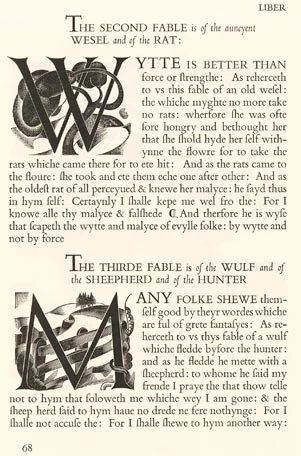
Fables of Esope
The fables of Esope

(1932). Agnes Miller Parker's wood engravings for this book, and XXI Welsh gypsy folk-tales (1933), established her as one of the greatest wood engravers of the twentieth century.

One of the more handsome productions was for Amgueddfa Cymru, and undertaken at a few weeks notice. This was the printing of the Loyal Address read at the formal opening of the Museum on 21st April 1927 by King George V, accompanied by Queen Mary. A number of copies were bound in blue levant morocco, decorated in gilt.

Printing

Illustrated psalm

Illustrated page of Psalm XC from Psalmau Dafydd (1929)

The first 'Press' book, Poems by George Herbert, was printed on an Albion hand press. Most of the printing at Gregynog was done on the less labour-intensive Victoria, although William McCance, the second controller of the Press, used the Albion to print his first book, John Milton's Comus, in 1931.

The first four books were restricted to a single typeface (Kennerley), but soon it became possible to use a range of types. A Gregynog type was made, but it was only used for one book (Eros and Psyche, 1935).

The paper used at Gregynog was handmade. From 1927 to aid the process of printing this was done on dampened paper, a widely used technique.

The outstanding quality of the printing of the letterpress and the wood engravings was largely due to Herbert Hodgson, printer from 1927 until 1936.

Wood Engravings

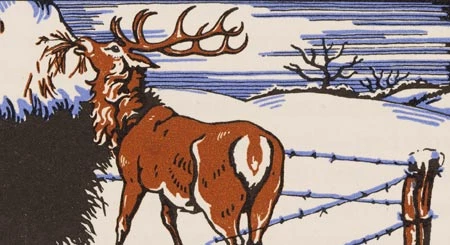
The story of the red-deer

Illustration from The story of the red-deer (1935/6), a children's book, which was the only book produced at Gregynog where the illustrations were printed in colour.

Some of the finest books ever illustrated with wood engravings were printed in Britain between the two world wars. The Press played a major part in this era. In the 1930s, the Gregynog Press saw one of the most outstanding periods of book illustration in Britain, with the sensuous engravings of Blair Hughes-Stanton and the intricate ones of Agnes Miller Parker.

A small number of external artists were commissioned to prepare engravings, one of the best known of whom was David Jones; his two engravings were printed in Llyfr y Pregeth-wr, the Book of Ecclesiastes.

Bindings

Illustration from The stealing of the mare (1930)

Illustrated capital from The stealing of the mare (1930)

The Gregynog Press was unique amongst private presses in that the binding of the books was seen as being as important as the printing. Up to 1935 each title was bound in buckram cloth or marbled paper, with one in vellum, but a small number of 'specials', were bound in full leather, of varying colours and designs.

Almost all the specials were bound by Fisher, who is recognised as one of the greatest bookbinders of the twentieth century. His versatility is shown at its best in the implementation of the designs prepared by McCance and Hughes-Stanton, notably for The Fables of Esope, The Revelation of Saint John the Divine and The Lamentations of Jeremiah. Other 'specials' were designed by the artistic staff including Maynard and Hughes-Stanton.

Images: Gwasg Gregynog/Gregynog Press

A splendid silver cup for a copper magnate

25 July 2007

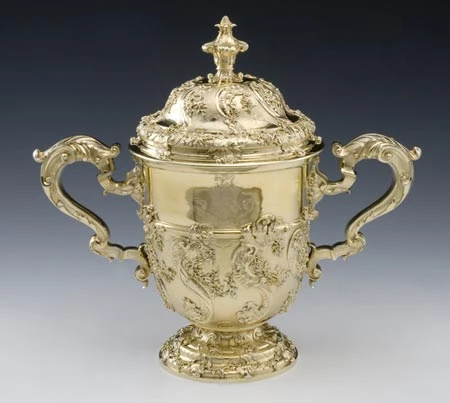
Ornamental silver cup and cover

Silver Cup and Cover, Paul Crespin, 1733

Silver Cup and Cover, Paul Crespin, 1733

Owning and displaying a large silver cup and cover was a mark of wealth and status for centuries in Britain. By 1700 such cups were no longer drinking vessels. They became entirely ornamental and a focus for the skills of their designers and makers.

William Lewis Hughes

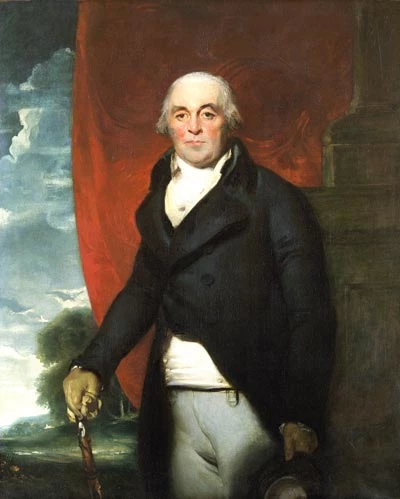
Sir Thomas Lawrence's (1769 - 1830) portrait of Thomas Williams (1737-1802) oil on canvas; 127.5 x 102.1 cm.

Sir Thomas Lawrence's (1769 - 1830) portrait of Thomas Williams (1737-1802) oil on canvas; 127.5 x 102.1 cm.

A hundred years later, a particularly splendid cup made in 1733, and now in Amgueddfa Cymru, was the prized possession of one of the wealthiest men in Wales, William Lewis Hughes (1767—1835), of Kinmel Park, Denbighshire. This tells us something about a growing taste at the time for antiques, rather than the new.

The cup bears the mark of Paul Crespin, together with London marks for 1733-4. Crespin was born in 1694 into a French Protestant family. He set up business in London in 1720, and although he was recorded as bankrupt in 1747, he seems to have continued working there until 1759.

Crespin was one of the most cosmopolitan and sophisticated makers of his day. As early as 1724 he made a "curious silver vessel for bathing, which weighed about 6030 ounces" (now lost) for the King of Portugal.

He had many important clients, and his masterpiece is perhaps the celebrated "Neptune" centrepiece of 1741 in the Royal Collection, an elaborate rococo object made for Frederick, Prince of Wales.

A large silver cup

Detail of the cup cover

Partly because of the wealth derived from the Parys copper mine and partly because of the energetic personality of Edward Hughes, the family was to become spectacularly rich.

The cup is exceptionally large, standing 14 inches high and weighing over 150 troy ounces — a cup and cover of 1731 by Crespin's associate Abraham Buteaux and described as "large" in 1749 weighed only 94 ounces.

It is ornamented entirely in the newly fashionable rococo manner, and would have seemed quite novel. The foliage and vine decoration also appear on a pair of wine coolers made by Crespin for the Duke of Marlborough in the same year, and the double scroll handles appear a little later on cups by George Wickes, Paul de Lamerie, John Le Sage and John White.

Coat of arms

The arms of William Lewis Hughes of Kinmel.

The arms of William Lewis Hughes of Kinmel. Note the arms of its original owner have been erased.

The engraving is of very high quality, remaining crisp, with little sign of surface wear. The arms of its original owner have been erased, presumably because the cup came on the market in the early 19th century. Its surface may originally have been white silver, rather than gilt. The present, rather brassy gilding is contemporary with the later armorials that can be dated to around 1830. It is interesting that the cup was 'improved' and resold in this way.

The cup's new owner was William Lewis Hughes of Kinmel. It probably came into his possession before he was raised to the peerage as Lord Dinorben in 1831, as his arms, which are engraved on both sides of the cup, have what appears to be an added Baron's coronet and lack the heraldic supporters that he was to adopt as a peer.

Parys copper mine

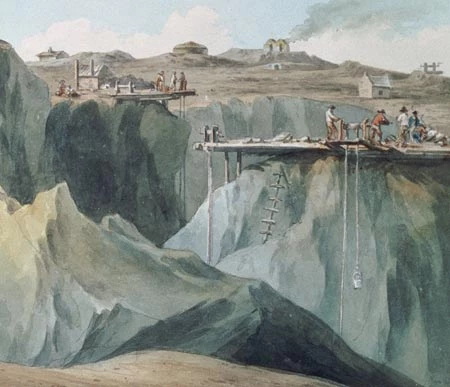
Junction of Mona and Parys Copper Mine as depicted in 1790.

Junction of Mona and Parys Copper Mine as depicted in 1790.

Hughes's mother was the niece of William Lewis of Llysdulas, Anglesey. With her husband the Rev. Edward Hughes she became heir of the Llysdulas estate, which included one side of Mynydd Parys. Partly because of the wealth derived from the Parys copper mine and partly because of the energetic personality of Edward Hughes, the family was to become spectacularly rich.

The Copper King

Foliage and vine decoration

The cup engraved ornament is of very high quality, remaining crisp, with little sign of surface wear.

William Lewis Hughes, the first Lord Dinorben, was colonel of the Anglesey Militia and MP for Wallingford from 1802 to 1831. From 1819 his London home was Bute House, South Audley Street. Edward and William Hughes were business partners of Thomas Williams, the 'copper king', whose portrait by Lawrence is also in the collections of Amgueddfa Cymru.

The cup was later owned by the Edwardian financier and philanthropist Sir Ernest Cassel (1852-1921), and was acquired by the Museum in 2005 with the support of the National Heritage Memorial Fund and the Art Fund.

The disappearance of the rural Welsh cottage

6 July 2007

Mud walls and thatched roofs

Today, hardly any rural cottages erected since before the middle of the eighteenth century survive in Wales — it was generally believed that the poor simply could not afford materials good enough to last. New research suggests that this is not the case.

In fact, cottages were built with great ingenuity and attention to detail, using the best materials available locally.

Examination of Welsh cottages and the study of contemporary surviving accounts by Amgueddfa Cymru have concluded that it was a lack of maintenance and, above all, changing fashions brought about by the Industrial Revolution that led to their disappearance.

Sustainable construction

Transporting materials cost money so traditional builders were expert at exploiting their local environment in a sustainable way. Cow dung, for instance, provided fertilizer for the fields, was used in the making of clay flooring, added to help bind cottage walls and also as a fire-retardant for chimneys made of woven wattle.

Earth and turf

As the poor could not afford bricks, cottage walls were built from stone, earth or timber. They used whatever they could most readily and cheaply get. In western lowland areas of Wales — Anglesey, Llŷn and west Wales — that was often earth.

Few earth cottages survive in Wales today; many more can by found in the drier areas of England. In the very wet uplands, many turf-walled cottages were built, as turf lasted much longer than earth.

Thatched roofs

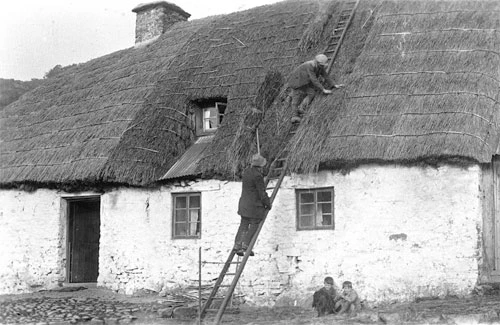
Up until the development of the great slate quarries of north Wales in the 19th century, and the coming of railways, thatch was a very common material. Today, very few thatched roofed buildings survive compared to in England.

Four different thatching techniques were common in Wales; only one still survives today in eastern Wales.

In west and north Wales the top coat of thatch was formed of knotted handfuls of straw thrust with a forked implement into a thick underthatch layer. The underthatch itself was often laid on a woven wattle foundation.

In the most exposed areas, the roof could be held down by a network of ropes pegged to the walltop, or held down by heavy stones.

Chimneys of straw and wattle

Cottage floors were often earth or mud. Partitions could be made of woven wattle or straw rope, covered with daub. The smoke hood above the chimney-stack was also often of daubed wattle, as was the chimney stack itself; no wonder that so many of these cottages were destroyed by fire.

But however sustainable the building materials used in these cottages, they fell prey to changes in society, and to fashion.

Changing fashions

With the growth of the Industrial Revolution, and the importation of food from abroad, more and more people left the countryside, most of them cottage dwellers.

More and more cottages, too, became the property of great estates, who began building larger homes for their workers. It was often easier to demolish the early cottages than it was to give them a second storey or to adapt them.

Today, traditional early cottages are rare survivals, and all the best remaining examples are listed as being of special architectural importance.