
A Rose Garden Restoration
6 July 2007

The original canal layout discovered
The original canal layout discovered
Over the past few years, increasing emphasis on fitness and green issues have helped give the bicycle a new lease of life. Today bikes are available in a wide range of styles and prices, but the first bicycles to be produced were extremely expensive and very difficult to ride.
A Cardiff couple on a lady-front tandem. The man, a piano tuner, was blind.
Bikes called High Ordinaries, later known as Penny farthings were particularly uncomfortable and required the rider to have very long legs, in order to reach the pedals.
In the 1870s the new cycle owners formed exclusive clubs, had caps emblazoned with their badges and wore military-style cycling suits. Although women initially steered clear of bicycles many became enthusiastic tri-cyclists, choosing more stable three wheeled varieties and special clothing designed for safety and comfort. Pleated skirts allowed more freedom of movement and the more modest individuals often wore breeches beneath their skirts.
There was a bicycle boom in the 1890s. New models were appearing almost weekly and new factories making bicycles opened up all over the country. The development of the safety bicycle, with chain-driven wheels of equal size, meant cycling was no longer restricted to tall athletic men. As cycling became more common cyclists' dress became less strange and men stopped wearing their cycling suits and began simply to wear their everyday clothes.
Because women were initially riding men's bicycles for which skirts were totally unsuitable, the Rational Dress Society and many cycling clubs encouraged them to wearing of a form of knickerbockers known as 'rationals'. The 'rationals' were not flattering and made their wearers objects of public ridicule. This proved too much for most women and by the turn of the 20th century most women had stopped wearing them.
As mass production brought bicycle prices down, the working classes grasped the opportunity to own their own transport. Bicycles replaced the pony and trap for the country postman, helped policemen cover large areas and speeded up shop deliveries. There were even experiments with bicycle-driven fire engines.
Local ironmongers and suppliers of agricultural goods began to sell bikes and many local blacksmiths became experts at repairing them.
The desire for speed had a great effect on bicycle design. As the wheels of the early bikes were directly driven by the pedals, the only way to increase the speed was to make the wheels bigger. There were some models produced with a wheel diameter of 62 inches which weighed approximately 50 pounds. Other efforts to increase speed by reducing the weight of the machines resulted in bicycles which were only 22 pounds, needless to say they were very unsafe.
Long distance road races, such as London to John O'Groats, captured public interest and helped increase the popularity of cycling. However, as speeds increased, accidents became more and more frequent and eventually the police put a stop to racing on public highways. Controlled racing over selected courses of 50 to 100 miles were then organised by the National Cyclists Union. Road races, like the Tour de France, did not really catch on here until the early 1950s. The first Tour of Britain race, which later became known as the Milk Race, took place in 1951.
Track racing, on the other hand, was one of the original sports of the 1st Olympiad in 1896. World Championships were held in track racing from 1892, although women's events were not introduced until 1958.
The earliest bicycle in the museum's collection is called a 'boneshaker'. It dates from around 1865, has an iron frame, wooden wheels and iron tyres, and is said to be the first of its kind in Cardiff. The collection also includes a country-made wooden 'boneshaker' copied from the manufactured type and built by a local craftsman. As well as the boneshakers, the museum also has Raleigh bikes from the 1930s, World War II roadsters, a 1938 New Hudson tandem and a sociable tricycle produced in the 1880s.
Pontnewydd Cave (Denbighshire). This cave produced the oldest human remains from Wales, dated to around 230,000 years ago.
Humans have lived in Wales for over a quarter of a million years, first by the Neanderthals and then by modern humans. Evidence for the first human occupation of Wales can be found in caves around the country.
The 'Palaeolithic' or 'Early Stone Age' period is the time popularly known as the 'Ice Age'. It saw very cold periods (known as glacials) when ice covered all of Wales, and warm periods (interglacials), like the one in which we live today.
It is against this backdrop of changing climate that our earliest ancestors evolved from their African origins, migrated across Europe and Asia, and developed into modern humans.
In Wales most of the evidence we have for the earliest Palaeolithic settlements come from caves. These caves are found in limestone areas, for example in parts of Denbighshire, Gower and south Pembrokeshire.
Coygan Cave (Carmarthenshire). No human remains have been found here, just a handful of tools that show that Neanderthals used the cave briefly.
The first evidence we have for humans in Wales comes from the site of Pontnewydd Cave (Denbighshire). Here, excavations have identified the remains of an early form of Neanderthal, that lived around 230,000 years ago.
Neanderthals were hunters and their tools show that they needed to get close to their prey in order to kill. Neanderthal skeletons excavated around Europe have a very high number of broken bones, suggesting that they may often have come off worst from these encounters.
The Neanderthals at Pontnewydd Cave made tools using the local stones picked up near the cave; including cutting tools, scrapers and hand axes. Handaxes have been discovered at Coygan Cave in Carmarthenshire - a site now destroyed by quarrying.
Bout coupè handaxes (Coygan Cave). These tools are characteristic of Neanderthal technology.
Coygan Cave was used briefly as a lookout point by Neanderthals some time between 60,000 and 40,000 years ago. The cave was then used as a den by hyeanas as the last glacial began.
It is possible that this deterioration in the climate is the reason for the extinction of the Neanderthals, who died out around 35,000 years ago.
In 1823, William Buckland of Oxford University discovered a skeleton in this cave. The bones were stained red and were accompanied by bracelets and shell beads. Buckland believed that the body was that of a woman, who had lived during the Roman period. Modern science has now proved this appealing theory to be wrong. The skeleton actually belongs to a 25 year old man buried around 26,000 years ago.
Modern humans, like us, first appear in Europe about 60,000 years ago. Our appearance is marked by the use of new types of stone tools made from long thin blades struck from a block of flint. These blades were much more versatile than those of the Neanderthals.
Excavation by Amgueddfa Cymru has shown that the cave was occupied around 30,000 years ago and again around 12,500 years ago.
Early modern humans also developed the first art. Cave paintings from this period have survived in France and northern Spain - areas unaffected by the return of the glaciers. In Wales no cave art has yet been discovered, but engraved and carved bones have been found. Perhaps the most significant site to have produced this material is Paviland Cave (Gower). This is home to the earliest human burial found in Britain, dating to around 26,000 years ago.
Other caves occupied during this early part of the last glacial include Cae Gwyn and Ffynnon Beuno (both in Denbighshire), and Hoyles Mouth (Pembrokeshire). This latter cave was used around 30,000 years ago. After this time, ice sheets spread across Wales reaching their greatest extent between 20,000 and 18,000 years ago, at this time, animals retreated south, forcing the people who hunted them to follow.
Around 18,000 years ago the ice sheets began a slow retreat and the animals and people returned. We believe they had returned by around 14,500 years ago, but the earliest evidence from Wales dates to around 12,500 years ago at caves such as Paviland and Hoyles Mouth.
With the end of the last glacial, about 11,500 years ago, the evidence for people living in Wales increases greatly and changes in character. This date is used to mark the end of the Early Stone Age (Palaeolithic) and the start of the Middle Stone Age (Mesolithic).
Ice Age hunters: neanderthals and early modern hunters in Wales by Stephen Green and Elizabeth A. Walker. Published by the National Museum of Wales (1991).
The Caerwent peacock. Many colours have been used to create the peacock - blues, yellows, greens and reds of varying shades.
Excavation at the Roman fortress of Caerleon, 10km (6 miles) from Caerwent, has revealed a range of original pigments. These include red and yellow ochre, as well as a pellet of the rare Egyptian blue.
A selection of natural minerals used by the Romans to make pigments. These illustrate the vibrancy of colours available to the Roman wall painters.
This reconstruction of the peacock shows how it might have looked when first painted. The pigment is applied to the plaster when it is still wet, becoming fixed to the wall as it dried. This technique is known as fresco painting.
Study of a fragile wall painting from Caerwent has revealed some of the influences Romans brought to the lives of native Britons.
The Roman conquest brought parts of Wales into contact with the style and sophistication of Imperial Rome. For wealthy Britons this contact offered a chance to share in the lifestyle of the invaders. For craftsmen it offered the prospect of new patrons and greater profits.
In the Roman world it was common for the wealthy to have the walls and sometimes the ceilings of their rooms painted with brightly coloured panels, floral motifs, or scenes from mythology. But, before the Roman conquest, wall painting in this style was unknown in Britain - here was a new craft, and one that appears to have been quickly seized upon.
It is in the Roman town of Caerwent that we have some of our best evidence for the work of the wall painters.
One piece that has attracted particular interest is a painting of a peacock from a late 3rd century AD house at Caerwent excavated in the 1980s.
Enough fragments of the peacock have survived to allow its original appearance to be recreated. It would have been painted as a fresco, that is while the plaster was still wet, the colours becoming bonded into the surface as it dried. Many colours have been used to create the peacock - blues, yellows, greens and reds of varying shades. The picture itself is on a white background within a blue frame.
While the peacock is itself a work of art, it is the pigments from which it was produced that tell us most about the wide cultural and trade contacts of Roman Britain.
For example, the blue pigment is an artificial colour first developed in Egypt but then manufactured in Italy, where a wealthy businessman set up production in the 1st century BC. It was made from heating together a mixture of sand, natron and copper, and was sold around the empire in the form of small balls to be ground up by the painter as required.
The bright red in the picture is cinnabar or vermillion (mercuric sulphide) mined in Sisapo, Spain and distributed from Rome. Trade in the pigment was so lucrative that the government had to fix its price to stop it rising. It has only been identified on 20-30 sites in Britain - an indication of its rarity.
Not all the pigments were imported from overseas - some of the red ochre in the peacock was probably mined locally, possibly in the Forest of Dean. However, the presence of the exotic pigments demonstrates a lot more than just artistic taste. They would have been a statement to anyone who visited the house with the painted peacock, that its owners were both aware of and able to afford the luxuries that came with a place in the Roman Empire.
Caerwent Roman Town by R. J. Brewer, Published by Cadw (2006)
Wall-painting in Roman Britain by N. Davey and R. Ling. Published by the Society for the Promotion of Roman Studies (1981).
Tredegar House and Park. The house and grounds are now in the ownership of Newport County Council. Many rooms have been restored and are open to the public. Image © Steve Burrow.
Man's short coat, dating to the early 1720s. The fabric is white taffeta with a lace pattern.
This coat was probably worn by Sir William Morgan. It is of yellow lace pattern silk, dated to about 1725, and is of either English or French origin.
Silver embroidered blue damask court mantua (an open fronted gown with an elaborate train), made in the 1720s.
An English silk robe and petticoat, dating to about 1745-47. Although this has been remade, the fabric survives in good condition. It has a yellow taffeta ground with white cannelè stripes and is brocaded with roses in coloured silks.
In the 18th century a gentleman's rank in society could be discerned from the quality of his house or his clothing - status was declared by the wearing of costly silks, lace or gold thread. Silks woven in the flourishing silk industry of Spitalfields in London and elsewhere were bought by Welsh families and brought to Wales to furnish their homes, dress themselves, and impress their neighbours.
The Morgans of Tredegar House, later Lords Tredegar, were one of the wealthiest families in Wales. They used rich silk furnishings in their home, as described in the inventory of 1698:
"4 green Silke Damask chequer curtains flowred with gold colour and lined with white chequer silke with double valiance, foot valiance, teaster and quilte imbroidred with Silke frings."
In the same bedroom there were four window curtains of white damask and seven silk cushions matching the bed hangings, all protected by a suite of orange dust covers.
In addition, the Morgans dressed themselves in the finest and most fashionable woven damasks and brocaded silks, some of which are now housed at St Fagans National History Museum, donated in 1923 by Lord Tredegar. Most date to the middle of the 18th century.
One robe and petticoat of French origin may have belonged to Martha Morgan, wife of Thomas Morgan, part of the Mansel family of Margam (and later of Penrice), one of the wealthiest families in the county. Thomas Morgan was succeeded by his brother, who considerably added to the estates. When his son, Sir William Morgan, inherited in 1719, he was able to embark upon a very flamboyant way of life.
In 1724 Sir William married Lady Rachel Cavendish, daughter of the Duke of Devonshire, who brought with her a dowry of £20,000. A number of items from Tredegar House date from between 1720 and 1731, when Sir William died. All of these garments match Sir William's reputation for extravagance - his annual expenditure in 1725 amounted to £37,418 (over £3.8 million or .9 million in today's terms) - and all would almost certainly have been bought in London.
Lady Rachel survived her husband for fifty years, and when her only son died unmarried in 1763, she lost a battle in the courts and her brother-in-law Thomas Morgan succeeded to the estate. Most of the remaining Tredegar garments belong to this period and were probably worn by Lady Rachel or Jane, the grand-daughter of John Morgan (born 1731), who had married in 1758 and was later to inherit the estate.
Since none of the Tredegar silks post-date Lady Rachel's life it is tempting to conclude that they all belonged to her and were packed away after her time, only being rediscovered by the family for their fancy dress possibilities during the following century.
This pictured garment had been remade and worn as fancy dress, probably during the 19th century. In 1971 it was returned to its original form, with the help of the late Janet Arnold. The later stitching was removed, which involved unpicking bust darts and the removal of stitching where the train had been caught up in several places, presumably in order to hide the fact that part of it had been cut away. The petticoat itself had not been altered.
This is a very grand robe which would have been worn for presentation at court. Lady Rachel Morgan was certainly sufficiently important to have worn it.
Social conditions at Tredegar House Newport in the 17th and 18th centuries, by M. R. Apted. In Monmouthshire Antiquarian, vol. 3:2, p124-54 (1972-3).
Tredegar House by David Freeman. Published by Newport Leisure Services Department (1982, revised edition published 1998).
Silk designs of the 18th century in the collection of the Victoria & Albert Museum by Natalie Rothstein. Published by the Victoria and Albert Museum (1990).
Woven Textile Design in Britain to 1750 by Natalie Rothstein. Published by the Victoria and Albert Museum (1994).
A court mantua of c. 1740 by Janet Arnold. In Costume (Journal of the Costume Society), vol. 6, p48-52 (1972).
What can you find in the garden?
If you go down to the beach today….
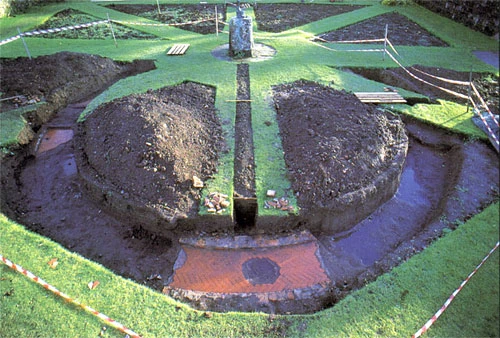
The original canal layout discovered
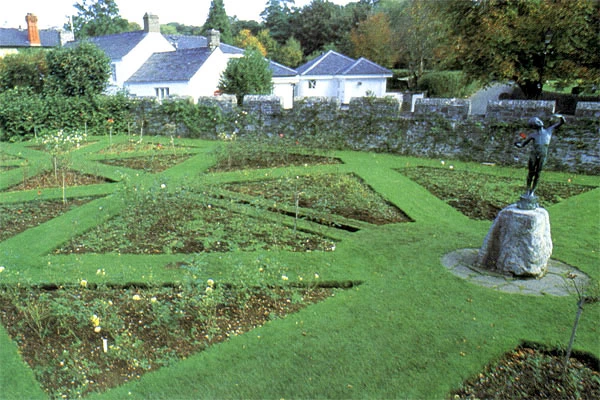
The Museum's 1951 design with the statue of 'Joyance'
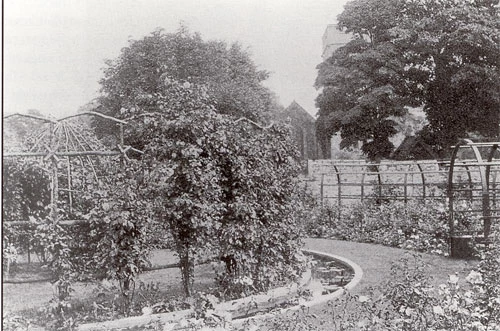
The Rosery in 1902
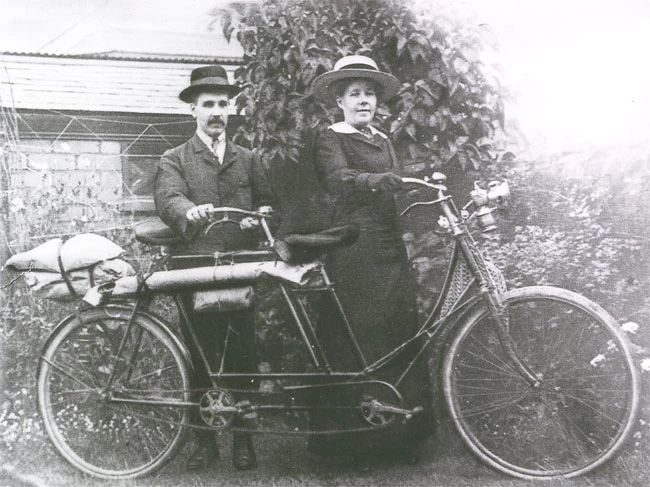
A Cardiff couple on a lady-front tandem. The man, a piano tuner, was blind.
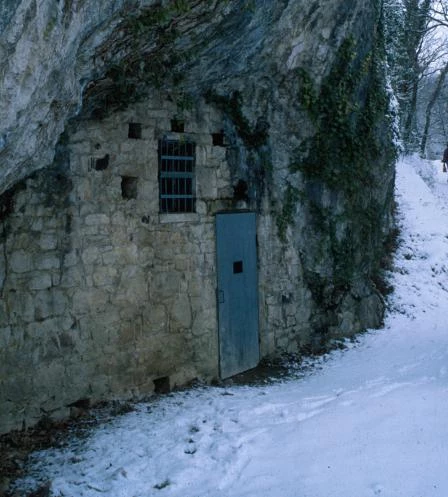
Pontnewydd Cave (Denbighshire). This cave produced the oldest human remains from Wales, dated to around 230,000 years ago.
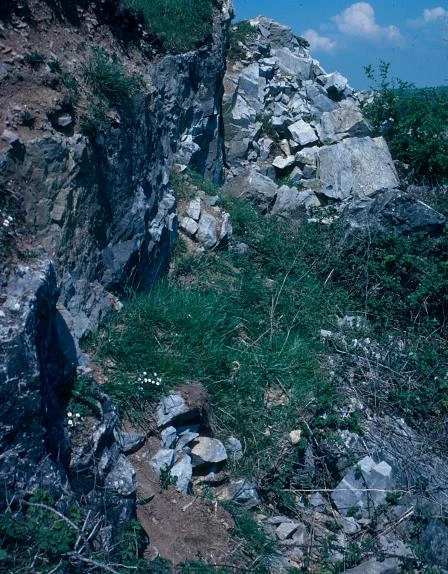
Coygan Cave (Carmarthenshire). No human remains have been found here, just a handful of tools that show that Neanderthals used the cave briefly.
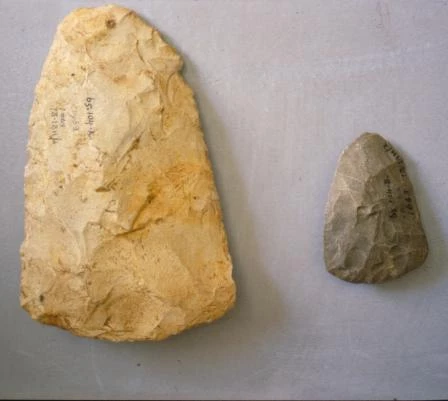
Bout coupè handaxes (Coygan Cave). These tools are characteristic of Neanderthal technology.
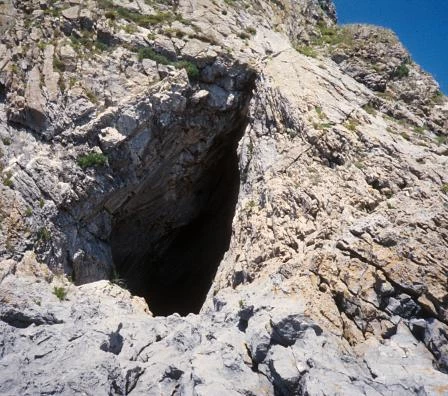
In 1823, William Buckland of Oxford University discovered a skeleton in this cave. The bones were stained red and were accompanied by bracelets and shell beads. Buckland believed that the body was that of a woman, who had lived during the Roman period. Modern science has now proved this appealing theory to be wrong. The skeleton actually belongs to a 25 year old man buried around 26,000 years ago.
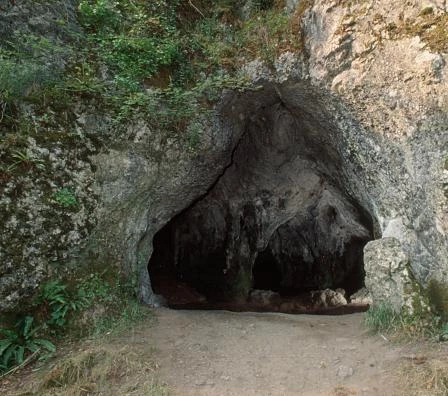
Excavation by Amgueddfa Cymru has shown that the cave was occupied around 30,000 years ago and again around 12,500 years ago.
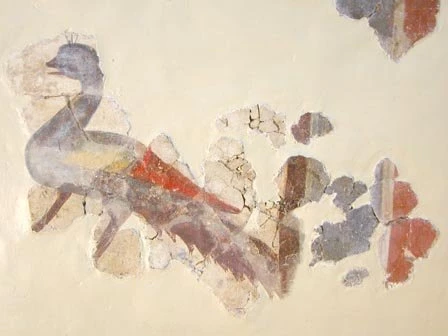
The Caerwent peacock. Many colours have been used to create the peacock - blues, yellows, greens and reds of varying shades.
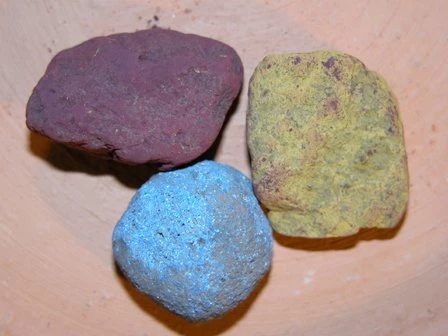
Excavation at the Roman fortress of Caerleon, 10km (6 miles) from Caerwent, has revealed a range of original pigments. These include red and yellow ochre, as well as a pellet of the rare Egyptian blue.
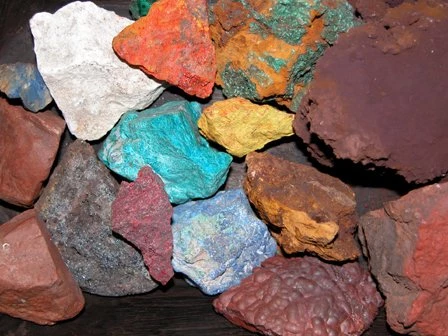
A selection of natural minerals used by the Romans to make pigments. These illustrate the vibrancy of colours available to the Roman wall painters.
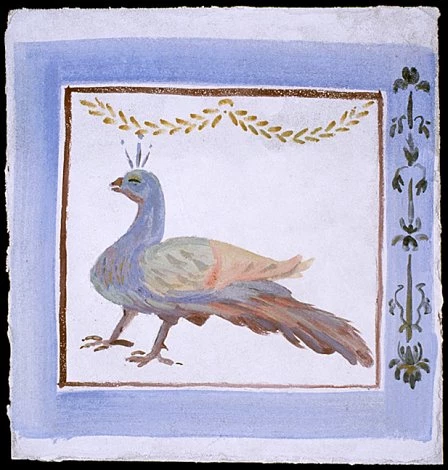
This reconstruction of the peacock shows how it might have looked when first painted. The pigment is applied to the plaster when it is still wet, becoming fixed to the wall as it dried. This technique is known as fresco painting.
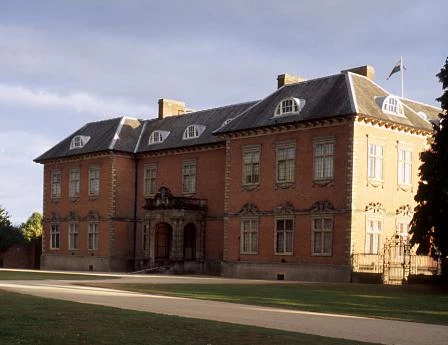
Tredegar House and Park. The house and grounds are now in the ownership of Newport County Council. Many rooms have been restored and are open to the public. Image © Steve Burrow.
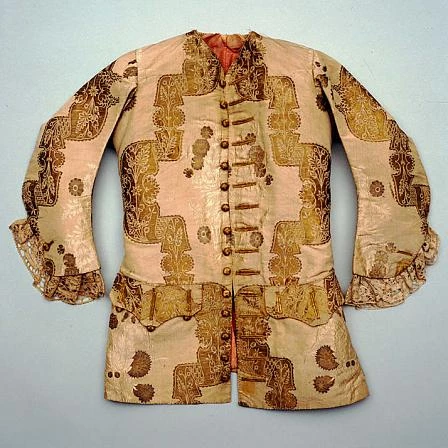
Man's short coat, dating to the early 1720s. The fabric is white taffeta with a lace pattern.
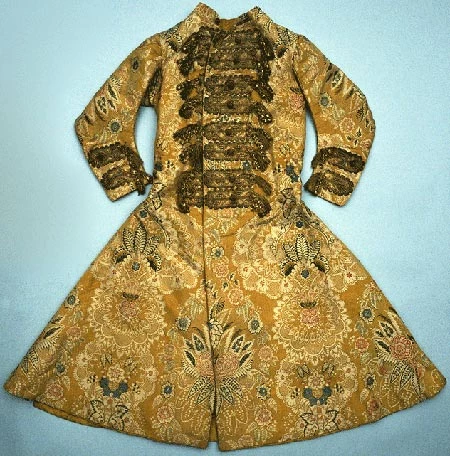
This coat was probably worn by Sir William Morgan. It is of yellow lace pattern silk, dated to about 1725, and is of either English or French origin.

Silver embroidered blue damask court mantua (an open fronted gown with an elaborate train), made in the 1720s.
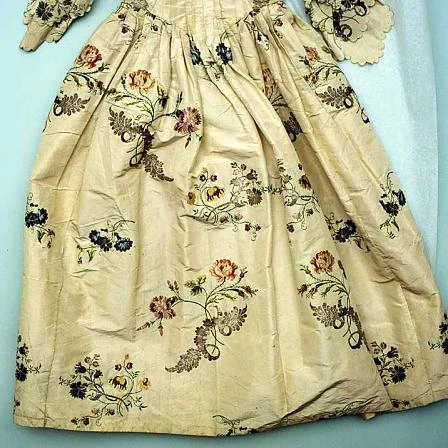
An English silk robe and petticoat, dating to about 1745-47. Although this has been remade, the fabric survives in good condition. It has a yellow taffeta ground with white cannelè stripes and is brocaded with roses in coloured silks.