: Housing & The Home

Medieval Cardiff

4 May 2007

Capital city of Wales

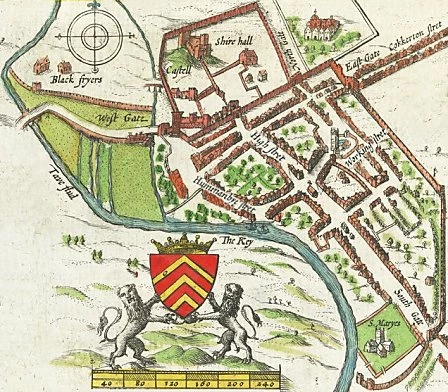
John Speed's map of 1610. Speed's plan of Cardiff reveals many aspects of the city's development, including the majority of features described in this article.

John Speed's map of 1610. Speed's plan of Cardiff reveals many aspects of the city's development, including the majority of features described in this article.

Travelling around Cardiff, capital city of Wales, it is easy to forget that this modern city's origins were laid many centuries ago. The heart of the city was formed during the medieval period and many traces from this time survive today, especially close to the castle.

Cardiff lies at the centre of three river systems, the Taff, the Ely and the Rhymney. Its location allowed its first residents to control trade and movement along these rivers, giving them power over a large area.

Roman Cardiff

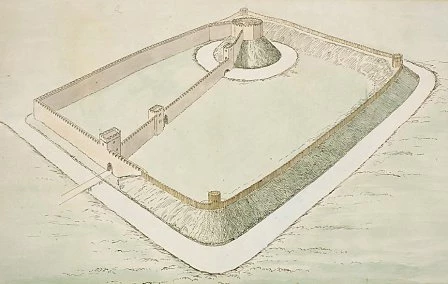
Cardiff Castle as it might have appeared in the 14th century.

Cardiff Castle as it might have appeared in the 14th century. The inner face of the medieval bank still survives within the castle grounds and on close inspection the foundations for the medieval east wall can still be seen on the top of the bank.

The first people to take advantage of this location were the Romans who set up a fort here about AD55-60. This dominating fort protected its inhabitants until about AD350-375 when it was abandoned at the end of Roman rule in Britain.

The stone walls of the fort provided later generations with a massive source of building materials, while a further legacy from the Romans was a network of roads linking Cardiff with neighbouring areas.

The medieval castle

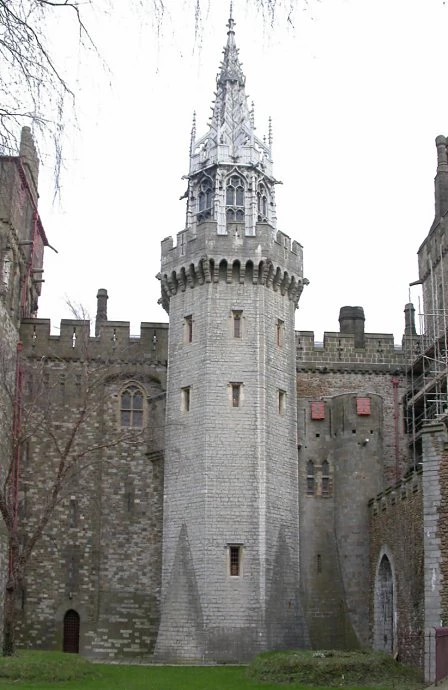
Beauchamp's tower, Cardiff castle.

Beauchamp's tower, Cardiff castle. Richard Beauchamp, Earl of Warwick, built this tower in the 15th century, to protect the castle's west gate. Openings at the top of the tower allowed stones or burning objects to be dropped on attackers. The unusual spire was added in the 19th century.

Today, much of Cardiff's Roman remains are lost beneath the medieval castle. The castle dates from the 11th century, when the Normans conquered Glamorgan. It was begun by William the Conqueror on his return from St David's in Pembrokeshire, in 1081. This is supported by an inscription on a coin found within the castle grounds which suggests that William may have established a mint at the castle.

Cardiff Castle was originally built in wood. In the 12th century, Robert Consol, Duke of Gloucester, rebuilt it in stone. At this time, the Castle's west and south walls were raised, building upon the ruined walls of the Roman fort.

Owain Glyndŵr

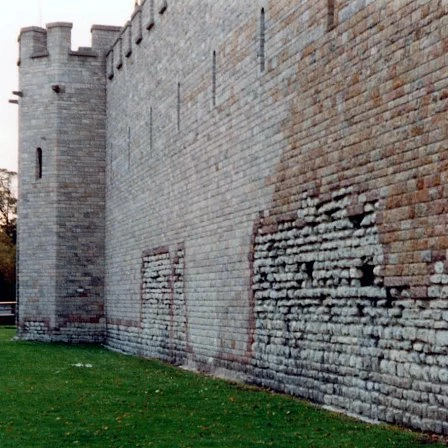
The castle wall, Cardiff.

The castle wall, Cardiff.

In 15th century, town was destroyed by Owain Glyndŵr's Welsh army. The Castle lay in ruin until Richard Beauchamp, Earl of Warwick, restored the defences and castle buildings in 1423. Beauchamp also constructed the octagonal tower, now known as Beauchamp's tower.

Much of the rest of the castle and walls dates to the 19th century, when the third Marquis of Bute employed William Burges to restore, refurbish and rebuild it.

The medieval town

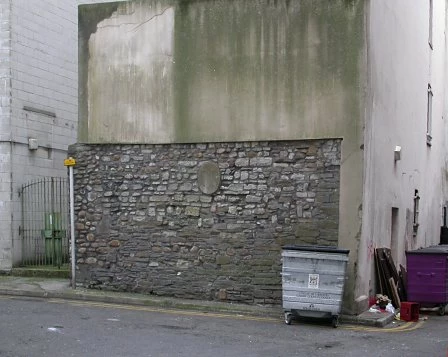
Medieval town wall, Cardiff. Sadly, this is the best preserved section of Cardiff's town walls. It is now hidden behind retail developments along Queen's Street.

Medieval town wall, Cardiff. Sadly, this is the best preserved section of Cardiff's town walls. It is now hidden behind retail developments along Queen's Street.

Cardiff's Shire Hall was built inside the castle's walls in the 15th-century. It was in use as the town's administrative centre until the 17th century.

The medieval town spread out from the castle's South Gate. Interestingly the High Street lines up with the Roman rather than the medieval south gate, suggesting it dates from this earlier period.

The Medieval town probably developed in two stages. The first stage was within a relatively small enclosure marked out by Working Street and Womanby (Hummanbye) Streets' both names are linked to old Norse. In the second stage of its development, Cardiff expanded south. The town was then enclosed and defended to the east by a bank and ditch and eventually a stone gate. To the west, the town was protected by the meandering river Taff.

Remains of the medieval wall

Only two sections of the medieval wall are known to survive. The first supports a flower bed just east of the Roman fort wall, while the larger surviving piece is across the road behind retail outlets. Much of the surviving foundations of the wall were destroyed by the large shopping centres which swallowed up many of the small medieval alleyways of the city.

Remains of the castle wall

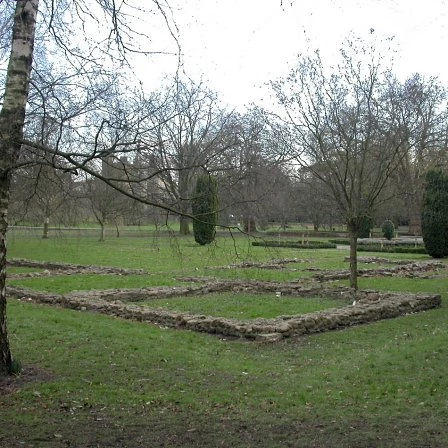
The remains of Blackfriars, Cardiff, in Cooper's Field beside the castle.

The remains of Blackfriars, Cardiff, in Cooper's Field beside the castle.

The lower section of the castle wall belonged to the Roman fort, while the upper section was added in the 1920s. During the medieval period, building plots were packed so tight against the Roman wall, that some of the inhabitants were forced to extend their homes backwards through it. This can be seen in the undulating profile of peaks and troughs along the surviving length of the Roman wall.

Religion

In the centre of Cardiff stands St John's church. Its earliest surviving stonework is mid 13th century and its tower was added around the 1470s. Much of the church we see today was rebuilt during the 18th century.

To the east of the castle lay the monastic settlement of Greyfriars, while to the west lay the Blackfriars, both were established around 1256-80. The friars were an active part of Cardiff life until the 1530s when Henry VIII dissolved their monasteries. By 1610, the Blackfriars buildings was in ruins, while the Greyfriars building was converted into a mansion of the Herbert family. The ruins of this mansion survived into the 20th century until they were pulled down to be replaced by a multi-storey car park and tower block. The foundations of Blackfriars were revealed during the 19th century, while the Marquis of Bute was renovating his gardens. These were opened to the public as a park in the 1940s.

Background Reading

'Cardiff Castle excavations, 1974-1981' by Peter Webster. In Morgannwg, vol. 25, p201-11 (1981).

Cardiff Castle: its history and architecture by J. P. Grant. Published by William Lewis (1923).

Medieval Town Plans by B. P. Hindle. Published by Shire Archaeology (1990).

The Cardiff Story. A history of the city from its earliest times to the present by Dennis Morgan. Published by Brown and Sons (1991).
French pottery in medieval Wales

4 May 2007

Saintonge jug

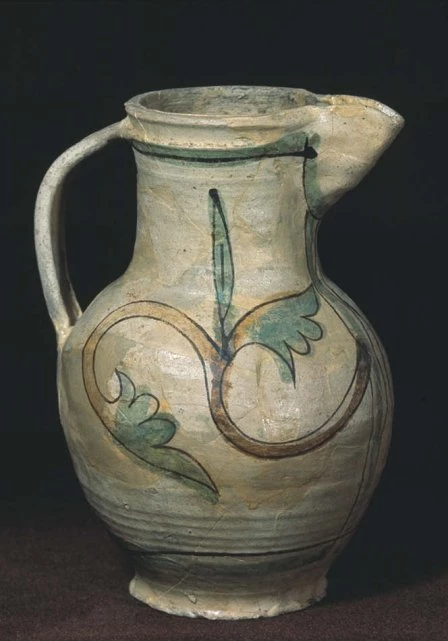
Saintonge jug from Kidwelly Castle, Carmarthenshire.

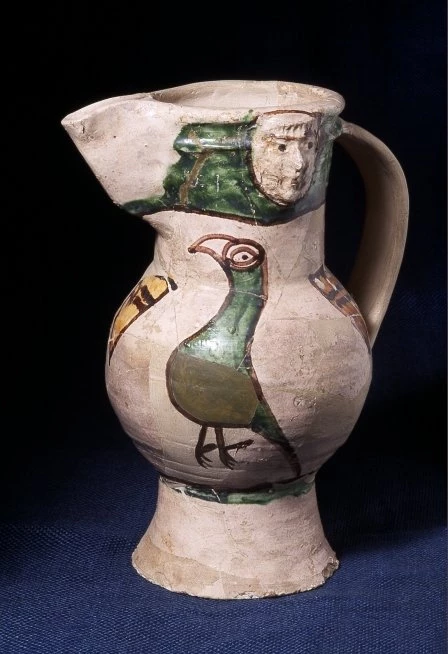
Elaborately decorated vessel found in Cardiff. 23.8cm (9.5 inches) tall.

Elaborately decorated vessel found in Cardiff. 23.8cm (9.5 inches) tall.

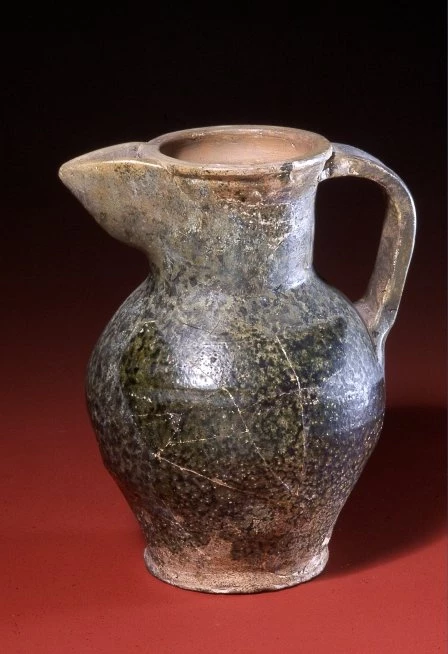
Jug found in the well at Castell-y-Bere, Gwynedd. 20.5cm (8.1 inches) tall.

Jug found in the well at Castell-y-Bere, Gwynedd. 20.5cm (8.1 inches) tall.

During the Middle Ages, several regions of France exported pottery to Britain - notably northern France, Normandy and the Ardennes. Most of the French pottery found in Wales came from the Saintonge area of south-west France.

The trade in pottery from the Saintonge area to Britain began early in the 13th-century and lasted for about 500 years. At the start of this period the English ruled neighbouring Gascony, and many of the vessels that have been found in Wales probably made their way to Britain from the ports of La Rochelle and Bordeaux as part of mixed cargoes (wine being the most important commodity).

Pottery from the Saintonge area was made from a fine clay that was well suited to the throwing of light, thin-walled shapes such as those seen here. The clay also had a low iron content, which meant that, when fired, it produced a vessel with a white or buff fabric.

The first example illustrated here was found in a midden at Kidwelly Castle (Carmarthenshire) during excavations in the 1930s. It appeared to have been thrown away along with several plainer vessels and is decorated with a vine scroll motif typical of Saintonge jugs. It was probably produced between 1275 and 1320. This elegantly decorated vessel illustrates the great skill of the Saintonge potters. It is 25cm (9.8 inches) tall and in places its walls are only 2.4mm (0.1 inches) thick.

In these years Kidwelly Castle passed from the ownership of the de Chaworth family, who greatly improved its defences, to William de Valence and then to the House of Lancaster. These later owners set about improving the castle's accommodation. This jug may have been used to pour wine in the Great Hall for one of these English owners or their guests, though such jugs may also have held water.

Saintonge pottery is known from many other sites in Wales, including Cardiff and Castell-y-Bere in Gwynedd. For the most part the ware has been found at coastal sites - locations more easily controlled by the English, or more accessible to their traders - though occasionally it has been found in remote upland sites.

  • Cardiff jug: This jug was discovered during work in Cardiff High Street in 1893. Its decoration includes birds, masks, and heraldic shields - all are common features on jugs from the Saintonge potteries.
  • Castell-y-Bere jug: Castell-y-Bere was only occupied by the English from 1284-1294. Given the frequency with which Saintonge pottery is found at other castles occupied by the English in Wales, it seems likely that the jug dates from this period.

While such pots may not even have been greatly valued by their owners, when viewed alongside vessels of silver, bronze or brass they survive as examples of great craftsmanship and illustrate links between Wales and the wider European world during the Middle Ages.

Background Reading

'Kidwelly Castle, Carmarthenshire; including a survey of the polychrome pottery found there and elsewhere in Britain', by C. Fox and C. A. R. Radford. In Archaeologia vol. 83, p93-138 (1933).

'Medieval finds from Castell-y-Bere, Merioneth' by L. A. S. Butler. In Archaeologia Cambrensis vol. 123, p78-112 (1974).

Medieval pottery and metal-ware in Wales by J. M. Lewis. Published by the National Museum of Wales (1978).

Remarkable treasures unearthed by workman

4 May 2007

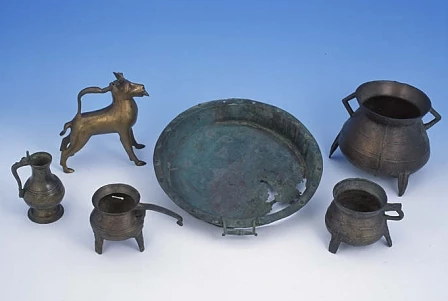
Part of the Cwm Nant Col Hoard, including the major copper-alloy pieces.

Part of the Cwm Nant Col Hoard, including the major copper-alloy pieces.

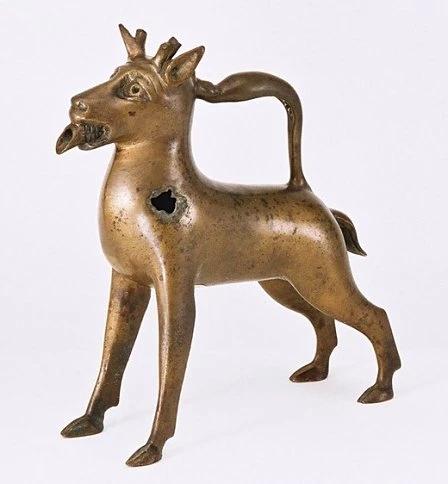
Late 13th or early 14th-century aquamanile in the shape of a stag. 26cm (10.2 inches) tall.

Late 13th or early 14th-century aquamanile in the shape of a stag. 26cm (10.2 inches) tall.

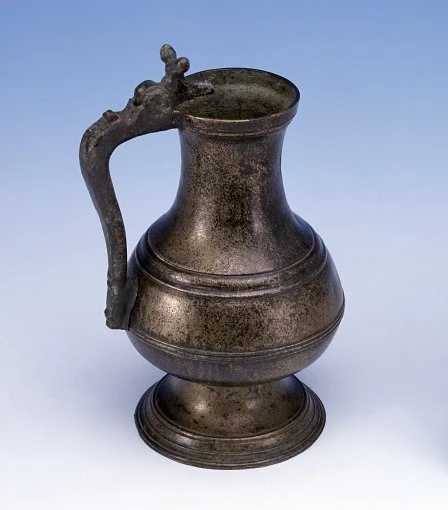
15th-century copper alloy ewer. 17.5cm (6.9 inches) tall.

15th-century copper alloy ewer. 17.5cm (6.9 inches) tall.

Copper-alloy tray or dish. 39.5cm (15.5 inches) in diameter.

Copper-alloy tray or dish. 39.5cm (15.5 inches) in diameter.

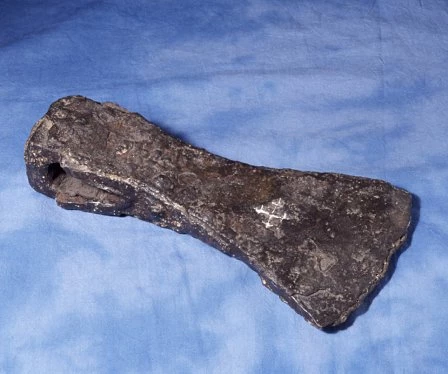
Woodman's iron axe with a maker's mark in the form of a cross. 27cm (10.6 inches) long.

Woodman's iron axe with a maker's mark in the form of a cross. 27cm (10.6 inches) long.

In 1918, a remarkable hoard of treasure was discovered by a workman mining for manganeese near Llanbedr in Gwynedd.

The hoard had been concealed in a cavity beneath a large stone on rough ground on the south side of Cwm Nant Col.

What makes the hoard so interesting is not just the wide range of objects - from a fine vessel (known as an aquamanile, used for pouring water) in the shape of a stag, to bronze skillets, a smaller water jug (known as a ewer) - but also their date. Most metalwork hoards found in Wales tend to be prehistoric, but this one was late medieval.

Extraordinary craftsmanship

One of the earliest items in the hoard is the aquamanile, dating from the late 13th to early 14th-century. Made of copper-alloy, it has a hinged lid on top of the stag's head to allow the hollow vessel to be filled with water. A short pouring spout extends from its mouth. It has been cast in a single piece, exhibiting extraordinary skill by its maker. It would have been used for ceremonial hand-washing either in a church or monastery, or at the feast table. Although the stag has lost his antlers he remains a fine example of this type of vessel.

The copper-alloy ewer is identical to one found at Strata Florida Abbey. The form and alloy composition of both of these vessels suggest parallels with 15th-century examples produced in pewter.

One copper-alloy cauldron, two skillets and tray from the hoard had a more mundane purpose, being typical items from a 15th-century kitchen - albeit a relatively wealthy one. The other items in the hoard were made of iron and included an axe and fragments from firedogs.

Scientific analysis

While we have learnt much from the style of these objects, we know much more about them as a result of scientific analysis.

The alloy composition of the aquamanile is higher in lead than zinc and tin, suggesting that it was made in Germany. The ewer may have been produced in France or England. The cauldron and skillets were made of a leaded bronze whose proportions of tin, zinc and antimony pointed to manufacture during the 14th- or 15th-century.

The diverse range of objects in the hoard, and their worn state, suggests that they had been gathered as scrap metal by a travelling tinker, probably in the early 16th-century. Why did he bury his goods on a remote hillside?

The answer may relate to the poor supply of copper to Britain in the last half of the 16th-century, and the laws that controlled the trade in bronze and brass. These laws were also intended to prevent the export of scrap metal that could be used to make cannon.

The tinker may therefore have been concealing a hoard that he had collected illegally and which might have been subject to confiscation. Alternatively, had he bought the hoard legally at a market, he may have concealed it temporarily while he tried to find more items to go with it.

As for where he might have hoped to sell his scrap, it is possible that he was heading towards Chester, or via Welshpool to the West Midlands, one of the most active areas of metal manufacturing at this time.

Background Reading

'The Nant Col Hoard of medieval metalware' by J. M. Lewis, R. Brownsword, E. E. H. Pitt and T. Ciuffini. In Archaeologia Cambrensis vol. 136, p156-70 (1987).

Prehistoric feasting in south Wales

4 May 2007

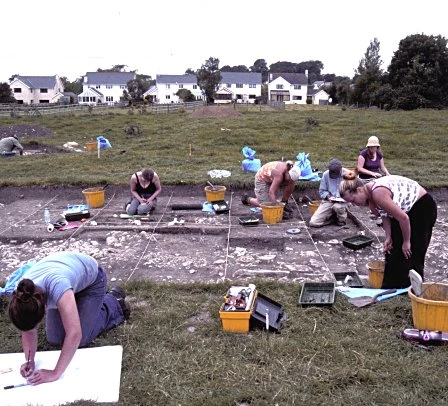
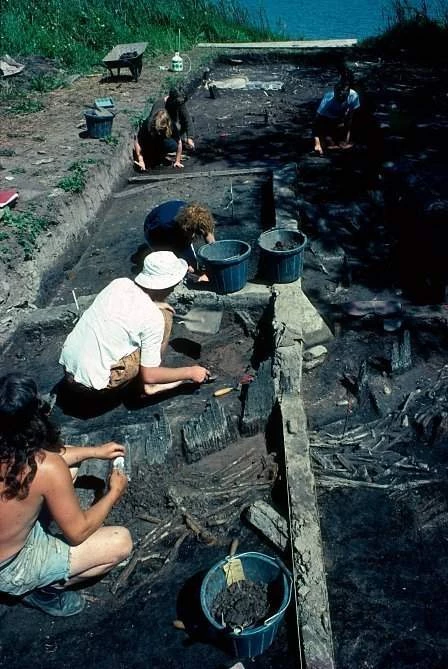
Excavations at Llanmaes in 2004.

Excavations at Llanmaes in 2004.

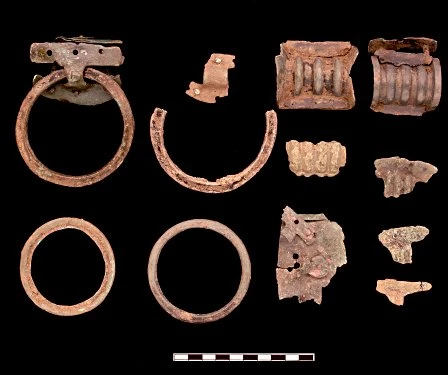
Handles and straps from cauldrons and bowls found at Llanmaes. Cauldrons were large bronze vessels used during feasts.

Handles and straps from cauldrons and bowls found at Llanmaes. Cauldrons were large bronze vessels used during feasts.

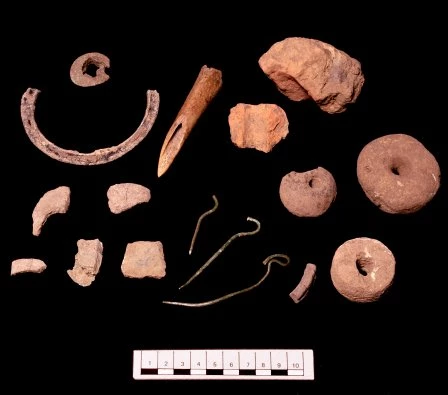
Finds from Llanmaes 2004: axe and cauldron fragments, swan's neck pins, spindle whorls and loom-weights.

Finds from Llanmaes 2004: axe and cauldron fragments, swan's neck pins, spindle whorls and loom-weights.

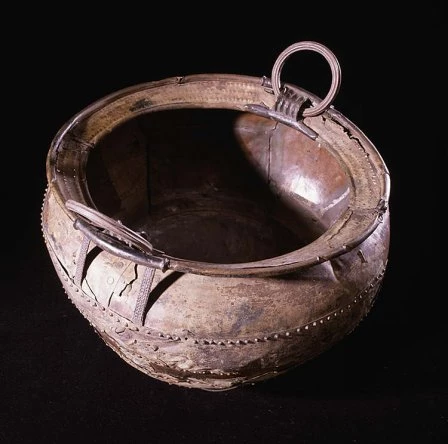
One of the two complete cauldrons from the Llyn Fawr hoard, Rhondda Cynon Taff.

One of the two complete cauldrons from the Llyn Fawr hoard, Rhondda Cynon Taff.

The discovery of a three-thousand-year-old settlement sheds new light on life in prehistoric Glamorgan.

In February 2003 a number of unusual metalwork items were unearthed at Llanmaes in the Vale of Glamorgan. The finds included bronze axes, horse harness fittings and fragments from bowls and cauldrons. Some of the bowls were of a previously unknown type.

Following the finds, the site was subject to excavations by Amgueddfa Cymru revealing a previously unknown prehistoric settlement, including a roundhouse and oval-shaped pits. One pit contained large broken pots of a style known to have been used between 1150 and 700BC. A large red deer antler had been placed over the pit - perhaps in a religious act, or possibly to mark the spot where the pits had once been.

Prehistoric wastepit

Above the roundhouse was a midden made of discarded domestic waste, now rotted down to form a dark soil. The midden also contained pottery from the Roman period, which began many hundreds of years later. This curious mixture of prehistoric and Roman finds makes it difficult to be sure how the settlement and midden were related.

Llanmaes as a feasting site

Apart from metalwork and pottery, the midden also contained many thousands of animal bone fragments, mostly of pigs. This is a very unusual discovery in Britain, where sheep and cattle tend to be more common. Perhaps Llanmaes was once a feasting site - pig was a favourite high-status meat at this time. More surprising still, human bones were also found in the midden, although no complete skeletons were recovered.

Items uncovered at the site are wide ranging. From bowls and cauldrons to dozens of fragments of bronze axes. Five swan's neck pins, elegant dress fasteners, spindle whorls and loom-weights used to make woollen garments, were also discovered. In addition, over 1,500 pieces of prehistoric pottery was collected - the largest collection of this date from south Wales.

Dating the settlement

All this suggests the site was probably settled between 800-500BC, with the possibility that settlement began as early as 1300BC. At a later date, it is likely that there was a Romanised farmstead nearby, although its precise location has not been determined.

These exciting discoveries are helping archaeologists to understand life at the very end of the Bronze Age when iron working had just been introduced into Britain.

The Llan-gors textile: an early medieval masterpiece

3 May 2007

Excavations at Llan-gors Lake in 1991. The textile was discovered in the silts beyond the oak palisade visible in this trench.

Excavations at Llan-gors Lake in 1991. The textile was discovered in the silts beyond the oak palisade visible in this trench.

The lump of charred textile, as found lying on a piece of wood.

The lump of charred textile, as found lying on a piece of wood.

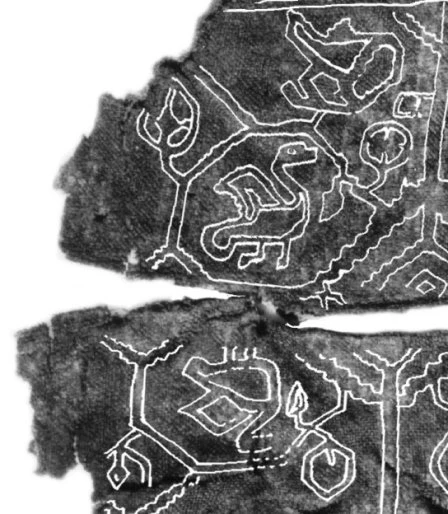
Part of the decoration preserved on the textile, showing a group of birds framed by vines. Unfortunately none of the original colour was preserved in the textile, making the design very difficult to see without assistance. It is picked out here with super

Part of the decoration preserved on the textile, showing a group of birds framed by vines. Unfortunately none of the original colour was preserved in the textile, making the design very difficult to see without assistance. It is picked out here with superimposed white lines. The total area shown is roughly 9cm tall by 7cm wide (3.5 x 2.8 inches).

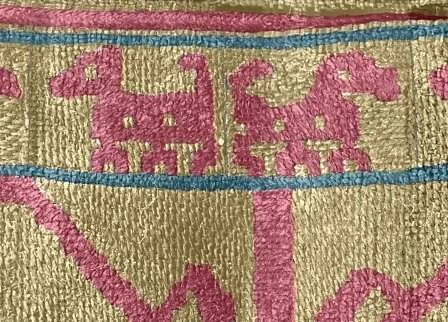
Digital-simulation of colour on a photograph of the original textile.

Digital-simulation of colour on a photograph of the original textile.

In 1990, archaeologists working at a site on Llan-gors Lake, near Brecon, made an unexpected discovery - the remains of a magnificently decorated textile, over a thousand years old.

Just off the northern shore of Llan-gors Lake lies a crannog (a man-made island) built as a royal site for the ruler of Brycheiniog in the 890s - a turbulent period in the kingdom's history.

At this time, Brycheiniog was under pressure from several neighbouring kingdoms, and Llan-gors must have seemed a safe retreat. However, excavations of the site have shown that this haven was short-lived, being destroyed by fire in the early 10th century.

Much of the archaeological work at Llan-gors focused on the waterlogged silts that surrounded the crannog. It was here that the textile was discovered, badly charred and very fragile.

Through careful conservation treatment it was possible to separate and clean its many layers revealing this unlikely lump to be among the most important finds of early medieval textile yet found in Britain.

The base material of the textile was a very fine plain-weave linen. Silk and linen threads have been used to decorate the textile with birds and other creatures within a framework of vines, and with borders containing repeating patterns or lions.

The skill with which this work has been accomplished continues to be a source of wonder. The linen has 23 threads to the centimetre - a magnificent achievement given the equipment available in the 9th and 10th centuries AD.

The textile appears to be part of a garment, perhaps a tunic or dress - it has a hem and a belt loop - but unfortunately too little survives to indicate its detailed shape.

Its owner was a person of considerable status since the silk that decorates it must have been imported to Britain, while the quality of the needlework suggest that it was produced in a specialist workshop.

So how did this fine textile come to be lost? A clue can be found in the Anglo-Saxon Chronicle for AD916, which records that in this year a Mercian army from England destroyed a site called Brecenanmere (Brecknock-mere = Llan-gors Lake) and captured 'the wife of the king and 33 other persons'.

Was this the event that saw the burning of Llan-gors and the loss of the textile? It is tempting to believe so.

Background Reading

'A fine quality insular embroidery from Llangors Crannog, near Brecon' by H. Granger-Taylor and F. Pritchard. In Pattern and Purpose in Insular Art edited by M. Redknap, S. Youngs, A. Lane and J. Knight, p91-99. Published by Oxbow Books (2001).

'Worn by a Welsh Queen?' by L. Mumford and M. Redknap. In Amgueddfa, vol. 2, p52-4 (1999).

'The Llangorse textile; approaches to understanding an early medieval masterpiece' by L. Mumford, H. Prosser and J. Taylor, in C. Gillis and M.-L. B. Nosch (eds), Ancient Textiles: Production, Craft and Society, 158-62. Published by Oxbow Books (2007).