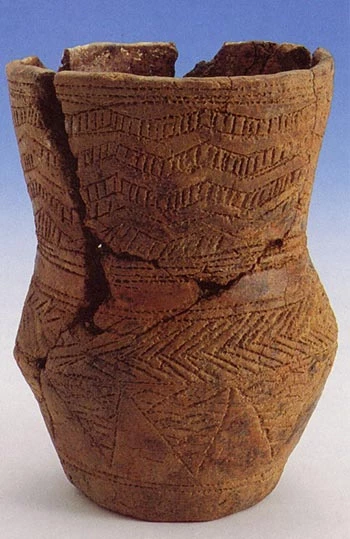
The Llandaf Beaker Man - An Early Bronze Age grave at Llandaf 12 April 2007 The Llandaff Beaker. In 1992, renovations at a house in the Llandaf area of Cardiff uncovered an unusual stone slab buried by river sands and silts. Beneath the slab was a long bone and clay pot. The pot turned out to be a beaker - a decorated clay vessel, fashionable in western Europe some 4,000 years ago, during what is known as 'the Beaker Period'. The beaker may originally have contained mead, beer or some other special brew. The stone slab marked the position of a grave. With the cooperation and encouragement of the owners, the Department of Archaeology and Numismatics conducted an excavation in the driveway to their house, to re-expose the grave and fully excavate its contents. The enclosing cist, constructed of slabs of the local Radyr Stone, was unusual in that it was the form of a lean-to, its capstone resting at an angle of 30° contrasting with more conventional box-like, beaker cists. Little of the skeleton remained. The expectation had been to find a crouched skeleton typical of the Beaker period, but only fragments of the cranium (the top of the skull) and limb bones survived. Additional grave-goods were unearthed, a bronze awl (a pointed tool for making holes, as in wood or leather) and a flint flake - objects that would have been buried alongside the person to be used in the 'next world'. Awls are usually associated with female burials. Analysis of the sediment filling the grave may explain the unusual form of the cist and why only part of the skeleton was preserved. The presence of graded water-lain sediments within the grave suggests disturbance and erosion of the burial by flood water. Today the river Taff flows close by and property where the grave was discovered is built on the former floodplain of the river.
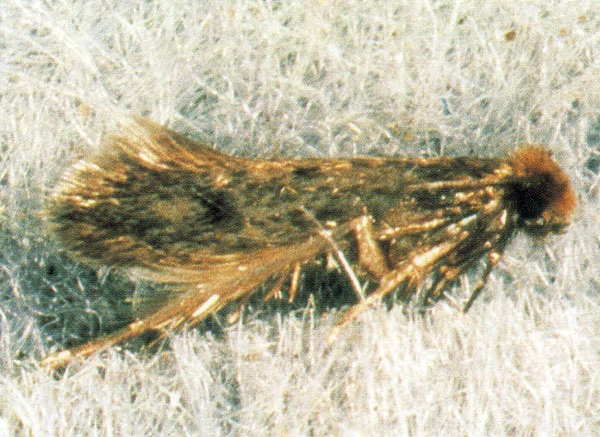
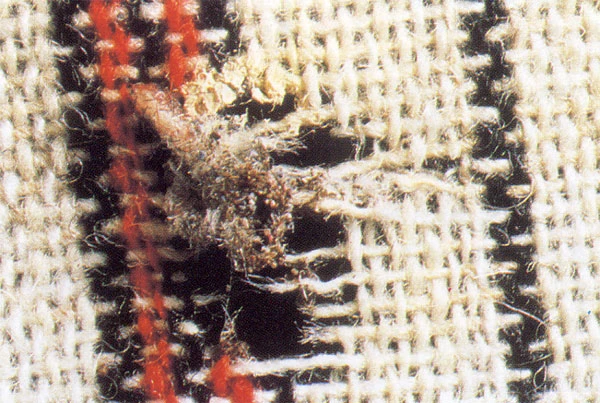
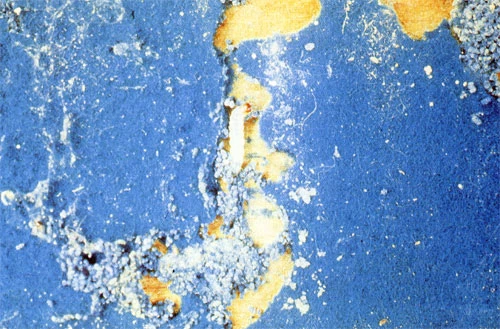
The Clothes Moth - Museums' No.1 Insect Pest 5 April 2007 Webbing cloths moth — Tineola bisselliella Moth damage. Moth larvae on piano felt. The humble clothes moth - Tineola bisselliella - is thought to be the number one insect pest in museums throughout the world. It is capable of destroying huge amounts of animal-based material. Amgueddfa Cymru is in the forefront of developing new methods in controlling this pest. Know your enemy In the past, museums fumigated collections regularly with large amounts of highly toxic insecticides to stop attacks. Modern methods of control try to recognise any problems early before any damage is caused - The key to good pest management is knowing your enemy. The common clothes moth The common, or webbing clothes moth, is a small shiny golden-coloured insect 6-8mm. long, often seen scuttling over infested material or fluttering around rooms somewhat aimlessly. The sole purpose of the males is to mate with the females (who do not fly), before dying. The females then lay tiny eggs pushed in between fibres and hairs. It is the larvae that hatch from these eggs that cause the damage. They are able to digest keratin, which is found in fur, wool, feathers, hair, finger nails etc. As this is rather a sparse diet on its own, the clothes moth larvae prefer food that is stained or dirty, meaning that dirty woollen clothing is usually attacked as are the edges of carpets where a vacuum cleaner may not reach. A protective silky web The larvae protect themselves by weaving silky tubes where they live and feed. These silky cases give it the name webbing clothes moth. When the larvae are fully grown they will pupate inside these cases and after a few weeks the adult moths emerge. The adults do not eat or cause damage themselves, but mate and start the life cycle all over again. On dirty wool in warm, moist conditions, two or three generations in a year are possible. With the humid climate of the UK and the centrally heated stores and galleries of museums, it is easy to see why the clothes moth is such a major pest. Formerly in the Museum, the practice was to react after damage was found. Now the aim is to prevent the insects entering the Museum in the first place and to make it as uninviting as possible. Store rooms have well sealed doors and windows along with filtered air conditioning systems. As museums are public buildings, then some moths, be it as adults, larvae or eggs will inevitably be brought in. A new generation of insect traps Keeping an eye out for insects and insect damage is part of the conservator's routine work which includes carefully inspecting for signs of damage, and using traps. The Museum is in the forefront of developing a new generation of insect traps designed to catch specific species such as the common clothes moth. These new traps are based on the power of sex. Females give off a scent, or pheromone - which can attract males from many metres away. This proves very effective for the moths in small areas such as cupboards and small rooms. Traps are lined with a sticky adhesive along with a synthetic version of the clothes moth pheromone. Insecticides as a last resort If, despite all these precautions, moths still manage to attack material, we only use insecticides as a last resort. A major form of pest control at the Museum is to put the object in a plastic bag and place it in a deep freeze for two to three days, killing the insects, eggs and larvae without any damage to the object or toxic residues. Through the combination of vigilance, good housekeeping and expertise, outbreaks of insect pests such as the common clothes moth are these days thankfully rare and dealt with rapidly.
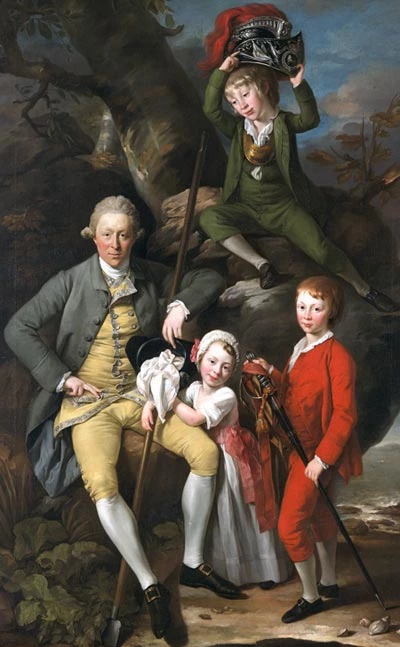
A portrait of a Welsh Squire and his children, by Johann Zoffany, distinguished painter to George III 22 February 2007 There are many portraits of well-known Welsh figures in the art collections of Angueddfa Cymru. However, the Museum also collects portraits of lesser-known people as they can be important works of art in their own right. The study of these portraits often sheds new light on when and how their subjects lived and adds to our understanding of art in the past.During the past 20 years several distinguished 18th and early 19th century portraits have been acquired by the Museum, including Henry Knight of Tythegston with his three children, painted by Johann Zoffany (1733-1810) in about 1770.Henry Knight of Tythegston with his three children by Johann Zoffany Johann Zoffany (1733-1810) Henry Knight of Tythegston (1738-1772) with his Children. c.1770 - oil on canvas The portrait shows the Glamorganshire squire Henry Knight (1738-1772) with his three children Henry, Robert and Ethelreda. Henry was a soldier in the 15th Light Dragoons, and his older son is shown trying on a helmet of that regiment. Henry Knight's father, Robert Knight (1711-1765), inherited the Tythegston estate of the Lougher family through his mother in 1732. Henry divorced from his wife in 1771, then a difficult and expensive process requiring a private Act of Parliament. The painting might have been commissioned to represent Henry Knight's decision to leave the military in order to care for his children. In the picture, he is dressed in civilian clothes, but he holds an infantry officer's spontoon, thrust blade-first into the ground. His sons hold his sword, gorget and helmet. The picture's seaside setting is probably a reference to Tythegston, a couple of miles from the coast, between Bridgend and Porthcawl. The tree motif, frequently used in Zoffany's family groups, allows all the figures to be given equal importance. Showing the boys playing with arms and armour belongs to a tradition that can be traced back to the Renaissance.Johann ZoffanyThis is one of Zoffany's largest family portraits (measuring 240 cm x 149 cm), and is a surprisingly ambitious commission for a Welsh squire of modest means. Zoffany, one of the most distinguished British painters of the reign of George III, was famous for his informal styles. One of his best-known pictures, Sir Lawrence Dundas with his grandson, shows the 17th century Dutch masterpiece The Calm by Jan van de Cappelle, also in the Museum's collections.Born near Frankfurt and trained in Rome, Zoffany moved to London in 1760. Lord Bute, George III's first prime minister, probably introduced him to the Royal Family, where he became the favourite painter of Queen Charlotte. The King nominated him a member of the Royal Academy in 1769. The appeal of Zofanny's work lies in his ability to catch a likeness and his astonishing attention to detail. His perspective, however, can be faulty, and here the helmet held by the older son is clearly too large.Purchasing the portrait for the MuseumThe picture is in a remarkably good state of preservation. X-ray examination reveals that the artist reworked the head of Robert Knight (the younger son dressed in red), but there are only a few other minor changes to the design, and most of the composition was laid on quite thinly. The picture was loaned to the Museum from 1940 until 1958. When it was offered for sale at Sotheby's in 1999 its acquisition by the Museum was a priority. The purchase was made possible by generous donations from the bequest of June Tiley, the Heritage Lottery Fund and the National Art Collections Fund.
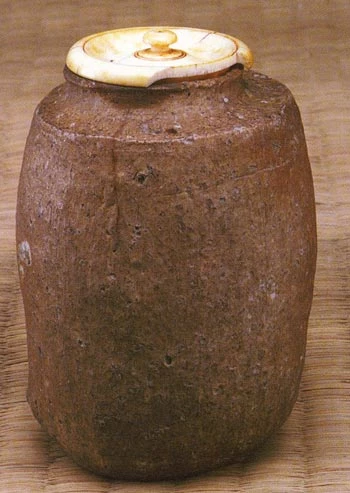
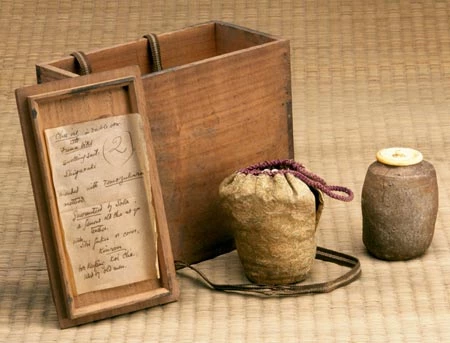
The art of the Japanese Tea Ceremony 22 February 2007 In 1915, several crates of textiles, lacquer, woodblock prints and utensils used for the Japanese tea ceremony (chanoyu), arrived at the Museum. These were sent from Japan by Bernard Leach, whose career as a potter was heavily influenced by his Japanese experiences. The items were previously undocumented and the purpose behind their acquisition was totally lost until 2001, when new archive discoveries made it possible to identify them. Chaire (tea jar), Shigaraki stoneware, probably late 16th century '...something unique' When Bernard Leach first went to Japan he was a young artist just discovering Japanese pottery. However he was soon to become the pre-eminent British potter of the 20th century. He did not doubt the value of the collection, describing it as 'something unique.' Taking advice from Japanese tea masters, he brought together objects of the type most valued in the Japanese chanoyu tradition, following principles established back in the 16th century. These dictate that the objects used should be simple and unpretentious, and contribute to the quiet sense of contemplation that a tea ceremony inspires. The chaire (tea jar) sent by Leach displays these qualities perfectly. It is an example of the roughly made stoneware of Shigaraki, prized by tea connoisseurs since the 15th century. Guests would traditionally take pleasure in examining and praising such an object after the host had finished serving tea. Recreating chanoyu Chanoyu is an art of life, a highly ritualised act of hospitality. Objects are chosen, arranged and handled with meticulous care, so that the combination of objects and people, time and place, makes each ceremony a unique and unrepeatable occasion. Leach was insistent that this same regard was observed when the collection was displayed at the Museum in 1924. Japanese traditions Chanoyu objects collected by Bernard Leach When Leach was in Japan, the preservation of Japanese heritage was under considerable threat from rapid industrialisation and westernisation. Some saw the tea ceremony as a metaphor for traditional Japan, and Leach hoped that this acquisition could allow a better understanding between East and West. In later life, Leach used his experience to act as a mediator between the cultural worlds of Western Europe and East Asia. However, we now know that the Japanese circles he moved in were themselves influenced by Western thinking and that his claims to have understood an authentic Japanese tradition should be treated with scepticism. Nevertheless, Leach stands out as one of the key figures in the ongoing history of interaction between Europe and East Asia. It seems fitting that, just as these items are valued for their beauty and their antiquity, they are now also valued for their association with Leach himself. Background Reading Edmund de Waal, Bernard Leach (London: Tate, 1999); Emmanuel Cooper, Bernard Leach: Life and Work (New Haven & London: Yale University Press, 2003); Kakuzo Okakura, The Book of Tea (New York: Dover, 1964); Paul Varley and Kumakura Isao (eds), Tea in Japan: Essays on the History of Chanoyu, (Honolulu: University of Hawaii Press, 1989)
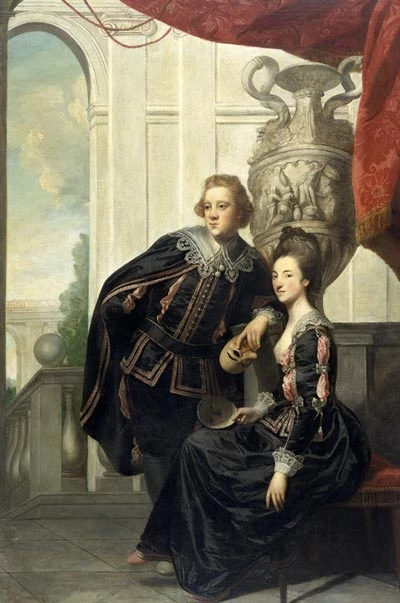
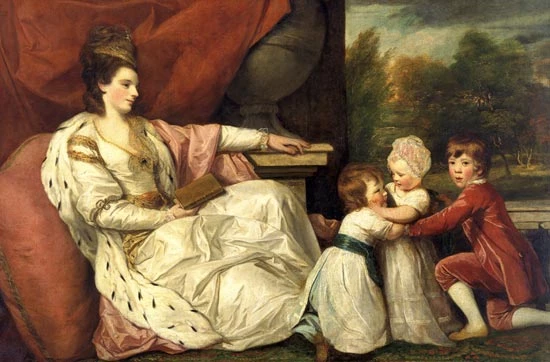
Two grand portraits by Joshua Reynolds 19 February 2007 The two wives of Sir Watkin Williams-Wynn Sir Joshua Reynolds (1723-1792), Sir Watkin Williams-Wynn, with his wife Lady Henrietta Somerset. The couple married on 11 April 1769 and she died in July the same year. Sir Joshua Reynolds (1723-1792) is a major figure in British art. One of his most enthusiastic patrons was the wealthy Welsh landowner Sir Watkin Williams-Wynn (1749-1789). By the late 1760s Sir Watkin's income allowed him to spend massively on building projects and works of art. In 1769 Sir Watkin married Lady Henrietta Somerset, a daughter of the 4th Duke of Beaufort. It was a short marriage, as Henrietta died three months later. Her mother-in-law's wedding gift to Henrietta was a magnificent silver-gilt toilet service made by Thomas Heming in 1768. Sir Watkin Williams-Wynn and Henrietta Somerset Reynold's first portrait for Sir Watkin, Sir Watkin Williams-Wynn and Henrietta Somerset, shows the young couple life-size in matching black and pink costume. They hold theatrical masks in a curtained architectural setting, beside a massive vase. The vase is of a type that appears in a number of Reynolds' portraits. It is copied from a 17th century engraving by G.B. Galestruzzi after Polidoro da Caravaggio. The sitters are wearing costume associated with the portrait painter Anthony Van Dyck, which was fashionable from the 1740s to the 1770s. Black Van Dyck costume was unusual for women, and it would have been unusual for a couple to wear colour co-ordinated clothes, except for a masquerade. Henrietta is shown in an attitude common in Reynolds' portraits of women, taken from his master Thomas Hudson. Sir Watkin is shown with a melancholy expression, in a pose in keeping with his short, stout build. The picture was presumably begun as a marriage portrait, although the black costume suggests that it was completed as a memorial portrait. Charlotte Grenville with her children Sir Joshua Reynolds (1723-1792). Charlotte Grenville, Sir Watkin Williams-Wynn's second wife and her children. The second portrait, Charlotte Grenville and her children, shows Sir Watkin's second wife. Charlotte Grenville (1754-1830) was a member of one of the great governing families of 18th century Britain. She was the eldest daughter of George Grenville (1712-1770) who was Prime Minister in 1763-5. They married in 1771, two years after Henrietta's death. The painting shows her accompanied by her three eldest children. Their apparent age suggests that this portrait was painted around 1778. This composition recalls early 16th century Venetian paintings of the Rest on the Flight with St John the Baptist. The children's position in the picture echoes the group at the right of Titian's Vendramin Family (National Gallery), which Reynolds knew well. Lady Charlotte's costume is in the Turkish fashion and her pose derives from the pastel portraits Ladies in Turkish dress by Jean-Etienne Liotard. Charlotte Grenville and her children is one of Reynolds' most sumptuous portraits of the 1770s, when he was at the height of his powers. Both portraits probably cost Sir Watkins around £315 each. Painted in the Grand Manner, they express the qualities Reynolds admired most in High Renaissance art. They also demonstrate the cultural ambitions of Sir Watkin Williams-Wynn and his wives. For over two centuries, the portraits remained with the Williams-Wynn family, before being purchased by the Museum in 1998. The Museum holds a spectacular group of works from Sir Watkin's collection, including major paintings by Batoni and Mengs, and silver and furniture designed by Robert Adam.