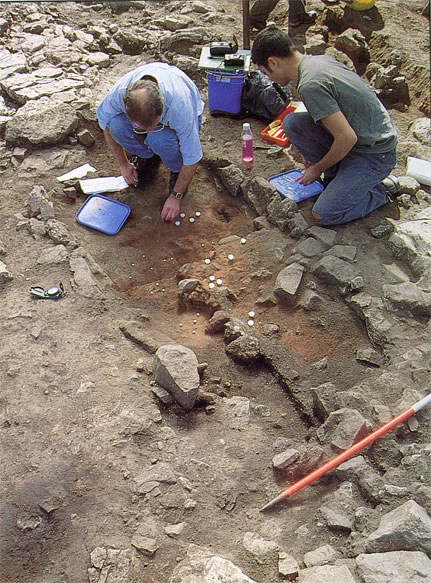
Vikings on Anglesey 1 May 2007 Llanbedrgoch on Anglesey is home to one of Wales' most interesting archaeological sites from when the Vikings invaded Wales. Research at this site by Amgueddfa Cymru has helped reveal the nature of Viking Age life that has puzzled scholars for decades. Excavation in progress on building 1 in 1997 The site was discovered in 1994 after a number of finds were brought to the Museum for identification. These included an Anglo-Saxon penny of Cynethryth (787-792 AD), a penny of Wulfred of Canterbury (about 810), and three Viking lead weights. From Neolithic to Roman After detailed excavation and research, the complex history of the site began to be unravelled. The site appears to have been a focus of activity from as early as 3300 BC, a period when most of the large burial chambers on Anglesey were built. Several items of pottery, radiocarbon dated to around 240 to 450 AD, show activity at the site during the Roman period. The Site Activity at the site can be broken up into a number of phases. A ditch was found measuring 2m wide and 1m deep. Further excavation uncovered post-holes cut into bedrock thought to represent a platform of a house. Items recovered suggest that the ditch is pre-Viking. It is at this time that a large timber hall, represented by large post pits, probably belongs. This timber building appears to have been replaced in the late 9th or early 10th century by at least two halls, last used between about 890 and 970. To the east was a large hall or barn, measuring about 8m by 12m, dated to around 855-1000 AD. A small section of stone paving to the west marked the entrance to a third, slightly smaller building. Ploughing has removed any clear evidence for the walls but a 10th century fine bronze buckle and an iron knife blade with angled back were recovered. A rubbish dump at the south-west corner of the site contained a few artefacts, including a Northumbrian styca (penny) of Archbishop Wigmund (about 848 - 58), socketed iron tools for leatherwork, mounts and bucket bindings. The area then appears to have returned to agriculture, which in time removed all surface traces of the former settlement. Like sites elsewhere, it is situated on a carefully selected, sheltered location, about 1000m from the sea. Forming one of the largest collections of this kind from Wales, the objects found at the site are remarkably well preserved. Coin and other evidence suggests an early period of economic growth at Llanbedrgoch from the late 8th century. In the 10th century, the settlement appears to have been at its peak, with harvesting of crops, keeping of livestock, the presence of craftsmen, and contact with Viking merchants arriving in ships. The enclosure at Llanbedrgoch appears to be the key to unlock further secrets and reveal the nature of Viking Age settlement which has puzzled scholars for decades.
Who was King Arthur? 26 April 2007 King Arthur has a strong link to Wales, but how much is known of the man and his times? King Arthur has evolved into a legend. Tales and romances celebrated the king and his court in the imaginative literature of Europe. Did Arthur really exist? What was he like? To find answers, it is necessary to look at two equally important sources of information: historical texts and archaeology. When did King Arthur live? The first mention of Arthur is thought to be a reference in a line from the poem, 'Y Gododdin', the earliest known work of literature in Welsh. The poem is from the 6th century, when much of western Britain (Wales, northern England and southern Scotland) spoke Welsh; the earliest surviving written form of the poem dates to the 13th century. The reference to Arthur in this source may be no earlier than the 9th century, but it demonstrates the fame of Arthur among the Welsh at this time. The most important of the historical texts is the Historia Brittonum, the 'History of the Britons', which gives the earliest written record of Arthur who 'fought against them [the Saxons] with the kings of the Britons but he himself was leader [Duke] of Battles', winning twelve battles. The earliest version of this history is dated about AD829-830. The Annales Cambriae, or 'Welsh Annals', probably compiled in the mid 10th century, record the date of one battle, the Battle of Badon in AD518, and Arthur's death at Camlann in AD537-9. This suggests that if Arthur was indeed an historical figure, he probably lived in the 6th century. Page from a 13th-century copy of the Book of Aneirin. The Book of Aneirin records an attack by the British on the Saxons at Catterick (Yorkshire). Although the poem was written in the 6th-century, the reference to Arthur which it contains may have been added later. [Image © Cardiff Library] Where is King Arthur buried? Early Welsh literature has many wondrous tales which form an important part of the Arthurian tradition. There are portrayals of Arthur in anonymous Welsh poetry found in 13th and 14th century manuscripts. In one of the poems of the Black Book of Carmarthen, Englynion y Beddau ('The Stanzas of the Graves'), Arthur's grave is described as a great wonder because no one knows where it is located. The greatest of the Welsh Arthurian prose tales is Culhwch ac Olwen. An English translation of this and eleven other Welsh tales appeared for the first time in the 19th century, publication The Mabinogion. Four other tales in this collection focus on Arthur - the 'romances' of The Lady of the Fountain (or Owain), Peredur, and Geraint son of Erbin, together with the Dream of Rhonabwy which presents a satirical view of Arthur and his world. Map showing distribution of places mentioned in this article Archaeology The second key source of information about Arthur is archaeology. Archaeological evidence for contact between Wales, Cornwall and the Saxon World takes many forms - from metalwork manufactured in an Anglo-Saxon style discovered in south-east Wales, to the distribution of early medieval pottery imported from the Continent and the shores of the Mediterranean. Excavations at Dinas Powys, a princely hillfort near Cardiff occupied between the 5th and 7th-centuries, has informed us about the nature of a high status site in south Wales at this time. This site is contemporary with others like South Cadbury in Somerset and Tintagel in Cornwall (both with their own Arthurian traditions). Pieces of glass from Dinas Powys (Vale of Glamorgan), a fort occupied between the 5th and 8th-centuries. These fragments come from vessels made in continental Europe. They illustrate the extent of trade between Wales and the wider-world at this time. Caerleon's Roman amphitheatre The Roman amphitheatre at Caerleon has been known as the site of King Arthur's court since the 12th century, but is there any evidence to prove this was the case? In AD1405, the French army, which had landed at Milford Haven to support Owain Glyn Dŵr in his uprising against the English Crown, reached Caerleon in South Wales. Here they visited 'King Arthur's Round Table'. According to a French source (Chronique Religieux de St Denys), the French visited 'The Round Table' of Arthurian legend. The Round Table was in fact the Roman amphitheatre of the legionary fortress of Isca. Geoffrey of Monmouth had identified Caerleon as the court of King Arthur in his fictional epic, the 'History of the Kings of Britain' in 1136. This identification, close to the area of his upbringing, has been described as 'the fruits of a lively historical imagination playing upon the visible remains of an imposing Roman city'. Some of Roman Isca was still standing in the 13th century. Caerleon soon appeared in popular Welsh and French writings by Dafydd ap Gwilym, Chrétien de Troyes and others as 'Arthur's Court', sealing this identification. Caerleon Roman amphitheatre. [Image © Steve Burrow] Arthur's Stone Some half dozen Welsh Stone Age megaliths are called 'Arthur's Stone', and his name has also been given to an Iron Age hillfort on the Clwydian Range, Moel Arthur, near Denbigh. According to one tradition, King Arthur and his knights lie sleeping in a cave below Craig y Ddinas, Pontneddfechan, in south Wales. Maen Ceti, on Gower, south Wales. The massive capstone of this prehistoric burial chamber is known as Arthur's Stone. The king's ghost is said to emerge occasionally from beneath it. Background Reading Arthur in Medieval Welsh Literature by Oliver James Padel. Published by University of Wales Press (2001). Arthur's Britain. History and Archaeology AD367-634 by Leslie Alcock. Published by Harmondsworth (1971). The Arthur of the Welsh. The Arthurian Legend in Medieval Welsh Literature by Rachel Bromwich, A. O. H. Jarman and Brynley F. Roberts. Published by University of Wales Press (1991). The Gododdin translated by A. O. H. Jarman. Published by Gomer Press (1988). The Mabinogion, translated by Jeffrey Gantz. Published by Penguin (1976).
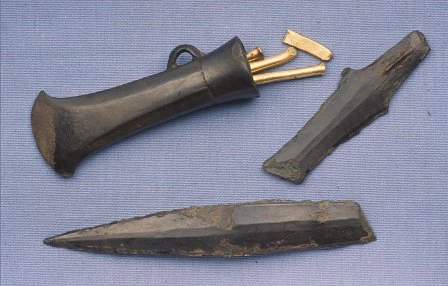
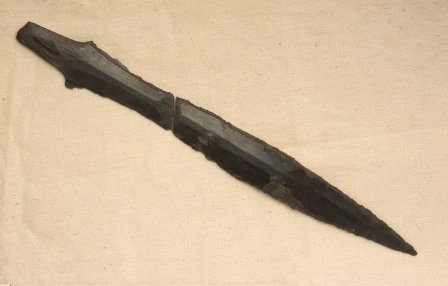
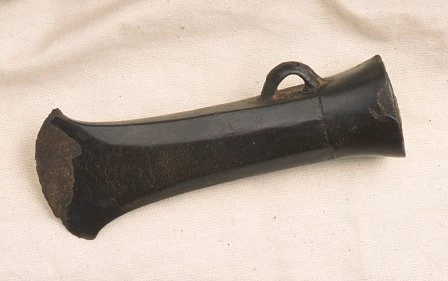
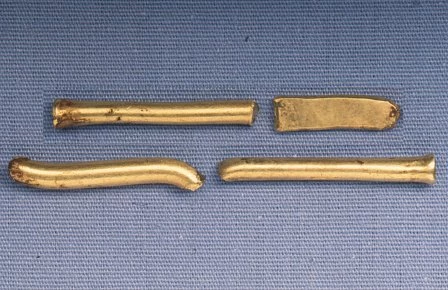
3,000 year old Irish gold from North Wales 26 April 2007 The hoard of Bronze Age artefacts recovered by metal detectorists near Wrexham. The bronze knife, found in two fragments. The edges of the blade were heavily notched, perhaps suggesting it had been used for some time before burial. The bronze axe, the socket of which contained the fragments of two or more gold bracelets. The fragments of bracelets, probably made from Irish gold. In 2002 a number of Bronze Age items were discovered near Wrexham, North Wales. Amoung the finds were a bronze knife, an axe head, and four fragments of gold bracelets. All were made between 1000-800BC and show links between Wales and Ireland during the Bronze Age. The knife is of a type used throughout southern England and Ireland, and its shape mirrors much larger swords that were in use at this time. However, it is the first of its kind to be found in Wales. The bronze axe head has a socket at one end, to which a wooden handle would have been attached, as well as a loop through which leather or twine would have been threaded to keep them together. It appears, however, that the axe head was buried without its handle since four fragments of gold bracelets were found stuffed into the socket. These valued finds include two terminals (end pieces) of a bracelet type most commonly used in Ireland, and are probably made of Irish gold. These artefacts would probably have belonged to a person of considerable social standing since few people at this time would have had access to Irish gold and such finely worked tools. Quite why their owner decided to part with them will never be known for certain, although it is likely that they were buried as an offering to the gods. The discovery adds valuable detail to our understanding of life in Wales 3,000 years ago. A time when leaders dressed to impress by wearing gold bracelets and hair ornaments, and a person's role within society was broadcast by the tools and weapons worn, the appearance of the horse they rode and the quality of a feast hosted. Though most people in Wales were settled farmers and herders at this time, finds like the hoard from Wrexham show us that these small communities were part of large trading networks that linked Wales with Ireland. Evidence that our ancestors had more on their minds than food, farming and survival. These items form part of the collections of Wrexham County Borough Museum.
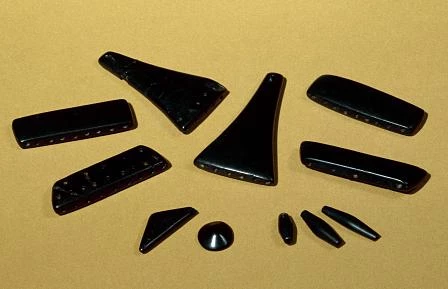
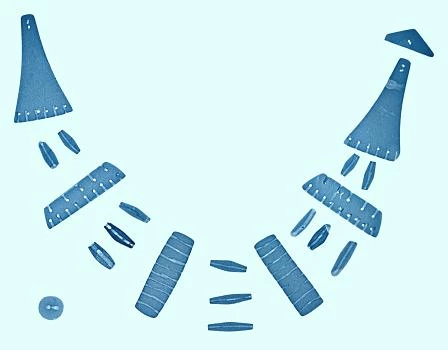
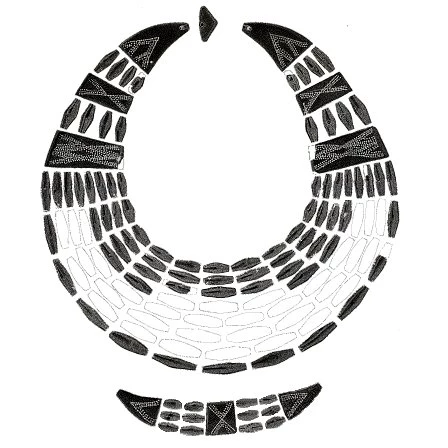
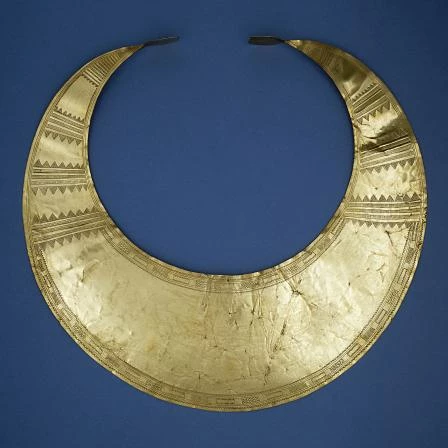
The Pen y Bonc necklace 26 April 2007 The Pen y Bonc necklace (Anglesey). Image © the Trustees of the British Museum. Xero-radiograph of the Pen y Bonc necklace. Image © the Trustees of the British Museum. Jet necklace from East Kinwhirrie, Angus (Scotland). Image: Helen Jackson for the National Museums of Scotland. Gold lunula from Co. Kerry, Ireland. Image © Trustees of the British Museum. Queen Victoria had a fascination with the black semi precious stone 'Jet' following the death of her husband, Prince Albert in 1861. The use of this stone has a much longer history as this 4,000 year old necklace from Anglesey shows. Important burial In 1828 a grave was discovered at Pen y Bonc, near Holyhead on Anglesey. Accounts of this discovery are incomplete, but the grave was dated to around 4,000 years. The person who was buried must have been important as the grave was cut into bare rock. A number of black beads and buttons were discovered in the grave. Unfortunately, most of the items were lost soon after the discovery, but some surviving pieces are now in the collections of the British Museum. These pieces form a crescent-shaped necklace of beads and spacer plates. Objects such as these are usually found with female burials. Jet necklace from East Kinwhirrie, Angus (pictured) shows the shape of a complete spacer plate necklace, and illustrates how some of the finest examples were decorated. A necklace made of coal Most of the beads and plates in the Pen y Bonc necklace are made of 'lignite' (fossilised wood). However, one bead and the surviving button are made of jet, a material found 300km (186 miles) away to the north-east, at Whitby (North Yorkshire). Jet is a dense black variety of lignite only found in a few parts of Europe. Only parts of this necklace survive. It is possible that this was all that was buried since Bronze Age jet necklaces are often found incomplete. Alternatively, parts of the necklace may have been made of materials which have since rotted away, or possibly pieces were lost when it was excavated. Manufacturing jet necklaces was a skilled job. The many strands of the necklace were suspended using spacer plates through which holes were bored to carry the strings. This delicate work was probably carried out using a bow-drill and a piece of bronze wire. In the case of the Pen y Bonc necklace some of the holes have been bored lengthways through the plates. But in order to increase the number of strands on one side of the plate, holes have been drilled at one end to allow new strings to be tied in. Unlike many types of gem, jet is warm to the touch and is relatively easy to shape; it also takes a very high polish. Today it looks rather like shiny plastic, but during the Bronze Age it must have appeared strange and unusual. Jet also has unusual electrostatic properties (when rubbed it can attract hair and other light materials) that might have been seen as magical in prehistoric Britain. Treasured jewellery The jet pieces in the Pen y Bonc necklace were heavily worn suggesting that they were treasured items that had been kept for many years. In contrast, the parts of the necklace that were made from local materials were less worn - suggesting that they were newer replacements for broken or damaged pieces of jet. Objects made of jet were popular throughout Britain during the Early Bronze Age (2300-1500BC), however, after this period its use declined. When the jet necklace from Pen y Bonc was discovered in the 19th century, the jet being mined at Whitby was just beginning a revival, thanks in large part to Queen Victoria's obsession with black mourning garments after the death of Prince Albert in 1861. Gold Lunula Gold lunula also date to the Early Bronze Age and are often decorated in a similar way to jet necklaces. However, whereas jet necklaces are usually found with burials, lunula are not found with the dead. Perhaps jet suggested death and gold represented life in the minds of people 4,000 years ago. Background Reading 'The Welsh 'jet set' in prehistory' by Alison Sheridan and Mary Davis. In Prehistoric ritual and religion by Alex Gibson and Derek Simpson, p148-62. Sutton Publishing (1998). 'Investigating jet and jet-like artefacts from prehistoric Scotland: the National Museums of Scotland project' by Alison Sheridan and Mary Davis. In Antiquity (2002) vol. 26, p812-25.
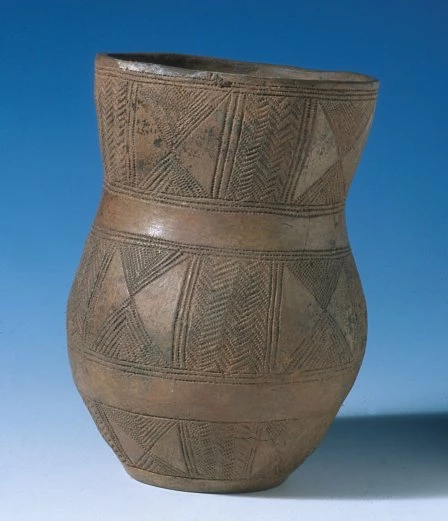
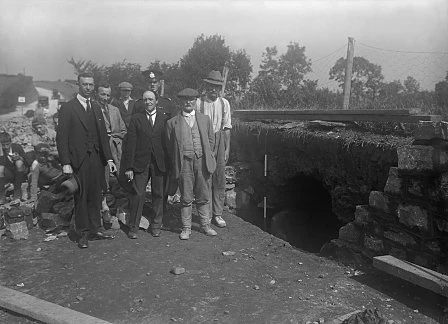
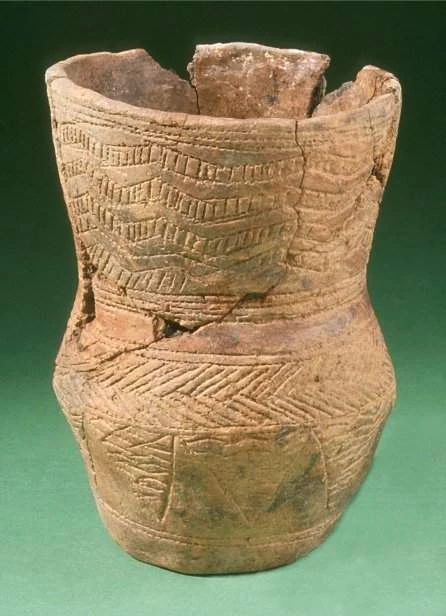
The Beaker Folk of south Wales 26 April 2007 The Naboth Vineyard Beaker, Llanharry (Rhondda Cynon Taff). Discovery of the Beaker grave near Llanharry in 1929 (grave next to striped pole). Another example of a Beaker, this time from a cist containing a female burial, discovered in 1991 in Llandaff (Cardiff). The burial was also accompanied by a bronze awl, an artefact commonly found with Beakers. A new style of pottery appeared in Britain 4,000 years ago, but was it brought by invaders or did it evolve as a local fashion statement? This finely decorated pot, known as a 'Beaker', was made about 4,000 years ago by an early community living in south Wales. At this time pots were handmade and fired in bonfires. It was found in September 1929 by workmen preparing a new road between Llanharan and Llanharry. This object is known as the "The Naboth Vineyard Beaker". The Beaker had been placed in a stone-lined grave (or cist), beneath a circular mound of earth known as a barrow. The grave also contained a crouched skeleton of a man about 1.7m tall (5 foot 9 inches) and under 35 years old. From this, and many other discoveries like it, it looks like these Beakers were very special pots, being placed beside someone when they were buried. Their shape suggests that they were drinking vessels. They possibly containing offerings of alcohol to accompany people into the afterlife. In fact, when found, this beaker contained "slimy stuff" - could this have been the rotted remains of a funeral offering? - unfortunately, it was washed out before archaeologists could retrieve and analyse it. This Beaker was made by rolling clay into long strips joined together at the ends to form rings that were smoothed to give the vessel shape. When the clay had dried a little, the vessel was polished (burnished) with a blunt tool, possibly of bone. Decoration was added with a toothed tool resulting in a distinctive pattern reminiscent of textile or worked leather. Finally, the Beaker was fired, giving it a rich, mottled, orange-brown colour. Beaker pots and Beaker burials became common across much of Europe between 2800-2000BC. They are often found with daggers, flint arrowheads, and items of gold, amber, jet and bone. In the past, it was believed that Beakers belonged to an innovative people, called the "Beaker Folk", who migrated around Europe and invaded Britain, bringing their artefacts with them. Recently, an alternative theory has been put forward. This sees the Beaker phenomenon as a spread of common ideas or fashions across Europe, rather than a spread of people. The Beaker fashion was adopted by the people of Britain, as a result of contact and trade with Continental Europe. In Wales, few early Beaker burials are known, and those that have been radiocarbon dated tend to be from 2300-1800BC. Beaker settlements are very rare. Background Reading "A Beaker-burial from Llanharry, Glamorgan" by V. E. Nash-Williams. In Archaeologia Cambrensis, vol. 85, p402-5 (1930). Guide catalogue of the Bronze Age collections by H. N. Savory. Published by National Museum of Wales (1980). Prehistoric Wales by F. Lynch, S. Aldhouse-Green and J. L. Davies. Sutton Publishing (2000).