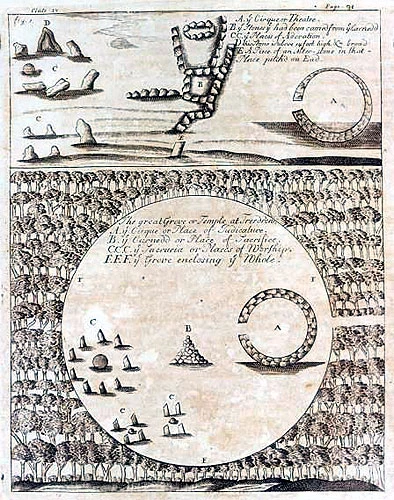
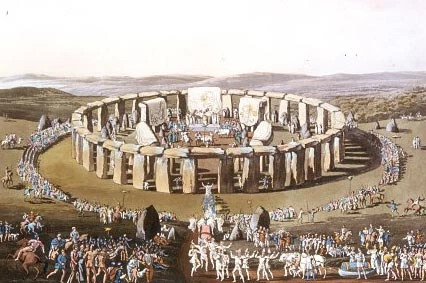
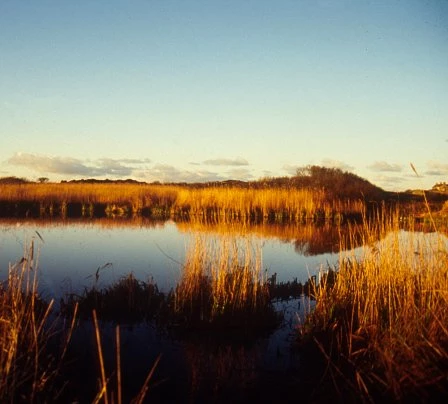
Ancient druids of Wales 3 May 2007 An Archdruid in his Judicial Habit from Costume of the Original Inhabitants of the British Isles (1815) by Samuel Rush Meyrick and Charles Hamilton Smith. The alleged Druidical Temple of Tre'r Dryw (Anglesey) - prepared by the Revd Henry Rowlands (1723) Early 19th-century speculation on how a Druidic ceremony might have appeared at Stonehenge. We now know that Stonehenge was built some 1,500 years before the first historical reference to the Druids. Llyn Cerrig Bach (Anglesey). A large quantity of Iron Age metalwork was found in this lake during 1943. [Image © Philip Macdonald.] Selection of metalwork found in Llyn Cerrig Bach, including slave chains, bent swords, tools and chariot equipment. Druids, the ancient priests of Britain and Ireland, have long intrigued and kindled the imagination of large popular audiences. The stereotypical image of the white robed wise man, carrying perhaps a golden sickle and mistletoe, or clasping a white staff, remains strong with us today, the outcome of many centuries of thinking and invention. Yet what evidence do we have for these powerful but elusive figures? Earliest mention of Druids comes during the 1st century BC, referring to druidae in Gaul (France) and Britain, who were wise men, observers of natural phenomena and moral philosophers. Similar to the druids were the bards (bardoi) - singers and poets, and diviners (vates), who interpreted sacrifices in order to foretell the future. Druids and bards were common in medieval Welsh and Irish texts, probably giving account of much earlier oral tradition, passed on by word of mouth. The visual appearance of druids - what they wore and what possessions they owned - is difficult to clarify. There are few illustrations or inscriptions of the time, whilst archaeology rarely provides certain answers. A druidic ceremony described by Pliny, in his Natural History, describes, a white robed druid climbing an oak tree to cut down mistletoe with a golden sickle. Hywel Dda In Wales, the roles and privileges of bards related to laws set down by Hywel Dda in the 10th century AD. During the 18th century, druids came to be seen as the ancestors of the bards, the praise poets, musicians and genealogists, who flourished in Welsh medieval society. Human Sacrifice A revival of interest in druids began during the Renaissance (14th to 16th-centuries), when translations of Classical Greek and Roman texts became widely available. A number of sources describe the druids as performing human sacrifice. Places of worship were described as isolated wooded groves and near sacred pools and lakes. According to one source, the druidic groves on Mona (Anglesey) had the blood of prisoners drenched upon their altars. Stonehenge Some accounts suggested that the stone circles at Avebury and Stonehenge had been druidic temples. Similarly, a number of megalithic monuments on Anglesey were thought as the temples and sacrificial altars of druids. However, with advances in archaeological understanding during the 19th century, it became clear that these monuments were built over 4,000 years ago, long before the appearance of druids. Nevertheless, modern druids and bards continue to meet within stone circles today. Celtic rituals of the Iron Age Archaeology does however provide evidence for the religious expression of Celtic Iron Age people. The tradition of offering gifts to the gods is well illustrated at the site of Llyn Cerrig Bach on Anglesey. Here, between 300BC and AD100, chariots, weapons, tools and decorated metalwork items were cast from a causeway or island into a small lake. Coincidentally, an account by the Roman author Tacitus vividly recounts the crushing of a druidic stronghold on Anglesey by the Roman army, leading some to infer that Llyn Cerrig Bach was a druidic site. Other instances of Celtic Iron Age ritual have also been identified. For example, a probable sacrificial victim preserved in peat has been found at Lindow Moss in Cheshire (England). Recently, the famous Cerrig-y-Drudion bowl , elaborately decorated in the Celtic or La Tène art style, has also been convincingly interpreted as a ceremonial crown. This and a number of other crowns and regalia, found with burials or in temples in Britain, may have denoted priestly office. In this prehistoric world, the power of the pagan Celtic gods was keenly felt, ever present and intermingled within everyday life. Anglesey The druids have long been associated with Anglesey in popular imagination. The historical evidence upon which this association is based is an account by the Roman author Tacitus, who wrote of the Roman conquest of Anglesey: "On the beach stood the adverse array [of Britons], a serried mass of arms and men, with women flitting between the ranks. In the style of Furies, in robes of deathly black and with disheveled hair, they brandished their torches; while a circle of Druids, lifting their hands to heaven and showering imprecations, struck the troops with such an awe at the extraordinary spectacle that, as though their limbs were paralysed, they exposed their bodies to wounds without an attempt at movement. Then, reassured by their general, and inciting each other never to flinch before a band of females and fanatics, they charged behind the standards, cut down all who met them, and enveloped the enemy in his own flames. The next step was to install a garrison among the conquered population, and to demolish the groves consecrated to their savage cults; for they considered it a pious duty to slake the altars with captive blood and to consult their deities by means of human entrails." (Translated by John Jackson, published by William Heinemann, 1951). Background Reading Druids by A. Ross. Tempus Publishing (1999). Exploring the World of the Druids by M. J. Green. Published by Thames & Hudson (1997). Shrines & Sacrifice by A. Woodward. Published by Batsford (1992). Tacitus: the annals By J. Jackson. Published by William Heinemann (1951). The Bog Man and the Archaeology of People by D. Brothwell. British Museum Publications (1986). The Druids by S. Piggott. Published by Thames & Hudson (1968).
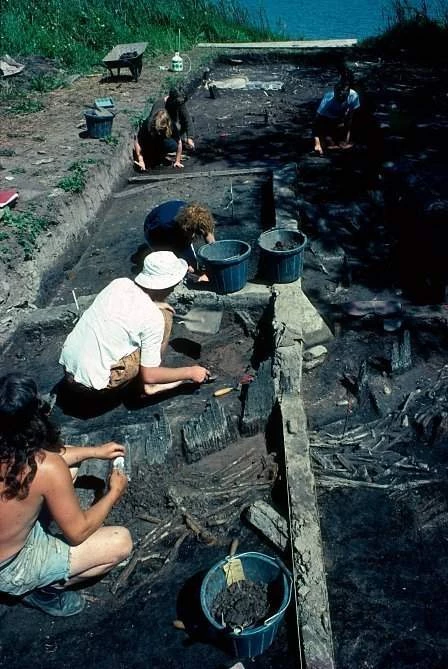
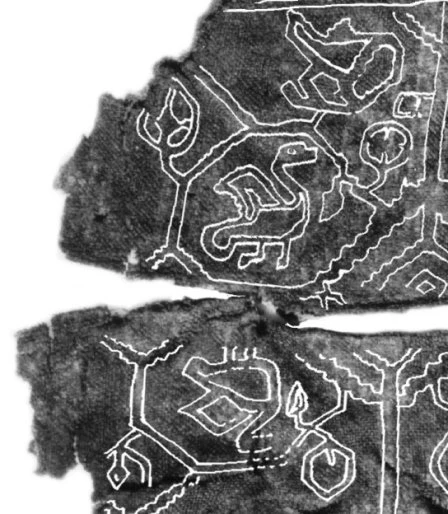
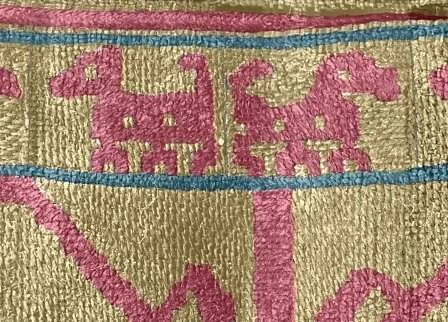
The Llan-gors textile: an early medieval masterpiece 3 May 2007 Excavations at Llan-gors Lake in 1991. The textile was discovered in the silts beyond the oak palisade visible in this trench. The lump of charred textile, as found lying on a piece of wood. Part of the decoration preserved on the textile, showing a group of birds framed by vines. Unfortunately none of the original colour was preserved in the textile, making the design very difficult to see without assistance. It is picked out here with superimposed white lines. The total area shown is roughly 9cm tall by 7cm wide (3.5 x 2.8 inches). Digital-simulation of colour on a photograph of the original textile. In 1990, archaeologists working at a site on Llan-gors Lake, near Brecon, made an unexpected discovery - the remains of a magnificently decorated textile, over a thousand years old. Just off the northern shore of Llan-gors Lake lies a crannog (a man-made island) built as a royal site for the ruler of Brycheiniog in the 890s - a turbulent period in the kingdom's history. At this time, Brycheiniog was under pressure from several neighbouring kingdoms, and Llan-gors must have seemed a safe retreat. However, excavations of the site have shown that this haven was short-lived, being destroyed by fire in the early 10th century. Much of the archaeological work at Llan-gors focused on the waterlogged silts that surrounded the crannog. It was here that the textile was discovered, badly charred and very fragile. Through careful conservation treatment it was possible to separate and clean its many layers revealing this unlikely lump to be among the most important finds of early medieval textile yet found in Britain. The base material of the textile was a very fine plain-weave linen. Silk and linen threads have been used to decorate the textile with birds and other creatures within a framework of vines, and with borders containing repeating patterns or lions. The skill with which this work has been accomplished continues to be a source of wonder. The linen has 23 threads to the centimetre - a magnificent achievement given the equipment available in the 9th and 10th centuries AD. The textile appears to be part of a garment, perhaps a tunic or dress - it has a hem and a belt loop - but unfortunately too little survives to indicate its detailed shape. Its owner was a person of considerable status since the silk that decorates it must have been imported to Britain, while the quality of the needlework suggest that it was produced in a specialist workshop. So how did this fine textile come to be lost? A clue can be found in the Anglo-Saxon Chronicle for AD916, which records that in this year a Mercian army from England destroyed a site called Brecenanmere (Brecknock-mere = Llan-gors Lake) and captured 'the wife of the king and 33 other persons'. Was this the event that saw the burning of Llan-gors and the loss of the textile? It is tempting to believe so. Background Reading 'A fine quality insular embroidery from Llangors Crannog, near Brecon' by H. Granger-Taylor and F. Pritchard. In Pattern and Purpose in Insular Art edited by M. Redknap, S. Youngs, A. Lane and J. Knight, p91-99. Published by Oxbow Books (2001). 'Worn by a Welsh Queen?' by L. Mumford and M. Redknap. In Amgueddfa, vol. 2, p52-4 (1999). 'The Llangorse textile; approaches to understanding an early medieval masterpiece' by L. Mumford, H. Prosser and J. Taylor, in C. Gillis and M.-L. B. Nosch (eds), Ancient Textiles: Production, Craft and Society, 158-62. Published by Oxbow Books (2007).
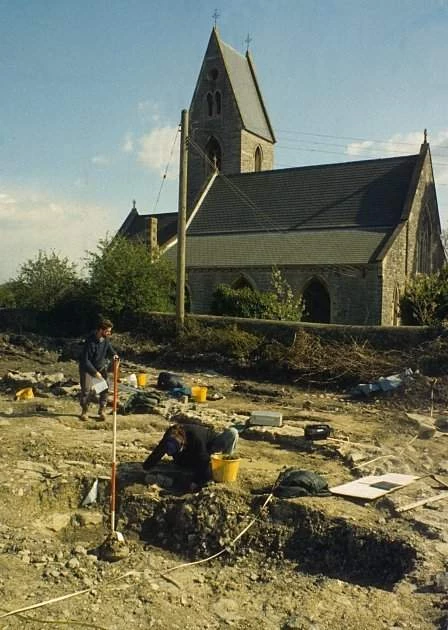
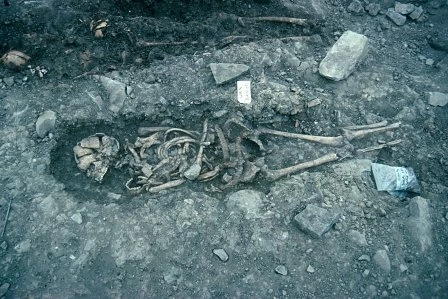
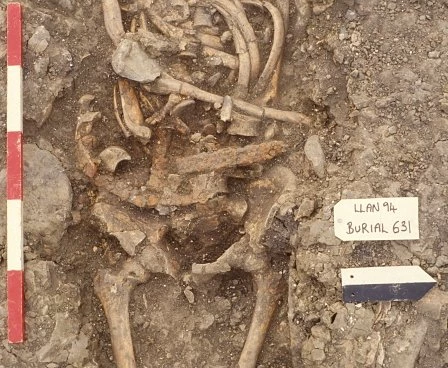
The suffering of burial 631 2 May 2007 Excavations in progress in 1994 in part of the cemetery of St Dochdwy's monastery. Burial 631 as discovered. Detail of the iron belts around the waist of burial 631. The iron belts during conservation work undertaken by a team at Amgueddfa Cymru. In 1994 archaeologists excavated the largest collection of early medieval burials yet found in Wales, as well as evidence for an unusual burial practice. Ideal Homes Wales Ltd had contracted archaeologists from Cotswold Archaeology to excavate land earmarked for a new housing development in Llandough (Vale of Glamorgan). The site was situated just outside the churchyard of the present parish church - reputedly the site of the early medieval monastery of St Dochdwy - the excavation discovered over 800 burials dating from the 4th- to the 11th-century AD. Careful study of the skeletons has shed fresh light on the population of Wales at this time. One grave in particular was exceptional. Burial 631 Burial 631 lay in the middle of the cemetery. The skeleton was that of a young man, aged between 25 and 35, and about 1.75m tall (5.75 feet). Radiocarbon dating of the bone suggested that he died between AD340-660. However, it was not his antiquity that made him special, but rather the two iron straps he wore around his waist. The ends of these straps were secured behind his back. The tapered iron ends passed through lugs and were hammered over by a second person, making it impossible for the wearer to remove the straps unaided. Clearly this was more than a fashion accessory, but what other functions could it have served? It has been suggested that the straps may have been worn as an act of penitence - a fitting purpose in the context of a monastic community. Similar cases are certainly known in the Middle Ages. For example, there was a visionary monk at the monastery of Much Wenlock (Shropshire) in the early 8th century called Begga, who wore 'an iron girdle about his loins for the love of God'. An alternative explanation is that the iron bands served as a hernia belt. Roman texts first record the use of hernia belts on the Continent. Examples have also been excavated from 6th- and 7th- century burials in France, Germany, Switzerland and Spain. So which interpretation is correct - penitent's belt or hernia truss? The answer is likely to be a little of both. During the early medieval period the endurance of suffering was seen as a path to heaven. So enduring the pain of a hernia may in itself have been in part an act of penitence from which the wearer of these two belts hoped to reap a reward in the afterlife. Background Reading 'Llandough' by A. Thomas and N. Holbrook. In Current Archaeology, vol. 146, p73-7 (1996). 'An early-medieval girdle from burial 631', by M. Redknap. In N. Holbrook and A Thomas 'An early-medieval monastic cemetary at Llandough, Glamorgan: excavations in 1994', Medieval Archaeology 49 (2005), 53-64.
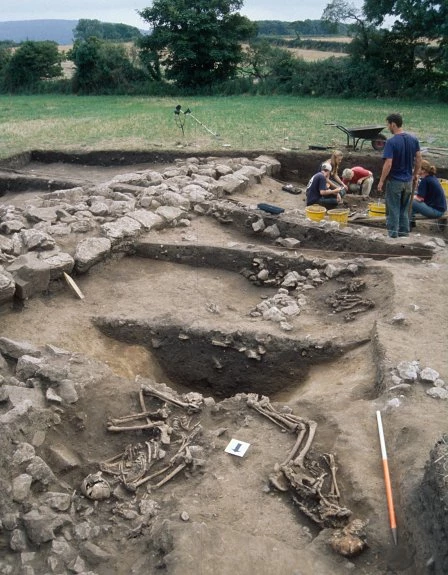
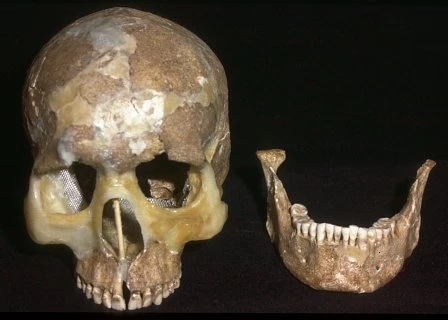
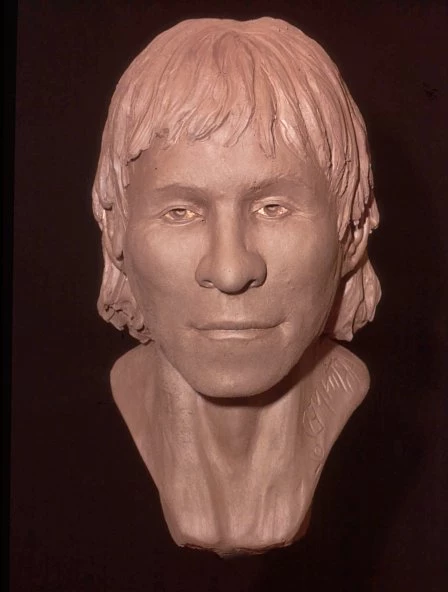
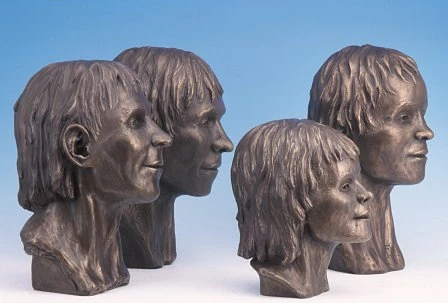
Science brings to life the witnesses to the Viking-age in North Wales 1 May 2007 Excavating the enclosure ditch and skeletons at Llanbedrgoch (Anglesey). To the left of the image are the lower courses of the settlement's defensive wall. Two of the skeletons can be seen lying in the upper levels of the ditch that lay outside this wall. The skull of burial 5. This skull was in pieces when discovered and has since been reconstructed. Photo by the School of Art and Medicine, University of Manchester. The face of burial 5 after recreation. Photo by the School of Art and Medicine, University of Manchester. Four of the five faces from Llanbedrgoch, cast in brass. Excavations by the National Museum of Wales on the early medieval settlement at Llanbedrgoch on Anglesey, North Wales, have unlocked details of life in 9th- and 10th-century Wales. Scientific techniques have allowed the faces of four of those that lived there to be recreated from their skulls. A puzzling discovery In 1998, an unexpected discovery was made on the west side of the settlement. Five human skeletons were found in the upper level of a filled-in ditch immediately outside a defensive wall that surrounded the settlement. Contrary to usual Christian practice, all skeletons were aligned with their heads either to the north or south rather than to the east possibly influenced by the position of the wall. They appear to have been casually buried in shallow graves. Three of the bodies had been buried individually, but there was one double burial in which an adult male (approximately 23-35 years old) had been thrown directly on top of a child (approximate age 10-15 years old). The adult male's arms may have been tied behind his back and he may have suffered a blow to the left eye with a sharp object. Another older adult male (35-45 years old) appears to have been placed face down, turned to left, body slightly twisted, and he may have had his wrists fastened in front of his body. In the case of three of the burials, the bodies were covered by scattered limestone blocks and smaller rubble, probably derived from the collapse of the enclosure wall. This suggests they were buried shortly before the abandonment of the site. The Llanbedrgoch skeletons date to the second half of the 10th century, a period when Vikings on the Isle of Man effectively controlled Gwynedd, and may have had bases on Anglesey. The circumstances of burial and lack of Christian orientation have led to speculation that these individuals were victims of raiding. The precise circumstances of their deaths may never be known, but they may have been the victims of military activity by Vikings in their search for wealth, perhaps in the form of hostages or slaves. The Llanbedrgoch skulls show a number of similar features, including horizontal eye fissures, square jaws and adherent ears (they were lacking ear-lobes). Some of these features suggest a genetic relationship between the individuals. Either they belonged to the same families or the individuals came from a small gene pool. Not only has the site produced a wealth of evidence for settlement layout, buildings, artefacts and standards of living on a high status site - it has also provided the remains of people who once breathed and walked there. Background Reading Vikings in Wales: an archaeological quest by Mark Redknap. Published by the National Museums & Galleries of Wales (2000).
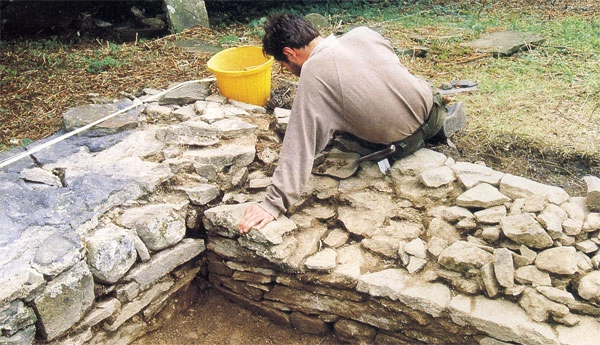
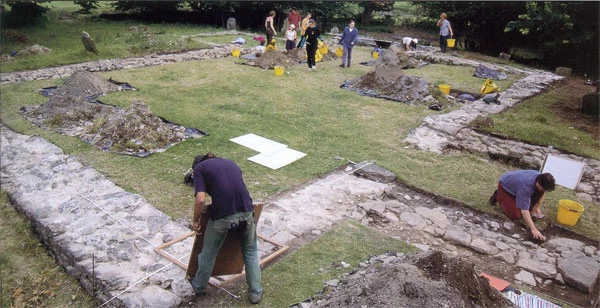
Discoveries from underneath a medieval church 1 May 2007 Cleaning the south wall of the medieval church Recording and cleaning in progress (nave and porch in foreground) Following the dismantling of St Teilos Church at Pontardulais, west Glamorgan, and its removal to St Fagans, excavations on the foundations uncovered further clues to the history of this medieval church. The dismantling and re-erection of the church made it possible to investigate the foundations of the church in a way that would be impossible otherwise. A detailed understanding of the building is essential in any investigation of a church's development. For churches still in use, only fleeting glimpses of the hidden fabric may be provided as opportunities arise. In the case of the dismantled St Teilo's church, it was possible to produce an accurate, stone-by-stone plan. Before excavation began, a geophysical survey of the area, using ground- penetrating radar, revealed evidence of numerous burials, and within the church itself a number of areas were identified that could have been related to structural activity. After excavating and surveying was done, details of the construction from the 12th or 13th century onwards were revealed. The present church probably dates from the 15th century. Before excavation, it was thought that the last addition was a small chapel on the north side of the chancel. The earliest recognisable phase of the building appears to be a small rectangular nave and chancel. To this was added a north and south transept, probably during the 14th or early 15th century (though not necessarily at the same time). Important churches in Wales during the later Middle Ages often had a cruciform plan. A south aisle was probably added in the late 15th century to provide for an expanding congregation, and finally a porch was added to the south side of the aisle. A buried grave-slab was found, at the junction of the chancel and north transept, to Mary Bevans of Killa, who died in 1717 aged 64. A section of rubble on the south side of the church, which appears to have been out-of-use by the time the porch was constructed, may have been the base for a churchyard cross. The excavation has significantly altered the understanding of the development of the church. The 12th century witnessed an explosion in church building, and much of what remains of the early stone phase of St Teilo's probably dates from about this period. Although the church can be matched with 'Lan Teliav Talypont', one of four places in Glamorgan called after St Teilo that are mentioned in the 12th century Liber Landavensis (The Book of Llandaff), no carved stones or evidence for a earlier timber construction have been discovered.