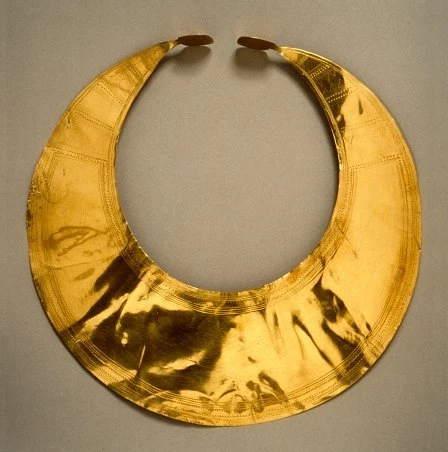
Stunning gold relic unearthed in Gwynedd 26 April 2007 Llanllyfni lunula. Weighing 185.4g (6.5 ounces) and measuring 24cm (9.5 inches) in diameter. This crescent-shaped ornament probably originated as a single rod shaped ingot and was expertly hammered into shape. The intricate decoration of zig-zags, lines and dots was then added using a fine pointed tool and a copper or bronze punch. These designs are very similar to those used to adorn pottery made at this time. Reconstruction of a lady wearing a gold lunula from Llanllyfni, (about 2000BC). Gold was one of the first metals to be used in Wales, along with copper and alloys such as bronze. The use of gold for jewellery and ornamentation has been a common theme since the earliest times. This stunning decorated object is one of the earliest gold artefacts to have been found in Wales and dates to the beginning of the Bronze Age (2400-2000BC). Yellow leaf sticking from the ground It was found a few miles from Llanllyfni (Gwynedd) on Llecheiddior-uchaf Farm near Dolbenmaen in about 1869. A farmer noticed what he took to be a yellow laurel leaf sticking out of some peat. Later, unsatisfied with this explanation, he returned to the site and uncovered the crescent-shaped object of gold. The Llanllyfni lunula Known as a 'lunula' after its crescent-shape (luna = moon in Latin), objects like this have been found in Scotland, Cornwall, and north-west France, with as many as 90 being discovered in Ireland. Lunula are generally found in isolated locations, away from ancient settlements and, like the Llanllyfni example, they have often been discovered by chance. It has been argued that they were intended to be worn around the neck as breast plates, although the lack of wear on the gold suggests that they were only rarely used - possibly they were the symbol of a priest or were used in the rituals of a community. The gold in the Llanllyfni lunula may come from a Welsh source, for example the Dolgellau gold belt, or north-west of Llandovery, but as so many have been discovered in Ireland, the suspicion is that it was traded as a raw material across the Irish Sea. Background Reading 'Bronze Age gold in Britain' by J. P. Northover. In Prehistoric gold in Europe by G. Morteani and J. P. Northover. Published by Kluwer (1993). Bronze Age goldwork of the British Isles by J. J. Taylor. Cambridge University Press (1980). 'Objects mostly of prehistoric date discovered near Beddgelert and near Brynkir station' by W. J. Hemp. In Proceedings of the Society of Antiquaries of London, 2nd series, vol. 1, p166-83 (1918).
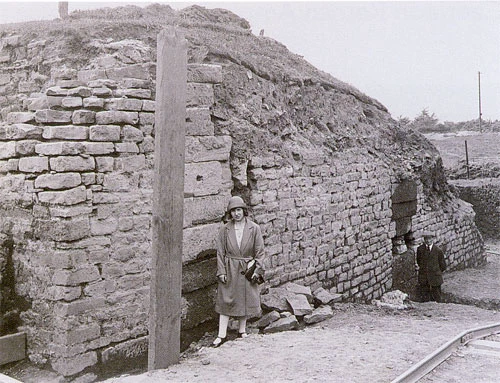
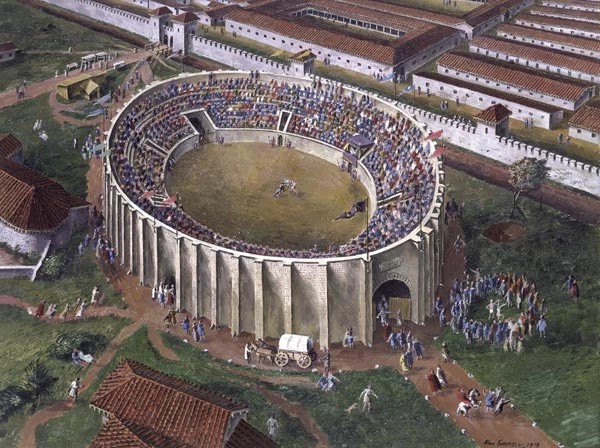
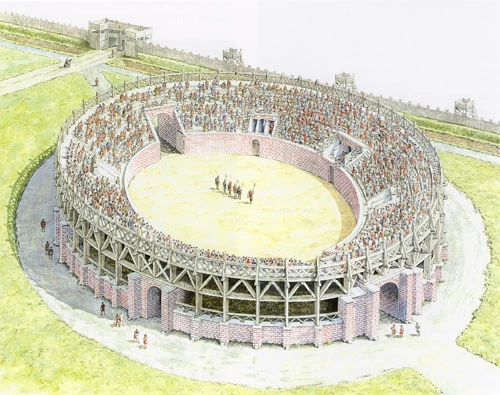
Where Gladiators Fought - Discoveries at Caerleon's Roman Amphitheatre 18 April 2007 Mrs T. V. Wheeler standing in entrance B of the amphitheatre during its excavation. Reconstruction of the Caerleon amphitheatre by Alan Sorrell. The amphitheatre is shown as a masonry structure to its full height. How the amphitheatre may have actually looked. Illustration by Dale Evans (1988) after the reconstruction by R. A. Anderson (1981). Cadw: Welsh Historic Monuments, Crown Copyright. Re-enactment at Caerleon. Next to the Roman fortress at Caerleon, near Newport (south Wales), lies the remains of a well-preserved oval amphitheatre, known to local folklore as King Arthur's Round Table. The amphitheatre was excavated in the 1920s by Dr. Mortimer Wheeler, then Director at Amgueddfa Cymru - National Museum Wales. Wheeler's reconstruction of how the amphitheatre may have looked has since been revised as subsequent discoveries have led to a re-think as to how it was constructed. Securing funds for excavation Wheeler exploited the connections with King Arthur to drum up sponsorship. The Daily Mail agreed to provide £1,000 for exclusive rights and daily reports on the excavation. The paper eventually trebled its original offer and presented the excavated remains to the then Office of Works (a predecessor of Cadw: Welsh Historic Monuments) as a national monument. Planning and excavating In 1926, Wheeler took up the post of Keeper of the London Museum meaning he could not continue his direct involvement with the excavations, but the sponsorship from the Daily Mail made the project binding and urgent, so his wife, Tessa, took over the direction. Every evening a newsworthy story had to be sent to the Daily Mail on the day's discoveries, with 'sensational' headlines such as 'Where Gladiators Fought'. A structure of earth and masonry After the excavations were complete and nearly 30,000 tons of soil had been examined and removed from the site, the excavators concluded that the amphitheatre had been constructed around AD 80, several years after the initial foundation of the main fortress at Caerleon. In the report on the findings, published in 1928, the amphitheatre was reconstructed as an earth and masonry structure with the auditorium supported by a bank of earth retained by inner and outer walls of masonry supported and strengthened by buttresses. It was calculated that the original arena wall must have risen to a height of four metres while the external wall must have reached a height of about ten metres. The seats were almost certainly of wood, as no evidence of stone seats was discovered. In 1939, Alan Sorrell, a well-known painter of archaeological reconstructions shows the amphitheatre built in masonry to its full height. A new theory In 1962, George Boon (from the Museum's Department of Archaeology) excavated a small trench in the bank of the amphitheatre, and caused a fundamental re-think of how the superstructure was constructed. The original surface of the bank was uncovered not far below the turf, this meant that the banks were never higher than they are today. Cut into the surface of the bank were pits, a metre square and deep. Boon concluded that these pits had held large wooden beams forming an openwork timber grandstand. Since this discovery, reconstructions of the amphitheatre have been re-drawn showing its lower part in stone, but with a timber superstructure. An amphitheatre of similar construction is shown on Trajan's Column at Dobreta, the Roman base on the Romanian side of the Danube bridge. It has been estimated that the timber grandstand at Caerleon contained 6,000 seats, approximately the full complement of the legion. Events at the amphitheatre, although undoubtedly less bloody, continue to attract large audiences today with exiting re-enactments and other events staged regularly. Background reading Caerleon Roman Fortress by J.K. Night. published by Cadw (2003) Isca: The Roman Legionary Fortress at Caerleon, Mon. by G.C. Boon. Published by the National Museum of Wales (1972) 'The Roman amphitheatre at Caerleon, Monmothshire' by T.V. -d R.E.M. Wheeler. In Archaeologica vol.78, p.111-218.
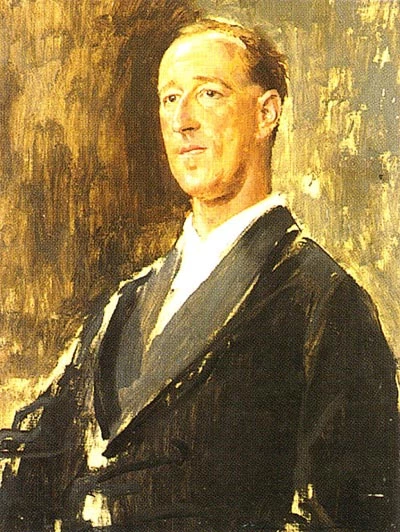
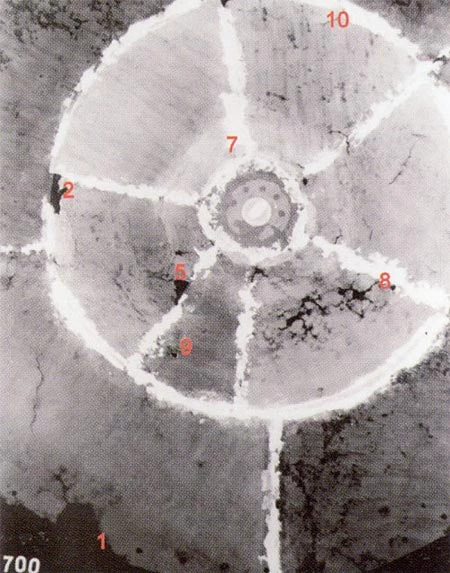
Trick or Treat? Ancient collection at Amgueddfa Cymru found to be modern 17 April 2007 At the beginning of the twentieth century, the president of Amgueddfa Cymru, Lord Howard de Walden, formed a remarkable collection of ancient European arms and armour. The collection included a number of classical pieces - helmets, swords, spearheads, belts and armour that were mainly Greek and Roman - or so it was thought until work at Amgueddfa Cymru discovered otherwise... The collection comes to Amgueddfa Cymru Portrait of Lord Howard de Walden (1880-1946) Etruscan bronze 'helmet' embellished with gold showing half of the false patina removed X-Ray of helmet In 1945, Lord Howard offered to lend seventy-nine 'antique bronze objects' to the Museum. Following his death in 1946, his son donated the collection to the Museum. In 1990 research by a Russian scholar had shown that some items from this collection had almost certainly been made in a jeweller's workshop in Odessa, south Russia between 1890 and 1910. Further investigation has revealed some of the objects to be totally genuine, but others reveal signs of being 'improved' or even manufactured more recently from antique metal parts fashioned into classical forms. In order to meet the demand for classical antiques during this period, it was quite common to produce a particular object using ancient pieces from a number of sources, or in other words, a pastiche (a work of art that imitates the style of some previous work). There are also a number of fakes, where the metal used was wrong for the period of the object. Lord Howard de Walden was well aware of this, for when the loan to the Museum was being organised, he wrote 'there are certain pieces you may not wish to have, such as...several specimens of doubtful authenticity'. Bronze 'helmet' One such object that Museum conservators examined was a helmet, made of bronze and decorated with gold, apparently dating from the third century B.C. The helmet was X-rayed to determine the condition of the metal and the extent of the corrosion, as well as to reveal its construction. However, the X-ray uncovered much more than was originally expected, for dense solder lines could be clearly seen criss-crossing the image. The helmet had undergone considerable restoration work in recent times; cracks had been filled with solder and holes patched with metal. To disguise these recent repairs a fake patina (the sheen on an object produced by age and use) mimicking corroded bronze had been applied over the top. Analysis of the metal revealed that the bronze helmet was in fact old, and even the patches of metal used to repair the holes were ancient. However, there were indications that the gold was modern. The investigations concluded that the helmet had been repaired and embellished with gold that would have increased its value and made it more desirable to collectors. This work may have been carried out at the turn of the twentieth century. Should the modern repair work be removed or conserved? In the end, it was decided to remove half the false patina in order to reveal the repair work below, for it was felt that the alterations were now part of the history of the object and could shed light on techniques employed at the time the helmet was collected. Study of this important collection not only throws light on the ancient technology of the genuine pieces of classical arms and armour, but also the practices of the antiquities market a century ago.
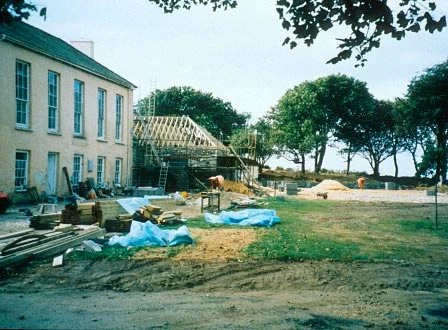
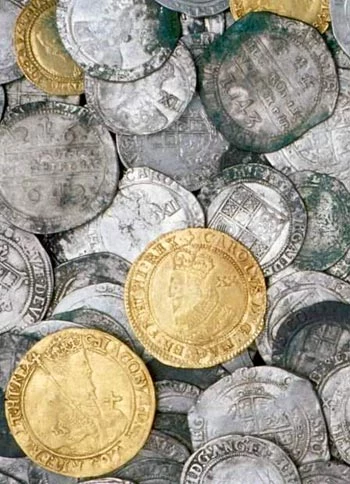
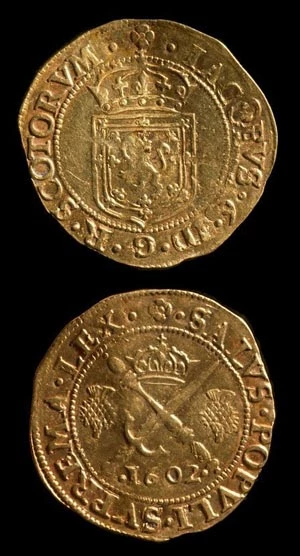
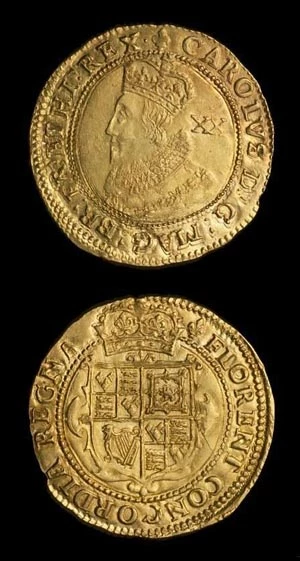
The 'legendary' treasure of Tregwynt 17 April 2007 Tregwynt Mansion, September 1996: the tennis court under construction. The Tregwynt hoard: a selection of the coins as found. A Scottish Sword-and-Sceptre piece of James VI, 1602. The money brought south by James in 1603 when he became King of England was made legal tender in England and Wales. A gold Pound coin: a twenty-shillings piece of King Charles I (1625-49). A silver half crown (2s 6d [12½p]) of Charles I, 1642. Struck at an emergency mint at Shrewsbury at the beginning of the Civil War, this was a day's pay for a cavalryman. On the back, the King promises to fight for the Laws of England, the Protestant religion and the Liberty of Parliament. Round the edge: 'Let God arise, let his enemies be scattered!' Tregwynt Mansion, Fishguard, Pembrokeshire Each year Amgueddfa Cymru receives a few chance finds of coins and tokens, but occasionally something more spectacular comes to light. On 17th September 1996, one of Wales' finest coin hoards was discovered. The story begins in 1996 at Tregwynt Mansion, not far from Fishguard, Pembrokeshire, when the owners were building a tennis court. As they levelled the site and removed the topsoil, a few coins were uncovered. As more soil was removed, more coins were found and after a few days 87 silver and gold coins had been uncovered dating from the 16th and 17th centuries. An initial news blackout on the discovery proved to be a wise precaution, since by mid October, further searching, helped by a hired JCB, brought the total to 33 gold and 467 silver coins, fragments of pottery, a sheet of lead, and a gold ring! At a coroner's inquest at Haverfordwest on 12th June 1997, the coins and ring were declared treasure trove. The Museum was able to acquire the hoard with the aid of the Heritage Lottery Fund. Why is the Tregwynt hoard special? The Tregwynt Hoard is one of the finest coin hoards ever recovered from Wales. At the time of its burial it was worth £51 9s. (in today's terms perhaps around £10,000) - enough to pay fifty soldiers for about a month. The hoard contains an unusually wide range of mid-17th century currency in gold and silver, including a gold crown (five shillings) dating back to the time of Henry VIII. The coins cover a range of values and reigns: sixpences and shillings of Edward VI (1547-53), Philip and Mary (1554-8), Elizabeth I (1558-1603), The remaining English gold coins are of James I (1603-25) and Charles I (1625-49), but there is also one Scottish gold coin of James VI dated 1602, just before he became king of England. Tregwynt is unusual in containing coins from no fewer than seven of the emergency mints operated by the royalists during the Civil War. There are also two very rare Irish coins: a half crown probably issued in 1642 by the rebel Catholic Confederacy, and a crown from an emergency Dublin issue of 1643, probably the first recorded find of this type in a Civil War context in England and Wales. Dating the Hoard The latest coin at Tregwynt is a single shilling bearing as its mint-mark a sceptre, in use during 1647 and 1648, so the hoard was buried no earlier than 1647. Oliver Cromwell and the Battle of St. Fagans Tregwynt is the first 'Civil War' coin hoard to be recorded from Pembrokeshire, and although the hoard's burial cannot be dated with any precision, it seems likely that the county was a major focus of the so-called 'Second Civil War' - a series of royalist risings during the first half of 1648. In February that year Colonel Poyer, a staunch parliamentarian, refused to hand over Pembroke Castle to Colonel Fleming, and by March was in revolt. The parliamentarians were driven out of Pembrokeshire and the royalists were only finally halted at the battle of St Fagans, near Cardiff on the 8th May 1648. The revolt brought Oliver Cromwell to west Wales in person to attack Pembroke Castle, which did not surrender until 11th July. When, By Who and Why? It is highly likely, therefore, that burial of the Tregwynt hoard relates to the events of 1648. Who owned it? This we shall never know for certain, but whoever it was never came back to collect it. The occupier of Tregwynt at the time was Llewellin Harries, an important farmer who died in 1663 and had at least twelve children. As the hoard was buried in a pot covered by a lead sheet, in an outbuilding it suggests that one of the family was probably involved in its burial: but was it the owner? In the confused times of civil war, almost anything is possible. There is some slight evidence that the Harries were royalist, but if so, they seem to have kept out of the way when it came to the post-war fines imposed on the King's supporters. Three men named Harries fought for the king at St Fagans but none were definitely connected with Tregwynt. The gold ring, which is presumed to have belonged to the hoard, is a 'posy' (motto) ring inscribed 'Rather death then [than] falce of fayth' - but the meaning cannot be assumed, nor its owner identified. The Tregwynt Legend There has long been a legend of treasure at Tregwynt, of valuables supposedly hidden in a hurry when the 1797 French invasion at Fishguard interrupted a ball at the mansion. Reality has proved somewhat different. We shall never know the full story of the Tregwynt treasure, but it stands out as a fine example of the currency of Wales in the early modern period and a spectacular reminder of the disruption visited upon every community during the English Civil War. Background Reading 'A Civil War hoard from Tregwynt, Pembrokeshire' by E. Besly. In British Numismatic Journal, vol. 68, p119-36 (1998). 'Welsh treasure from the English Civil War' by E. Besly. In Minerva, vol. 9(4), p49-51 (July/August 1998).
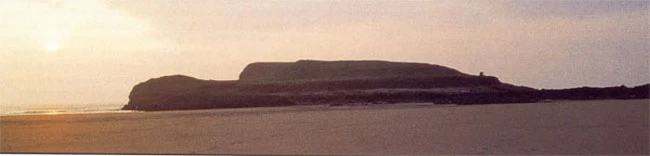
Stone Age Man on Burry Holms, Gower, South Wales 17 April 2007 Burry Holmes, Gower. As the last ice sheet retreated from Wales 12,000 years ago, plants, trees and animals and people slowly started to return. By the start of the Early Mesolithic, or Middle Stone Age period, 10,000 years ago, woodland had started to re-establish itself and hunter-gather humans had moved into the region. Burry Holms Archaeology Today, Burry Holms is a tidal island situated on the northern end of Rhossili Bay, Gower, Swansea. The island has a lot of archaeology including a Mesolithic site, a Bronze Age burial mound, an Iron Age fort with a deep defensive ditch and bank, and the remains of a settlement founded in the 11th century and abandoned during the 17th century. Amgueddfa Cymru decided to investigate Burry Holms further as we hold a little understood collection of stone tools from work undertaken on the island in the 1920s. Mesolithic discoveries A scientific survey and excavation was undertaken at the area of the island where the Mesolithic finds are believed to have been found. Working on a tidal island were challenging with just five hours working-time on the island. However, this short digging day allowed time to process all the finds and samples as they were collected. A number of stone items washed in from the surrounding higher parts of the island were found in one patch of sand deposited by wind during the Middle Ages. Finds such as these are very difficult to age, but some yellow glass beads have been dated as Iron Age, and, therefore, matching up with the Iron Age fort on the island. Stone Age Tools Below these sands was a layer of buried soil containing evidence of stone tools and spears of Mesolithic age. A column of sediment from the complete sequence of deposits was removed and tested for pollen grains, which will supply environmental evidence for the landscape during the Mesolithic and later periods at Burry Holms. In addition, large pieces of charcoal found from Mesolithic layer were sent for identification of the tree species and radiocarbon dating. Life on Burry Holms in the Stone Age By studying the evidence discovered with the collections held at the Museum, an interpretation for the Mesolithic site on Burry Holms can be suggested. The twenty-two small stone spears found at the site have been identified as microliths. Microliths are small stone points only found in the Mesolithic period, and were attached to a handle and used as hunting and fishing spears. One of the microliths has an impact fracture at its tip suggesting that it was broken during use. It is possible that its Mesolithic owner took the damaged spear to Burry Holms where he discarded the broken microlith and made a replacement for his spear before going off hunting or fishing again. There is a good supply of flint and stone at the area, ideal for the manufacture of sharp tools. The variety of objects discovered clearly shows that stone tools were being produced at the site. Most of the microliths discovered are Early Mesolithic, but three appear to be of Late Mesolithic appearance. During the Early Mesolithic period the sea level was much lower than it is today meaning that Burry Holms would not have been an island at that time, but a distinctive inland hill. In many ways this site would have been an ideal place for Mesolithic people to have established a camp or settlement. The hilltop shelter from the winds and the prominent position would have been ideal for scanning the surrounding landscape for prey to hunt and the nearby River Loughor a source of fish for their diet. Unfortunately, due to the acidic soils, bones have not been preserved at the site, so the remains of their meals and indeed the remains of the people themselves, as well as any of their bone or wooden tools, will not have survived.