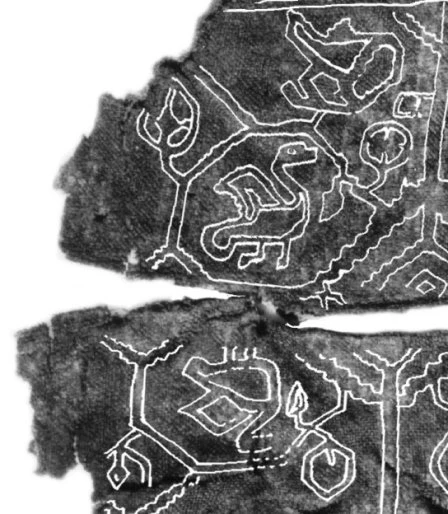
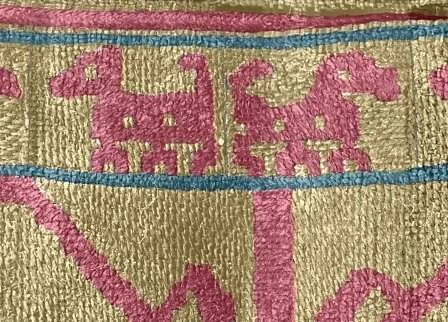
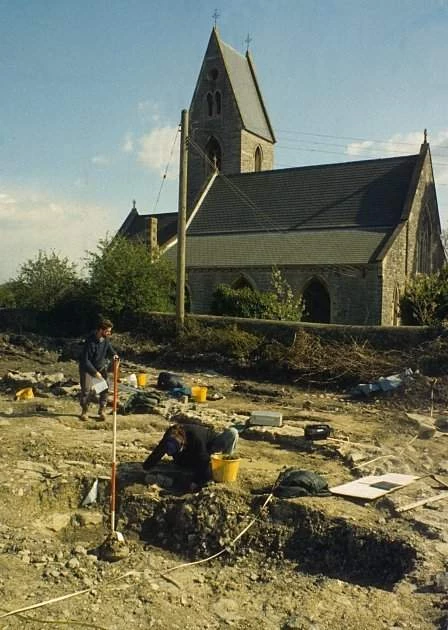
The Llan-gors textile: an early medieval masterpiece 3 May 2007 Excavations at Llan-gors Lake in 1991. The textile was discovered in the silts beyond the oak palisade visible in this trench. The lump of charred textile, as found lying on a piece of wood. Part of the decoration preserved on the textile, showing a group of birds framed by vines. Unfortunately none of the original colour was preserved in the textile, making the design very difficult to see without assistance. It is picked out here with superimposed white lines. The total area shown is roughly 9cm tall by 7cm wide (3.5 x 2.8 inches). Digital-simulation of colour on a photograph of the original textile. In 1990, archaeologists working at a site on Llan-gors Lake, near Brecon, made an unexpected discovery - the remains of a magnificently decorated textile, over a thousand years old. Just off the northern shore of Llan-gors Lake lies a crannog (a man-made island) built as a royal site for the ruler of Brycheiniog in the 890s - a turbulent period in the kingdom's history. At this time, Brycheiniog was under pressure from several neighbouring kingdoms, and Llan-gors must have seemed a safe retreat. However, excavations of the site have shown that this haven was short-lived, being destroyed by fire in the early 10th century. Much of the archaeological work at Llan-gors focused on the waterlogged silts that surrounded the crannog. It was here that the textile was discovered, badly charred and very fragile. Through careful conservation treatment it was possible to separate and clean its many layers revealing this unlikely lump to be among the most important finds of early medieval textile yet found in Britain. The base material of the textile was a very fine plain-weave linen. Silk and linen threads have been used to decorate the textile with birds and other creatures within a framework of vines, and with borders containing repeating patterns or lions. The skill with which this work has been accomplished continues to be a source of wonder. The linen has 23 threads to the centimetre - a magnificent achievement given the equipment available in the 9th and 10th centuries AD. The textile appears to be part of a garment, perhaps a tunic or dress - it has a hem and a belt loop - but unfortunately too little survives to indicate its detailed shape. Its owner was a person of considerable status since the silk that decorates it must have been imported to Britain, while the quality of the needlework suggest that it was produced in a specialist workshop. So how did this fine textile come to be lost? A clue can be found in the Anglo-Saxon Chronicle for AD916, which records that in this year a Mercian army from England destroyed a site called Brecenanmere (Brecknock-mere = Llan-gors Lake) and captured 'the wife of the king and 33 other persons'. Was this the event that saw the burning of Llan-gors and the loss of the textile? It is tempting to believe so. Background Reading 'A fine quality insular embroidery from Llangors Crannog, near Brecon' by H. Granger-Taylor and F. Pritchard. In Pattern and Purpose in Insular Art edited by M. Redknap, S. Youngs, A. Lane and J. Knight, p91-99. Published by Oxbow Books (2001). 'Worn by a Welsh Queen?' by L. Mumford and M. Redknap. In Amgueddfa, vol. 2, p52-4 (1999). 'The Llangorse textile; approaches to understanding an early medieval masterpiece' by L. Mumford, H. Prosser and J. Taylor, in C. Gillis and M.-L. B. Nosch (eds), Ancient Textiles: Production, Craft and Society, 158-62. Published by Oxbow Books (2007).
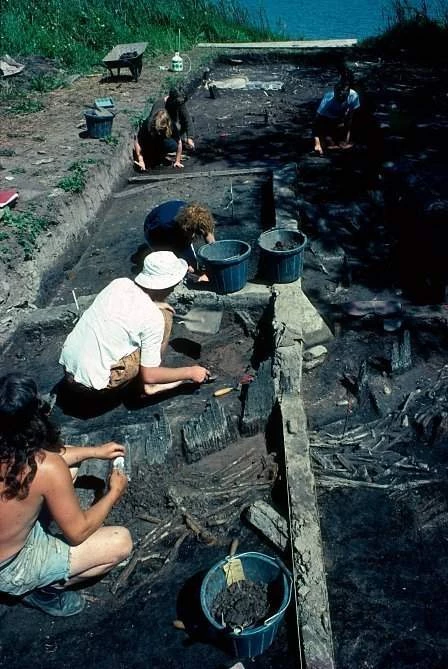
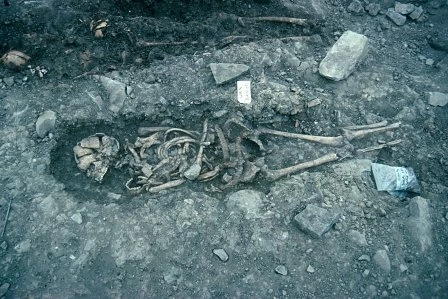
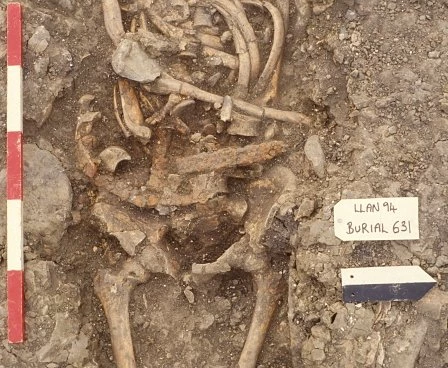
The suffering of burial 631 2 May 2007 Excavations in progress in 1994 in part of the cemetery of St Dochdwy's monastery. Burial 631 as discovered. Detail of the iron belts around the waist of burial 631. The iron belts during conservation work undertaken by a team at Amgueddfa Cymru. In 1994 archaeologists excavated the largest collection of early medieval burials yet found in Wales, as well as evidence for an unusual burial practice. Ideal Homes Wales Ltd had contracted archaeologists from Cotswold Archaeology to excavate land earmarked for a new housing development in Llandough (Vale of Glamorgan). The site was situated just outside the churchyard of the present parish church - reputedly the site of the early medieval monastery of St Dochdwy - the excavation discovered over 800 burials dating from the 4th- to the 11th-century AD. Careful study of the skeletons has shed fresh light on the population of Wales at this time. One grave in particular was exceptional. Burial 631 Burial 631 lay in the middle of the cemetery. The skeleton was that of a young man, aged between 25 and 35, and about 1.75m tall (5.75 feet). Radiocarbon dating of the bone suggested that he died between AD340-660. However, it was not his antiquity that made him special, but rather the two iron straps he wore around his waist. The ends of these straps were secured behind his back. The tapered iron ends passed through lugs and were hammered over by a second person, making it impossible for the wearer to remove the straps unaided. Clearly this was more than a fashion accessory, but what other functions could it have served? It has been suggested that the straps may have been worn as an act of penitence - a fitting purpose in the context of a monastic community. Similar cases are certainly known in the Middle Ages. For example, there was a visionary monk at the monastery of Much Wenlock (Shropshire) in the early 8th century called Begga, who wore 'an iron girdle about his loins for the love of God'. An alternative explanation is that the iron bands served as a hernia belt. Roman texts first record the use of hernia belts on the Continent. Examples have also been excavated from 6th- and 7th- century burials in France, Germany, Switzerland and Spain. So which interpretation is correct - penitent's belt or hernia truss? The answer is likely to be a little of both. During the early medieval period the endurance of suffering was seen as a path to heaven. So enduring the pain of a hernia may in itself have been in part an act of penitence from which the wearer of these two belts hoped to reap a reward in the afterlife. Background Reading 'Llandough' by A. Thomas and N. Holbrook. In Current Archaeology, vol. 146, p73-7 (1996). 'An early-medieval girdle from burial 631', by M. Redknap. In N. Holbrook and A Thomas 'An early-medieval monastic cemetary at Llandough, Glamorgan: excavations in 1994', Medieval Archaeology 49 (2005), 53-64.
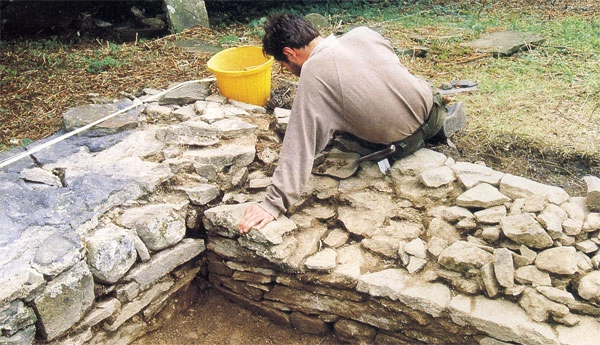
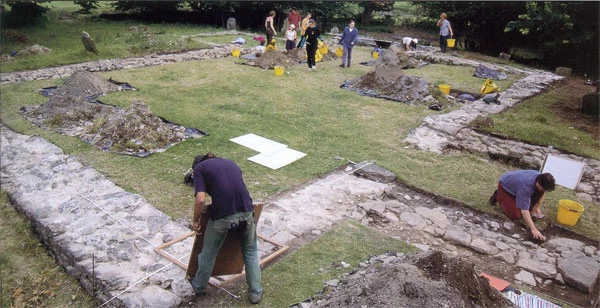
Discoveries from underneath a medieval church 1 May 2007 Cleaning the south wall of the medieval church Recording and cleaning in progress (nave and porch in foreground) Following the dismantling of St Teilos Church at Pontardulais, west Glamorgan, and its removal to St Fagans, excavations on the foundations uncovered further clues to the history of this medieval church. The dismantling and re-erection of the church made it possible to investigate the foundations of the church in a way that would be impossible otherwise. A detailed understanding of the building is essential in any investigation of a church's development. For churches still in use, only fleeting glimpses of the hidden fabric may be provided as opportunities arise. In the case of the dismantled St Teilo's church, it was possible to produce an accurate, stone-by-stone plan. Before excavation began, a geophysical survey of the area, using ground- penetrating radar, revealed evidence of numerous burials, and within the church itself a number of areas were identified that could have been related to structural activity. After excavating and surveying was done, details of the construction from the 12th or 13th century onwards were revealed. The present church probably dates from the 15th century. Before excavation, it was thought that the last addition was a small chapel on the north side of the chancel. The earliest recognisable phase of the building appears to be a small rectangular nave and chancel. To this was added a north and south transept, probably during the 14th or early 15th century (though not necessarily at the same time). Important churches in Wales during the later Middle Ages often had a cruciform plan. A south aisle was probably added in the late 15th century to provide for an expanding congregation, and finally a porch was added to the south side of the aisle. A buried grave-slab was found, at the junction of the chancel and north transept, to Mary Bevans of Killa, who died in 1717 aged 64. A section of rubble on the south side of the church, which appears to have been out-of-use by the time the porch was constructed, may have been the base for a churchyard cross. The excavation has significantly altered the understanding of the development of the church. The 12th century witnessed an explosion in church building, and much of what remains of the early stone phase of St Teilo's probably dates from about this period. Although the church can be matched with 'Lan Teliav Talypont', one of four places in Glamorgan called after St Teilo that are mentioned in the 12th century Liber Landavensis (The Book of Llandaff), no carved stones or evidence for a earlier timber construction have been discovered.
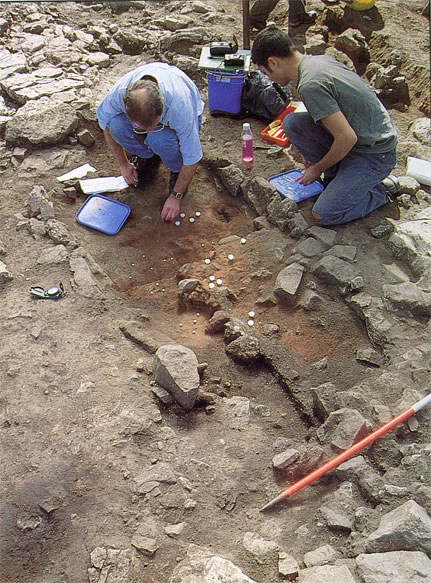
Vikings on Anglesey 1 May 2007 Llanbedrgoch on Anglesey is home to one of Wales' most interesting archaeological sites from when the Vikings invaded Wales. Research at this site by Amgueddfa Cymru has helped reveal the nature of Viking Age life that has puzzled scholars for decades. Excavation in progress on building 1 in 1997 The site was discovered in 1994 after a number of finds were brought to the Museum for identification. These included an Anglo-Saxon penny of Cynethryth (787-792 AD), a penny of Wulfred of Canterbury (about 810), and three Viking lead weights. From Neolithic to Roman After detailed excavation and research, the complex history of the site began to be unravelled. The site appears to have been a focus of activity from as early as 3300 BC, a period when most of the large burial chambers on Anglesey were built. Several items of pottery, radiocarbon dated to around 240 to 450 AD, show activity at the site during the Roman period. The Site Activity at the site can be broken up into a number of phases. A ditch was found measuring 2m wide and 1m deep. Further excavation uncovered post-holes cut into bedrock thought to represent a platform of a house. Items recovered suggest that the ditch is pre-Viking. It is at this time that a large timber hall, represented by large post pits, probably belongs. This timber building appears to have been replaced in the late 9th or early 10th century by at least two halls, last used between about 890 and 970. To the east was a large hall or barn, measuring about 8m by 12m, dated to around 855-1000 AD. A small section of stone paving to the west marked the entrance to a third, slightly smaller building. Ploughing has removed any clear evidence for the walls but a 10th century fine bronze buckle and an iron knife blade with angled back were recovered. A rubbish dump at the south-west corner of the site contained a few artefacts, including a Northumbrian styca (penny) of Archbishop Wigmund (about 848 - 58), socketed iron tools for leatherwork, mounts and bucket bindings. The area then appears to have returned to agriculture, which in time removed all surface traces of the former settlement. Like sites elsewhere, it is situated on a carefully selected, sheltered location, about 1000m from the sea. Forming one of the largest collections of this kind from Wales, the objects found at the site are remarkably well preserved. Coin and other evidence suggests an early period of economic growth at Llanbedrgoch from the late 8th century. In the 10th century, the settlement appears to have been at its peak, with harvesting of crops, keeping of livestock, the presence of craftsmen, and contact with Viking merchants arriving in ships. The enclosure at Llanbedrgoch appears to be the key to unlock further secrets and reveal the nature of Viking Age settlement which has puzzled scholars for decades.
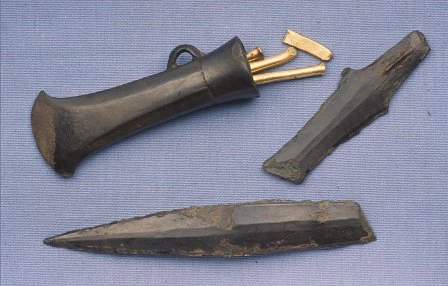
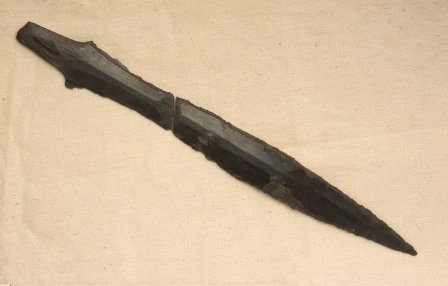
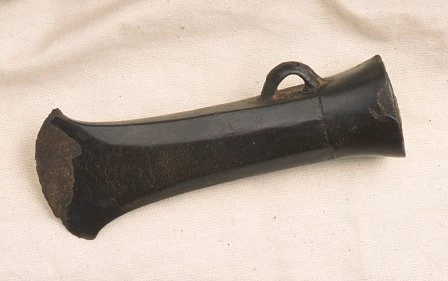
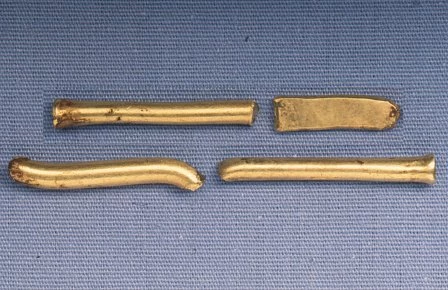
3,000 year old Irish gold from North Wales 26 April 2007 The hoard of Bronze Age artefacts recovered by metal detectorists near Wrexham. The bronze knife, found in two fragments. The edges of the blade were heavily notched, perhaps suggesting it had been used for some time before burial. The bronze axe, the socket of which contained the fragments of two or more gold bracelets. The fragments of bracelets, probably made from Irish gold. In 2002 a number of Bronze Age items were discovered near Wrexham, North Wales. Amoung the finds were a bronze knife, an axe head, and four fragments of gold bracelets. All were made between 1000-800BC and show links between Wales and Ireland during the Bronze Age. The knife is of a type used throughout southern England and Ireland, and its shape mirrors much larger swords that were in use at this time. However, it is the first of its kind to be found in Wales. The bronze axe head has a socket at one end, to which a wooden handle would have been attached, as well as a loop through which leather or twine would have been threaded to keep them together. It appears, however, that the axe head was buried without its handle since four fragments of gold bracelets were found stuffed into the socket. These valued finds include two terminals (end pieces) of a bracelet type most commonly used in Ireland, and are probably made of Irish gold. These artefacts would probably have belonged to a person of considerable social standing since few people at this time would have had access to Irish gold and such finely worked tools. Quite why their owner decided to part with them will never be known for certain, although it is likely that they were buried as an offering to the gods. The discovery adds valuable detail to our understanding of life in Wales 3,000 years ago. A time when leaders dressed to impress by wearing gold bracelets and hair ornaments, and a person's role within society was broadcast by the tools and weapons worn, the appearance of the horse they rode and the quality of a feast hosted. Though most people in Wales were settled farmers and herders at this time, finds like the hoard from Wrexham show us that these small communities were part of large trading networks that linked Wales with Ireland. Evidence that our ancestors had more on their minds than food, farming and survival. These items form part of the collections of Wrexham County Borough Museum.