: Work & Labour

Medieval Cardiff

4 May 2007

Capital city of Wales

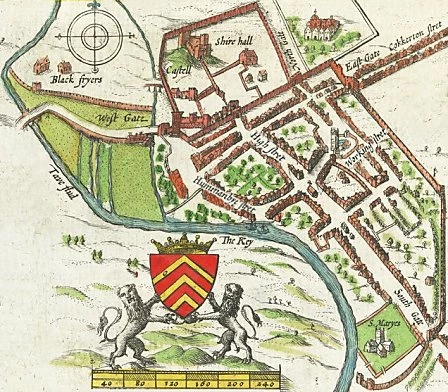
John Speed's map of 1610. Speed's plan of Cardiff reveals many aspects of the city's development, including the majority of features described in this article.

John Speed's map of 1610. Speed's plan of Cardiff reveals many aspects of the city's development, including the majority of features described in this article.

Travelling around Cardiff, capital city of Wales, it is easy to forget that this modern city's origins were laid many centuries ago. The heart of the city was formed during the medieval period and many traces from this time survive today, especially close to the castle.

Cardiff lies at the centre of three river systems, the Taff, the Ely and the Rhymney. Its location allowed its first residents to control trade and movement along these rivers, giving them power over a large area.

Roman Cardiff

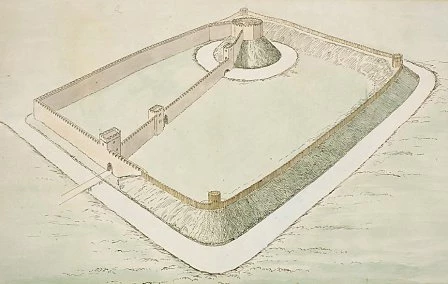
Cardiff Castle as it might have appeared in the 14th century.

Cardiff Castle as it might have appeared in the 14th century. The inner face of the medieval bank still survives within the castle grounds and on close inspection the foundations for the medieval east wall can still be seen on the top of the bank.

The first people to take advantage of this location were the Romans who set up a fort here about AD55-60. This dominating fort protected its inhabitants until about AD350-375 when it was abandoned at the end of Roman rule in Britain.

The stone walls of the fort provided later generations with a massive source of building materials, while a further legacy from the Romans was a network of roads linking Cardiff with neighbouring areas.

The medieval castle

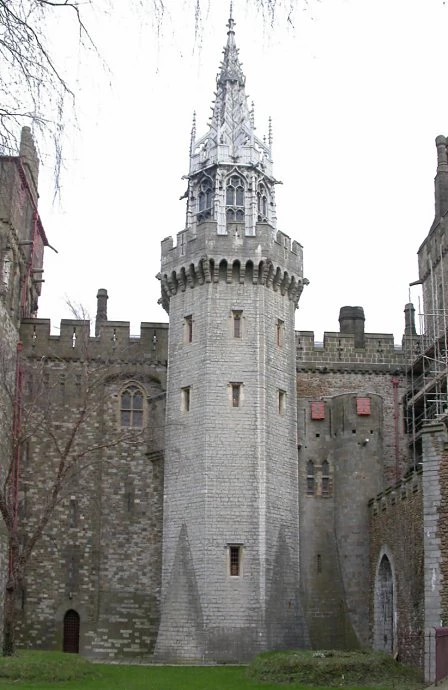
Beauchamp's tower, Cardiff castle.

Beauchamp's tower, Cardiff castle. Richard Beauchamp, Earl of Warwick, built this tower in the 15th century, to protect the castle's west gate. Openings at the top of the tower allowed stones or burning objects to be dropped on attackers. The unusual spire was added in the 19th century.

Today, much of Cardiff's Roman remains are lost beneath the medieval castle. The castle dates from the 11th century, when the Normans conquered Glamorgan. It was begun by William the Conqueror on his return from St David's in Pembrokeshire, in 1081. This is supported by an inscription on a coin found within the castle grounds which suggests that William may have established a mint at the castle.

Cardiff Castle was originally built in wood. In the 12th century, Robert Consol, Duke of Gloucester, rebuilt it in stone. At this time, the Castle's west and south walls were raised, building upon the ruined walls of the Roman fort.

Owain Glyndŵr

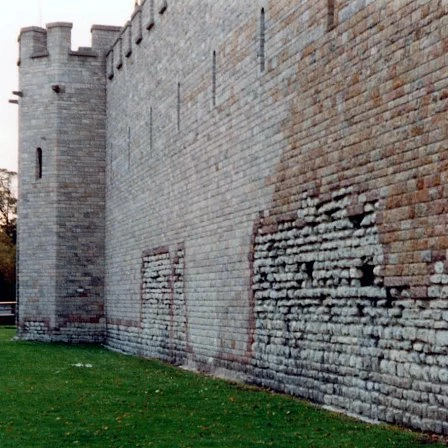
The castle wall, Cardiff.

The castle wall, Cardiff.

In 15th century, town was destroyed by Owain Glyndŵr's Welsh army. The Castle lay in ruin until Richard Beauchamp, Earl of Warwick, restored the defences and castle buildings in 1423. Beauchamp also constructed the octagonal tower, now known as Beauchamp's tower.

Much of the rest of the castle and walls dates to the 19th century, when the third Marquis of Bute employed William Burges to restore, refurbish and rebuild it.

The medieval town

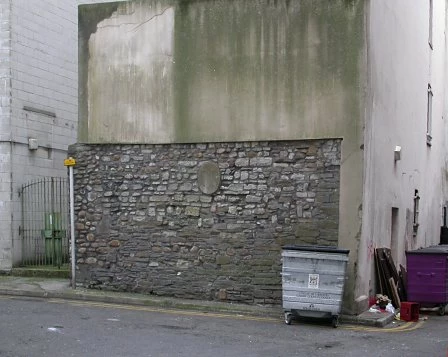
Medieval town wall, Cardiff. Sadly, this is the best preserved section of Cardiff's town walls. It is now hidden behind retail developments along Queen's Street.

Medieval town wall, Cardiff. Sadly, this is the best preserved section of Cardiff's town walls. It is now hidden behind retail developments along Queen's Street.

Cardiff's Shire Hall was built inside the castle's walls in the 15th-century. It was in use as the town's administrative centre until the 17th century.

The medieval town spread out from the castle's South Gate. Interestingly the High Street lines up with the Roman rather than the medieval south gate, suggesting it dates from this earlier period.

The Medieval town probably developed in two stages. The first stage was within a relatively small enclosure marked out by Working Street and Womanby (Hummanbye) Streets' both names are linked to old Norse. In the second stage of its development, Cardiff expanded south. The town was then enclosed and defended to the east by a bank and ditch and eventually a stone gate. To the west, the town was protected by the meandering river Taff.

Remains of the medieval wall

Only two sections of the medieval wall are known to survive. The first supports a flower bed just east of the Roman fort wall, while the larger surviving piece is across the road behind retail outlets. Much of the surviving foundations of the wall were destroyed by the large shopping centres which swallowed up many of the small medieval alleyways of the city.

Remains of the castle wall

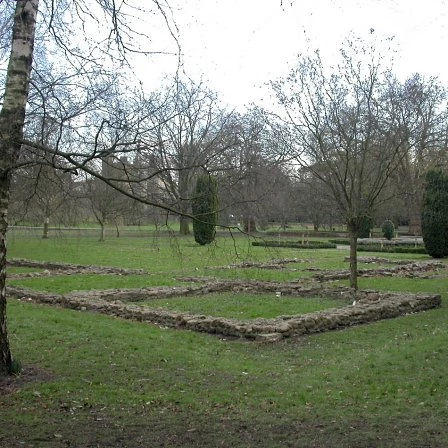
The remains of Blackfriars, Cardiff, in Cooper's Field beside the castle.

The remains of Blackfriars, Cardiff, in Cooper's Field beside the castle.

The lower section of the castle wall belonged to the Roman fort, while the upper section was added in the 1920s. During the medieval period, building plots were packed so tight against the Roman wall, that some of the inhabitants were forced to extend their homes backwards through it. This can be seen in the undulating profile of peaks and troughs along the surviving length of the Roman wall.

Religion

In the centre of Cardiff stands St John's church. Its earliest surviving stonework is mid 13th century and its tower was added around the 1470s. Much of the church we see today was rebuilt during the 18th century.

To the east of the castle lay the monastic settlement of Greyfriars, while to the west lay the Blackfriars, both were established around 1256-80. The friars were an active part of Cardiff life until the 1530s when Henry VIII dissolved their monasteries. By 1610, the Blackfriars buildings was in ruins, while the Greyfriars building was converted into a mansion of the Herbert family. The ruins of this mansion survived into the 20th century until they were pulled down to be replaced by a multi-storey car park and tower block. The foundations of Blackfriars were revealed during the 19th century, while the Marquis of Bute was renovating his gardens. These were opened to the public as a park in the 1940s.

Background Reading

'Cardiff Castle excavations, 1974-1981' by Peter Webster. In Morgannwg, vol. 25, p201-11 (1981).

Cardiff Castle: its history and architecture by J. P. Grant. Published by William Lewis (1923).

Medieval Town Plans by B. P. Hindle. Published by Shire Archaeology (1990).

The Cardiff Story. A history of the city from its earliest times to the present by Dennis Morgan. Published by Brown and Sons (1991).
French pottery in medieval Wales

4 May 2007

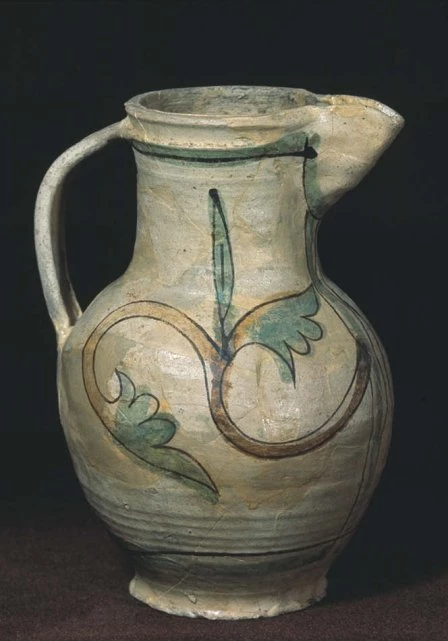
Saintonge jug

Saintonge jug from Kidwelly Castle, Carmarthenshire.

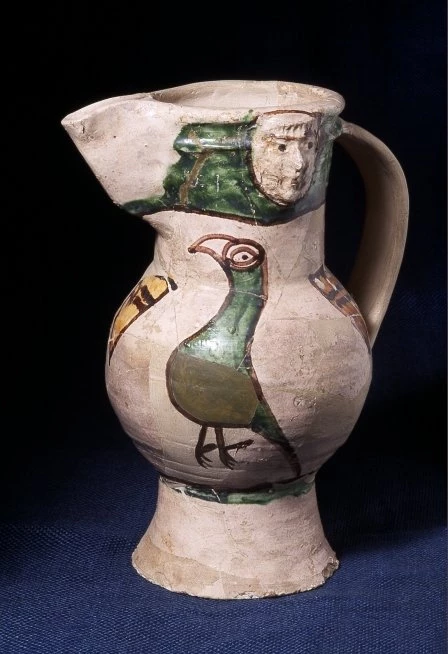
Elaborately decorated vessel found in Cardiff. 23.8cm (9.5 inches) tall.

Elaborately decorated vessel found in Cardiff. 23.8cm (9.5 inches) tall.

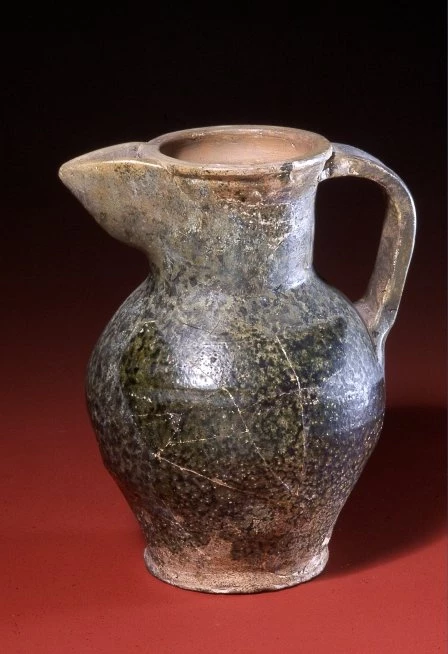
Jug found in the well at Castell-y-Bere, Gwynedd. 20.5cm (8.1 inches) tall.

Jug found in the well at Castell-y-Bere, Gwynedd. 20.5cm (8.1 inches) tall.

During the Middle Ages, several regions of France exported pottery to Britain - notably northern France, Normandy and the Ardennes. Most of the French pottery found in Wales came from the Saintonge area of south-west France.

The trade in pottery from the Saintonge area to Britain began early in the 13th-century and lasted for about 500 years. At the start of this period the English ruled neighbouring Gascony, and many of the vessels that have been found in Wales probably made their way to Britain from the ports of La Rochelle and Bordeaux as part of mixed cargoes (wine being the most important commodity).

Pottery from the Saintonge area was made from a fine clay that was well suited to the throwing of light, thin-walled shapes such as those seen here. The clay also had a low iron content, which meant that, when fired, it produced a vessel with a white or buff fabric.

The first example illustrated here was found in a midden at Kidwelly Castle (Carmarthenshire) during excavations in the 1930s. It appeared to have been thrown away along with several plainer vessels and is decorated with a vine scroll motif typical of Saintonge jugs. It was probably produced between 1275 and 1320. This elegantly decorated vessel illustrates the great skill of the Saintonge potters. It is 25cm (9.8 inches) tall and in places its walls are only 2.4mm (0.1 inches) thick.

In these years Kidwelly Castle passed from the ownership of the de Chaworth family, who greatly improved its defences, to William de Valence and then to the House of Lancaster. These later owners set about improving the castle's accommodation. This jug may have been used to pour wine in the Great Hall for one of these English owners or their guests, though such jugs may also have held water.

Saintonge pottery is known from many other sites in Wales, including Cardiff and Castell-y-Bere in Gwynedd. For the most part the ware has been found at coastal sites - locations more easily controlled by the English, or more accessible to their traders - though occasionally it has been found in remote upland sites.

  • Cardiff jug: This jug was discovered during work in Cardiff High Street in 1893. Its decoration includes birds, masks, and heraldic shields - all are common features on jugs from the Saintonge potteries.
  • Castell-y-Bere jug: Castell-y-Bere was only occupied by the English from 1284-1294. Given the frequency with which Saintonge pottery is found at other castles occupied by the English in Wales, it seems likely that the jug dates from this period.

While such pots may not even have been greatly valued by their owners, when viewed alongside vessels of silver, bronze or brass they survive as examples of great craftsmanship and illustrate links between Wales and the wider European world during the Middle Ages.

Background Reading

'Kidwelly Castle, Carmarthenshire; including a survey of the polychrome pottery found there and elsewhere in Britain', by C. Fox and C. A. R. Radford. In Archaeologia vol. 83, p93-138 (1933).

'Medieval finds from Castell-y-Bere, Merioneth' by L. A. S. Butler. In Archaeologia Cambrensis vol. 123, p78-112 (1974).

Medieval pottery and metal-ware in Wales by J. M. Lewis. Published by the National Museum of Wales (1978).

Stunning ironwork firedog uncovered in farmer’s field

4 May 2007

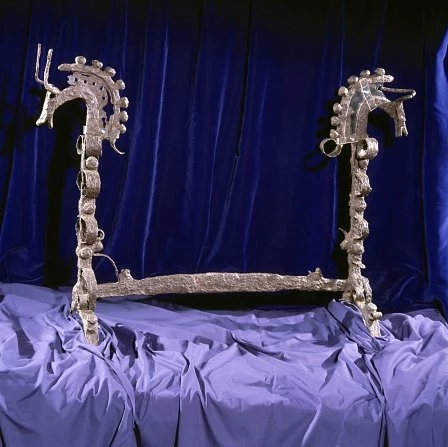
The Capel Garmon Firedog

The Capel Garmon Firedog (Conwy). Firedogs are decorated stands used to contain wood burning in a fireplace. This fine example has heads and crests shaped to resemble aspects of both a bull and a horse.

One of the heads on the firedog

Detail showing one of the heads on the firedog. The head may have represented a mythical creature recounted in the tales of warriors or an emblem of the tribe or community of its owners.

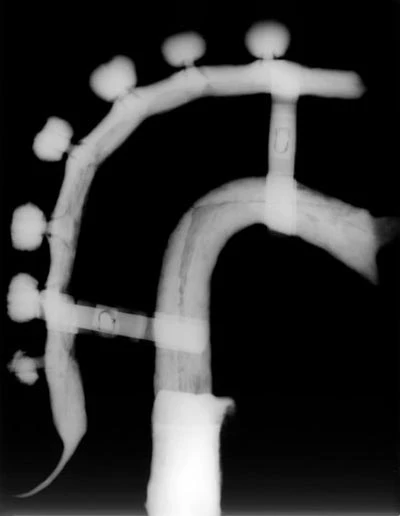
X-ray of one of the heads on the Capel Garmon Firedog

X-ray of one of the heads on the Capel Garmon Firedog. This X-ray shows the complex way in which the firedog was constructed. (The horizontal and vertical struts are modern supports added to stabilize the head).

Experimental iron smelting

Experimental iron smelting has shown the amount of time and skill that would have been involved in the production of the Capel Garmon Firedog.

This iron stand with two opposing horned animal heads is known as the Capel Garmon Firedog, and was made by a master craftsperson of the Celtic Iron Age.

An offering to the gods

Found in 1852, the firedog was uncovered in a field at Carreg Goedog Farm, Capel Garmon (Conwy). It lay on its side, with a large stone placed at each end, and was deeply buried. Its careful placing and unbroken state suggest that it was deliberately placed as an offering to a god of the pagan Celtic world. This fits into a long-established tradition of depositing metalwork in Wales’s lakes, rivers and bogs during the Bronze and Iron Ages.

One of a pair

Originally one of a pair, the firedog would have sat next to a hearth at the centre of a timber or stone round-house. This hearth would have been a natural focus for eating, feasting and discussion and the firedog would have been on view to be admired by all.

Recent X-raying of the firedog, together with an attempt to replicate the artefact by a modern blacksmith, has shown that its maker was a master craftsperson, highly skilled in shaping and working iron.

Magical process

It has been estimated that the Capel Garmon Firedog may have taken one person over 3 years to make, from the gathering of raw materials, through the smelting of the ore to the finishing of the artefact. This transformation of iron ore into metal was probably viewed as a magical process by the Celts, and blacksmiths would have been given great respect for the powers that they wielded.

Dating the Capel Garmon Firedog is difficult - there were no archaeologists to record the excavation. However, since the Capel Garmon find, similar firedogs have been discovered in south-east England, in the graves of Iron Age chieftains.

In addition to the firedogs, these burials were accompanied by grave goods, all of which can be dated to between 50BC and AD75 - the Late Iron Age. It therefore seems likely that the Capel Garmon firedog was also buried around this time.

Iron was first used in Wales at around 750BC. From 300BC onwards iron tools, weapons and brooches became increasingly common on hillforts, settlements and in hoards. However, the scale and quality of the Capel Garmon Firedog sets it apart from these objects. Despite all the discoveries that have been made in the past 150 years, it remains one of the most important pieces of early decorative ironwork to have been found in Britain.

Background Reading

Celtic art, reading the messages by M. Green. Published by Weidenfeld & Nicholson (1996).

'Firedogs in Iron Age Britain and beyond' by S. Piggott. In The European community in later prehistory: studies in honour of C. F. C. Hawkes by J. Boardman, M. A. Brown and T. G. E. Powell, p245-70. Published by Routledge & Kegan Paul (1971).

'The Capel Garmon Firedog' by C. Fox. In The Antiquaries Journal, vol. 19, p446-8 (1939).

Heroic rescue for man dangling from girder 50 meters high

23 April 2007

Edward Medal for bravery

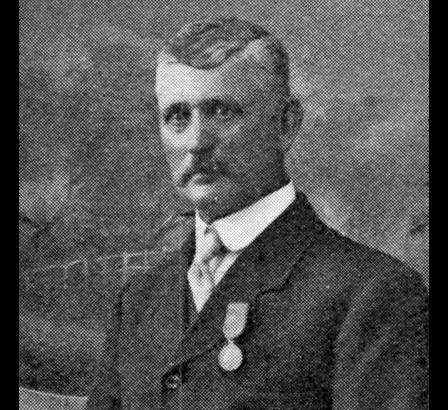
James Dally, wearing the Edward Medal. From the Great Western Railway Magazine, September 1915.

James Dally, wearing the Edward Medal. From the Great Western Railway Magazine, September 1915.

In October 1914 James Dally saved a colleague from a 52m fall from a viaduct. He was awarded the Edward Medal for his bravery.

On 28 October 1914, the Crumlin viaduct, near Newport, south Wales, was being painted by using a staging of planks timber supports. Around 5:00 pm, one of the supports broke, and the foreman, Mr Skevington, fell 52m (175 feet) to his death into the goods yard below. The second man, Thomas Bond, just managed to grip onto the main bridge structure in time, but was left dangling in mid air...

Heroic rescue

The Crumlin Viaduct. The location of the rescue is marked with a red dot.

The Crumlin Viaduct. The location of the rescue is marked with a red dot.

Bridgeman James Dally, of Crumlin, was nearby, supervising the operation. He immediately crawled out from the gangway on to the diagonal bracings - which were a mere eight centimetres wide:

"I asked him to swing his legs in an upward direction, so as to get them around the stretcher, if possible. This he succeeded in doing. I then got hold of Bond's legs; & told him to move one hand at a time & by that means he was drawn nearer to the gangway & when he was near enough I got a better hold of him, & eventually landed him safely on the gangway."

According to the London Gazette, "The man would probably have lost his life had it not been for the courage and presence of mind shown by Dally." Bond himself had no doubts: "I was suspended in the air; but if Mr Dally had not been on the gangway at the time, & taken the action he did I could not have saved myself... I owe a deep debt of gratitude to Mr Dally, for had it not been for the encouragement he gave me, & the prompt effort he made, I would have undoubtedly met the same fate as Mr Skevington."

Acts of courage in other industries

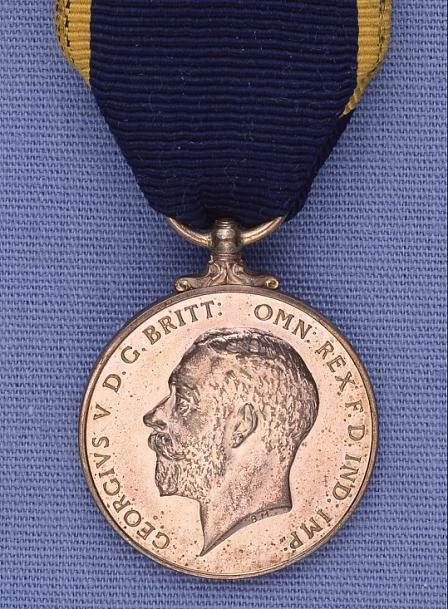
James Dally's Edward Medal, Industry, Second Class (bronze), front view.

James Dally's Edward Medal, Industry, Second Class (bronze), front view.

In the event, Dally was awarded the Edward Medal, which he received from King George V on 12 July 1916. This medal had been created in 1907 to reward "heroic acts performed by miners and quarrymen" and in 1909 its award was extended to acts of courage in other industries.

The Crumlin Viaduct was 512m (1,680 feet) long and rose some 60m (200 feet) above the valley of the Ebbw. The viaduct was opened on 1 June 1857 and by 1863 was part of the Great Western Railway network; it was demolished in 1965-66.

Background Reading

For Those in Peril, by Edward Besly. Published by the National Museums & Galleries of Wales (2004).

Gallantry: its public recognition and reward in peace and war at home and abroad by A. Wilson and J. H. F. McEwen. Published by Oxford University Press (1939).

The Brynmawr Experiment, 1929-40

23 April 2007

Brynmawr furniture

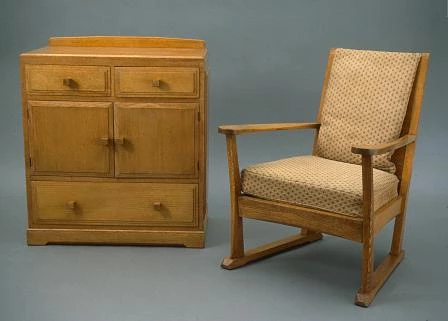
Talybont cupboard-chest and Ynysddu armchair by the Brynmawr Furniture Company.

Talybont cupboard-chest and Ynysddu armchair by the Brynmawr Furniture Company.

The 'Brynmawr Experiment' was an attempt by the Quakers to relieve the mass unemployment in the town of Brynmawr, south Wales in the early 1920s. They set up a small furniture-making enterprise that led to a major chapter in the social and artistic history of Wales.

The venture started in 1929, employing twelve local untrained men and later took on boys trained straight from school. Support came mainly from other successful Quaker companies - the first order was for 400 chairs for a Quaker school in York. Each chair cost £1 each (equivalent to £41 or $71 today). New equipment and machinery was bought with the profits

Paul Matt

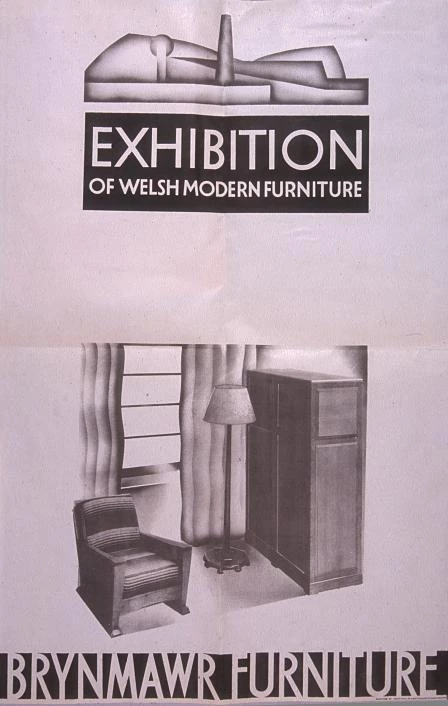
Advertising poster for the Brynmawr Furniture Company.

Advertising poster for the Brynmawr Furniture Company.

The success of Brynmawr furniture was mainly due to the designer, Paul Matt. He had served his apprenticeship under his father, a skilled designer and cabinet-maker in London.

Paul Matt designed furniture that was simple to construct, taking into consideration that the workers were initially all unskilled. The main timber used was imported oak, finished with a coat of clear wax which gave the furniture an overall simple and minimal appearance, in line with the Quaker philosophy.

Glossy catalogues and promotional leaflets emphasised the high quality and design of the products whilst providing sustainable employment for the local community. These ideals appealed to the middle and professional classes of the 1930s and the company made the furniture affordable to such professions.

'Welsh' furniture

David Morgan's department store opened in Cardiff in 1879. The store provided important support for the Brynmawr Furniture Company between 1932 and 1940.

David Morgan's department store opened in Cardiff in 1879. The store provided important support for the Brynmawr Furniture Company between 1932 and 1940.

Brynmawr furniture was available in large department stores such as Browns of Chester and Lewis's of Birmingham and Manchester. In 1938 the company had a permanent showroom in London's fashionable Cavendish Square.

Although successful in England, the company was also keen to promote Brynmawr furniture in Wales. David Morgan Limited, a well-known Cardiff department store provided exhibition space free of charge for the products and exhibitions were held at the National Eisteddfods.

The furniture was marketed as 'Welsh' and branded using Welsh place-names such as the Cwmbran chest, Llanelli table and the Cwm-du chair. This ensured a loyal following within Welsh professional and academic circles throughout the 1930s.

The advent of War

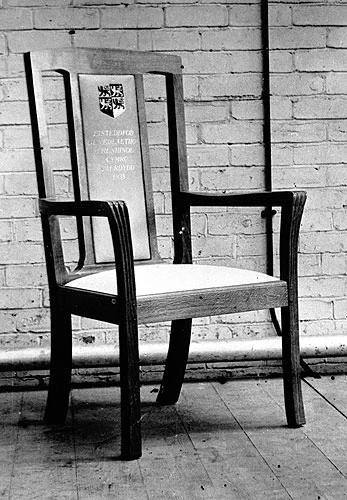
The Cardiff National Eisteddfod Chair, 1938 from the Bryn-mawr Settlement Factory.

The Cardiff National Eisteddfod Chair, 1938 from the Bryn-mawr Settlement Factory.

In 1936 Arthur Reynolds took over as designer from Paul Matt. Although production remained relatively unaffected, sales gradually declined in the late 1930s as the war approached. The advent of war also made it difficult to import materials therefore the Brynmawr Furniture Co. sadly had no other choice than to cease trading in 1940.

Background Reading

'Crafts and the Quakers' by Gwen Lloyd Davies. In Planet, vol. 51, p108-111 (July 1985).

'Utopian designer: Paul Matt and the Brynmawr Experiment', by Roger Smith. In Furniture History vol. 23, p88-94 (1987).

Lindsay Shen, 'Philanthropic Furniture: Gregynog Hall, Powys' by Lindsay Shen. In Furniture History vol. 31, p217-235 (1995).