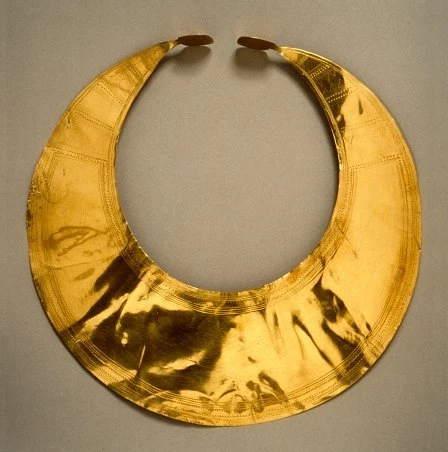
Stunning gold relic unearthed in Gwynedd 26 April 2007 Llanllyfni lunula. Weighing 185.4g (6.5 ounces) and measuring 24cm (9.5 inches) in diameter. This crescent-shaped ornament probably originated as a single rod shaped ingot and was expertly hammered into shape. The intricate decoration of zig-zags, lines and dots was then added using a fine pointed tool and a copper or bronze punch. These designs are very similar to those used to adorn pottery made at this time. Reconstruction of a lady wearing a gold lunula from Llanllyfni, (about 2000BC). Gold was one of the first metals to be used in Wales, along with copper and alloys such as bronze. The use of gold for jewellery and ornamentation has been a common theme since the earliest times. This stunning decorated object is one of the earliest gold artefacts to have been found in Wales and dates to the beginning of the Bronze Age (2400-2000BC). Yellow leaf sticking from the ground It was found a few miles from Llanllyfni (Gwynedd) on Llecheiddior-uchaf Farm near Dolbenmaen in about 1869. A farmer noticed what he took to be a yellow laurel leaf sticking out of some peat. Later, unsatisfied with this explanation, he returned to the site and uncovered the crescent-shaped object of gold. The Llanllyfni lunula Known as a 'lunula' after its crescent-shape (luna = moon in Latin), objects like this have been found in Scotland, Cornwall, and north-west France, with as many as 90 being discovered in Ireland. Lunula are generally found in isolated locations, away from ancient settlements and, like the Llanllyfni example, they have often been discovered by chance. It has been argued that they were intended to be worn around the neck as breast plates, although the lack of wear on the gold suggests that they were only rarely used - possibly they were the symbol of a priest or were used in the rituals of a community. The gold in the Llanllyfni lunula may come from a Welsh source, for example the Dolgellau gold belt, or north-west of Llandovery, but as so many have been discovered in Ireland, the suspicion is that it was traded as a raw material across the Irish Sea. Background Reading 'Bronze Age gold in Britain' by J. P. Northover. In Prehistoric gold in Europe by G. Morteani and J. P. Northover. Published by Kluwer (1993). Bronze Age goldwork of the British Isles by J. J. Taylor. Cambridge University Press (1980). 'Objects mostly of prehistoric date discovered near Beddgelert and near Brynkir station' by W. J. Hemp. In Proceedings of the Society of Antiquaries of London, 2nd series, vol. 1, p166-83 (1918).
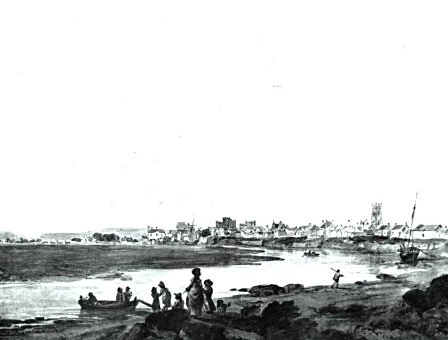
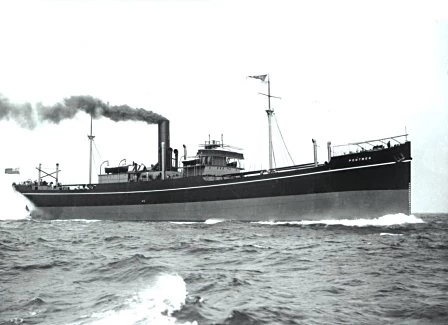
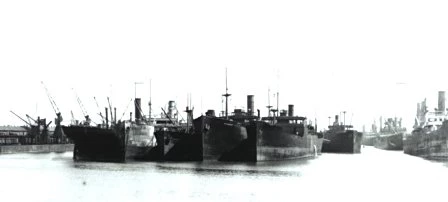
Cardiff – Coal and Shipping Metropolis of the World 18 April 2007 Cardiff: the pre-industrial port. Two sloops lying in the River Taff, as portrayed by Paul Sandby in 1776. Cardiff: the industrial port. An aerial view showing the completed dock system about 1948. A typical Cardiff tramp steamer - the SS Pontwen, built in 1914. The age of depression. Laid-up ships in Cardiff docks about 1930. Cardiff: the port transformed. Modern retail developments now stand where Cardiff once exported coal to the world. Second Marquess of Bute In 1862, 2 million tonnes of coal were exported from Cardiff Docks ; by 1913, this had risen to nearly 11 million. This was the heyday of the coal industry before the depression of the 1930s. Cardiff was the boom town of late Victorian Britain. For a few years before the First World War, the tonnage of cargo handled at the port outstripped that of either London or Liverpool. Yet in the late 18th century, Cardiff's trade was all transported by two small sloops sailing to Bristol on alternative days. So what had led to this transformation? It was the growth of the iron industry in the South Wales Valleys that caused Cardiff to develop a port. In 1794, the Glamorganshire Canal was completed, linking Cardiff with Merthyr, and in 1798 a basin was built, connecting this canal to the sea. Cardiff's foremost landowner, the 2nd Marquess of Bute, built West Bute Dock in 1839. Two years later, the Taff Vale Railway was opened. Coal overtakes Iron From the 1850s, coal began to replace iron as the industrial foundation of south Wales. South Wales steam coal was what oil is today, with yearly exports reaching 2 million tonnes as early as 1862. A further dock, the East Bute, was opened in 1859, but following the death of the 2nd Marquess in 1848, the Bute Estate trustees were over-cautious and reluctant to invest in new dock facilities. Coal exports reach 9 million tonnes Frustration at the lack of development at Cardiff led to rival docks being opened at Penarth in 1865 and Barry in 1889. These developments eventually spurred Cardiff into action, with the opening of the Roath Dock in 1887, and the Queen Alexandra Dock in 1907. By then, coal exports from Cardiff totalled nearly 9 million tonnes per annum, much of it exported by locally-owned tramp steamers. Tramp steamers and steamships Cardiff's first steamship was the little Llandaff of 1865, and she was the first of a fleet of steamships that grew rapidly in the late 19th century. By 1910, there were some 250 tramp steamers owned at Cardiff. Each day, the owners would meet to arrange cargoes of coal for their ships in the opulent Coal Exchange in Mount Stuart Square. The coal export industry reached its peak in 1913, when 10.7 million tonnes of coal were exported from the port. First World War After the First World War, there was a significant increase in shipping in Cardiff, with 122 shipping companies in business in 1920. The boom proved short-lived, however; oil was growing in importance as a maritime fuel, and the terms of the Treaty of Versailles soon flooded Europe with cheap German coal. By 1932, in the depths of the depression, coal exports had fallen to below 5 million tonnes and dozens of locally owned ships were laid-up. It was an era of depression from which Cardiff never really recovered, and despite intense activity at the port during the Second World War, coal exports continued to decline, finally ceasing altogether in 1964. Modern day Cardiff Today, the port of Cardiff presents a very different picture from that existing a century ago. The waterfront has been totally transformed. Exclusive flats now stand where coal hoists once stood, and the rough and ready sailortown pubs have been replaced by sedate bistros. Only two docks, the Roath and the Queen Alexandra, remain in use, and just two shipping companies remain. There is still some trade in timber, oil, and containers, but the days when the port was packed with tramp steamers, shrouded in coal dust as they loaded the 'black diamonds' of the valleys of south Wales, will never be seen again. Background Reading Cardiff and the Marquesses of Bute, by John Davies. Published by University of Wales Press (1981). Cardiff Shipowners, by J. Geraint Jenkins and David Jenkins. Published by the National Museums & Galleries of Wales (1986). Coal Metropolis: Cardiff, 1970-1914, by Martin Daunton. Published by Leicester University Press (1977).
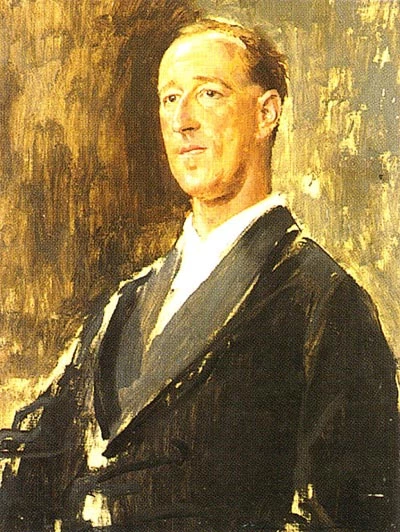
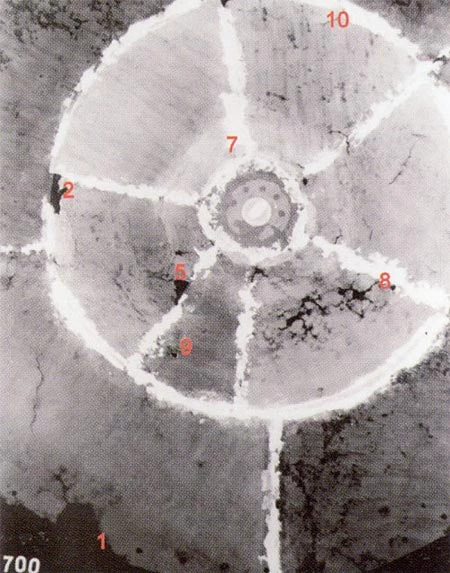
Trick or Treat? Ancient collection at Amgueddfa Cymru found to be modern 17 April 2007 At the beginning of the twentieth century, the president of Amgueddfa Cymru, Lord Howard de Walden, formed a remarkable collection of ancient European arms and armour. The collection included a number of classical pieces - helmets, swords, spearheads, belts and armour that were mainly Greek and Roman - or so it was thought until work at Amgueddfa Cymru discovered otherwise... The collection comes to Amgueddfa Cymru Portrait of Lord Howard de Walden (1880-1946) Etruscan bronze 'helmet' embellished with gold showing half of the false patina removed X-Ray of helmet In 1945, Lord Howard offered to lend seventy-nine 'antique bronze objects' to the Museum. Following his death in 1946, his son donated the collection to the Museum. In 1990 research by a Russian scholar had shown that some items from this collection had almost certainly been made in a jeweller's workshop in Odessa, south Russia between 1890 and 1910. Further investigation has revealed some of the objects to be totally genuine, but others reveal signs of being 'improved' or even manufactured more recently from antique metal parts fashioned into classical forms. In order to meet the demand for classical antiques during this period, it was quite common to produce a particular object using ancient pieces from a number of sources, or in other words, a pastiche (a work of art that imitates the style of some previous work). There are also a number of fakes, where the metal used was wrong for the period of the object. Lord Howard de Walden was well aware of this, for when the loan to the Museum was being organised, he wrote 'there are certain pieces you may not wish to have, such as...several specimens of doubtful authenticity'. Bronze 'helmet' One such object that Museum conservators examined was a helmet, made of bronze and decorated with gold, apparently dating from the third century B.C. The helmet was X-rayed to determine the condition of the metal and the extent of the corrosion, as well as to reveal its construction. However, the X-ray uncovered much more than was originally expected, for dense solder lines could be clearly seen criss-crossing the image. The helmet had undergone considerable restoration work in recent times; cracks had been filled with solder and holes patched with metal. To disguise these recent repairs a fake patina (the sheen on an object produced by age and use) mimicking corroded bronze had been applied over the top. Analysis of the metal revealed that the bronze helmet was in fact old, and even the patches of metal used to repair the holes were ancient. However, there were indications that the gold was modern. The investigations concluded that the helmet had been repaired and embellished with gold that would have increased its value and made it more desirable to collectors. This work may have been carried out at the turn of the twentieth century. Should the modern repair work be removed or conserved? In the end, it was decided to remove half the false patina in order to reveal the repair work below, for it was felt that the alterations were now part of the history of the object and could shed light on techniques employed at the time the helmet was collected. Study of this important collection not only throws light on the ancient technology of the genuine pieces of classical arms and armour, but also the practices of the antiquities market a century ago.
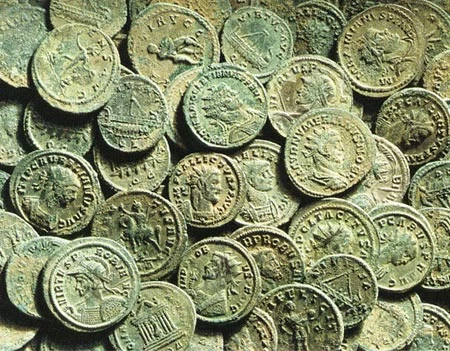
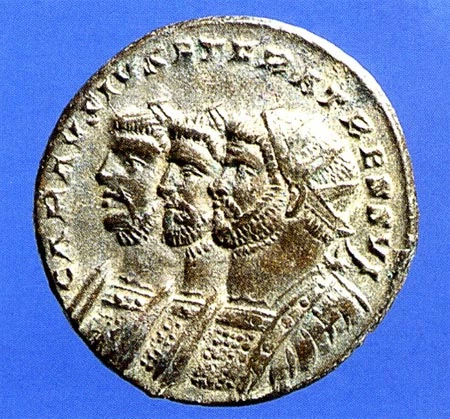
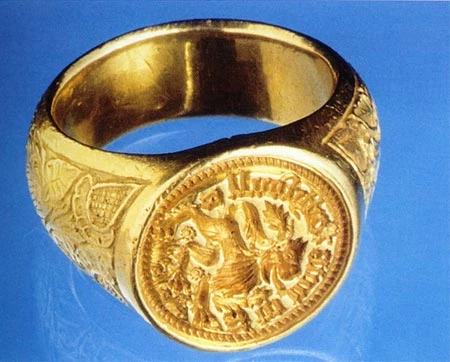
Metal detector discoveries from Monmouthshire: Two spectacular treasure finds 16 April 2007 In 1998 two separate but significant discoveries were unearthed by metal detectorists in Monmouthshire - a unique hoard of roman coins from Rogiet and a gold ring from Raglan. Both finds were significant and fine examples of treasure that are now in the collections of Amgueddfa Cymru. The Treasure Act of 1997 The Rogiet hoard, as found. 'Carausius and his brothers' (Rogiet hoard) The Treasure Act of 1997 covers certain classes of coins and precious metal objects found in England and Wales and has extended legal protection to single objects of gold and silver and to virtually all coin hoards. The new regulations have provided improved protection for certain categories of newly-found antiquities, and better opportunities for preserving these for the public benefit. Since the act came into force, staff from Amgueddfa Cymru have handled numerous finds, including the spectacular discoveries of an unique hoard of Roman coins from Rogiet and a massive gold signet ring from Raglan. One of the finest hoards of roman coins ever found in Wales In September 1998, thousands of Roman coins from the third century AD were discovered by Colin Roberts at Rogiet, Monmouthshire. This was one of the finest hoards ever recorded from Wales and were declared treasure in December 1998. The 3,750 coins had been buried, possibly in a wooden box, around AD 295-6 (we believe this to be the date since there were no coins later than this in the box) and span a forty-year period, with twenty-two emperors represented, a sign of the political instability of the times. Political trouble Their deposit, and the owner's failure to recover them, probably relate to this military and political instability. At the same time, however, the currency of the Roman empire was going through major change. In AD 294-5, new gold, silver and copper alloy coins were introduced to uniform designs and standards empire-wide. The hoard is made up of an unusual composition for a British find as the coins found in it were not circulated in great numbers here. The hoard is significant as it contains a number of faulty issues of the 260s, and also because it contains over 750 coins of the two individuals who declared themselves Emperor in Britain, Carausius (287-93) and Allectus (293-96). These are not often found in hoards and contain rare denominations representing a variety of warships. Also included in the hoard is a particularly fine specimen, perhaps the best in existence, of a classic rarity of the Romano-British coinage series. In around 292, Carausius seems to have wanted official appreciation from the emperors Diocletian and Maximian, issuing coinage in their names as well as his own. He even depicted himself with the others on a single design, with the slogan 'Carausius and his brothers'. The feeling was not shared, and within a year Carausius was gone, murdered by his minister Allectus. An ornate gold ring from Raglan The Raglan Ring In the same year as the Roman coins were unearthed at Rogiet, a massive and ornate gold signet ring was found near Raglan, Monmouthshire, by Ron Treadgold, and was also declared treasure. The ring has a circular bezel engraved with a design of a lion on a bed of flowers, within a single cable border with the legend: to yow feythfoull or feythfoull to yow and initials W A either side of the lion. The finest example of late medieval gold jewellery to be found in Wales The shoulders of the ring are decorated with flowers and leaves and is significant for the study of late medieval rings as very close comparisons exist in the engraving on the gold episcopal ring of John Stanbury, Bishop of Hereford (1452-1474), a mid 15th century cross from Winteringham, Lincolnshire and a gold ring from Godstow Priory, Oxfordshire. The Raglan ring is likely to date from the middle or third quarter of the 15th century, and is perhaps the finest example of late medieval gold jewellery ever to be found in Wales. The ring's owner The original owner of the seal has yet to be identified, though the finding of the ring near Raglan and initials W A make William Herbert, first Earl of Pembroke (executed after the battle of Banbury during the Wars of the Roses, in 1469) a possibility. He married Anne Devereux, and the initials might stand for William and Anne. The size of the ring suggests that it was worn by a man, and the inscription may be regarded as a sign of faithfulness to his wife. Herbert was one of two men referred to as the 'chosen and faithful' to the new king, Edward IV, and on Edward's coronation he was ennobled. However, the identification of the ring as that of William Herbert is not proven and other names are possible. At present, all that we can safely say is that the ring was a mark of rank, and probably belonged to an important officer or visitor to Raglan during the second half of the 15th century.
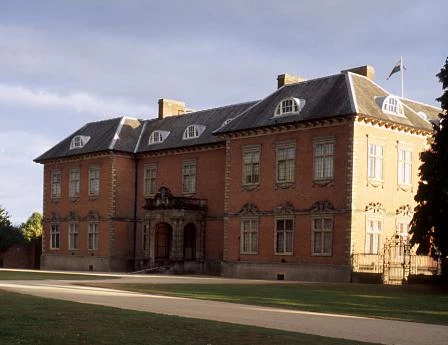
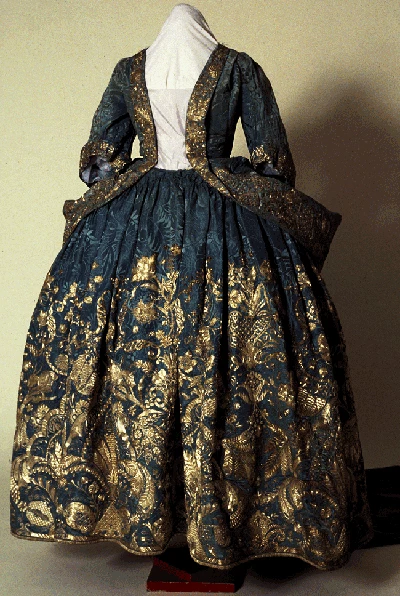
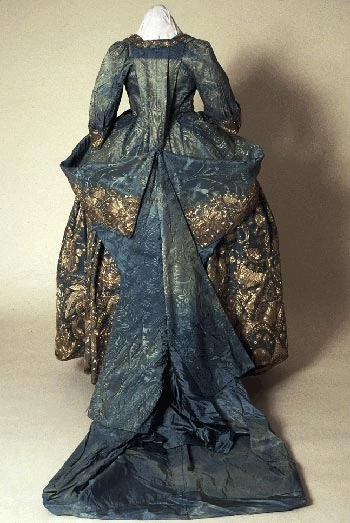
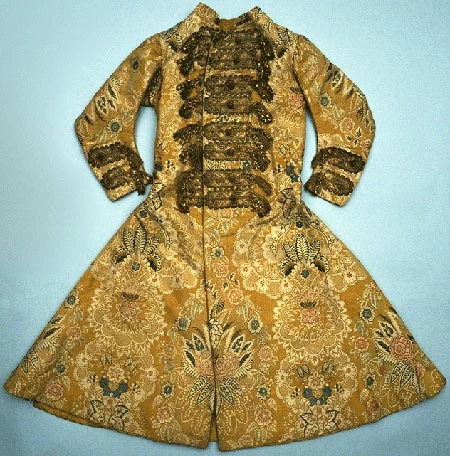
Glitz and glamour - the outstanding costumes of the the Tredegar Collection 11 April 2007 Tredegar House and Park. The house and grounds are now in the ownership of Newport County Council. Many rooms have been restored and are open to the public. Image © Steve Burrow. Silver embroidered blue damask court mantua (an open fronted gown with an elaborate train), made between about 1730-40. This is a very grand robe which would have been worn for presentation at court. This coat was probably worn by Sir William Morgan. It is of yellow lace pattern silk, dated to about 1725, and is of either English or French origin. For glitz and glamour, look no further than the Tredegar Collection. This impressive collection of 18th century costume was presented to the Museum in 1923 by Courtenay Morgan, also known as Lord Tredegar. The items belonged to his rich ancestors who wanted to flaunt their wealth and power. Each garment was designed to dazzle. Although the Morgans owned Tredegar House near Newport, they spent most of their time in London. For the gentry, the capital was the place to be. Pleasure gardens, operas and assemblies - their lives revolved around socializing. A royal debut The Tredegar costumes were probably made in London, using the finest woven damasks and brocaded silks you could buy. The most elegant dress in the collection dates from around mid-1720s. The grandness of this open fronted blue gown - often called a mantua - suggests that it was made for a young lady's royal debut. The detailing is elaborate and elegant, both on the front and the back.The gown was much longer originally, but a large section was cut off during the 1800s, supposedly for a fancy dress party. Whalebone corsets Gowns like this one were very awkward to wear. To achieve the exaggerated look, women wore wide hoop petticoats to increase the width of their skirts. They also wore tight corsets stiffened with whalebone under their dresses. Corsets encouraged good posture by squeezing the upper body into shape. Style was more important than comfort. This yellow brocaded frockcoat was made in the early 1720s. The floral design is typical of the period, so is the bright yellow colour. Further reading: M. R. Apted, 'Social Conditions at Tredegar House, Newport, in the 17th and 18th Centuries', The Monmouthshire Antiquary 3:2 (1972-3), pp. 124-54. Janet Arnold, 'A Court Mantua of c. 1740', Costume: Journal of the Costume Society 6 (1972), pp. 48-52. Avril Hart & Susan North, Historical Fashion in Detail: The 17th and 18th Centuries (London: V & A Publications, 1998).