: Keeping and caring for collections

The Llan-gors textile: an early medieval masterpiece

3 May 2007

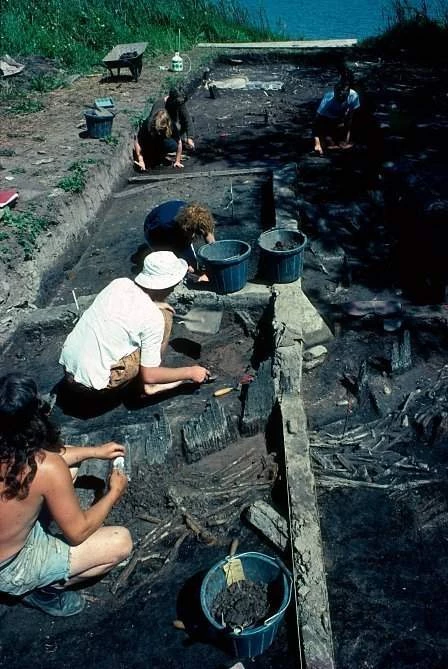
Excavations at Llan-gors Lake in 1991. The textile was discovered in the silts beyond the oak palisade visible in this trench.

Excavations at Llan-gors Lake in 1991. The textile was discovered in the silts beyond the oak palisade visible in this trench.

The lump of charred textile, as found lying on a piece of wood.

The lump of charred textile, as found lying on a piece of wood.

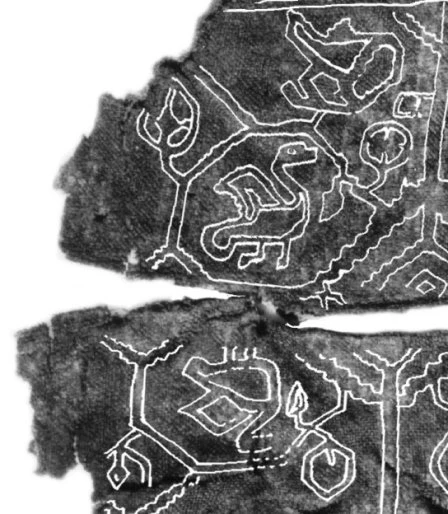
Part of the decoration preserved on the textile, showing a group of birds framed by vines. Unfortunately none of the original colour was preserved in the textile, making the design very difficult to see without assistance. It is picked out here with super

Part of the decoration preserved on the textile, showing a group of birds framed by vines. Unfortunately none of the original colour was preserved in the textile, making the design very difficult to see without assistance. It is picked out here with superimposed white lines. The total area shown is roughly 9cm tall by 7cm wide (3.5 x 2.8 inches).

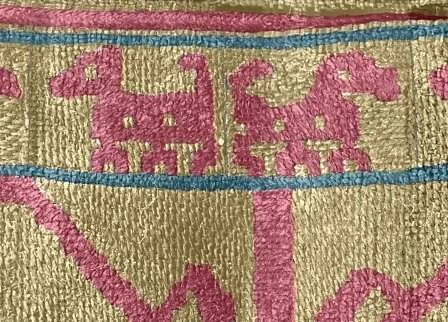
Digital-simulation of colour on a photograph of the original textile.

Digital-simulation of colour on a photograph of the original textile.

In 1990, archaeologists working at a site on Llan-gors Lake, near Brecon, made an unexpected discovery - the remains of a magnificently decorated textile, over a thousand years old.

Just off the northern shore of Llan-gors Lake lies a crannog (a man-made island) built as a royal site for the ruler of Brycheiniog in the 890s - a turbulent period in the kingdom's history.

At this time, Brycheiniog was under pressure from several neighbouring kingdoms, and Llan-gors must have seemed a safe retreat. However, excavations of the site have shown that this haven was short-lived, being destroyed by fire in the early 10th century.

Much of the archaeological work at Llan-gors focused on the waterlogged silts that surrounded the crannog. It was here that the textile was discovered, badly charred and very fragile.

Through careful conservation treatment it was possible to separate and clean its many layers revealing this unlikely lump to be among the most important finds of early medieval textile yet found in Britain.

The base material of the textile was a very fine plain-weave linen. Silk and linen threads have been used to decorate the textile with birds and other creatures within a framework of vines, and with borders containing repeating patterns or lions.

The skill with which this work has been accomplished continues to be a source of wonder. The linen has 23 threads to the centimetre - a magnificent achievement given the equipment available in the 9th and 10th centuries AD.

The textile appears to be part of a garment, perhaps a tunic or dress - it has a hem and a belt loop - but unfortunately too little survives to indicate its detailed shape.

Its owner was a person of considerable status since the silk that decorates it must have been imported to Britain, while the quality of the needlework suggest that it was produced in a specialist workshop.

So how did this fine textile come to be lost? A clue can be found in the Anglo-Saxon Chronicle for AD916, which records that in this year a Mercian army from England destroyed a site called Brecenanmere (Brecknock-mere = Llan-gors Lake) and captured 'the wife of the king and 33 other persons'.

Was this the event that saw the burning of Llan-gors and the loss of the textile? It is tempting to believe so.

Background Reading

'A fine quality insular embroidery from Llangors Crannog, near Brecon' by H. Granger-Taylor and F. Pritchard. In Pattern and Purpose in Insular Art edited by M. Redknap, S. Youngs, A. Lane and J. Knight, p91-99. Published by Oxbow Books (2001).

'Worn by a Welsh Queen?' by L. Mumford and M. Redknap. In Amgueddfa, vol. 2, p52-4 (1999).

'The Llangorse textile; approaches to understanding an early medieval masterpiece' by L. Mumford, H. Prosser and J. Taylor, in C. Gillis and M.-L. B. Nosch (eds), Ancient Textiles: Production, Craft and Society, 158-62. Published by Oxbow Books (2007).
Discovering the secrets beneath - 18th century paintings under the microscope

30 April 2007

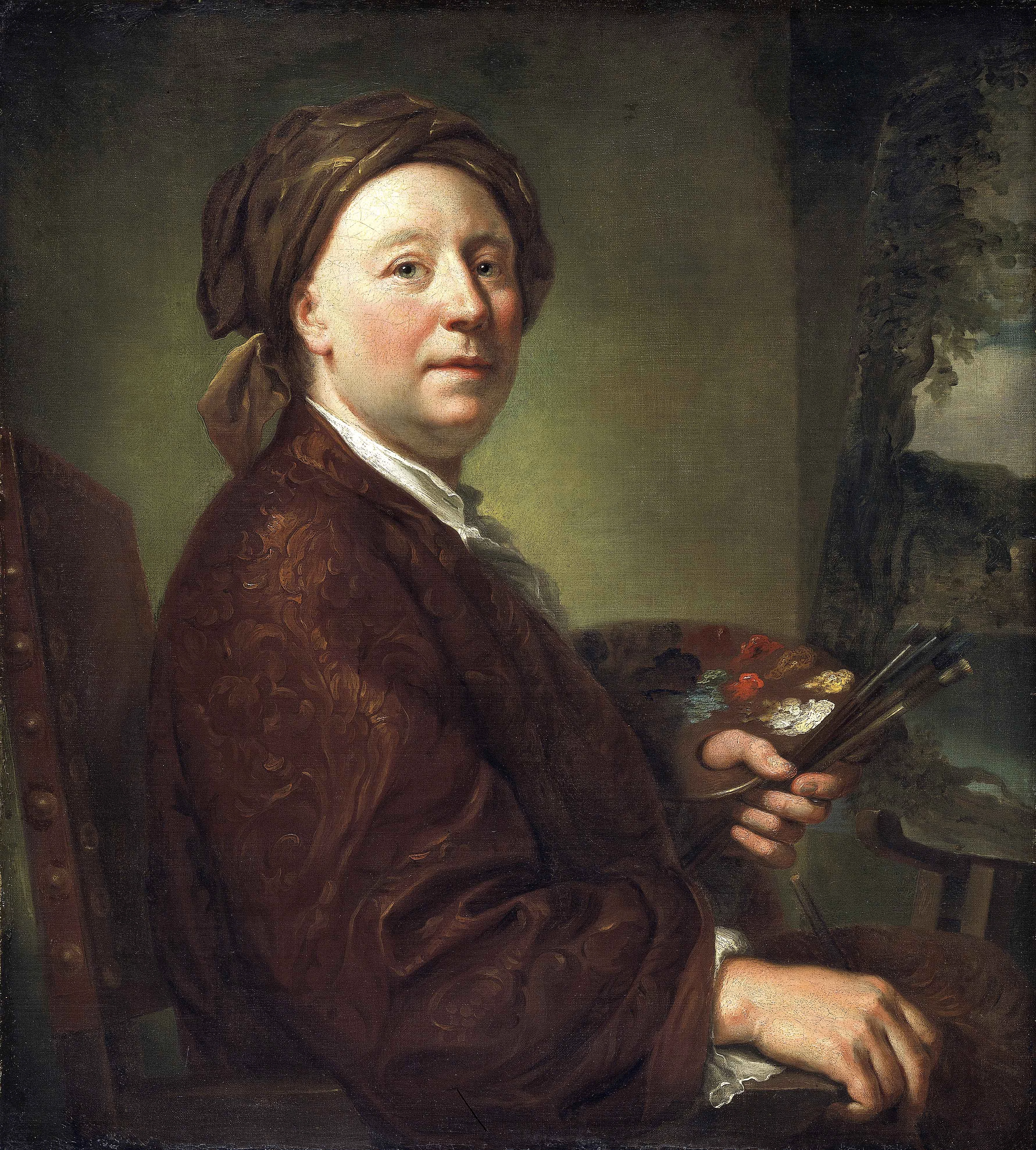
Richard Wilson (1714-1782)

Richard Wilson (1714-1782). This portrait was painted in Rome by Anton Mengs in return for one of Wilson's landscapes - a gesture of friendship and mutual admiration.

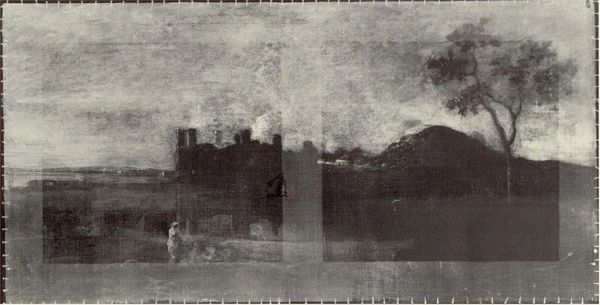
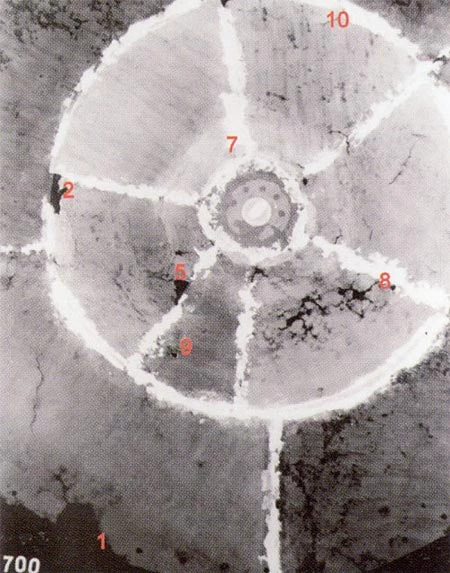
Caernarvon Castle X-ray image

Caernarvon Castle X-ray image (NMW A 73)

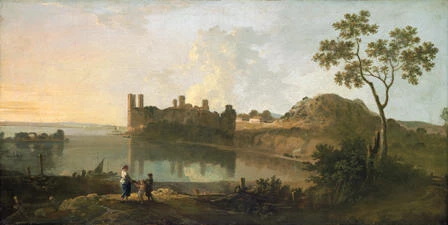
Caernarvon Castle by Richard Wilson

Caernarvon Castle by Richard Wilson

Dolbadarn Castle X-ray image

Dolbadarn Castle X-ray image (NMW A 72)

Dolbadarn Castle in I.R. light

Dolbadarn Castle in I.R. light (NMW A 5203)

Over the past few years, the Museum has been examining a number of paintings in the collections by Richard Wilson. Modern scientific equipment can reveal hidden details about the structure and materials used in these paintings. The results provide a fascinating insight into the artist's working methods and have led to discovering the origin of some of the more doubtful paintings from Wilson's work.

Infra-Red Light

Infra-red light has been used to see whether the paintings have subsequently been altered or painted over by the artist. Infra-red light can penetrate all but the deepest blue pigments to reveal any dark tones overlying a light coloured ground. It has been discovered that there are underdrawings in both the oil sketch of Dolbadarn Castle (NMW A 5203) and the large finished painting of the same subject (NMW A 72). In the oil sketch, the underdrawing includes a bridge across the river in the distance and a fence in the right foreground. Neither of these features were used in the final sketch. Furthermore in the large painted version Mount Snowdon is included in the background and the distant riverside buildings are moved further to the left. His ability to rework his designs brings variety to the many versions he painted of the same subjects and helps explain how he gives his English and Welsh views a grand classical appearance.

Paint Structure and Materials

Subjecting Wilson's work to X-rays has enabled the structure of Wilson's paintings to be examined. X-rays easily penetrate some materials, but are reflected by others. Some pigments traditionally used in oil painting come from heavy metals such as mercury, cadmium and lead. Lead white being one of the most commonly used. X-rays show up the structure of the painting and any changes that may have been made using lead white. Wilson usually painted his skies in a mixture of lead white and a blue pigment only down as far as the horizon, skirting around any trees and foliage silhouetted against the sky. The foreground and trees are painted largely with earth colours, which X-rays easily penetrate. A typical X-ray of a painting by Wilson should show a strong contrast between sky and foreground areas. This is best illustrated by Caernarfon Castle (NMW A 73). Any landscape not showing this characteristic contrast therefore can be assumed to have been produced by someone other than Wilson.

A few of the paintings examined so far show that Wilson sometimes completely reworked a composition. Dinas Bran (NMW A 3277) was originally started as a View of Tivoli (see NMW A 495). The town on the slopes of the hill is clearly visible in X-ray together with a wayside shrine, which occurs in other versions of that subject. He also occasionally reused a canvas. Dolbadarn Castle (NMW A 72) has been painted over a portrait of a woman, and Landscape with Banditti around a Tent (NMW A 69) is painted over a Venetian-style reclining nude.

Powerful microscopes

Tiny paint samples have been taken and looked at under incredibly powerful microscopes.

The pigments found in the paint layers almost exactly match the palette Wilson used. Prussian blue and indigo mixed with lead white are the chief pigments found in his skies, and ochre, Naples yellow, red and yellow lakes, Prussian blue and indigo in his foliage and foregrounds. Ultramarine blue however, which, according to contemporary accounts, Wilson used in finishing his skies, has not yet been found.

Proving Fakes

Although most of Wilson's close followers would have used a very similar palette to that of their master, this type of modern analysis has proved that later imitations were false as the pictures contained pigments that were not known in Wilson's day. These include NMW A 5195 Coast Scene near Naples, which contains cobalt blue, first introduced in 1817 and NMW A 5206 Cilgerran Castle which has a ground containing barytes, introduced at the end of the 18th century.

This research has produced information vital to a deeper historical understanding of individual works by Wilson, as well as some definite conclusions as to the status of paintings of doubtful origin.

Trick or Treat? Ancient collection at Amgueddfa Cymru found to be modern

17 April 2007

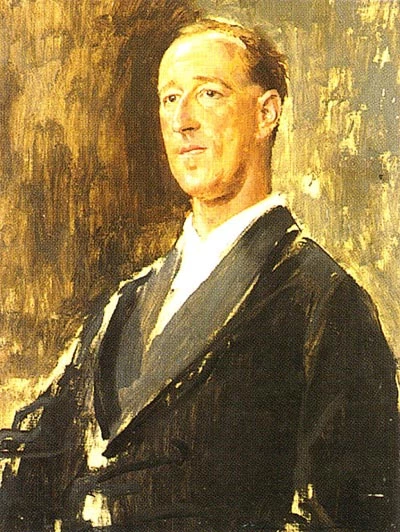
At the beginning of the twentieth century, the president of Amgueddfa Cymru, Lord Howard de Walden, formed a remarkable collection of ancient European arms and armour. The collection included a number of classical pieces - helmets, swords, spearheads, belts and armour that were mainly Greek and Roman - or so it was thought until work at Amgueddfa Cymru discovered otherwise...

The collection comes to Amgueddfa Cymru

Portrait of Lord Howard de Walden (1880-1946)

Portrait of Lord Howard de Walden (1880-1946)

Etruscan bronze 'helmet' embellished with gold showing half of the false patina removed

Etruscan bronze 'helmet' embellished with gold showing half of the false patina removed

X-Ray of helmet

X-Ray of helmet

In 1945, Lord Howard offered to lend seventy-nine 'antique bronze objects' to the Museum. Following his death in 1946, his son donated the collection to the Museum.

In 1990 research by a Russian scholar had shown that some items from this collection had almost certainly been made in a jeweller's workshop in Odessa, south Russia between 1890 and 1910. Further investigation has revealed some of the objects to be totally genuine, but others reveal signs of being 'improved' or even manufactured more recently from antique metal parts fashioned into classical forms.

In order to meet the demand for classical antiques during this period, it was quite common to produce a particular object using ancient pieces from a number of sources, or in other words, a pastiche (a work of art that imitates the style of some previous work). There are also a number of fakes, where the metal used was wrong for the period of the object. Lord Howard de Walden was well aware of this, for when the loan to the Museum was being organised, he wrote 'there are certain pieces you may not wish to have, such as...several specimens of doubtful authenticity'.

Bronze 'helmet'

One such object that Museum conservators examined was a helmet, made of bronze and decorated with gold, apparently dating from the third century B.C.

The helmet was X-rayed to determine the condition of the metal and the extent of the corrosion, as well as to reveal its construction. However, the X-ray uncovered much more than was originally expected, for dense solder lines could be clearly seen criss-crossing the image. The helmet had undergone considerable restoration work in recent times; cracks had been filled with solder and holes patched with metal. To disguise these recent repairs a fake patina (the sheen on an object produced by age and use) mimicking corroded bronze had been applied over the top.

Analysis of the metal revealed that the bronze helmet was in fact old, and even the patches of metal used to repair the holes were ancient. However, there were indications that the gold was modern.

The investigations concluded that the helmet had been repaired and embellished with gold that would have increased its value and made it more desirable to collectors. This work may have been carried out at the turn of the twentieth century.

Should the modern repair work be removed or conserved?

In the end, it was decided to remove half the false patina in order to reveal the repair work below, for it was felt that the alterations were now part of the history of the object and could shed light on techniques employed at the time the helmet was collected.

Study of this important collection not only throws light on the ancient technology of the genuine pieces of classical arms and armour, but also the practices of the antiquities market a century ago.

Medieval boat discovered in south Wales estuary

12 April 2007

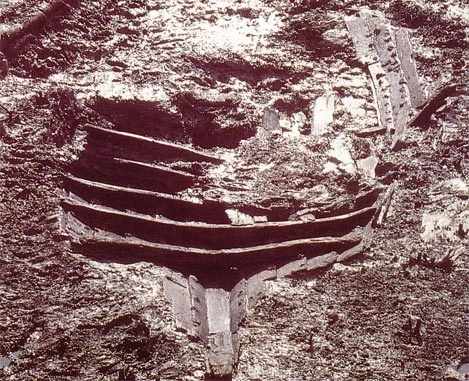
The remains of the boat in the mud

The remains of the boat in the mud

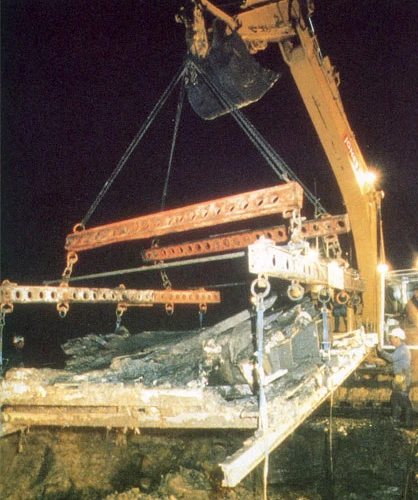
Raising the boat from the mud 4.00am August 27th 1995

Raising the boat from the mud 4.00am August 27th 1995

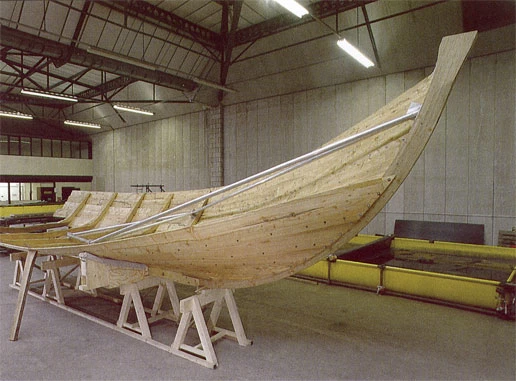
A reconstructed model of the Boat

A reconstructed model of the Boat

In 1994, the remains of a boat were discovered in the thick mud on the Gwent Levels, south Wales. Tests on the timber revealed that the boat dated from around 1194. Further excavation revealed that an intact portion of the vessel, 7.2m long and 3.9m wide, survived, making it the most important boat find of the Middle Ages in Britain for 25 years.

Lifting the Wreck

Recovery of the wreck was essential, but it could either be dismantled on site, or recovered intact. Dismantling could only be done in controlled conditions. However, the wreck was only accessible at low tide for a few hours at a time. The only reasonable course of action therefore was to retrieve the vessel intact.

Outside assistance in lifting the wreck was provided from the company building the nearby Second Severn Crossing, and over a period of seven tidal windows, day and night, a team of people worked tirelessly to dig tunnels underneath the vessel to build a cradle of aluminium beams. Extreme care had to be taken as the poor condition of the wreck made it vulnerable to disintegration.

The cradle was then attached to a lifting crane, the cables tightened, and the remaining sediment dug out. The vessel was successfully lifted at 4.00 in the morning before being transported to Cardiff, where it was placed in water to prevent the wood rotting further.

The remains were recorded and dismantled with each timber being drawn individually. The vessel was carrying iron ore at the time of sinking so had to be thoroughly cleaned using water and soft brushes to remove the iron salts from the ancient remains.

Since it was hoped that the boat could be displayed in its original form at the Museum, the timbers had to be conserved either in a way that would allow reshaping after conservation, or be moulded to shape before conservation. Both these methods have advantages and disadvantages:

Conserving the ancient wood

Waterlogged wood is conserved using a water-soluble wax, this means either immersing the timbers for five to ten years in a concentrated solution before being slowly dried in air; or immersed in a more dilute solution followed by freeze-drying to remove the water, producing a 'dry' product within one to two years.

The first method results in an object that is more wax than timber, with a non-wood like appearance, but the large amount of wax allows reshaping of the timbers. Freeze drying, on the other hand, produces a material which still has the appearance of wood as the amount of wax is much lower. However, the timbers are much more brittle than those treated by the first method and it is not possible to reshape the timbers.

Creating a Model of the boat

It was decided to reshape the timbers into their original form before conserving the wood and so a full-size model of the surviving structure had to be built to work out what the final shape of the timbers should be.

The model had to accurately replicate in three dimensions the lay-out and shapes of all the surviving timbers. The model could then provide a set of moulds to be constructed to shape and hold the planking during conservation.

After the remains were successfully reshaped, the timbers were conserved using the wax and freeze-drying treatment. The dried and stabilised timbers are now safely in the collections of Amgueddfa Cymru and research on the vessel continues, helping to place this important find within its historical context.

Moving a coalface to the museum

11 April 2007

When a miners' hospital closed in 2001, a working coalface that was used to exercise the patients for work again was dismantled and moved to the collections of Amgueddfa Cymru.

Talygarn House

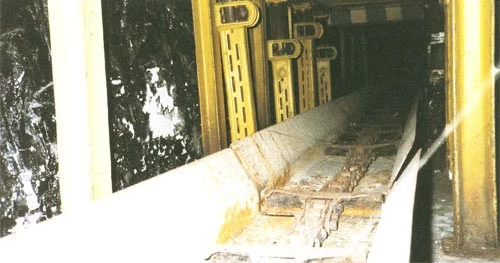
Talygarn House: a view along the full size model coalface

Talygarn House: a view along the full-size model coalface

Talygarn House, Pontyclun, south Wales, was a large stone mansion that became a hospital in 1880. The interior is decorated with wood panelling and painted ceilings. The house is surrounded by extensive parklands on which were grown, according to legend, specimens of every tree that can be cultivated in Britain.

Talygarn as a Convalescent Home

In October 1923, Talygarn House was opened as a miners' convalescent home, and in 15 years of its opening it had more than 41,000 patients.

In 1943, the Miners' Welfare Commission was asked to organise a rehabilitation service for injured mineworkers. Due to a serious shortage of manpower at that time, it was vitally important for injured colliers to return to work as quickly as possible. For this purpose Talygarn House was purchased as a centre for the coalfields of south Wales.

By 1964, 95% of patients treated at Talygarn returned to the mining industry. It continued to serve as a rehabilitation and physiotherapy centre until it was put up for sale in August 2000.

Miner rehabilitation and the 'Model Mine'

Due to the need to harden the men up to return to the collieries, a carpentry shop was provided where patients cut wood and sawed logs. Miniature stairs and static bicycles were available to exercise unused muscles.

Talygarn House was also equipped with a grand 'Model Mine' in which patients could get used to working back in a mining environment. The structure was a long concrete tunnel supported by arch girders. The roadway was equipped with rails and the metal framework known as 'horseheads', which prevented falls of stone on a real coalface.

Relocating the mine

In 2001, the contents of the 'Model Mine' were donated to Amgueddfa Cymru as a 'permanent reminder to visitors of the work of the Talygarn rehabilitation centre'.

The coalfaces were dismantled as if they were the real thing. Despite working in only four feet of height, the thirty-foot-long chain conveyor was successfully disassembled and removed.

All the items were safely transported to the Collections Centre at Nantgarw. The Talygarn donation is a unique survival of a complete thirty-foot section of a typical semi-mechanised coalface of the early 1960s.