Art

Wooden crucifix originally sparkled with gold

4 September 2007

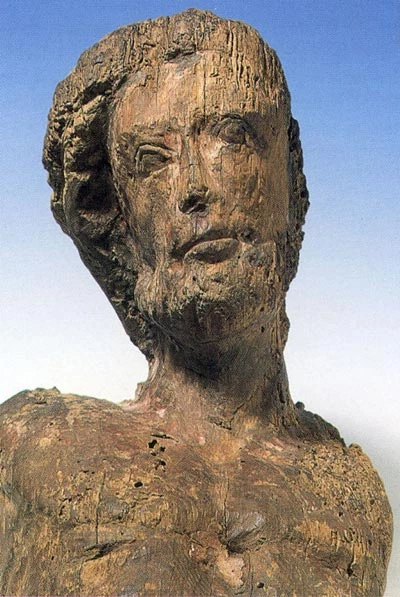
The crucifix figure from Kenys Inferiour, Monmouthshire

The crucifix figure from Kenys Inferiour, Monmouthshire

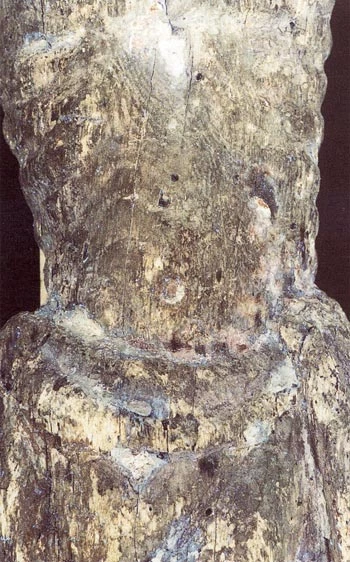
Detail of the head of the crucifix figure.

Detail of the head of the crucifix figure.

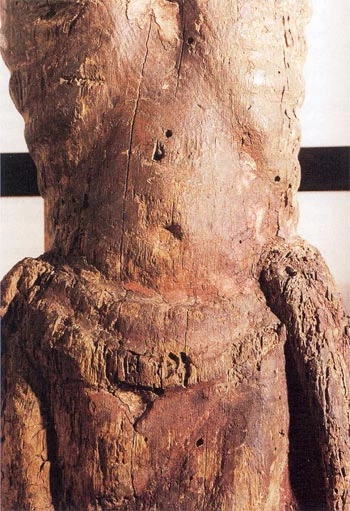
Detail of the torso and loin-cloth in UV light.

Detail of the torso and loin-cloth in UV light.

Detail of the torso and loin-cloth in reflected light.

Detail of the torso and loin-cloth in reflected light.

Scientific examination of a crucifix of the Middle Ages from Kemeys Inferior, south Wales reveals that the wooden object seen today was once richly decorated in vibrant colours and magnificent gold leaf.

In 1850, the remains of a carved wooden figure of Christ were discovered in the church of Kemeys Inferior, a few kilometres east of Caerleon, south Wales.

An object of exceptional importance

Before the Reformation of the 16th century (when England and Wales officially turned from being a Catholic nation to a Protestant one), such figures of Christ were common throughout England and Wales and the Kemeys Christ is the most complete example of only a handful of medieval fragments to survive in Britain, and so is of exceptional importance.

Fragments of the Kemeys Inferior figure were found, 'together with skulls and bones', in 'the blocked up rood-staircase' during repairs and alterations to the church in about 1886. It was transferred in 1930 to Amgueddfa Cymru.

Although the figure was thought to be from the 14th century, arguments supporting this have never been set out in detail. Dating the figure relies on comparing other sculptures, and it is now thought to be from the late 13th century.

Made in Wales

Owing to the rarity of surviving figures in Britain from this period it is necessary to study objects from the continent for further clues. For example, late 13th-century crucifix figures from Sweden share several similar characteristics, whereas the 14th-century Christ from Mochdre, Denbighshire, the only comparable wooden figure from Wales, is quite different. The Kemeys Christ was more than likely to have been made in England or Wales.

Investigation and analysis of the crucifix

Very little of the colour that once covered the wooden figure can be seen today, but routine work done by Amgueddfa Cymru in 1999 led to in-depth investigation of the surface of the object.

The figure was X-rayed and viewed under ultra violet (UV) and infra-red (IR) light before being examined under the microscope. This revealed the original colour scheme, with differences between the torso and the arms, previously considered to have been later additions.

Vivid and rich colours

In contrast to its present condition, the Kemeys Christ originally boasted a vivid and richly coloured appearance as was popular throughout the Middle Ages. Great care was taken in decorating the figure. When new, it would have shone with gold leaf.

Examination of the figure has revealed considerable evidence of polychromy (use of many colours), and, like other examples of medieval sculpture, over-painting. Although little colour survives on the arms, the right arm does have two layers, which may suggest replacement of the left arm either during the first half of the 16th century or even earlier.

At least three layers of painting have been detected, though the dating of each is problematic. The secondary colour scheme appears to have included gilding on the hair; gold, red and blue on the inside of the loin-cloth; dark brown and black details on the face; a green crown of thorns; and flesh tones in pale pink, with red emphasising the wounds.

Stunning polychrome work like this would have been standard on such an important sculpture. The Kemeys figure clearly represents Christ on the cross, who is portrayed alive, with his eyes still open.

The Kemeys Christ is a rare survival of pre-Reformation devotional figures once common in the British Isles. With the original height of about 94 cm, this powerful image of Christ's suffering would have been widely seen and prayed to, and formed a purposeful part of everyday life.

Drawn from nature: Botanical illustrations

20 August 2007

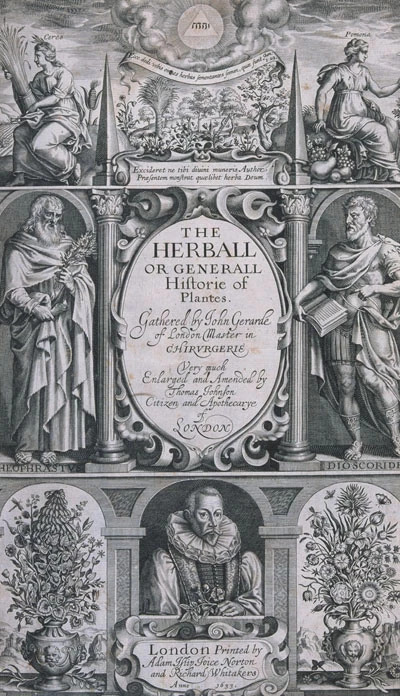
Old herbal

Throughout the Dark Ages, disease and poor hygiene were rife and people relied on herbalists and their remedies. Cure for deafness: take rat's urine, the oil of eels, the house leek, the juice of travellers' joy and a boiled egg.

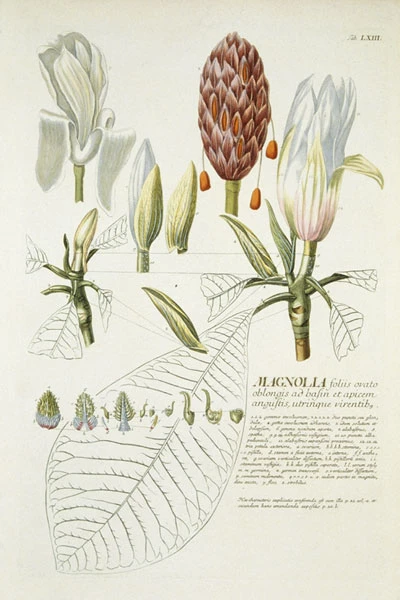
Magnolia

Plant collectors travelled to remote parts of the world. Finding new plants meant exploring new lands - often without accurate maps, through country without roads, and with few settlements.

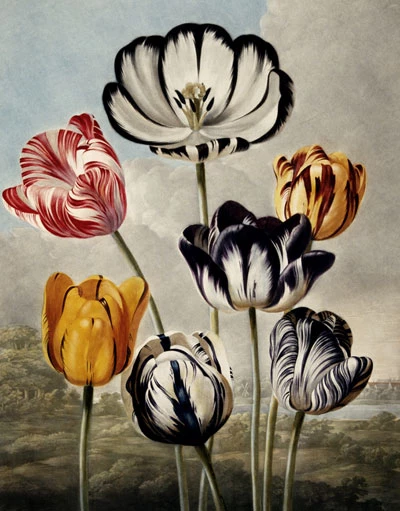
Tulips

In the 17th century, travel and trade brought many new exotic plants to Europe. So-called 'Tulipomania' rose from the passionate desire of the wealthy to own the rarest plants. In Holland, a single tulip bulb was bought for 4,600 florins, plus a coach and a pair of dappled greys.

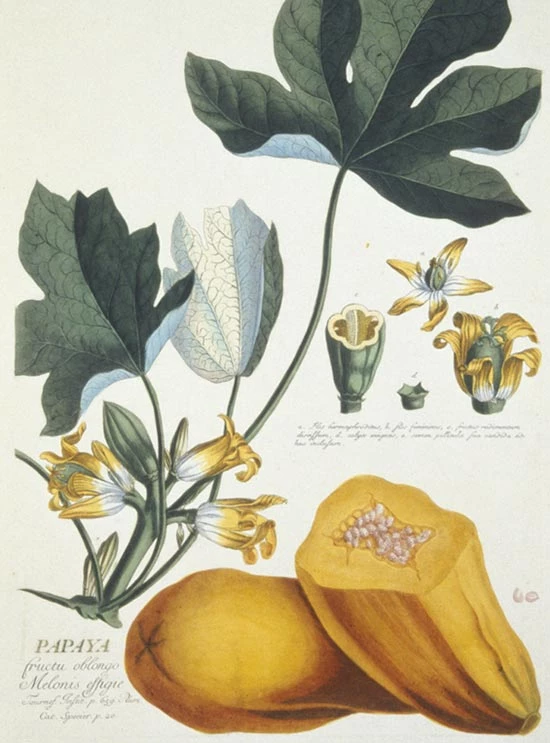
Papaya

Many of the exotic fruits such as the Paw-paw and Pineapple discovered on the voyages of discovery quickly became fashionable in Europe. The Paw-paw (papaya) is a native of tropical America.

Mankind has always been fascinated by flowers, by their beauty, and by their possibilities for healing and knowledge. Amgueddfa Cymru holds a unique collection of more than 9,000 botanical illustrations spanning five centuries.

After a small exhibition at National Museum, Cardiff in 1942, the illustrations were put into store. Fifty years later the breadth and significance of the collection was rediscovered and their exquisite draughtsmanship fully appreciated.

The collection comprises work ranging from professional engravings to amateur watercolours, and includes several items by acknowledged masters such as Georg Dionysius Ehret and Pierre Joseph Redouté.

500 years of botanical illustrations

The collection traces the development of botanical illustration and its relationship between art and science from the medieval herbals of the Dark Ages, when man feared nature, through the Enlightenment and the great voyages of discovery to the contemporary illustrations of the 21st century.

Floras

By 1600, after the early woodblocked herbals, the process of engraving on metal allowed a finer delineation of every minute detail, revolutionising botanical illustration. Flora Londinensis (1777-87) by William Curtis is one of the most famous British floras listing all the plants within a ten-mile radius of London. An important early 19th century European flora is the Flora Danica (1763-1885), which took almost a hundred years to complete.

In the 17th century, plants were grown for their beauty as well as practical and scientific use. The wealthy produced 'florilegias' illustrating the rare and beautiful plants on their estates, while scientific guides were full of precise illustrations from a whole range of plants.

The collection contains many original prints from the 17th century, including work by Redoute, Sowerby, Fitch and the Welsh-born Sydenham Edwards.

The introduction of taxonomy

In 1753 the Swedish naturalist Carl Linnaeus developed a new system of naming and classifying all living things. Everything was given two names in Latin: a genus name and a species name. This had a profound impact on the style of botanical illustration. Emphasis was now on the plant's sexual organs — much to the alarm of polite society.

The acceptance of the new Linnaean system was helped, in part, by the high quality of illustrations produced by G. D. Ehret at that time. The Museum holds illustrations by Ehret from Plantae Selectae (1750-73) and also a collection by J. S. Miller from Bute's Botanical Tables (1785), commissioned by John Stuart, 3rd Earl of Bute.

The collection also includes works by Redouté, Kirchner and Elizabeth Blackwell. Backwell illustrated a herbal entitled A Curious Herbal to free her husband from incarceration in a debtor's prison.

Voyages of discovery

Botanists accompanying the epic voyages of discovery in the 18th and 19th centuries were the first to record and collect the exotic plants encountered in the remote uncharted lands. For the first time Europeans saw pictures of exotic fruits such as pineapples, paw-paws and pomegranates. Examples in the collections include Banks' Florilegium and works from Curtis's Botanical Magazine.

Victorian enthusiasm

The Victorians brought about an immense enthusiasm for science. Engravings of newly introduced plants became widely available through journals and popular magazines, such as Carter's Floral Illustrations and Paxton's Floral Garden.

With the discovery of Victoria regia, the giant water lily from the Amazon, there was much rivalry between the gardeners of the stately houses of England as to who would be first to induce it to flower in Britain. Joseph Paxton, the gardener at Chatsworth, won the race. It is said that the structure of the huge leaf inspired his design for the Crystal Palace.

The industrial legacy of David Davies

29 July 2007

David Davies (1818-1890)  This image shows him in a rare moment of repose. Private collection (Lord Davies)

David Davies (1818-1890)
This image shows him in a rare moment of repose. Private collection (Lord Davies)

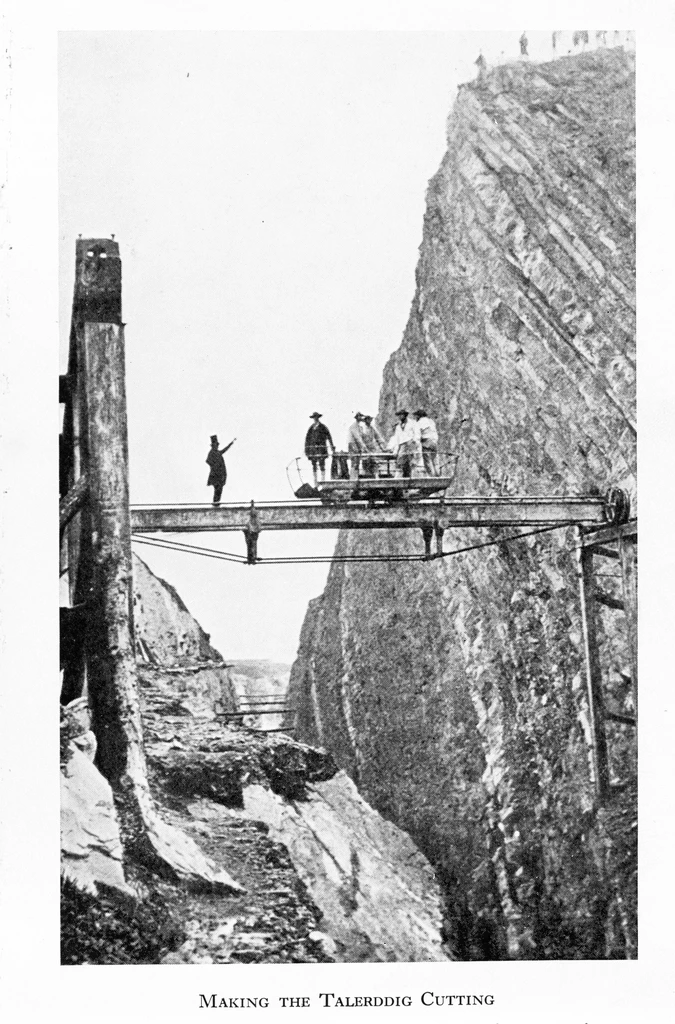
The completed Talerddig cutting, the deepest in the world at that time.  Private Collection (Lord Davies)

The completed Talerddig cutting, the deepest in the world at that time.
Private Collection (Lord Davies)

No.1 dock in 1913, when Barry docks exported 11m tons of coal. What appears to be a solid level surface in the right foreground of this scene in is fact water — thick with coal dust.

No.1 dock in 1913, when Barry docks exported 11m tons of coal. What appears to be a solid level surface in the right foreground of this scene in is fact water — thick with coal dust.

David Davies of Llandinam

The gifts and bequests of Gwendoline and Margaret Davies completely transformed the range and quality of Wales's national art collection. The sisters were the granddaughters of David Davies of Llandinam, one of the great entrepreneurs of 19th–century Wales.

Gwendoline and Margaret Davies were the granddaughters of David Davies of Llandinam, one of the great entrepreneurs of 19th–century Wales.

David Davies started in life as a tenant farmer and sawyer. He made his fortune during the industrialisation of Victorian Wales. He built much of the railway system in mid-Wales, became a pioneer of the coal industry in the Rhondda valley and was the driving force behind the construction of Barry dock in south Wales.

Railways

Starting with the construction of the Newtown & Llanidloes Railway in 1859, he became involved in the construction of a number of railways in mid-Wales, the Vale of Clwyd and Pembrokeshire.

His greatest achievement as a railway engineer was the great Talerddig cutting on the Newtown & Machynlleth Railway, completed in 1862 and the deepest in the world at that time.

Not all the ventures in which Davies was involved succeeded — the grandly named Manchester & Milford Railway reached neither destination!

Coal – 'Davies yr Ocean'

1864 marked a decisive turning point in David Davies's career when he took out a pioneering mineral lease in the south Wales valleys. It took two years before the first pits were in full production. Five more collieries were opened by 1886.

In the following year they were vested in a new public limited company, the Ocean Coal Co. Ltd.

At the time of Davies's death in 1890, it was the largest and most profitable coal company in south Wales.

From pit to port

The crowning achievement of David Davies's career was the construction of the dock at Barry, south Wales.

Davies and a number of fellow Rhondda colliery owners came together to solve congestion both on the Taff Vale Railway and at Cardiff's Bute docks. They promoted the construction of a railway from the coalfield to a new dock facility at Barry, then a tiny hamlet. Despite fierce opposition from the Bute faction, the dock opened in 1889.

The application of wealth

David Davies was a passionate supporter of Calvinistic Methodism — a strict non-conformist faith unique to Wales and distinct from Wesleyan Methodism.

Like all of Gwendoline and Margaret's family he was a life-long Sabbatarian and teetotaller. It instilled in him a profound sense of philanthropy and public service. He gave generously to religious and educational causes.

Having received a very basic schooling himself, the provision of university education in Wales was a cause close to his heart. He was a staunch supporter of the first college at Aberystwyth, opened in 1872.

He served as Liberal MP for Cardigan Boroughs during 1874-86 and was elected to the first Montgomeryshire County Council upon its creation in 1889.

After David Davies

David Davies died in 1890 and was succeeded by his son Edward, who found the stresses of running the business empire so overwhelming that he died just eight years later.

He in turn was succeeded by Gwendoline and Margaret's brother David, later 1st Lord Davies, who had to contend with the depression of the inter-war years.

The post-war nationalisation of the coal, dock and railway industries saw the family lose control of their vast undertaking.

Today, all the Ocean pits have closed, as has much of the railway system created by David Davies, and Barry dock sees little activity.

The Davies Sisters during the First World War

29 July 2007

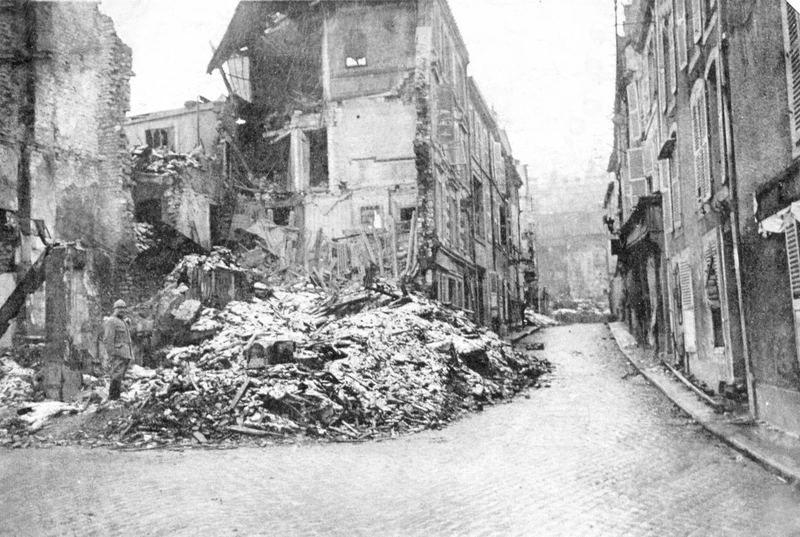
Black-and-white photograph of a road junction in a French city, with the building on one corner reduced to rubble

Gwendoline Davies visited the damaged and largely empty French city of Verdun on 9 and 10 March 1917, where she acquired this postcard image as a souvenir. Private collection (Lord Davies)

The First World War had a profound effect on the lives of Gwendoline and Margaret Davies, two sisters from mid Wales whose gifts and bequests completely transformed the range and quality of Wales's national art collection.

They lost much-loved relatives and served with the Red Cross in France, seeing the destruction first hand. They were deeply conscious of the horrors experienced by both British and French soldiers, and shocked at the suffering of civilian refugees.

While their brother David flung himself into the cause of international peace, the sisters hoped to repair the lives of ex-soldiers traumatized by the war, through education in the crafts and through music. Out of this grew the idea of Gregynog, as a centre for the arts, and for the discussion of social problems.

Bringing Refugee Artists to Wales

On 4 August 1914 Germany invaded Belgium, precipitating the First World War. Over a million Belgians fled their homes.

The Davies family decided that Belgian artists should be brought to Wales, where they could work in safety, and inspire the country's art students. Major Burdon-Evans, their agent, and their friend Thomas Jones journeyed to Belgium where they assembled a group of ninety-one refugees, including the sculptor George Minne, and the painters Valerius de Saedeleer and Gustave van de Woestyne and their families.

All three artists were to spend the rest of the war as refugees, largely dependent on the Davies family for support. While their impact on the arts in Wales was limited, the work of all three was to be profoundly influenced by their Welsh exile.

The Sisters in France, 1916–1918

Initially the sisters undertook charitable work at home in connection with the war. They were keen to do more 'in the way of helping', but few women managed to go out to France. One way of doing so was to volunteer through the London Committee of the French Red Cross.

There was little provision in the French army for the welfare of the ordinary soldier, and the Committee sent women to operate canteens at railway stations, hospitals and transit camps.

In July 1916 Gwendoline was posted to a transit camp near Troyes. Margaret joined the canteen there in June 1917, and her journals record their lives at this period.

The sisters were deeply moved by the stoicism of the ordinary soldiers of the French army and by the suffering of exhausted, sick, and hungry refugees.

Wartime collecting

The sisters sometimes managed to add to their art collection during the First World War. Although wartime travel in France was difficult, trips to Paris on Red Cross business provided Gwendoline with opportunities to visit the Bernheim-Jeune gallery.

She bought a Daumier and a Carrière there in April 1917, and paintings by Renoir, Manet and Monet in December. In February 1918 she bought her two celebrated landscapes by Cézanne, The François Zola Dam and Provençal Landscape, which are among her most important and far-sighted purchases.

In February 1916, Gwendoline Davies spent £2,350 on ten oils and a drawing by Augustus John. Both she and Margaret went on to acquire more works by John, and they collected the work of no other artist on this scale.

Gwendoline was determined that the work of Augustus John be seen at Amgueddfa Cymru, later placing several of her own purchases on loan to the Museum.

Guide to the paintings

Paul Cézanne (1839-1906), Provençal Landscape, oil on canvas, about 1887-8.
Paul Cézanne

(1839–1906), Provençal Landscape, oil on canvas, about 1887–8

Bought by Gwendoline Davies with Cézanne's The François Zola Dam in 1918, this picture cost half as much, £1,250. It was probably painted at his family's property outside Aix-en-Provence. Full of the shimmering colour of the South of France where the sisters had holidayed in 1913–14, it must have seemed a world away from war-time Paris in winter.

Amgueddfa Cymru (Bequest of Gwendoline Davies, 1951) NMW A 2438.

Paul Cézanne (1839-1906), The François Zola Dam, oil on canvas, about 1879
Paul Cézanne

(1839–1906), The François Zola Dam, oil on canvas, about 1879

This landscape is one of Gwendoline Davies's greatest pictures, bought in Paris for £2,500 in February 1918. The Troyes canteen was closed for repairs. She was in the city, then under intermittent German bombardment, on Red Cross business. She may have seen it on a previous visit, as in January Margaret had translated from the French the art dealer Ambroise Vollard's anecdotal account of Cézanne's life. Together with Provençal Landscape acquired with it, this was one of the first Cézannes to enter a British collection.

Amgueddfa Cymru (Bequest of Gwendoline Davies, 1951) NMW A 2439.

Camille Pissarro (1831-1903), Sunset, the Port of Rouen (Steamboats), oil on canvas, 1898.
Camille Pissarro

(1831–1903), Sunset, the Port of Rouen (Steamboats), oil on canvas, 1898

Margaret Davies bought several works by Pissarro at the Leicester Galleries, London, in June 1920. This was the most expensive at £550. The previous year she had worked at a canteen in Rouen run by the Scottish Churches Huts Committee.

Amgueddfa Cymru (Bequest of Margaret Davies, 1963) NMW A 2492.

Gregynog: Arts and Music for Wales

29 July 2007

After the First World War, Gwendoline and Margaret Davies were determined to help people whose lives had been shattered by the war and to do what they could to improve living conditions at home.

In 1920, they bought Gregynog Hall from their brother, who had bought it as an investment in 1914. Gregynog might have been a quiet retreat to receive company, but the sisters wished it to be a place of use and of beauty that they could share with many for the benefit of others.

The sisters championed many social, economic, educational and cultural initiatives in Wales during the 1920s and ’30s. They hoped that conferences held at Gregynog would go some way towards building a new Wales in the aftermath of the First World War.

Visitors to Gregynog

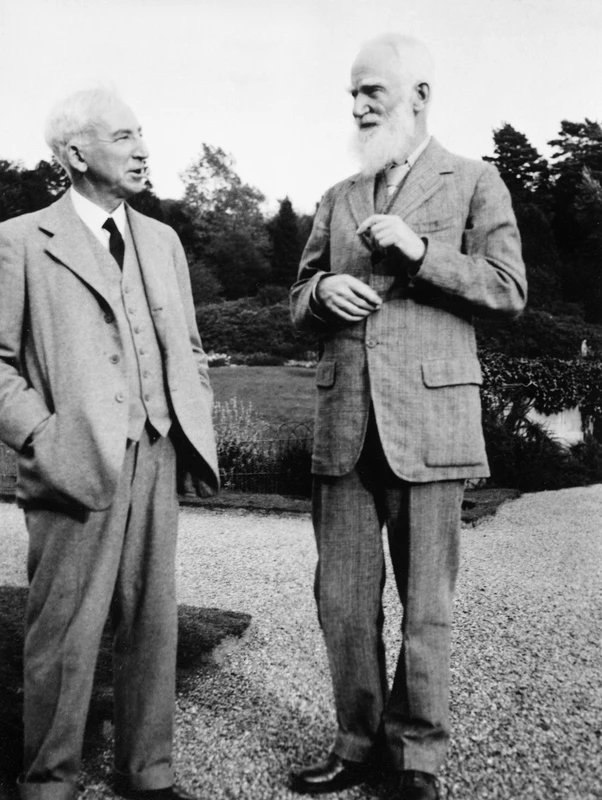
George Bernard Shaw and Thomas Jones at Gregynog

George Bernard Shaw and Thomas Jones at Gregynog. Private collection (Lord Davies)

A huge range of organisations met at Gregynog. Conferences were attended by eminent national and international educationalists, politicians, and peace and social welfare campaigners.

The magnificent collections at Gregynog were seen by its many visitors. Writing in 1938 Mary Hackett, a visiting Australian, wrote home ‘Did I tell you of the Music Room with its wall hung with priceless pictures, the works of Turner, Monet, Manet and many others’.

The most frequent visitor was Thomas Jones. As Deputy Cabinet Secretary, he knew many prominent figures from politics and the arts. The playwright George Bernard Shaw and Stanley Baldwin, the Prime Minister, were among those for whom he arranged invitations to Gregynog.

Shaw and his wife Charlotte visited in 1930, 1932 and in 1933. Each evening after dinner Shaw read to the assembled company his play On the Rocks. Gwendoline told a guest: ‘Charlotte and G. B. S. came over from Malvern. We enjoyed them immensely. We just let him talk – and we talked to her!’

The Davies sisters and music

Music was a vital part of the sisters’ lives. They received a better musical education than was usual in well-to-do families.

Musical provision in Wales was patchy, and most people’s contact with music was through chapel alone. Although there were music departments at three of the universities, there was a tendency towards insularity and standards of instrumental composition were not high.

The sisters were among a group who wanted to change attitudes and access to music in Wales. They were active in pockets of progressive activity, such as the Welsh Folk Song Society and the University Music Club at Aberystwyth.

The Gregynog Festival

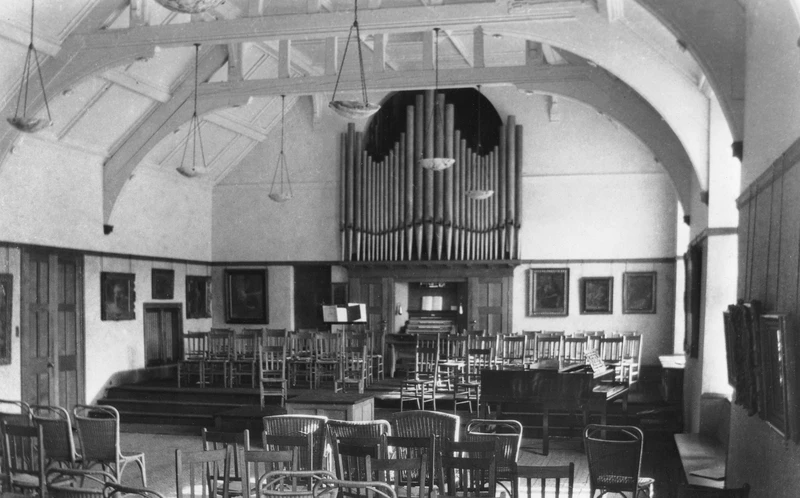
The Music Room at Gregynog

The Music Room. This photograph illustrates the Music Room as used for the summer festivals in the 1930s. Manet’s Rabbit is on the left-hand wall and visitors remember Monet’s water lily paintings and Pissarro’s Pont Neuf here.
Private collection (Lord Davies)

Musical activity at Gregynog reached a peak in the 1930s with the Gregynog Festival of Music and Poetry. The Festival ran annually from 1933 to 1938. It was a three- or four-day affair, with concerts taking place in the 200-seat Music Room. Collections were taken for local causes. The poetry element was considered just as important as the musical.

The festivals played host to important figures of the period, including the composers Ralph Vaughan Williams, Edward Elgar, and Gustav Holst, the conductor Adrian Boult, the poet Lascelles Abercrombie and performers including Jelly d’Arnyi and the Rothschild Quartet.

Despite the international flavour of the performers, there was a Welsh emphasis, with many local musicians participating. The programme generally comprised contemporary and not-so-contemporary British music, European chamber classics and a Welsh folk-song element. Choral music dominated, and on every festival Sunday, religious works were programmed.

The end of an era

The 1930s were the heyday of musical activity at Gregynog. The festivals ceased at the outbreak of war in 1939 as the sisters turned their attention to the war effort. The deaths of Walford Davies in 1941, and of Gwendoline ten years later in 1951, had a profound effect on the musical life of Gregynog. Though plans were mooted to transform the Hall into a centre for Welsh music, these never came to fruition.

At his appointment to the post of Gregynog Professor of Music at Aberystwyth in 1954, Ian Parrott resurrected the musical spirit of the Hall by reviving the Festival in 1955. This ran until 1961 and adhered largely to the ethos of the 1930s programmes. In 1988, the Festival was revived once more, this time by the tenor Anthony Rolfe Johnson, and continues today under the direction of Rhian Davies, a tangible example of the sisters’ musical legacy in Wales.

Guide to the paintings

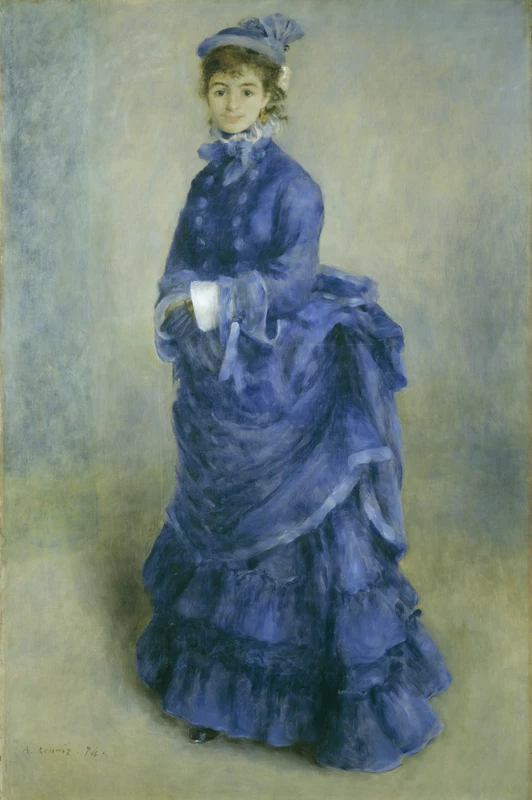
Pierre-Auguste Renoir (1841 - 1919), La Parisienne
Pierre-Auguste Renoir

(1841–1919), La Parisienne, oil on canvas, 1874

Renoir’s La Parisienne, according to Eirene White, ‘hung in the small entrance hall, facing the main door to the Music Room’. The present Lord Davies recalls visiting in about 1960 and seeing the Sisley of Moret (purchased by Margaret that year) and Berthe Morisot’s At Bougival in the drawing room with Derain’s Madame Zborowska over the fireplace.

 
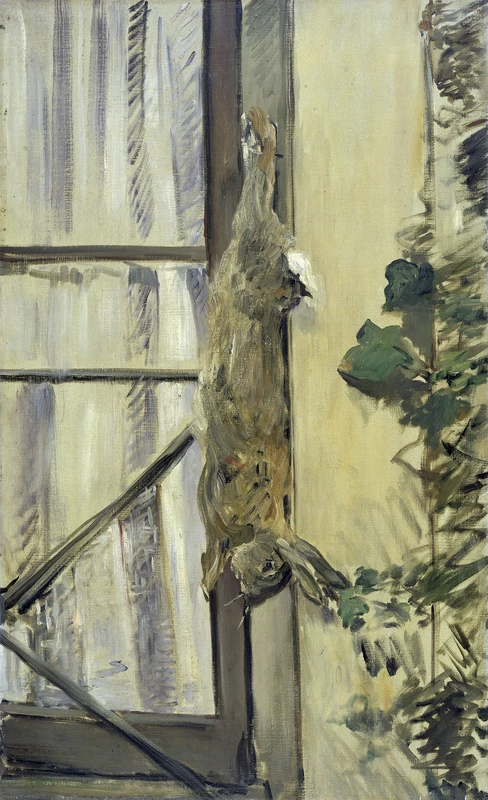
Edouard Manet (1832 — 1883), The Rabbit
Édouard Manet

(1832–1883), The Rabbit, oil on canvas, 1881

This was originally intended to be part of a decorative cycle and was painted to be viewed at a distance. It was sold after Manet’s death to the dealer Durand-Ruel. It was purchased by Gwendoline Davies from Bernheim-Jeune for £1,000 in 1917. It later hung at Gregynog in the Music Room next to the Effect of Snow at Petit-Montrouge.

Amgueddfa Cymru (Bequest of Gwendoline Davies, 1951) NMWA 2466.

 
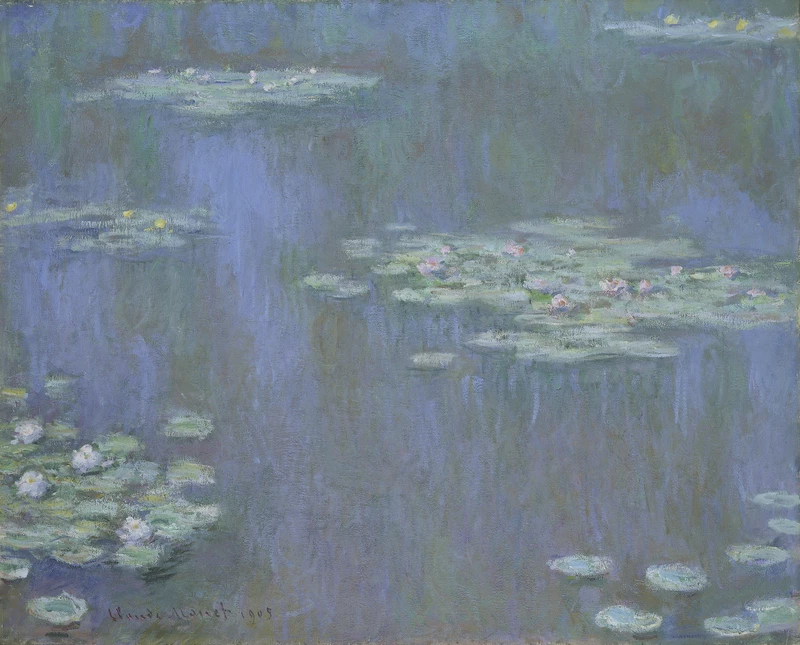
Claude Monet (1840 — 1926), Waterlilies
Claude Monet

(1840–1926), Water Lilies, oil on canvas, 1905

Monet employed a man to tend the water lily ponds at Giverny. He worked daily cleaning the pond so that Monet could paint the reflections in the water. Gwendoline Davies purchased this work in July 1913. Both sisters were enthusiastic gardeners and they created their own lily pond at Gregynog where Margaret in later years liked to paint.

Amgueddfa Cymru (Bequest of Gwendoline Davies, 1951) NMW A 2484.

 
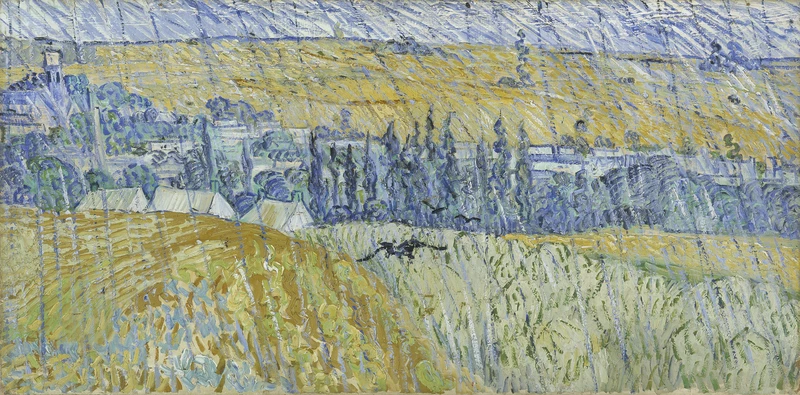
Vincent van Gogh (1853 — 1890), Rain — Auvers
Vincent van Gogh

(1853–1890), Rain – Auvers, oil on canvas, about 1890

Van Gogh wrote to his brother of ‘the crows flying in circles over the fields’ which made him feel sad and lonely. This work was painted when Van Gogh was staying in Auvers and was being treated for depression. Gwendoline purchased it for £2,020 in 1920.

Amgueddfa Cymru (Bequest of Gwendoline Davies, 1951) NMW A2463.