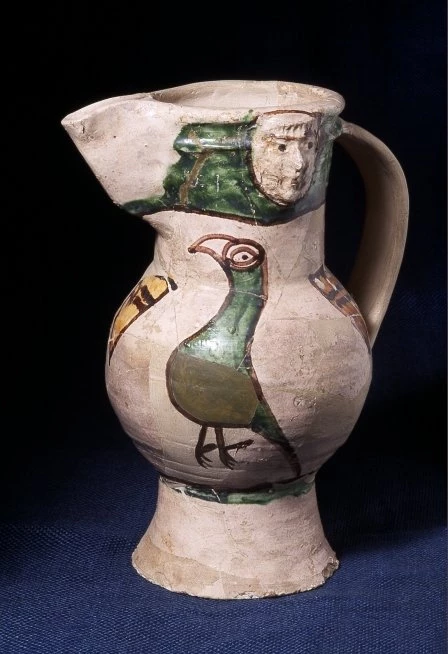
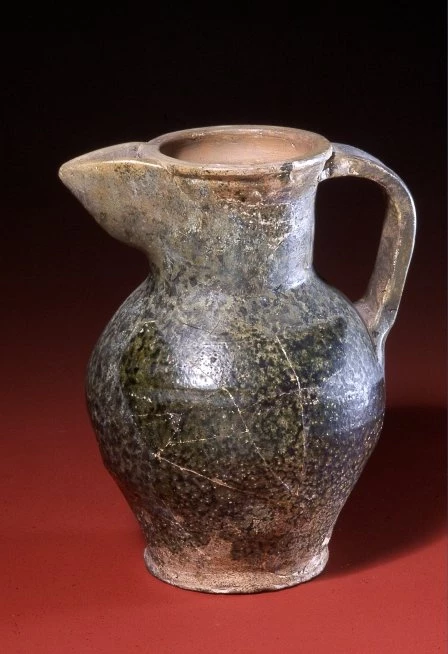
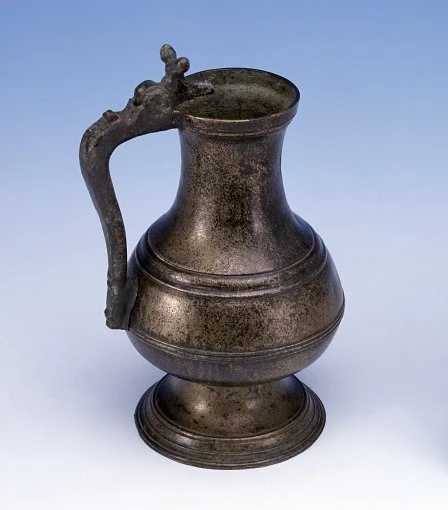
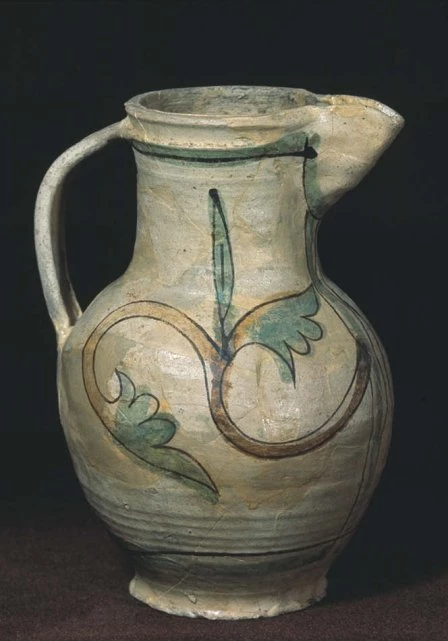
French pottery in medieval Wales 4 May 2007 Saintonge jug from Kidwelly Castle, Carmarthenshire. Elaborately decorated vessel found in Cardiff. 23.8cm (9.5 inches) tall. Jug found in the well at Castell-y-Bere, Gwynedd. 20.5cm (8.1 inches) tall. During the Middle Ages, several regions of France exported pottery to Britain - notably northern France, Normandy and the Ardennes. Most of the French pottery found in Wales came from the Saintonge area of south-west France. The trade in pottery from the Saintonge area to Britain began early in the 13th-century and lasted for about 500 years. At the start of this period the English ruled neighbouring Gascony, and many of the vessels that have been found in Wales probably made their way to Britain from the ports of La Rochelle and Bordeaux as part of mixed cargoes (wine being the most important commodity). Pottery from the Saintonge area was made from a fine clay that was well suited to the throwing of light, thin-walled shapes such as those seen here. The clay also had a low iron content, which meant that, when fired, it produced a vessel with a white or buff fabric. The first example illustrated here was found in a midden at Kidwelly Castle (Carmarthenshire) during excavations in the 1930s. It appeared to have been thrown away along with several plainer vessels and is decorated with a vine scroll motif typical of Saintonge jugs. It was probably produced between 1275 and 1320. This elegantly decorated vessel illustrates the great skill of the Saintonge potters. It is 25cm (9.8 inches) tall and in places its walls are only 2.4mm (0.1 inches) thick. In these years Kidwelly Castle passed from the ownership of the de Chaworth family, who greatly improved its defences, to William de Valence and then to the House of Lancaster. These later owners set about improving the castle's accommodation. This jug may have been used to pour wine in the Great Hall for one of these English owners or their guests, though such jugs may also have held water. Saintonge pottery is known from many other sites in Wales, including Cardiff and Castell-y-Bere in Gwynedd. For the most part the ware has been found at coastal sites - locations more easily controlled by the English, or more accessible to their traders - though occasionally it has been found in remote upland sites. Cardiff jug: This jug was discovered during work in Cardiff High Street in 1893. Its decoration includes birds, masks, and heraldic shields - all are common features on jugs from the Saintonge potteries. Castell-y-Bere jug: Castell-y-Bere was only occupied by the English from 1284-1294. Given the frequency with which Saintonge pottery is found at other castles occupied by the English in Wales, it seems likely that the jug dates from this period. While such pots may not even have been greatly valued by their owners, when viewed alongside vessels of silver, bronze or brass they survive as examples of great craftsmanship and illustrate links between Wales and the wider European world during the Middle Ages. Background Reading 'Kidwelly Castle, Carmarthenshire; including a survey of the polychrome pottery found there and elsewhere in Britain', by C. Fox and C. A. R. Radford. In Archaeologia vol. 83, p93-138 (1933). 'Medieval finds from Castell-y-Bere, Merioneth' by L. A. S. Butler. In Archaeologia Cambrensis vol. 123, p78-112 (1974). Medieval pottery and metal-ware in Wales by J. M. Lewis. Published by the National Museum of Wales (1978).
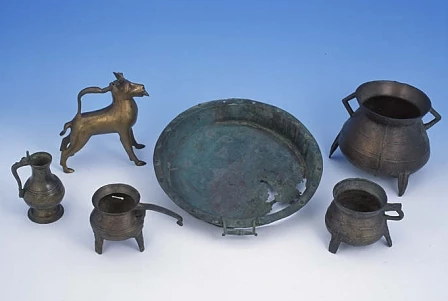
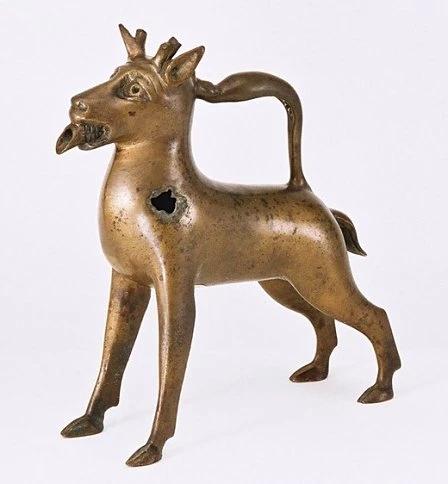
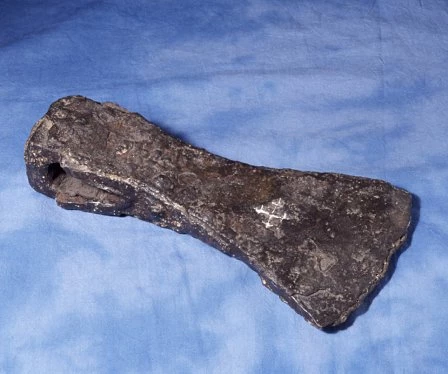
Remarkable treasures unearthed by workman 4 May 2007 Part of the Cwm Nant Col Hoard, including the major copper-alloy pieces. Late 13th or early 14th-century aquamanile in the shape of a stag. 26cm (10.2 inches) tall. 15th-century copper alloy ewer. 17.5cm (6.9 inches) tall. Copper-alloy tray or dish. 39.5cm (15.5 inches) in diameter. Woodman's iron axe with a maker's mark in the form of a cross. 27cm (10.6 inches) long. In 1918, a remarkable hoard of treasure was discovered by a workman mining for manganeese near Llanbedr in Gwynedd. The hoard had been concealed in a cavity beneath a large stone on rough ground on the south side of Cwm Nant Col. What makes the hoard so interesting is not just the wide range of objects - from a fine vessel (known as an aquamanile, used for pouring water) in the shape of a stag, to bronze skillets, a smaller water jug (known as a ewer) - but also their date. Most metalwork hoards found in Wales tend to be prehistoric, but this one was late medieval. Extraordinary craftsmanship One of the earliest items in the hoard is the aquamanile, dating from the late 13th to early 14th-century. Made of copper-alloy, it has a hinged lid on top of the stag's head to allow the hollow vessel to be filled with water. A short pouring spout extends from its mouth. It has been cast in a single piece, exhibiting extraordinary skill by its maker. It would have been used for ceremonial hand-washing either in a church or monastery, or at the feast table. Although the stag has lost his antlers he remains a fine example of this type of vessel. The copper-alloy ewer is identical to one found at Strata Florida Abbey. The form and alloy composition of both of these vessels suggest parallels with 15th-century examples produced in pewter. One copper-alloy cauldron, two skillets and tray from the hoard had a more mundane purpose, being typical items from a 15th-century kitchen - albeit a relatively wealthy one. The other items in the hoard were made of iron and included an axe and fragments from firedogs. Scientific analysis While we have learnt much from the style of these objects, we know much more about them as a result of scientific analysis. The alloy composition of the aquamanile is higher in lead than zinc and tin, suggesting that it was made in Germany. The ewer may have been produced in France or England. The cauldron and skillets were made of a leaded bronze whose proportions of tin, zinc and antimony pointed to manufacture during the 14th- or 15th-century. The diverse range of objects in the hoard, and their worn state, suggests that they had been gathered as scrap metal by a travelling tinker, probably in the early 16th-century. Why did he bury his goods on a remote hillside? The answer may relate to the poor supply of copper to Britain in the last half of the 16th-century, and the laws that controlled the trade in bronze and brass. These laws were also intended to prevent the export of scrap metal that could be used to make cannon. The tinker may therefore have been concealing a hoard that he had collected illegally and which might have been subject to confiscation. Alternatively, had he bought the hoard legally at a market, he may have concealed it temporarily while he tried to find more items to go with it. As for where he might have hoped to sell his scrap, it is possible that he was heading towards Chester, or via Welshpool to the West Midlands, one of the most active areas of metal manufacturing at this time. Background Reading 'The Nant Col Hoard of medieval metalware' by J. M. Lewis, R. Brownsword, E. E. H. Pitt and T. Ciuffini. In Archaeologia Cambrensis vol. 136, p156-70 (1987).
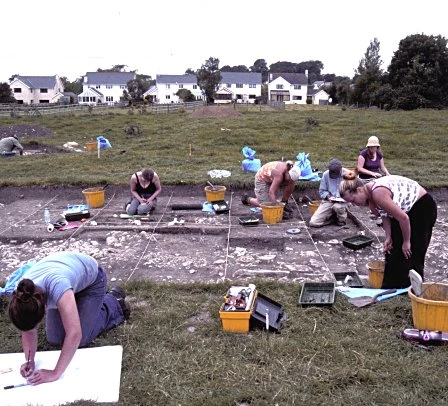
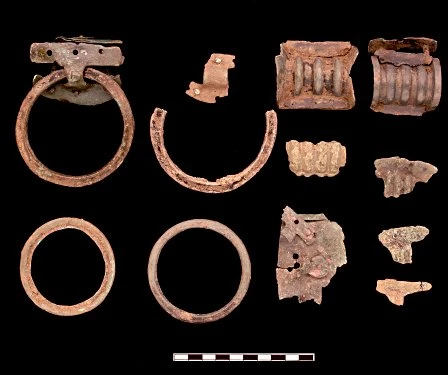
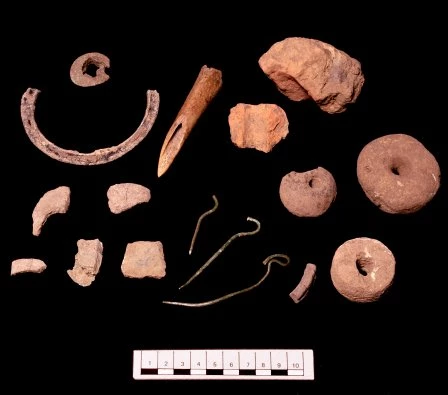
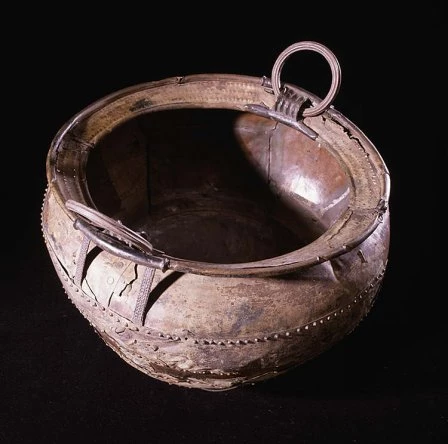
Prehistoric feasting in south Wales 4 May 2007 Excavations at Llanmaes in 2004. Handles and straps from cauldrons and bowls found at Llanmaes. Cauldrons were large bronze vessels used during feasts. Finds from Llanmaes 2004: axe and cauldron fragments, swan's neck pins, spindle whorls and loom-weights. One of the two complete cauldrons from the Llyn Fawr hoard, Rhondda Cynon Taff. The discovery of a three-thousand-year-old settlement sheds new light on life in prehistoric Glamorgan. In February 2003 a number of unusual metalwork items were unearthed at Llanmaes in the Vale of Glamorgan. The finds included bronze axes, horse harness fittings and fragments from bowls and cauldrons. Some of the bowls were of a previously unknown type. Following the finds, the site was subject to excavations by Amgueddfa Cymru revealing a previously unknown prehistoric settlement, including a roundhouse and oval-shaped pits. One pit contained large broken pots of a style known to have been used between 1150 and 700BC. A large red deer antler had been placed over the pit - perhaps in a religious act, or possibly to mark the spot where the pits had once been. Prehistoric wastepit Above the roundhouse was a midden made of discarded domestic waste, now rotted down to form a dark soil. The midden also contained pottery from the Roman period, which began many hundreds of years later. This curious mixture of prehistoric and Roman finds makes it difficult to be sure how the settlement and midden were related. Llanmaes as a feasting site Apart from metalwork and pottery, the midden also contained many thousands of animal bone fragments, mostly of pigs. This is a very unusual discovery in Britain, where sheep and cattle tend to be more common. Perhaps Llanmaes was once a feasting site - pig was a favourite high-status meat at this time. More surprising still, human bones were also found in the midden, although no complete skeletons were recovered. Items uncovered at the site are wide ranging. From bowls and cauldrons to dozens of fragments of bronze axes. Five swan's neck pins, elegant dress fasteners, spindle whorls and loom-weights used to make woollen garments, were also discovered. In addition, over 1,500 pieces of prehistoric pottery was collected - the largest collection of this date from south Wales. Dating the settlement All this suggests the site was probably settled between 800-500BC, with the possibility that settlement began as early as 1300BC. At a later date, it is likely that there was a Romanised farmstead nearby, although its precise location has not been determined. These exciting discoveries are helping archaeologists to understand life at the very end of the Bronze Age when iron working had just been introduced into Britain.
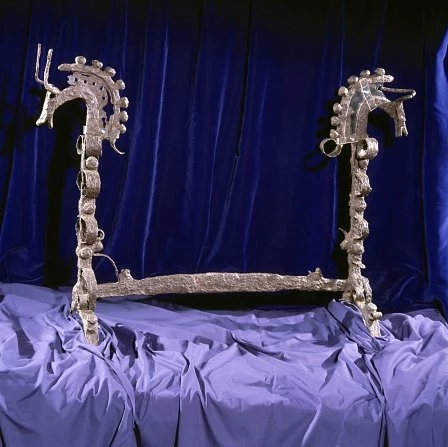
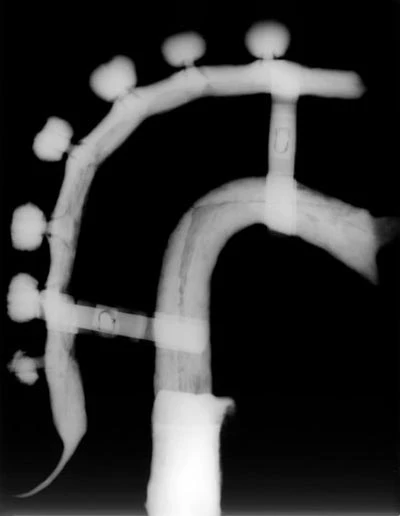
Stunning ironwork firedog uncovered in farmer’s field 4 May 2007 The Capel Garmon Firedog (Conwy). Firedogs are decorated stands used to contain wood burning in a fireplace. This fine example has heads and crests shaped to resemble aspects of both a bull and a horse. Detail showing one of the heads on the firedog. The head may have represented a mythical creature recounted in the tales of warriors or an emblem of the tribe or community of its owners. X-ray of one of the heads on the Capel Garmon Firedog. This X-ray shows the complex way in which the firedog was constructed. (The horizontal and vertical struts are modern supports added to stabilize the head). Experimental iron smelting has shown the amount of time and skill that would have been involved in the production of the Capel Garmon Firedog. This iron stand with two opposing horned animal heads is known as the Capel Garmon Firedog, and was made by a master craftsperson of the Celtic Iron Age. An offering to the gods Found in 1852, the firedog was uncovered in a field at Carreg Goedog Farm, Capel Garmon (Conwy). It lay on its side, with a large stone placed at each end, and was deeply buried. Its careful placing and unbroken state suggest that it was deliberately placed as an offering to a god of the pagan Celtic world. This fits into a long-established tradition of depositing metalwork in Wales’s lakes, rivers and bogs during the Bronze and Iron Ages. One of a pair Originally one of a pair, the firedog would have sat next to a hearth at the centre of a timber or stone round-house. This hearth would have been a natural focus for eating, feasting and discussion and the firedog would have been on view to be admired by all. Recent X-raying of the firedog, together with an attempt to replicate the artefact by a modern blacksmith, has shown that its maker was a master craftsperson, highly skilled in shaping and working iron. Magical process It has been estimated that the Capel Garmon Firedog may have taken one person over 3 years to make, from the gathering of raw materials, through the smelting of the ore to the finishing of the artefact. This transformation of iron ore into metal was probably viewed as a magical process by the Celts, and blacksmiths would have been given great respect for the powers that they wielded. Dating the Capel Garmon Firedog is difficult - there were no archaeologists to record the excavation. However, since the Capel Garmon find, similar firedogs have been discovered in south-east England, in the graves of Iron Age chieftains. In addition to the firedogs, these burials were accompanied by grave goods, all of which can be dated to between 50BC and AD75 - the Late Iron Age. It therefore seems likely that the Capel Garmon firedog was also buried around this time. Iron was first used in Wales at around 750BC. From 300BC onwards iron tools, weapons and brooches became increasingly common on hillforts, settlements and in hoards. However, the scale and quality of the Capel Garmon Firedog sets it apart from these objects. Despite all the discoveries that have been made in the past 150 years, it remains one of the most important pieces of early decorative ironwork to have been found in Britain. Background Reading Celtic art, reading the messages by M. Green. Published by Weidenfeld & Nicholson (1996). 'Firedogs in Iron Age Britain and beyond' by S. Piggott. In The European community in later prehistory: studies in honour of C. F. C. Hawkes by J. Boardman, M. A. Brown and T. G. E. Powell, p245-70. Published by Routledge & Kegan Paul (1971). 'The Capel Garmon Firedog' by C. Fox. In The Antiquaries Journal, vol. 19, p446-8 (1939).
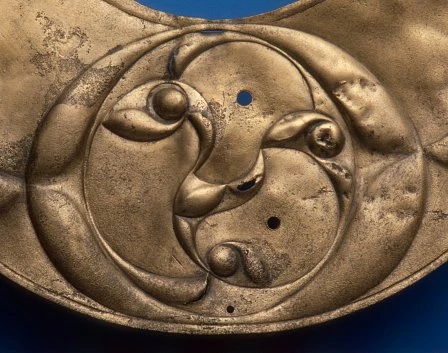
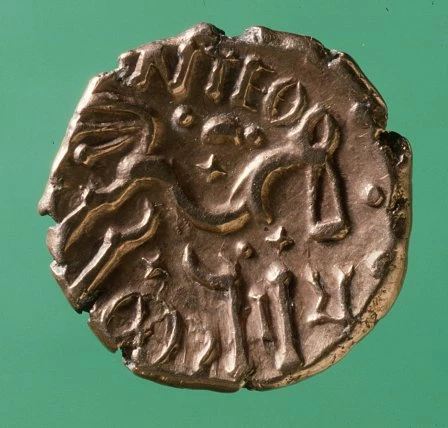
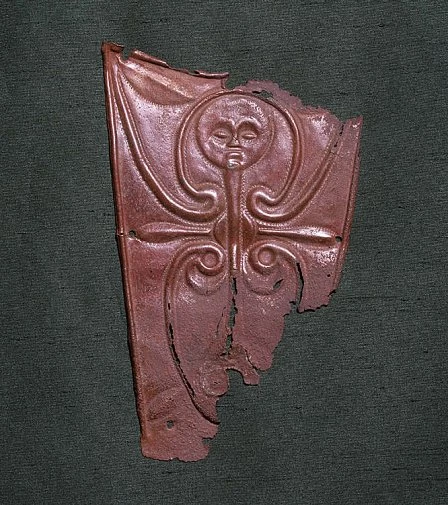
Celtic Art in Iron Age Wales 3 May 2007 Crescentic plaque from Llyn Cerrig Bach, Anglesey. Celtic coin from Tintern, Monmouthshire. Plaque from Tal-y-Llyn, Gwynedd, thought to date to the 1st century AD. Ox-head bucket fittings found at Little Orme, Conwy. Celtic Art Celtic art reflects the way Iron Age people interpreted the world around them. The designs they used help us understand how they viewed themselves, their environment and their gods. The Celtic art found in Wales is part of a much wider tradition in Britain and Europe, often called La Tène art, which developed during the Iron Age from about 500BC. The earliest example from Wales is the Cerrig-y-Drudion bowl which was found in 1924 in a stone-lined grave in the county of Conwy. It is one of the few decorated artefacts from Britain to date to the 4th century BC and was probably made by British craftsmen influenced by Continental traditions. Many more decorated objects are known from about 200BC, by which time Britain had developed its own distinctive style. British craftsmen continued to produce swords, daggers, spears, brooches and horse equipment, but also other objects such as tankards, mirrors and spoons. Symbolic designs Particular motifs and designs are introduced and often repeated, reinforcing their meaning. Archaeologists interpret these as symbolic and powerful with religious connotations. For example the three-fold character of the triskele (a three-legged design radiating from a centre) may represent the relationships between the living, the dead and the gods or the ongoing cycle of birth, life and death. The crescentic plaque from Llyn Cerrig Bach (pictured) is decorated with an elaborate triskele, each limb ending with a trumpet and raised circle that suggests a stylised bird head. Stylised representations of people and animals become more common after 100BC with faces often hidden within complex patterns. Human heads surrounded by a flowing plant-like design can be seen on plaques from the Tal-y-Llyn hoard while a variety of cows, horses, boars and birds adorn a wide range of other artefacts. Ox head escutcheons (bucket-fittings) have been found in Wales (pictured - the Little Orme (Conwy) hoard also contained two Roman trumpet brooches, indicating that this Celtic style continued in use after the Roman conquest), showing the stylised characteristics and flowing lines of native British artistic styles. Mythical beasts are also hinted at, for example in the imaginatively constructed horse-cow heads that ornament the Capel Garmon firedog. Celtic designs did not disappear with the Roman conquest, but continued to influence art. A bronze trulleus (saucepan) from Coygan Camp in Carmarthenshire was repaired with a sheet of metal sometime in the 3rd century AD. It was not decorated with a typical Roman design, but with a triskele motif, showing a continuing appreciation of Celtic art. Background Reading Early Celtic art in Britain and Ireland by Ruth and Vincent Megaw. Published by Shire Archaeology (1986).