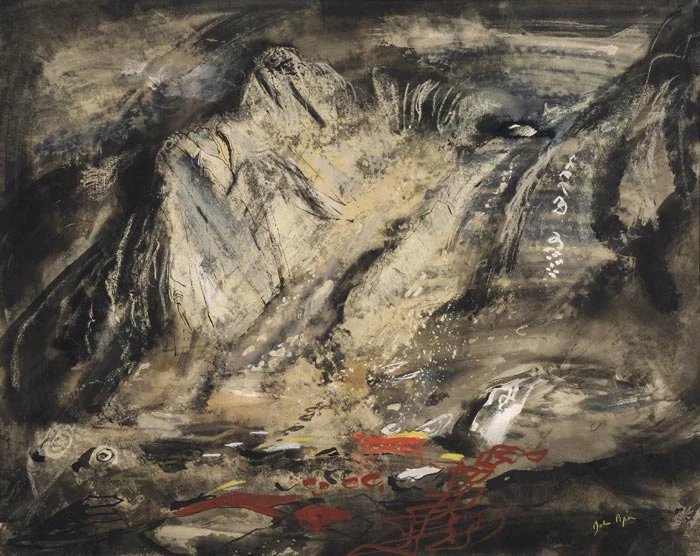
ink, watercolour & gouahce, c.1948
22 x 27 inches
Copyright John Piper Estate
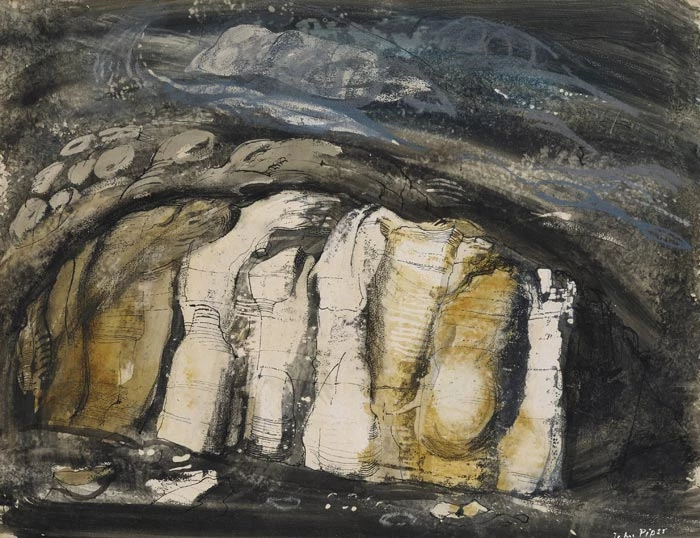
John Piper Rock formations
ink, watercolour & gouache, c.1948
21 x 27.5 inches
Copyright John Piper Estate
From around 1943 to 1950 John Piper undertook an intense artistic journey through the mountains of north Wales, conveying a passion and vision like none other seen before. There is an exuberance and brilliancy to the tones and hues, as well as sheer drama in each of the pictures.
One of the most versatile British artists of the twentieth century, John Piper's work encompasses portraiture, landscape, architectural studies, still life, ceramics and designs for theatre, stained glass and tapestry. Piper's interest in landscape and architecture extended to all areas of Britain, however his first significant encounter with North Wales came when he was working as an official war artist during the Second World War.
Manod Mawr Quarry: storehouse for priceless objects during the Blitz
In 1943 the War Artists Advisory Committee commissioned Piper to record the interior of Manod Mawr quarry. At the time it housed artworks from the National Gallery and the Royal Collection to protect them from bombing during the Blitz.
The dark conditions of the quarry were not suitable for painting or drawing and so the commission was abandoned. It did, however, provide the opportunity for Piper to explore North Wales. This sparked an intense period of recording the mountains of Wales.
Inspiration from Turner and Wilson
During the period Piper spent in North Wales, he often referred to the guidebooks and early geological texts of the eighteenth and nineteenth centuries as he travelled around the area recording the mountains. Not only did he admire their engraved illustrations, but they also provided a link to the artists of the period most admired by Piper, Richard Wilson (1714-1782) and J.M.W. Turner (1775-1851).
Church architecture from West Wales
Piper's painting trips to Wales did not start with Snowdonia or North Wales, but Pembrokeshire and Cardiganshire in 1936. The following year, he produced Five Chapels, 1937. The chapels depicted are: Emmaus, Llanon, Red Roses, Rhydygwyn and Tyrhos. These five collages were produced with torn and cut papers drawn and assembled. It shows his early interest in church architecture. He took a particular interest in the simple though neo-classical architecture of non-conformist chapels in Wales.
Piper in North Wales
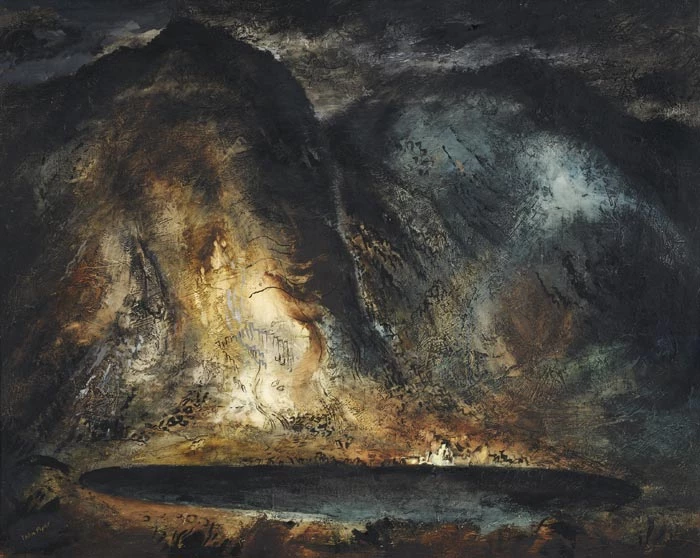
During the unsuccessful Manod Mawr commission, Piper began to explore north Wales and the locations painted by Wilson and Turner such as Cader Idris. This trip also brought him in close proximity to Aran Fawddwy, the subject of an impressive oil, The Rise of the Dovey, 1943-44. The title of this painting refers to Creiglyn Dovey, the lake in the foreground, which is the source of the River Dovey.
Turner painted a slightly different view of Aran Fawddwy in 1798 in a watercolour titled, A bridge over the Dyfi near Dinas Mawddwy, with Aran Fawddwy beyond (collection of the British Museum). The almost abstract nature, foreboding dark atmosphere and brilliant hues of light gold, yellow, blue and red in this work are very similar to Turner's style of painting. Upon the canvas is a layer of gesso, which has been painted on top of in oils. This gives the work this very rough texture, evoking a sense of the roughness of the rocks and the elements.
In 1945 John and his family rented a cottage named Pentre. There is a painting titled Nant Ffrancon Farm, 1950, which shows the house from the roadside. It is situated in the Nant Ffrancon valley, with a steep hill leading up behind the house. The property was sub-let to the Pipers for £35 a year. At the time there was a basic muddy track, rather than a concrete road, making the house almost inaccessible in bad winter weather conditions. Along with this, the house was at the foot of a steep hill, which caused the house to be flooded by heavy rain.
I felt then that I was seeing the mountains for the first time and seeing them as nobody had seen them before.
John Piper quoted in Richard Ingrams and John Piper, Piper's Places, London, 1986
John Piper The Rise of the Dovey
oil on canvas on board, 1944
27.5 x 34.5 inches
Copyright John Piper Estate
A stormy and wintery Snowdonia
The difficulties and hardships presented by living here, even though only for short periods at a time, encouraged the Pipers to move to another rented house called Bodesi around 1947. Bodesi is situated across the road from Tryfan facing the mountain and Llyn Ogwen. This was the landlord's hafod or summer house, so the Pipers had use of it for the rest of the year. This would account for most of Piper's paintings of Snowdonia being stormy and wintery.
Bodesi was well-placed and a flurry of paintings and drawings of Tryfan began. Jagged Rocks under Tryfan, 1949-50, is a wonderful example of Piper's attention to detail by selecting very particular rock formations on and around Tryfan. It depicts Tryfan Bach (little Tryfan) situated at the base of the mountain on its western side. Its jaggedness mimics that of its parent, Tryfan. White spirals drawn in gouache are most likely patterns left on rocks by lichen which has since detached. In the lower foreground are splashes of red and yellow, in some cases accentuating the shape of the rocks, in other areas denoting the 'chrome yellow and chrome orange lichen' Piper described in his notes.
The influence of nineteenth century guides to Snowdonia in Piper's work also encouraged him to write his own guide to the area. Unfortunately it never went beyond note form, which is now in the archives at Tate Britain.
Although Piper's dream of publishing a guide to Snowdonia never came to pass, it is justifiable to say that he provided an enthralling guide through his paintings and drawings. This series of work is considered by some to be the best of all his paintings. In the 1960s, the Pipers bought a house in Pembrokeshire called Garn Fawr and much of his Welsh work from this period onwards focuses on Pembrokeshire and South Wales. He would never work in North Wales with this intensity again.
Celebrate this Christmas by exploring recipes that have brought generations of families and communities together. Our curated selection will fill your season with the warmth of tradition, one recipe at a time.
The Goose
Group with geese at a farm on Stalling Down, near Cowbridge
Goose has been the festive bird associated with Christmas in Wales over the centuries. Since the late medieval times the yeoman farmer had a goose on his Christmas table. Geese were easily bred and readily fed, especially in the early autumn when they were allowed to glean the fields after the corn harvest. Many farmers would give one as a gift to tenants and workmen to celebrate Michaelmas Day but a fair number would be reserved and fattened for the Christmas Market.
Christmas Turkey in Wales?
Turkey was not part of the Christmas fare in the rural areas until the second half of the twentieth century.
In general, the turkey was not accepted as part of the Christmas fare in the rural areas until the second half of this century.
Goose Blood Tart
In mid-Wales, it was the custom to make goose blood tart when the farmers were killing a large number of geese at Christmastime.
Oral evidence testifies that this cake was an essential part of the Christmas fare in the Trefeglwys district and similarly in the districts of Staylittle, Llanbrynmair and Llangurig in Montgomeryshire. To date, however, there is no evidence to show that it was prepared in any other county in Wales.
Gooseblood tart, a Christmas delicacy in parts of Montgomeryshire
The blood of about three geese would be put in a greased basin and boiled in a saucepan half full of water. Then the blood would be allowed to cool and set solid before it was rubbed between the fingers to make fine crumbs. Mixed with currants, flour, suet, salt , spice and golden syrup, it would be baked between two layers of crust on a plate in the oven.
A strange mixture of ingredients, you may think, but not unlike the mincemeat in mince pies, which originally included real meat as an ingredient!
Plum pudding, well fruited and spiced, has been associated with Christmas since the early 18th century.
It would be boiled in one large lump in a linen pudding cloth, a custom that gave it the names lump pudding, rag pudding or bag pudding. The mixture was then bunched together and tied securely with strong cord to form a bag. The bag was then suspended from a stick placed across the top of the cauldron or boiler and immersed in boiling water. It was served with a sweet butter sauce.
Mixing the Christmas pudding involved the whole family when each member, from the youngest to the oldest, would take his turn to stir the pudding and in doing so would cast a secret wish. It was a common custom also when preparing the pudding to put small coins in the mixture - the old silver threepenny or sixpenny pieces, and the lucky recipients on Christmas day regarded them as tokens of good luck.
Toffee Evenings
Adding icing sugar to prevent toffee sticking together
Noson Gyflaith (Toffee Evening) was a traditional part of Christmas or New Year festivities in some areas of north Wales earlier this century. Families, in their turn, would invite friends to their homes for supper, usually in the form of a Christmas dinner, and it would be followed by merriment, playing games, making toffee, and story telling.
When the required ingredients had boiled to a certain degree, the toffee was poured onto a well-greased slate or stone slab. The hearth-stone itself was used for this purpose in some houses. Members of the happy gathering would then cover their hands with butter and attempt to "pull" the toffee while it was still quite warm. It was a skilled art to "pull" and twist the toffee until it became golden yellow in colour. Both the skilled and unskilled would take part - the one being a source of envy, the other a source of banter.
Toffee-making was also practised in parts of south Wales, especially in the coal-mining areas.
As far as we know, it was not associated here with a particular festive occasion, but housewives were known to sell it from their homes or on local market stalls. It was known by various names such as taffi, dant, or "fanny" or indeed it could be known by the name of the person who made it, e.g. losin Magws, or losin Ansin bach. Children would buy it - a six inch strip or two ounces for a penny.
Loaf cake, the rich yeast fruit cake baked for Christmas in the counties of south Wales
Loaf cake was synonymous with Christmas celebrations in the industrial valleys of south Wales. The dough, prepared in large quantities, would be carried to the local bakehouse where the baker would be responsible for baking the cakes for a penny or two per loaf.
Neighbours were invited to taste each other's cake, and tradition has it (in the district of Margam near Port Talbot) that if a young maid was given the opportunity to taste thirteen different cakes in one season, she would marry before the following Christmas.
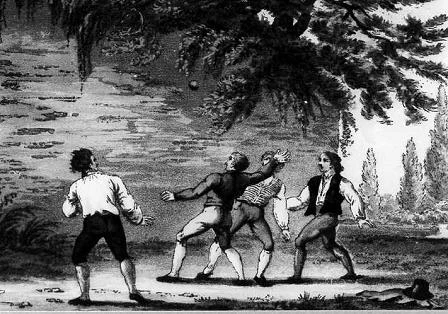
The game of 'fives', rather like a primitive form of squash, often took place against the church walls. Image from The Cambrian Popular Antiquities, Peter Roberts (1815).
The gŵyl mabsant was one of the most popular rural festivals in Wales. Commemorating the local parish saint, this annual celebration developed from a dedication through prayer to a programme of recreational activities, enjoyed by all.
Gŵylmabsantau was mentioned in writing as early as 1470, and the festival was common throughout Wales up until the end of the 19th century.
From cockfighting to grinning matches
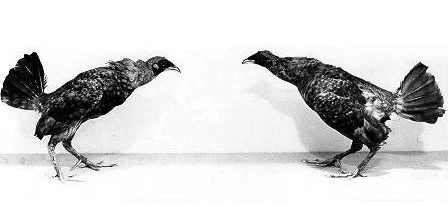
Competitions at the festivals ranged from running races to old women's grinning matches and blindfolded wheelbarrow-driving. At the three day sports event held in Llangyfelach near Swansea in 1780, competitions and prizes included a women's race for a smock and petticoat and eating a hot pudding for a silver table spoon. Animal sports were a familiar scene, particularly cockfights, on which large amounts of money were wagered. Birds were specially trained for the contest, and the owner of a victorious cockerel was held in high esteem.
Early versions of Association Football were often played over Christmas, New Year and at Shrovetide. Large crowds of spectators gathered to witness the matches, which, owing to a lack of pre-determined rules, tended to degenerate into chaos, with injuries being common.
Bando
Bando was another favoured team sport and continued in some areas until the late 19th century. Particularly popular in Glamorgan, bando was similar to the modern game of hockey and teams used clubs to strike the ball towards a goal.
A rowdy reputation
Cockfighting featured prominently on the rural calendar, and was popular with all sections of society throughout Wales until the early 19th century.
Owing to the combination of betting, feasting and alcohol consumption, it was not surprising that parish festivals built-up a reputation for their rowdiness. Publicans often played a significant role in organising and promoting sports events, many being arranged over the bar. The games contested were high-spirited and unwritten rules were often decided informally before the start of a match. As many sports were localised activities, rules usually differed from place to place, leading to disagreements between parishes.
Concern regarding the unlicensed revelry and alcoholic over-indulgence commonly occurring at the festivals, as well as the doubtful benefits of the games themselves, was increasingly voiced from the 18th century onwards, most noticeably by religious leaders.
Worthless and sinful
The Methodist and other religious revivals which swept across Wales from the mid 18th century until the turn of the 20th century, attacked sporting activities indiscriminately as worthless and sinful. Physical recreation was viewed by some as a great threat to the morals of the population. Eminent religious figures, such as Thomas Charles, tried to suppress impious fairs and festivals, in 1799 he described Wales as "sunk in superstition and vice". Consequently, parishioners turned increasingly to churches and chapels for release and salvation, and as prayer meetings were sometimes purposely arranged to clash with sports days, religion became a potent force in the eventual decline of the Gŵyl Mabsant.
Background Reading
"Gŵyl Mabsant" by T.Llew Jones. In Llafar Gwlad p10-11 (Winter, 1997), p8-9 (Spring, 1998).
"Festivals and social structure in early modern Wales" by Richard Suggett. In Past and Present, vol. 152, p79-112 (August, 1996).
ink, watercolour & gouahce, c.1948
22 x 27 inches
Copyright John Piper Estate
John Piper Rock formations
ink, watercolour & gouache, c.1948
21 x 27.5 inches
Copyright John Piper Estate
John Piper The Rise of the Dovey
oil on canvas on board, 1944
27.5 x 34.5 inches
Copyright John Piper Estate
The game of 'fives', rather like a primitive form of squash, often took place against the church walls. Image from The Cambrian Popular Antiquities, Peter Roberts (1815).
Cockfighting featured prominently on the rural calendar, and was popular with all sections of society throughout Wales until the early 19th century.
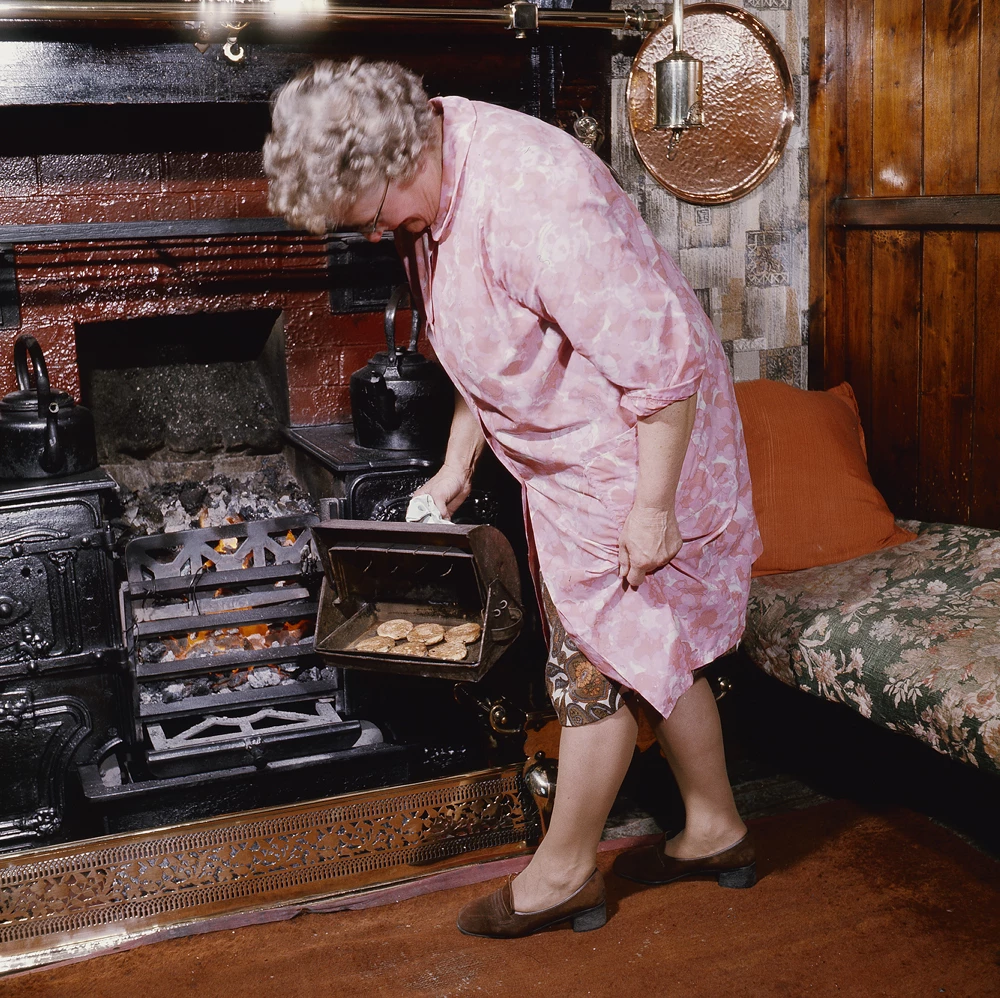
Margaret Maddocks baking round cakes in a Dutch oven, North Cornelly, Glamorgan.