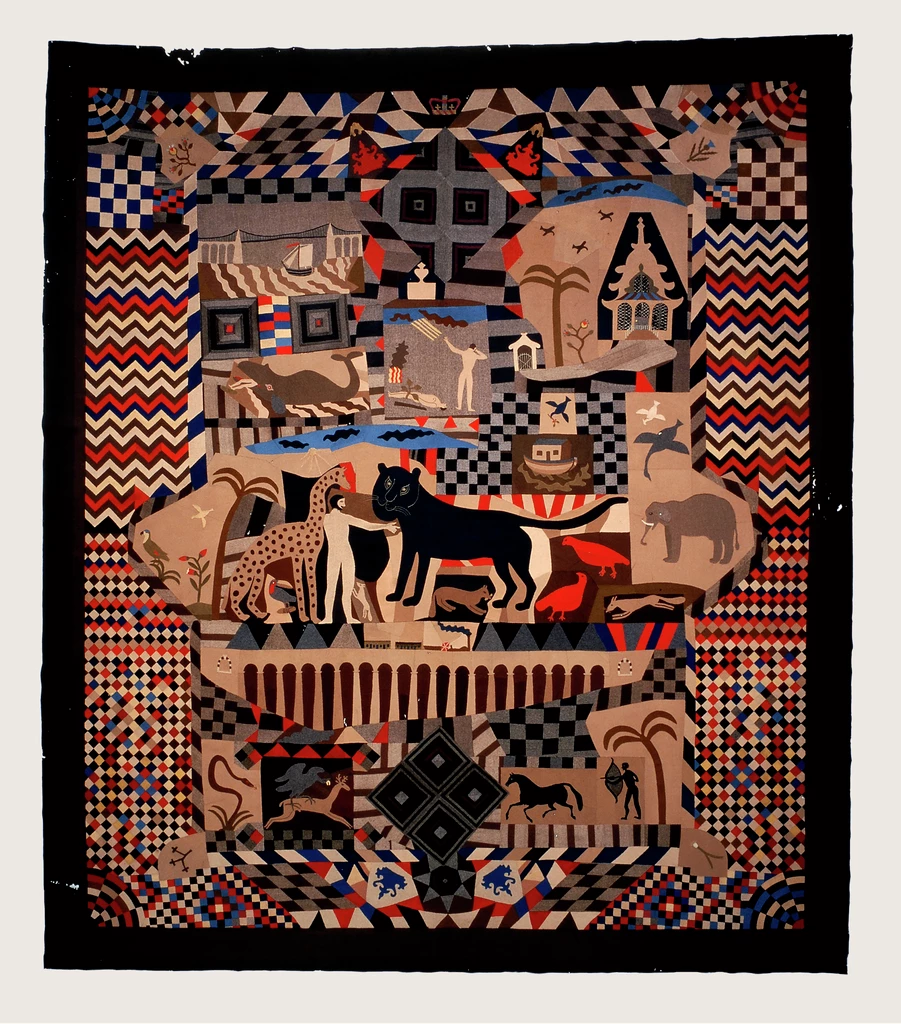
The Wrexham Tailor’s Quilt, 1842–52 Elen Phillips, 2 March 2020 Wrexham Tailor’s Quilt, 1842–52 Collections Online: Patchwork Bedcover Amgueddfa Cymru – National Museum Wales is home to over two hundred examples of quilting and patchwork. This vast collection includes a wide variety of styles and techniques, ranging in date from the early 1700s to the present day. The Wrexham Tailor’s Quilt is probably one of the most well-known patchworks produced in Wales. Made by James Williams – a military master tailor from 8 College Street, Wrexham – its design is unlike any other in the Museum’s collection. The quilt’s background is a pieced composition of diamond patches, chevrons, squares and rhomboids. Biblical scenes dominate the centre – Adam naming the animals, Jonah and the Whale, Noah’s Ark with a dove bearing an olive branch, and Cain and Abel. Other figurative motifs include Thomas Telford’s Menai Suspension Bridge (opened in 1826), a Chinese pagoda, and Cefn Viaduct, complete with a crossing steam train. Details are picked out through embroidery in silk thread. Meticulously pieced, James Williams made his quilt by recycling a variety of felted woollen cloths, possibly off-cuts of broadcloth from military uniforms. In total, it consists of 4,525 separate pieces of cloth, butt-joined with overcast stitches worked from the reverse. Examples of this type of inlaid (‘intarsia’) patchwork found in museum collections are usually the work of professional tailors. The technique requires a high degree of skill and the use of thick cloth that does not fray to accommodate the oversewing required. According to family history, James Williams spent a decade completing the piece, the work being done in his leisure hours between 1842 and 1852. The quilt soon became an exhibition piece; it was displayed at the Art Treasures Exhibition in Wrexham in 1876, at the Palace of Arts in Wembley in 1925, and to much public acclaim at the Wrexham National Eisteddfod of 1933. Census returns for the Wrexham area suggest that James Williams was born in 1818. His tailoring establishment appears in numerous trade directories from the 1850s onwards. He died in 1895, leaving his son to inherit the family business. Forty years after his death, the economic depression of the 1930s prompted Williams’s grandson to sell the quilt to the Museum, stating that “it has always been my wish that the quilt should be sent to [the] National Museum of Wales so as my fellow countrymen should have the opportunity to admire a work of art that today could not be done if you were to pay the most skilful craftsman £1 a minute to do”.
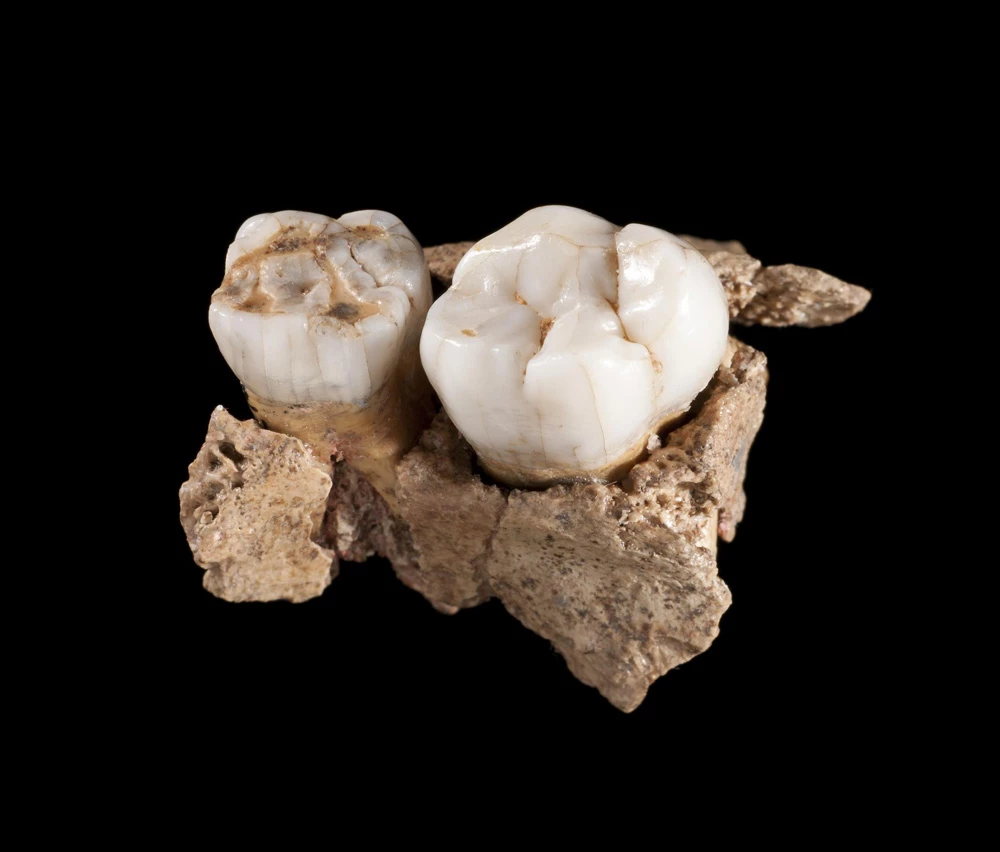
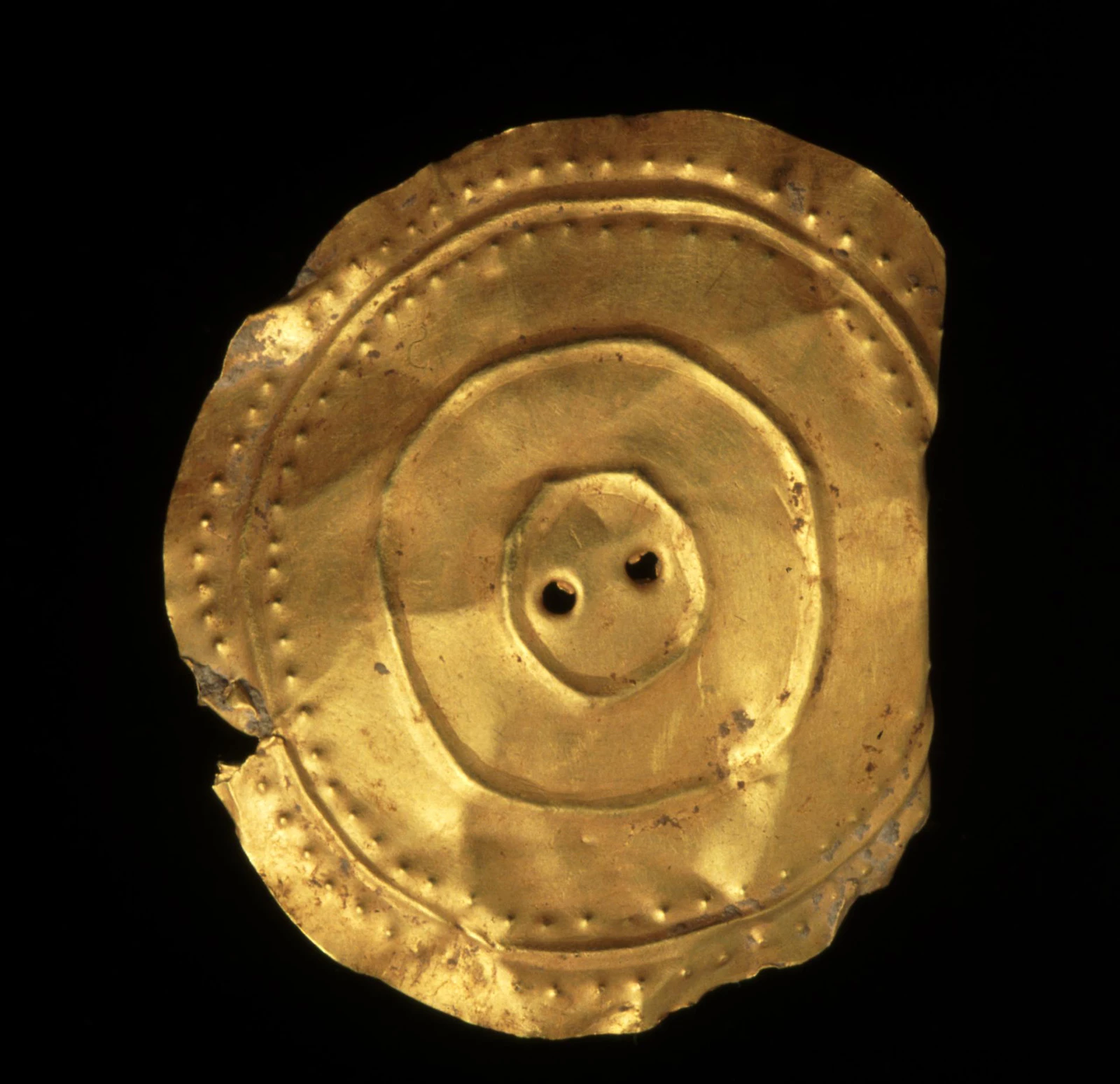
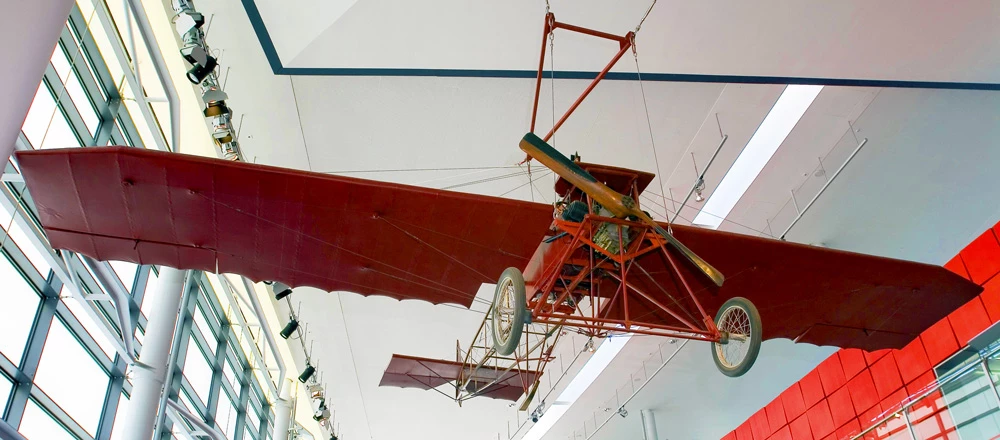
Uncovering our Collections: Half a Million Records now Online 26 March 2018 As we reveal half a million collection records for the first time, we look at some of the strangest and most fascinating objects from National Museum Wales Collections Online. This article contains photos of human skeletal fragments. The Biggest We have some real whoppers in our collections - including a full-size Cardiff Tram and a sea rescue helicopter - but the biggest item in our collection is actually Oakdale Workmen's Institute. Built in 1917, the Institute features a billiard room, dance hall and library - and is nowadays found in St Fagans National Museum of History. Horace Watkins testing his monoplane in 1908 Many of the buildings in St Fagans are part of the national collection - meaning they have the same legal status as one of our masterpiece Monets or this coin hoard. The buildings are dismantled, moved, rebuilt - and cared for using traditional techniques, by the museum's legendary Historic Buildings Unit. The Oldest The oldest human remains ever discovered in Wales These teeth belonged to an eight year-old Neanderthal boy - and at 230,000 years old, they are the oldest human remains in Wales. They were discovered in a cave near Cefn Meiriadog in Denbighshire, along with a trove of other prehistoric finds, including stone tools and the remains of a bear, a lion, a leopard and a rhinocerous tooth. These teeth are among some of the incredible objects on display at St Fagans National Museum of History The Shiniest People in Wales have been making, trading and wearing beautiful treasures from gold for thousands of years - like this Bronze Age hair ornament and this extremely blingy Medieval signet. At around 4000 years old, this sun disc is one of the earliest and rarest examples of Welsh bling One of the earliest examples of Welsh bling is this so-called 'sun disc', found near Cwmystwyth in Ceredigion. Current research suggests that these 'sun discs' were part of ancient funeral practice, most likely sewn onto the clothes of the dead before their funerals. Only six have ever been found in the UK. Most Controversial At first glance, an ordinary Chapel tea service - used by congregations as they enjoyed a 'paned o de' after a service. A closer look reveals the words - 'Capel Celyn'. The chapel, its graveyard and surrounding village are now under water. Capel Celyn, in the Tryweryn Valley, is now underwater Flooded in 1965 by the Liverpool Corporation, the Tryweryn valley became a flashpoint for Welsh political activism - creating a new generation of campaigners who pushed for change in how Welsh communities were treated by government and corporations. Curators from St Fagans collected these as an example of life in Capel Celyn - to serve as a poignant reminder of a displaced community, and to commemorate one of the most politically charged moments of the 20th century in Wales. Honourable Mention: an Airplane made from a Dining Room Chair Made from a dining room chair, piano wire and a 40 horsepower engine, the Robin Goch (Red Robin) was built in 1909 - and also features a fuel gauge made from an egg timer. The Robin Goch (Red Robin) on display at the National Waterfront Museum Its builder, Horace Watkins, was the son of a Cardiff printer - here he is pictured with an earlier, even more rickety version of his famous monoplane. Horace Watkins testing his monoplane in 1908 Our collections are full of stories which reflect Wales' unique character and history. The Robin Goch is one of the treasures of the collection, and is an example of Welsh ingenuity at its best. Half a Million Searchable Items The launch of Collections Online uncovers half a million records, which are now searchable online for the first time. “Collections Online represents a huge milestone in our work, to bring more of our collections online and to reach the widest possible audience. It’s also just the beginning. It’s exciting to think how people in Wales and beyond will explore these objects, form connections, build stories around them, and add to our store of knowledge." – Chris Owen, Web Manager Search Collections Online Plans for the future Our next project will be to work through these 500,000 records, adding information and images as we go. We'll be measuring how people use the collections, to see which objects provoke debate or are popular with our visitors. That way, we can work out what items to photograph next, or which items to consider for display in our seven national museums. Preparing and photographing the collections can take time, as some items are very fragile and sensitive to light. If you would like to support us as we bring the nation's collections online, please donate today - every donation counts. Donate Today We are incredibly grateful to the People's Postcode Lottery for their support in making this collection available online.
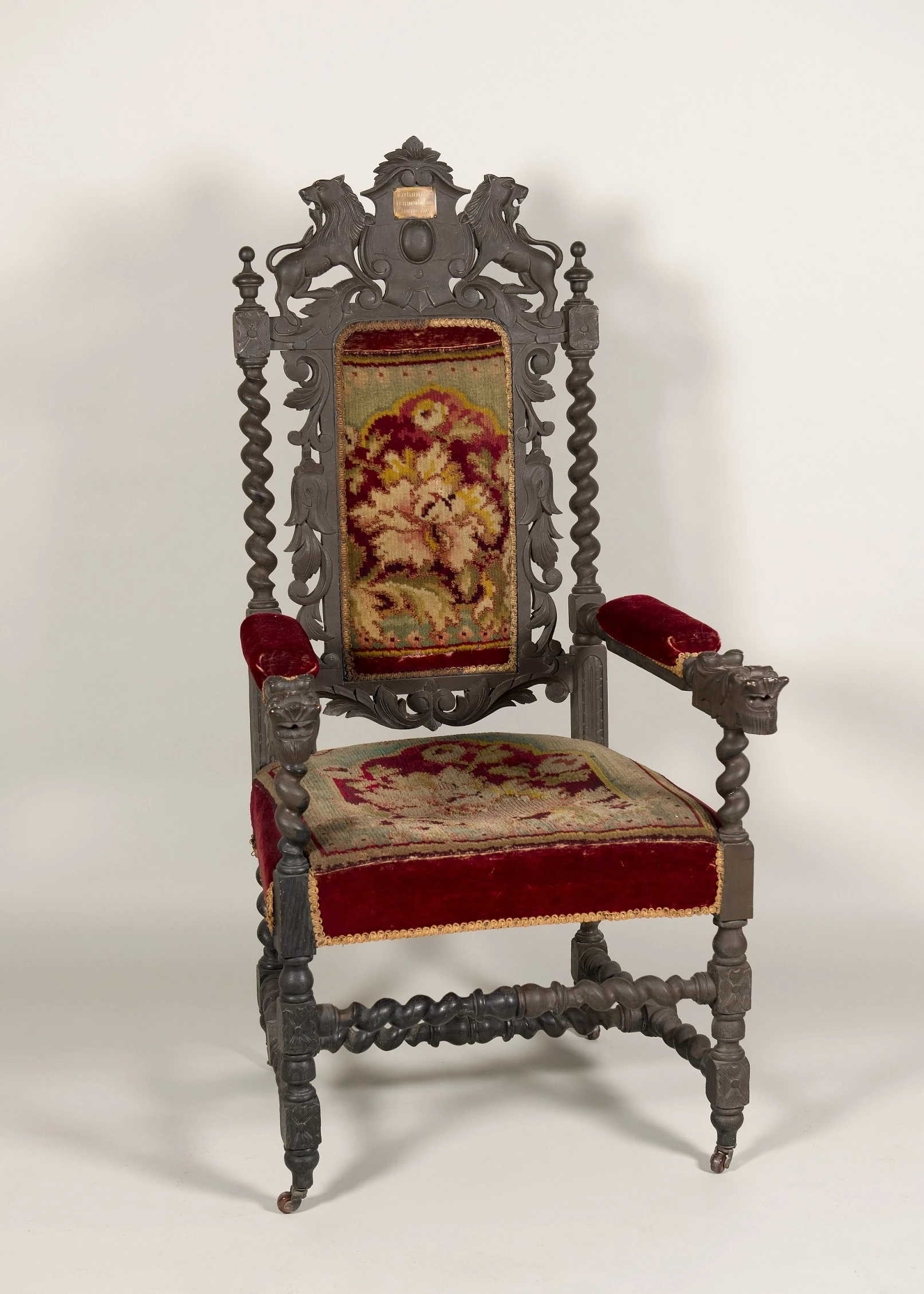
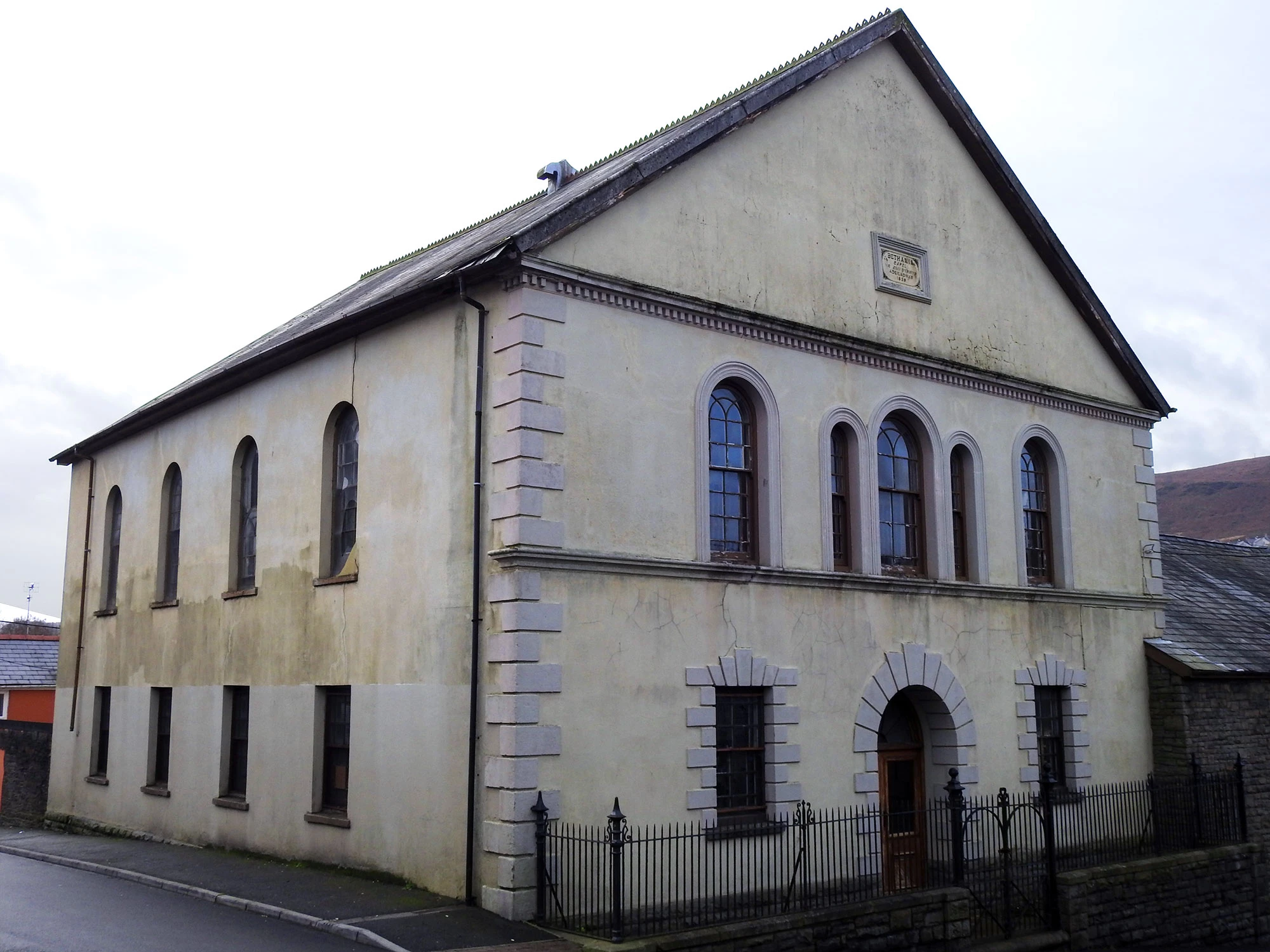
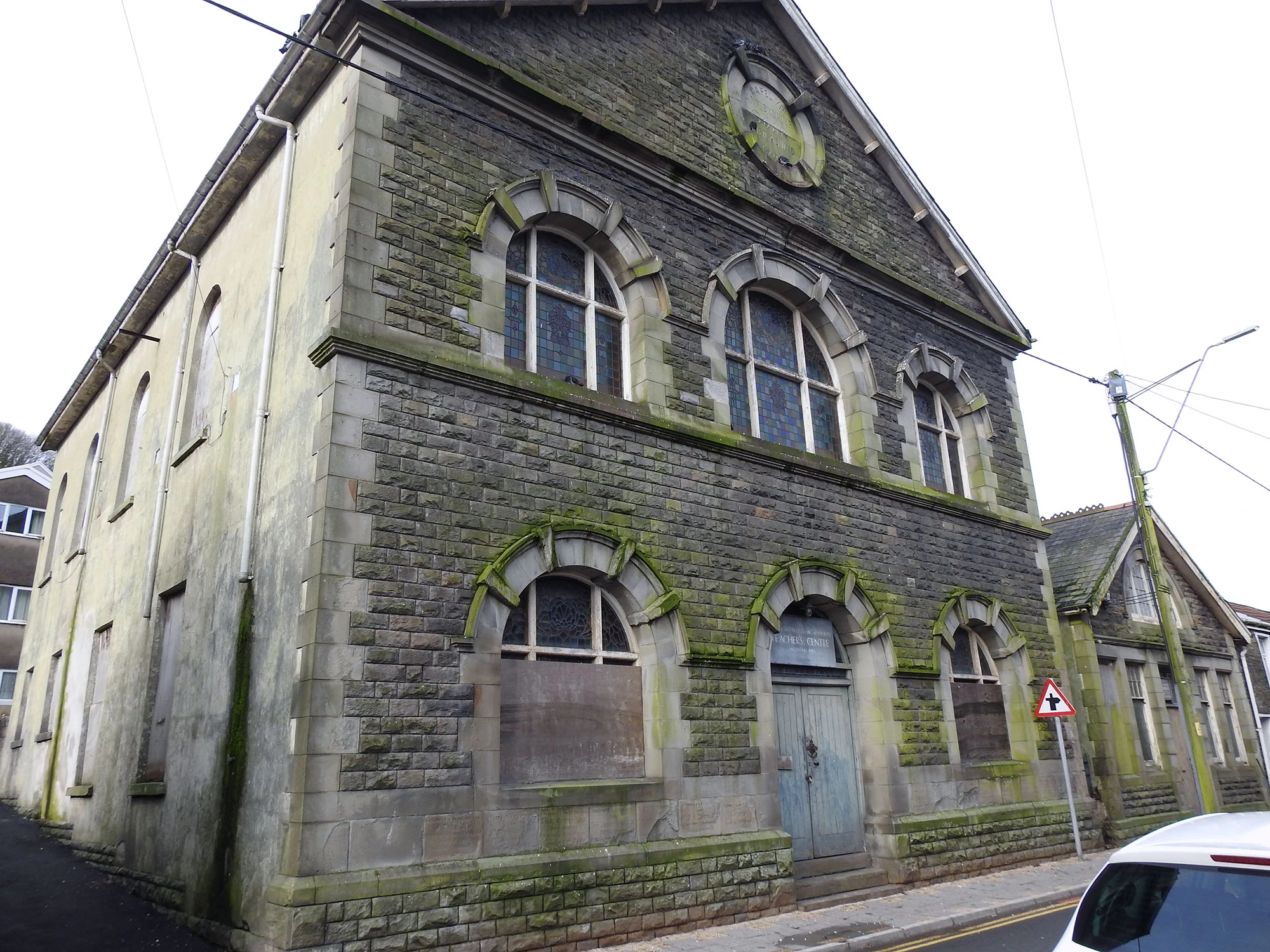
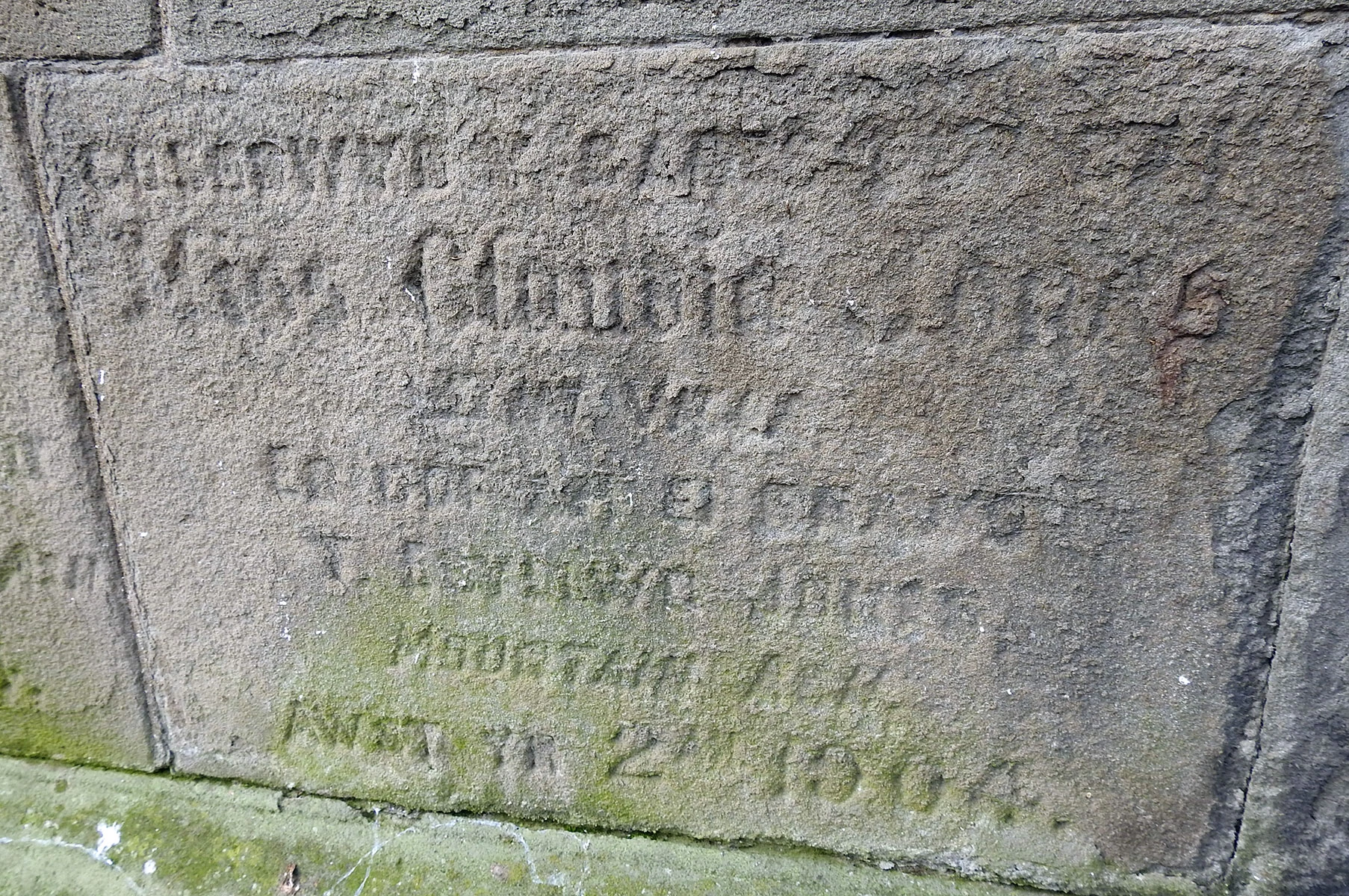
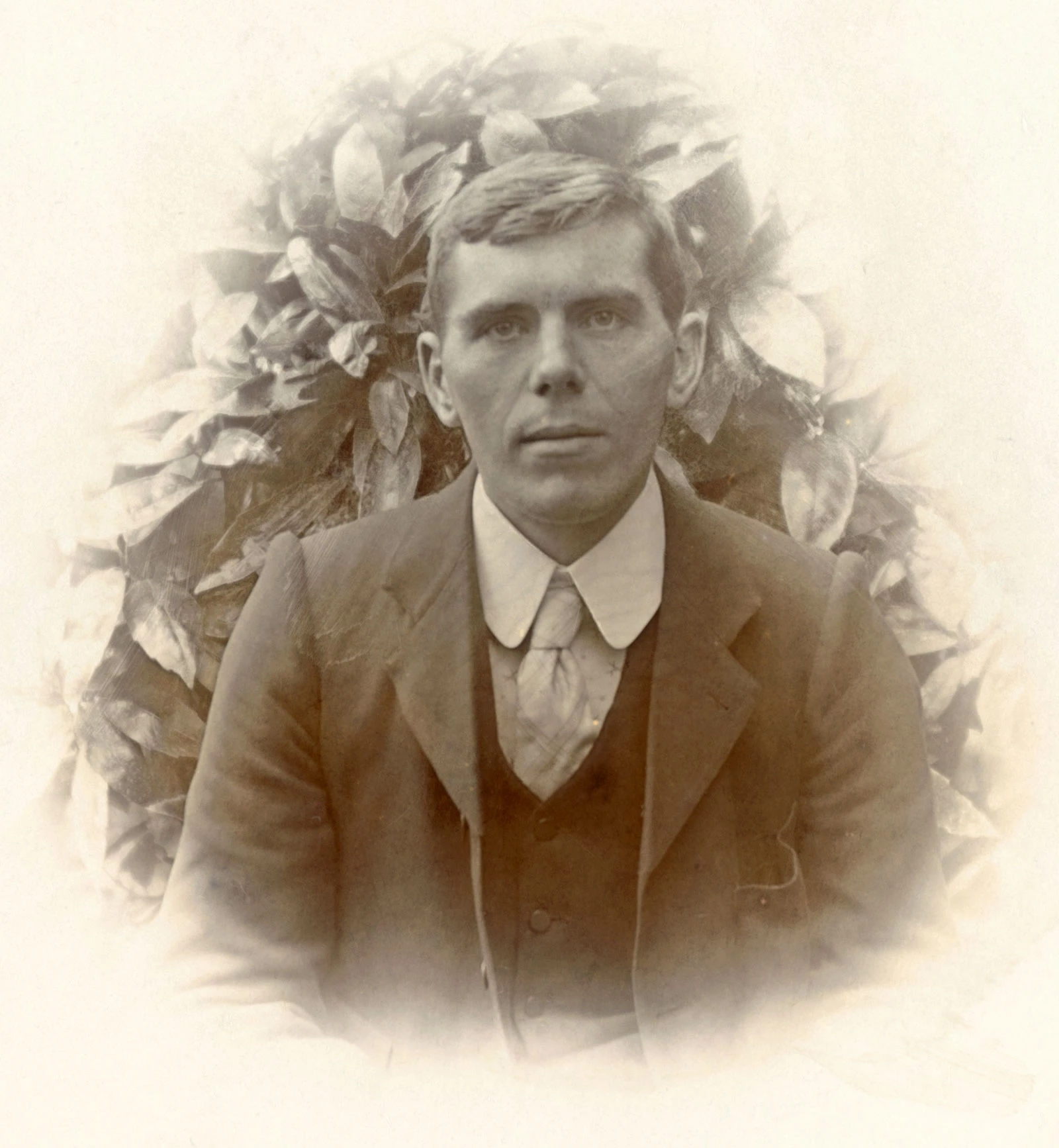
Esyllwg’s Sad Fate Ceri Thompson, 1 March 2017 ‘The most beautiful work of art’ - the Eisteddfod chair In the Rhondda Fawr on Good Friday, April 10th 1903, the fifth Blaenclydach Chair Eisteddfod was held in the village’s Gosen Chapel. Seventeen competitors took part in the ‘best poetical competition’, the prize being £1.11.6d and a handsome chair (The Rhondda Leader described it as ‘the most beautiful work of art’) given by Mr Joseph Jones of Blaenclydach. The competitors’ task was to write 120 lines on the subject of ‘Adgof’ (memory or reminiscence) and the adjudicator was Ap Ionawr of Llansamlet. The competition was won by ‘Esyllwg’ (the ancient name for south-east Wales), the bardic name of Thomas Jones, a thirty year old collier from Mountain Ash. The Aberdare Leader announced that ‘… the first chaired bard of Mountain Ash is a young man with a promising career’ and went on to say that ‘it is intended to have a repetition of the chairing ceremony at Bethania Hall (Mountain Ash) sometime next month.’ Sadly, that ceremony never took place. Thomas’s father, David Thomas Jones, was born in Brynaman in 1846 and came to work in Nixon’s Navigation Colliery in Mountain Ash. ‘Esyllwg’ followed his father into the colliery but was also well known as a teacher of Welsh classes in the Science and Art Department of the Continuation School at Mountain Ash, a faithful member of Bethania Welsh Congregational Chapel and a member of the Caegarw String Band. Bethania Chapel, Mountain Ash Soar Chapel, Mountain Ash Thomas Jones' memorial stone Thomas Jones Esyllwg's Accident On the 4th May, almost a month after his Eisteddfod success, Thomas was working in the 2’9” seam of Deep Duffryn Colliery when he was killed under a fall of roof. His Majesty’s Inspector of Mines Inspector’s Report for 1903 describes the incident as follows:- “Fall of roof: no.42, Thomas Jones, 30, collier, 4 May 1903, 12.30pm, Deep Duffryn Colliery, Glamorgan, Nixon’s Navigation Co Ltd. “At face, cliff, 10 ft. by 4ft 8 ins. by 44 ins. thick. Deceased wanted to get this stone down, so commenced knocking the props out from under it, and, when he knocked out the last, the fall occurred. Its falling so suddenly was due to a “false slip” in the roof, which could not be seen previous to the fall. Two feet nine seam.” The Aberdare Leader for the 9th May 1903 announced the death under the headline “Esyllwg’s Sad Fate” and described him as “The sweet singer of Pennar”. The article ends “The blighting of a budding genius by the grim hand of death is always distressing, but the tragic circumstances make the demise of our friend doubly pathetic. His relatives are the objects of the most sincere sympathy.” In 1904 Thomas Jones’s sister Claudia dedicated a memorial stone on the outside wall of the, then, newly-built Soar Chapel in High Street, Mountain Ash. Although disused the chapel is still there but the stone is now so worn as to be almost unreadable. The chair is now in the coal mining collection of Amgueddfa Cymru: National Museum Wales. Poem of Remembrance 'Pryddest Goffadwriaethol' - Poem of Remembrance from his funeral.
The 1958 British Empire and Commonwealth Games Queen’s Baton Relay Dr Emma Lile, 21 May 2014 The 1958 British Empire and Commonwealth Games Queen’s Relay baton. The Queen’s message, signed ‘Elizabeth R’, dated 14 July 1958, and sent from Buckingham Palace to Cardiff via the baton relay. By Gracious Permission of Her Majesty Queen Elizabeth II. The route of the Queen’s message relay in 1958. (© Commonwealth Games Federation) Who would have thought that the exciting, colourful and internationally renowned Commonwealth Games Queen’s Baton Relay actually started its life in Wales? Signifying a visual celebration of the unity and diversity of all the Commonwealth nations, and highlighting sport’s ability to join people of all races, this much-anticipated event has now become a familiar and popular prelude to the Games’ grand opening. Having begun as the Empire Games in 1930, the Commonwealth Games has always been proud to follow the Olympic ideal of friendship, solidarity and fair play, and endeavours to promote good relations between the Commonwealth countries. The British Empire and Commonwealth Games, as they were known in 1958 when held in Cardiff between 18 and 26 July, were the first to stage the Queen’s Baton Relay, intended to symbolise peace and harmony through sports participation. In a fitting tribute to the capital city’s success as host, the Cardiff baton will form part of this year’s ceremony when the 2014 Glasgow equivalent arrives in Wales on 24 May to begin its seven-day journey around the country. The baton Although its origins remain unclear, it is believed that the idea for a Commonwealth baton relay was conceived during the late 1950s by the Games Organising Committee. Appointed as the event’s Honorary Organiser was retired Royal Navy officer, Commander Bill Collins, who had previously coordinated the London Olympic Torch Relay in 1948. For the Cardiff relay Collins was ably assisted by a team of local organisers, selected by athletic associations from all counties through which the running route passed. The 1958 silver-gilt and enamel baton was designed by Cardiff jeweller and former soldier, Colonel Roy Crouch, Chairman of the Games’ Medals Committee. Measuring 40cm in length and 4cm in diameter, it was decorated with Welsh national symbols, namely a red dragon, daffodils and leeks, along with crowns representing the royal connection. ‘VI British Empire and Commonwealth Games, Wales 1958’ was inscribed on the hollow tubular baton, which was manufactured by Turner and Simpson, silversmiths, of Birmingham. The 1958 British Empire and Commonwealth Games Queen’s Relay baton. The first baton relay Dr Roger Bannister, then holder of the Empire Games mile record, leaving Buckingham Palace carrying the baton at the start of the relay. He is accompanied by fellow Games champions Chris Chataway (left) and Peter Driver. (© Commonwealth Games Federation) On 14 July 1958, the baton relay set off from the forecourt of London’s Buckingham Palace, the residence of Queen Elizabeth, Head of the Commonwealth, before travelling through several English counties and all thirteen Welsh on its journey to Cardiff. Unfortunately, owing to illness, the Queen was unable to hand her message to the opening runners, namely Dr Roger Bannister, the first sub-four-minute miler, escorted by fellow 1954 Games champions Chris Chataway and Peter Driver. Her place was taken by the relay organiser, Commander Collins, who placed the message inside the baton; a cap on one end being secured by a spring catch, thus avoiding the need for a key. In order to prevent damaging the baton en route, the message was transferred to a metal replica version following the relay’s second stage, which, for security reasons, was fitted with a lock. The ceremonial silver baton then resumed its duties on the final changeover, carried, message safely inside, by the last runner. A total of 664 athletes, including 32 schoolboys, were involved in the relay, which covered more than 600 miles over almost four days. According to The Story of the Sixth British Empire and Commonwealth Games by Clive Williams (2008): One runner from each club, service unit and school in each county was given a stage to run. The seniors ran two-mile legs while the juniors ran a mile. The run continued day and night, seniors being used in dense traffic conditions and, where possible from midnight to 6.00am. In the north the message passed through Llangollen, Wrexham, Flint, Llandudno and Caernarfon before heading south down the west coast through Dolgellau, Aberystwyth, Cardigan and Haverfordwest. To satisfy the needs of the more heavily populated south the relay wound around the coast from Carmarthen, Llanelli, Swansea and Bridgend before it covered the valleys of the south through Aberdare, Brynmawr, Abergavenny, and Newport then on to Cardiff. An official car followed directly behind the runner throughout to protect him from unofficial cycle or motor car escorts, to light the road at night, and to enable the section organisers to keep the time-table correct. Speeds varied as necessary from 6.5 to 7.5 minutes to the mile, thus ensuring that there was no idea of a race and to allow spectators to be shown the baton at take-over points. Ken Jones, former Wales rugby player and Olympic athlete, presenting the baton to the Duke of Edinburgh at the opening ceremony at Cardiff Arms Park. (© Commonwealth Games Federation) The opening ceremony 'A Quick Laugh' by Geoffrey Evans, Western Mail, 18 July 1958. Reproduced by kind permission of the National Library of Wales Following a trumpet fanfare and six-gun salute, on Friday 18 July at 6.33pm, the final leg runner entered the Arms Park stadium to complete the relay. This athlete’s identity was a closely guarded secret and rapturous applause rang out from the 40,000 or so spectators when he was revealed as former Wales rugby player and Olympic silver sprint relay medallist, 36-year-old Ken Jones of Newport. Donning a red vest complete with Welsh badge and white shorts, Jones appeared in the competitors’ entrance before running once around the cinder track, holding the baton aloft. He then stopped in front of the Duke of Edinburgh, the President of the Commonwealth Games Federation, and handed him the baton accompanied by the light-hearted remark of ‘Nice pass Ken’ by a member of the crowd, in recognition of Jones’s prestigious rugby career. The Duke proceeded to read the Queen’s message to the excited crowd: To all athletes assembled at Cardiff for the 6th British Empire and Commonwealth Games I send a warm welcome and my very best wishes. I am delighted that so many Commonwealth countries have sent teams to Wales for these Games. The number is larger than ever and more than three times as great as for the first meeting at Hamilton in 1930. This is welcome proof of the increasing value which is being placed today on physical strength and skill as an essential factor in the development of the whole man, healthy in mind and body. It also gives the greatest personal pleasure to know that so many members of the Commonwealth family are meeting in friendly rivalry and competition. I hope that many lasting friendships will grow from this great meeting of athletes and spectators, and that you will all go home with a better understanding of the value of our Commonwealth of nations. I am greatly looking forward to being with you at the end of next week. The much-anticipated Games were then officially opened, as Cardiff welcomed 35 nations and 1,122 athletes to compete in the sports of athletics, boxing, cycling, fencing, bowls, rowing, swimming and diving, weightlifting and wrestling. In addition to the use of Cardiff Arms Park for the opening and closing ceremonies and the athletics events, other venues included Cardiff’s Wales Empire pool, built especially to host the swimming, Sophia Gardens for the boxing bouts, Maindy Stadium the cycling and Llyn Padarn, Llanberis the rowing. Wales’s sole gold medal was won by bantamweight boxer Howard Winstone, although the home nation did also collect three silvers and seven bronze. The closing ceremony and beyond Following a Games widely considered an outstanding success, the closing ceremony on 26 July proved to be an historic occasion. Although continued illness prevented the Queen from attending in person, a recorded message was played to the crowd in which she announced: ‘I intend to create my son Charles, Prince of Wales today. When he is grown up, I will present him to you at Caernarfon.’ Despite being the smallest ever host nation, Wales’s superbly organised sporting spectacle did the country proud and was recognised at the time as a magnificent occasion which celebrated the cream of athletic strength and stamina on a global stage. On the culmination of the 1958 Games the Queen’s relay baton was offered by the Organising Committee to the National Museum of Wales, at the wish of Queen Elizabeth. It has been housed in the Art Department ever since, along with the accompanying royal message, and represents an enduring visual testament to an unforgettable and momentous festival of sport. Thanks to Chris Jenkins, Chief Executive, Commonwealth Games Council for Wales, and Clare Ewing, Events Officer, Sport Wales, for their kind assistance.
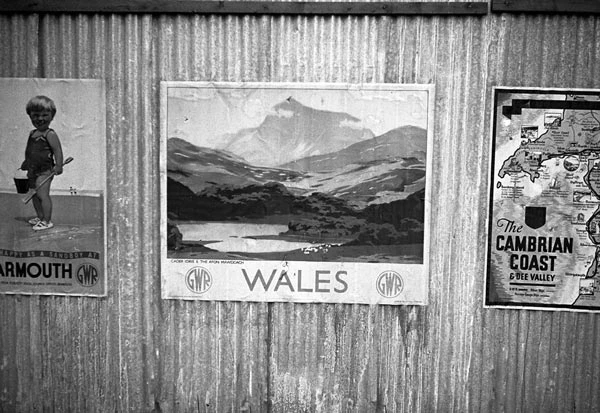
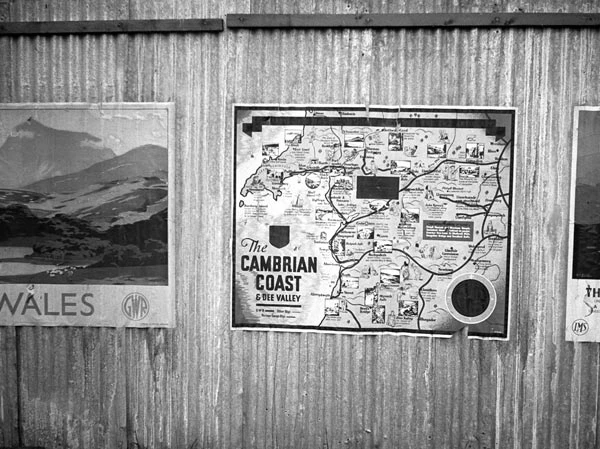
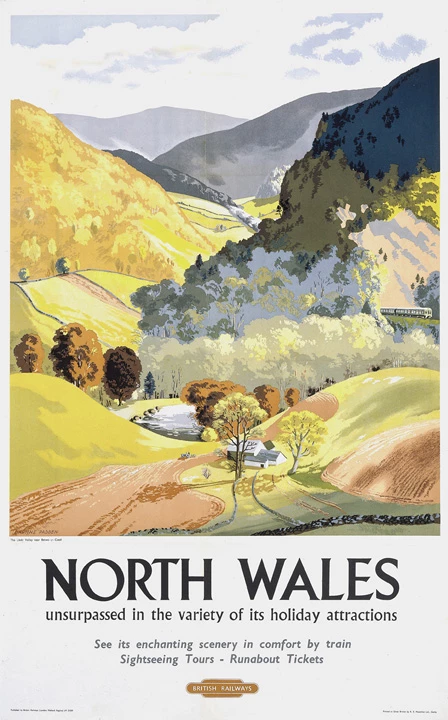
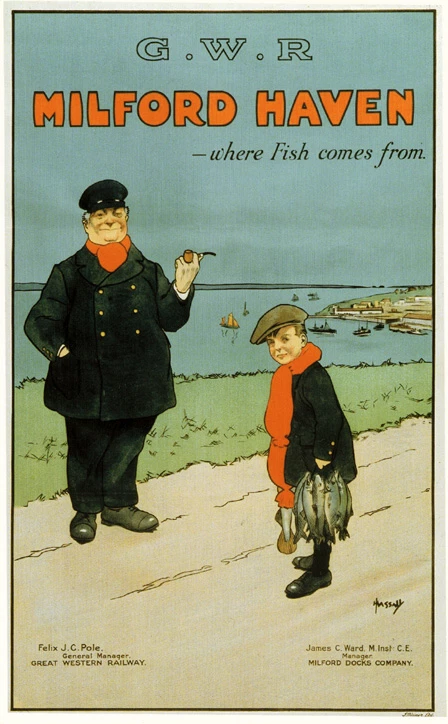
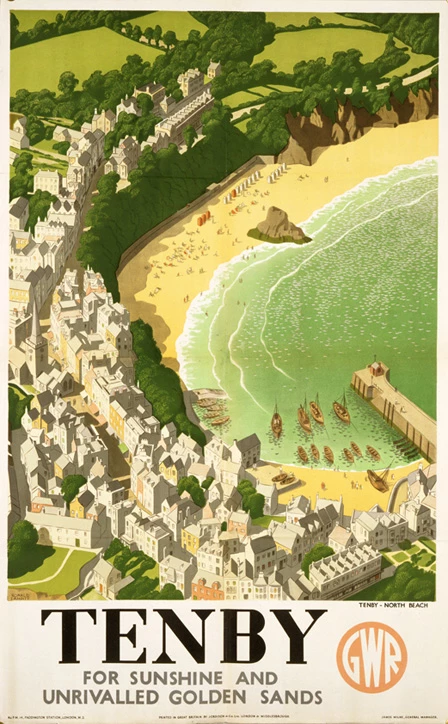
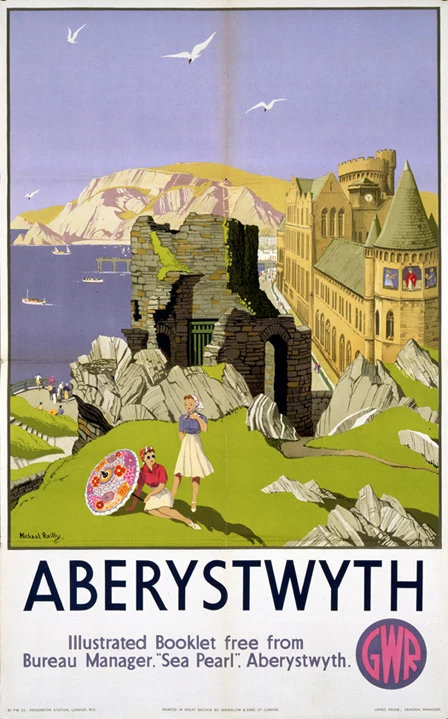
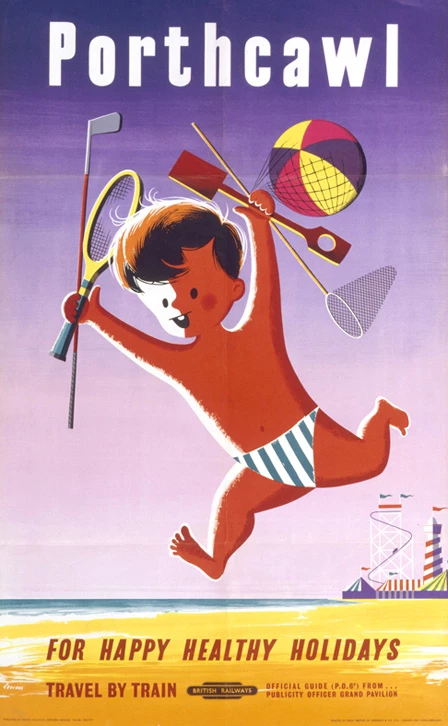
Railway Posters Mark Etheridge, 4 November 2013 Railway posters displayed at Machynlleth Station, circa. 1930s Railway Posters displayed at Machynlleth Station, circa. 1930s Railway posters are colourful works of art that epitomise the era in which they were produced. Amgueddfa Cymru’s collection comprises about 60 examples, and these provide a good representation of the types of posters produced and displayed all over Wales. Railway posters were a familiar feature when travelling on the railway, being displayed in stations, ticket offices and on platforms hoardings. They were used to entice the public to board the railway and escape from their daily routine. Generally they presented idealised images of popular holiday resorts, such as Tenby and Aberystwyth; historic towns, such as Caernarfon; and the countryside and coastline of north Wales, Pembrokeshire and Gower. These had all been made accessible by the lines on which the railway companies operated. It is often claimed that the railway invented the ‘package holiday’. During the early years of the railways most advertising was in the form of simple printed leaflets and handbills. However these gradually became more elaborate, and with improvements in colour lithography in the later part of the 19th century there was a revolution in poster printing, as the colour poster became cheaper to produce. Although railway posters have been in popular use since the late nineteenth century, it is generally regarded that their heyday was between 1923 (when four large companies, the Great Western Railway, Southern Railway, London, Midland & Scottish, and London & North Eastern Railway were formed) and 1947, when the railways were nationalised. However, Amgueddfa Cymru has many examples of British Railway posters produced in the 1950s and 60s which are equally eye catching and interesting, and often much more bright and cheerful. The jolly fisherman Some posters combined both images and slogans. One of the most famous is John Hassall’s image of a ‘jolly fisherman’ skipping along the beach, and the slogan “Skegness is SO Bracing”. The ‘jolly fisherman’ became the mascot of Skegness and is believed to have contributed to the success of this resort as a holiday destination. A G.W.R. poster by John Hassall in our collection, dating from c.1925, advertises Milford Haven, and depicts a fisherman and a boy holding fish with the slogan “Milford Haven – where fish comes from.” The Museums collection comprises about 60 examples, and these provide a good representation of the types of posters produced and displayed all over Wales. Examples range in date from about 1914 into the 1960s, with the 1950s and 60s very well represented. Each railway company developed their own distinct style, and they all used some of the finest poster artists of the day. Our collection includes excellent examples by Norman Wilkinson, Charles Pears & John Hassall. Museum collections A selection of these posters can now be viewed on our Images of Industry collections database. Further Reading Happy as a Sand-Boy Early Railway Posters by Beverly Cole & Richard Durack (1990) Railway Posters 1923-1947 by Beverly Cole & Richard Durack (1992).