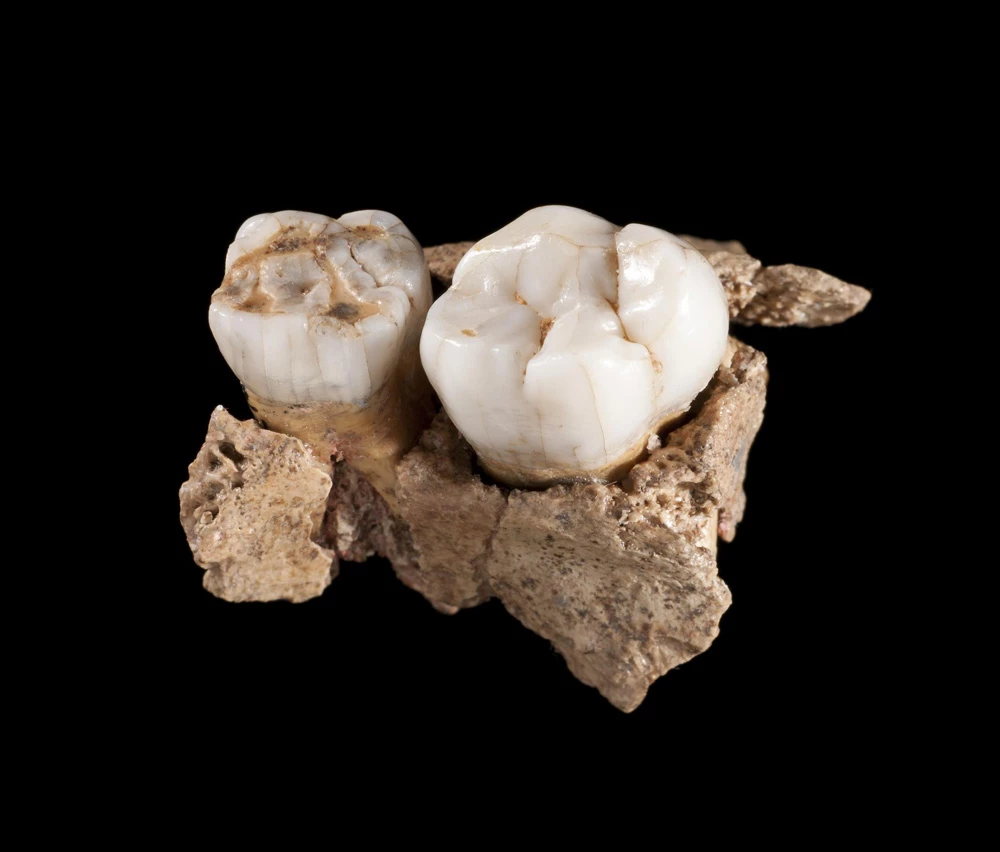
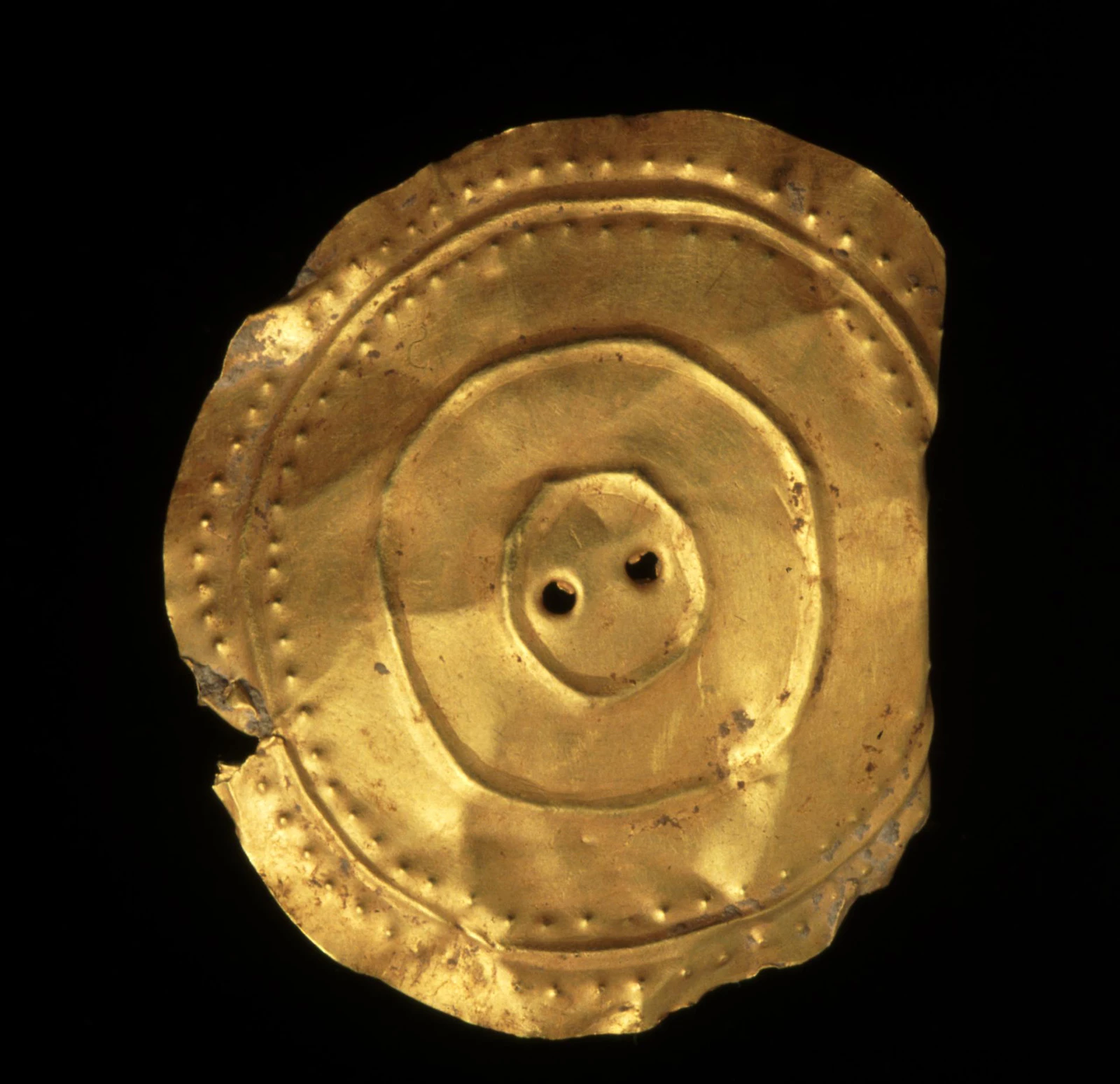
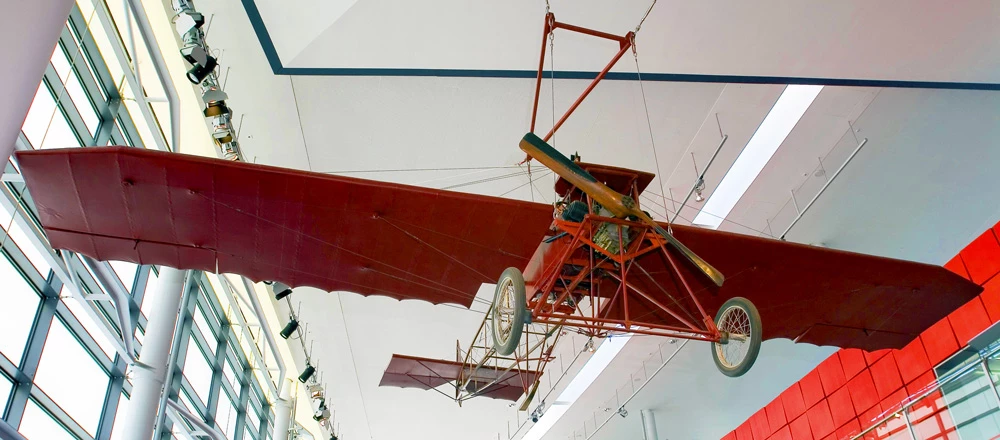
Uncovering our Collections: Half a Million Records now Online 26 March 2018 As we reveal half a million collection records for the first time, we look at some of the strangest and most fascinating objects from National Museum Wales Collections Online. This article contains photos of human skeletal fragments. The Biggest We have some real whoppers in our collections - including a full-size Cardiff Tram and a sea rescue helicopter - but the biggest item in our collection is actually Oakdale Workmen's Institute. Built in 1917, the Institute features a billiard room, dance hall and library - and is nowadays found in St Fagans National Museum of History. Horace Watkins testing his monoplane in 1908 Many of the buildings in St Fagans are part of the national collection - meaning they have the same legal status as one of our masterpiece Monets or this coin hoard. The buildings are dismantled, moved, rebuilt - and cared for using traditional techniques, by the museum's legendary Historic Buildings Unit. The Oldest The oldest human remains ever discovered in Wales These teeth belonged to an eight year-old Neanderthal boy - and at 230,000 years old, they are the oldest human remains in Wales. They were discovered in a cave near Cefn Meiriadog in Denbighshire, along with a trove of other prehistoric finds, including stone tools and the remains of a bear, a lion, a leopard and a rhinocerous tooth. These teeth are among some of the incredible objects on display at St Fagans National Museum of History The Shiniest People in Wales have been making, trading and wearing beautiful treasures from gold for thousands of years - like this Bronze Age hair ornament and this extremely blingy Medieval signet. At around 4000 years old, this sun disc is one of the earliest and rarest examples of Welsh bling One of the earliest examples of Welsh bling is this so-called 'sun disc', found near Cwmystwyth in Ceredigion. Current research suggests that these 'sun discs' were part of ancient funeral practice, most likely sewn onto the clothes of the dead before their funerals. Only six have ever been found in the UK. Most Controversial At first glance, an ordinary Chapel tea service - used by congregations as they enjoyed a 'paned o de' after a service. A closer look reveals the words - 'Capel Celyn'. The chapel, its graveyard and surrounding village are now under water. Capel Celyn, in the Tryweryn Valley, is now underwater Flooded in 1965 by the Liverpool Corporation, the Tryweryn valley became a flashpoint for Welsh political activism - creating a new generation of campaigners who pushed for change in how Welsh communities were treated by government and corporations. Curators from St Fagans collected these as an example of life in Capel Celyn - to serve as a poignant reminder of a displaced community, and to commemorate one of the most politically charged moments of the 20th century in Wales. Honourable Mention: an Airplane made from a Dining Room Chair Made from a dining room chair, piano wire and a 40 horsepower engine, the Robin Goch (Red Robin) was built in 1909 - and also features a fuel gauge made from an egg timer. The Robin Goch (Red Robin) on display at the National Waterfront Museum Its builder, Horace Watkins, was the son of a Cardiff printer - here he is pictured with an earlier, even more rickety version of his famous monoplane. Horace Watkins testing his monoplane in 1908 Our collections are full of stories which reflect Wales' unique character and history. The Robin Goch is one of the treasures of the collection, and is an example of Welsh ingenuity at its best. Half a Million Searchable Items The launch of Collections Online uncovers half a million records, which are now searchable online for the first time. “Collections Online represents a huge milestone in our work, to bring more of our collections online and to reach the widest possible audience. It’s also just the beginning. It’s exciting to think how people in Wales and beyond will explore these objects, form connections, build stories around them, and add to our store of knowledge." – Chris Owen, Web Manager Search Collections Online Plans for the future Our next project will be to work through these 500,000 records, adding information and images as we go. We'll be measuring how people use the collections, to see which objects provoke debate or are popular with our visitors. That way, we can work out what items to photograph next, or which items to consider for display in our seven national museums. Preparing and photographing the collections can take time, as some items are very fragile and sensitive to light. If you would like to support us as we bring the nation's collections online, please donate today - every donation counts. Donate Today We are incredibly grateful to the People's Postcode Lottery for their support in making this collection available online.
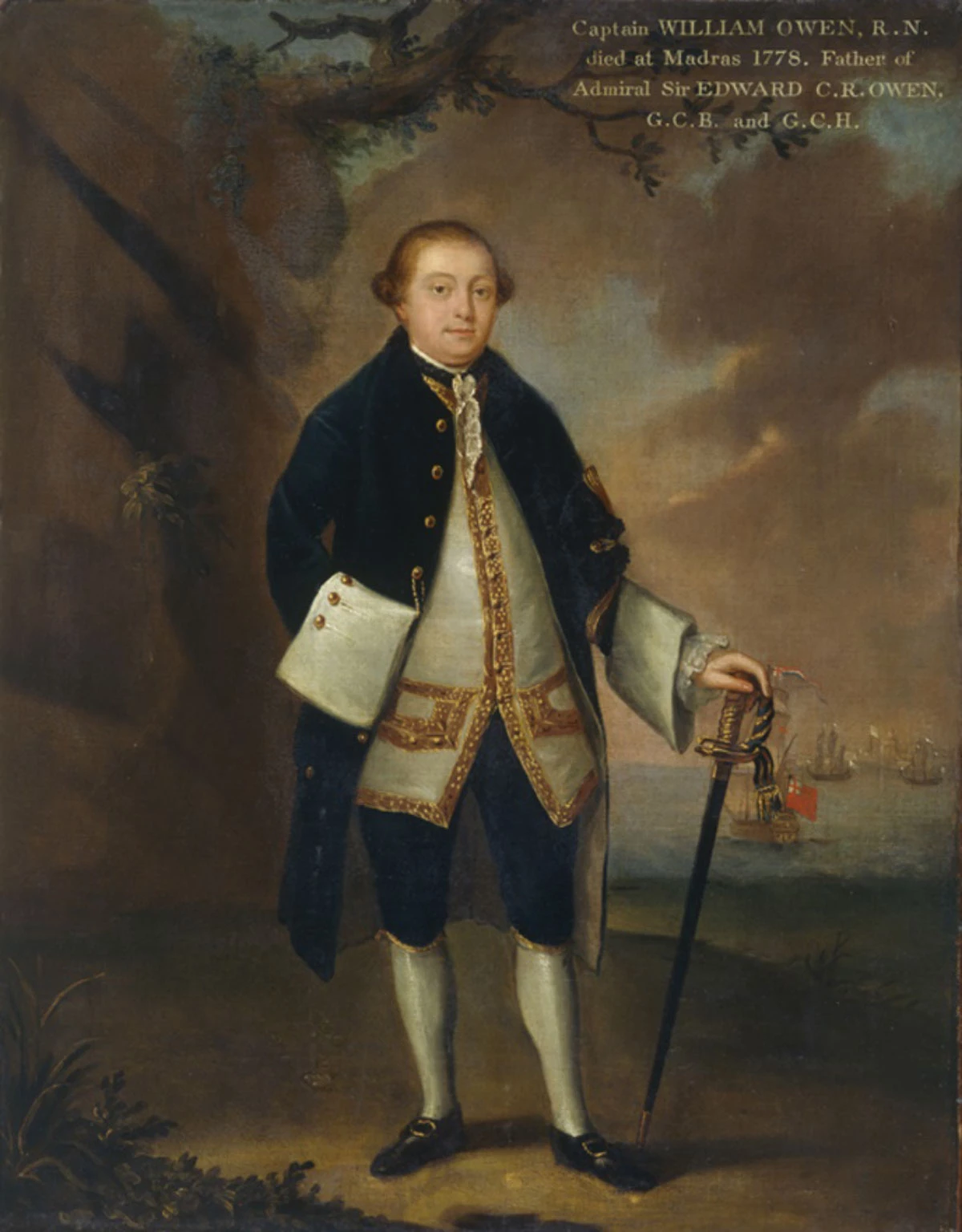
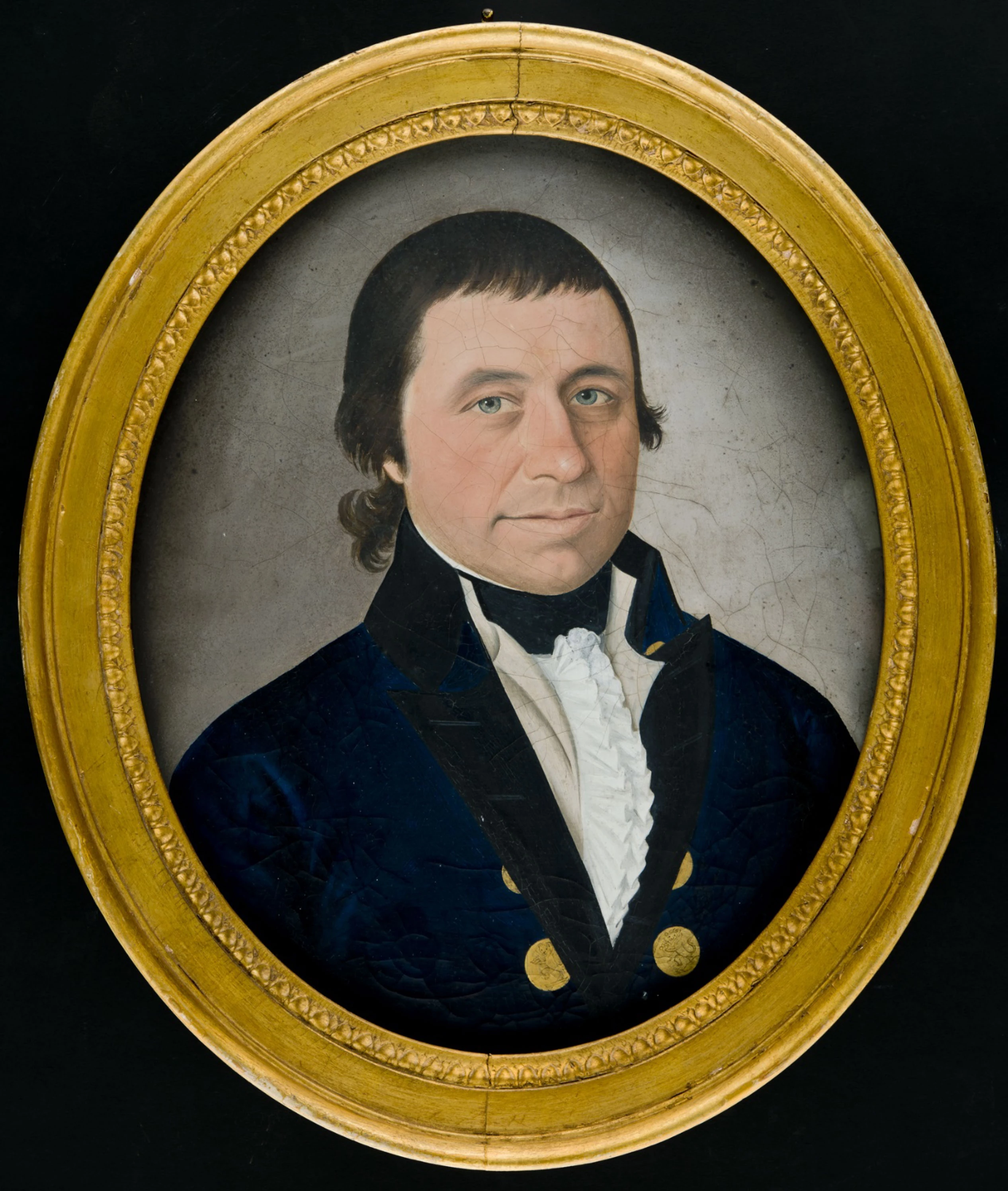
Welsh participation in the development of Britain’s maritime empire Oliver Fairclough, 27 November 2015 Two portraits illustrate Welsh participation in the development of Britain’s maritime empire. One of these, a small full-length measuring 54.5 x 42.6 cm, was painted around 1764. Its subject is William Owen (1737-1778). The other was made in Canton, China, perhaps in 1791, and is of John Jones (1751-1828), a Captain in the service of the East India Company. William Owen William Owen (1737-1778) William Owen came from a Montgomeryshire gentry family, the Owens of Cefyn-yr-Hafodau. Life at sea was dangerous, and progress up the career ladder was difficult and required influence as well as talent. However, it was a socially appropriate career for a gentleman, it required little investment, and there was the remote possibility of making a fortune from prize money. Families had to persuade a Captain to accept their son on board as ‘a young gentleman’ to build up the six years’ service needed to qualify as a Lieutenant. William’s father obtained a recommendation to the Secretary of the Admiralty who placed the boy with his son-in-law. William served in West Africa and the West Indies, before sailing for India in 1754. He was to be in India for a hectic seven years, while Britain was at war with France. William fought on land at the Battle of Plassey as well as at sea, being wounded with a musket ball. William, who was promoted Lieutenant in 1758, also took part in the blockade of the French base of Pondicherry and was again wounded in an attack on two French ships in the harbour. In his portrait, Owen is wearing the uniform of a Lieutenant in the Royal Navy (pattern of 1748-1767). Part of his right arm is missing, as he explains in an account of his services: ‘on the night of 7 Oct 1760 he [was] ordered to cut out the French ships La Baleine and Hermoine from under the guns of Pondicherry, … [when] he had the misfortune to have his right arm shot off … by a Cannon Ball’. Owen went on half-pay when the war ended in November 1762. Promotion in the Navy was slow in peacetime and in 1766 he accompanied Lord William Campbell, newly appointed as governor, to Nova Scotia. Campbell granted him an island in Passamaquoddy Bay (between New Brunswick and Maine). By 1771 there were seventy-three settlers on Owen’s island. As Britain and Spain then appeared close to war, he returned to England. However it was not until 1776 that he was recommissioned and ordered to India. Promotion followed and he was made Commander into the sloop HMS Cormorant. William did not live to see the end of that war as he was killed in a drunken accident in Madras in October 1778. John Jones John Jones (1751-1828) The subject of the other portrait, John Jones was born in Swansea in August 1751. He came from a middle-class family, and was apprenticed a merchant seaman in the West India trade, He then served on the East India Company’s ship Queen, on a voyage to Madras and China in 1770-1772. On his return he joined the Royal Navy. In 1773 Britain was at peace, and he probably did so in the hope of improving his social as well as his professional status. He was less obviously officer-class than William Owen, and served as a Master, the warrant officer responsible for navigation, before being commissioned Lieutenant in 1782 at the end of the American War. He was now out of a job and re-joined the East India Company which he served for the next fifteen years. He was 1st Mate on the Carnatic in 1786-7, and of the Deptford in 1787-9. He was then appointed Captain of the East Indiaman Boddam, making three voyages to China in 1791-2, 1793-4 and 1800-1. His private ledger survives for his first voyage in the Boddam and reveals that he invested £11,000 in goods to be sold in Madras and Canton including a pack of fox hounds, making a personal profit of nearly £4,000. He was then able to invest £7,500 in Chinese goods in Canton, which would have sold for a further profit in London. His portrait was painted by Guan Zuolin, a Chinese artist active in Canton between 1770 and 1805. He worked in a flat, clear-cut European style using oils thinned with water. In 1794 Jones bought St Helen’s House, overlooking Swansea bay, which was rebuilt for him as a neo-classical villa by the architect William Jernegan. A view of about 1800 shows it set in its own parkland, grazed by Jones’s horses, cattle and sheep. Here he passed a comfortable retirement until his death in a carriage accident in 1828. St Helen’s House
Wales – a modern maritime nation? David Jenkins, 26 September 2013 A Welsh tramp steamer loading Welsh coal at a Welsh port - The Cardiff-owned Radnor at Barry Docks in 1925
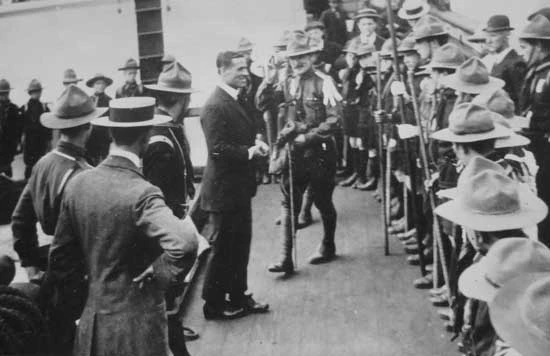
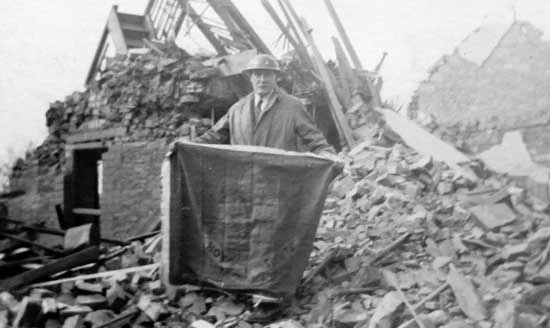
The scout flag that went South with Scott Jennifer Barsby, Department of Conservation, Elen Phillips, Department of Social and Cultural History, and Tom Sharpe, 14 June 2013 Commander Evans returns the flag to Scoutmaster T.W. Harvey on board the Terra Nova on 17 June 1913. The flag being retrieved from the rubble of the scout hall in Wyverne Road, Cathays, Cardiff after the German bombing raid of 30 April 1941 When Captain Scott's Antarctic Expedition ship, the Terra Nova, sailed into her home port of Cardiff on 14 June 1913, she had not only the White Ensign flying at the stern, the Welsh flag on the mainmast and the Cardiff City coat of arms on the foremast, but another, much smaller flag fluttering at the bow. Bearing the colour of the 4th Cardiff Scout Troop, this little green flag had accompanied the expedition to the Antarctic and back. The 4th Cardiff (St Andrews) Troop had been set up in the Cathays district of Cardiff in October 1908, just five months after the first publication in book form of Scouting for boys by the organisation's founder, Robert Baden-Powell. Despite its title as the 4th Cardiff, it was the first scout troop established in Wales. In March 1910, their Scoutmaster, T.W. Harvey, ordered a flag from the Boy Scouts headquarters in London, with the intention of presenting it to Scott's upcoming expedition to the South Pole. The flag cost six shillings, plus threepence postage, and the invoice, which was returned with the payment by postal order, he marked "Urgent. For Captain Scott Terra Nova for South Pole". The flag was presented to the expedition in June 1910 when the Terra Nova was in Cardiff to take on coal and other supplies prior to sailing for Antarctica on 15 June. It was one of several flags given to the expedition in Cardiff with requests that they be taken to the South Pole. The flags certainly made it to the expedition's base hut at Cape Evans on McMurdo Sound in the Ross Sea, but it is unlikely that they were taken by Scott to the South Pole itself. The 4th Cardiff scouts formed a guard of honour on the quayside at the Roath Dock when the Terra Nova sailed back into Cardiff on Saturday 14 June 1913. Three days later, on 17 June, some fifty members of the troop gathered on the deck of the Terra Nova to see their colour handed back to their Scoutmaster, T.W. Harvey, by Commander Teddy Evans who had assumed command of the ship after the death of Scott. Addressing the boys, Evans said, "Well, boys, here's your flag, and I hope you will treasure it. It has been a long way. If you become such good soldiers as Captain Oates, you will be good men." Following the flag's return to the scouts, it hung, framed, in a place of honour in the scout hall in Wyverne Road in Cardiff until the night of 30 April 1941 when a German land mine, dropped during an air raid, destroyed the building. A search of the ruins soon afterwards revealed that, remarkably, the flag had survived intact. But that wasn't the last of the flag's adventures. The rebuilt hut in which it later hung burnt down, and yet the flag survived. Replacement premises in Cathays flooded when a pipe burst, but still the flag came through unscathed. Now in the textile collections of Amgueddfa Cymru, the flag of the 4th Cardiff (St Andrews) Scout Troop has been reunited with two of the other Terra Nova flags which flew on the ship when she returned to Cardiff, the White Ensign and the Welsh flag. The flag of the 4th Cardiff Scout Troop Boy Scouts Be Prepared The flag is made from two pieces of coarse green, plain weave, woollen cloth, machine sewn across the centre with a double line of stitching in black cotton thread. Its sides have been turned to the reverse and machine sewn using the same black thread. The centre features the yellow fleur-de-lis motif of the Boy Scouts with a painted outline in black and brown. The green cloth has been cut-away and the edges turned in, the motif laid on the front, and the edges turned under and machine sewn with double line of stitching. This technique enables the motif to be seen from both sides when flying, although the text can only be viewed from the front. Below the fleur-de-lis is a scroll, also in yellow wool, with the motto BOY SCOUTS BE PREPARED painted in black capital letters. The troop's name is painted in white in the bottom left corner. It measures 92.5 cm x 115cm, making it the smallest of the Terra Nova flags in the Museum's collection. The edge which would have been exposed to the wind is quite frayed. This type of damage is often found on flags. There are also lines of black soiling on the front, the source of which has not yet been identified, but is comparable to the soiling found on the other two Terra Nova flags in the collection. Small rust marks, pin holes and long tacking stitches indicate that it was previously displayed on a stiff board inside a frame. It has also suffered substantial light damage to its front side. Unfortunately, light damage cannot be reversed, but the physical structure of the flag will be supported with the use of conservation-grade materials. Faded areas, stains and tears help us to understand how the flag has been used, stored and displayed during its 103 year history. Our goal is to preserve as much information about its past as possible.
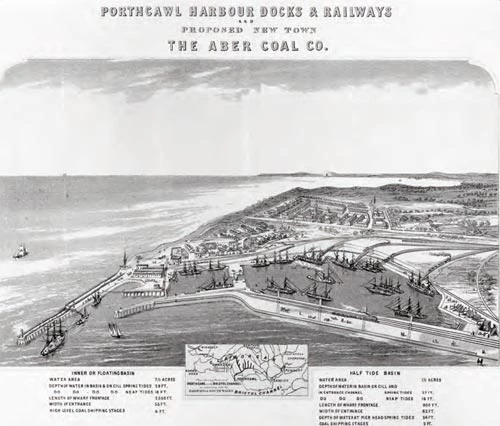
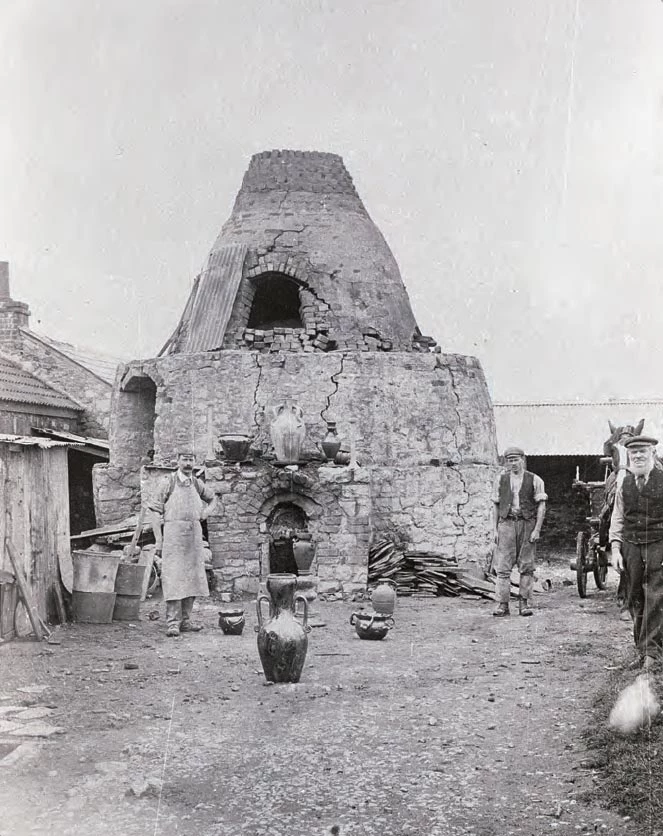
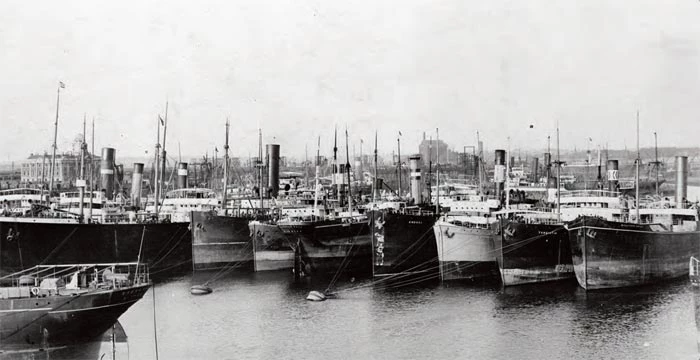
The Vale of Glamorgan - a hive of industry 31 July 2012 In the nineteenth century new docks were built at Porthcawl to help handle the worldwide demand for coal. This view of Ewenny Pottery dates from the early twentieth century. A limestone quarry near Aberthaw in the 1950s. Barry docks, c.1910, with ships moored to buoys waiting to load coal. The Vale of Glamorgan - a hive of industry Although the Vale of Glamorgan has been predominantly agricultural, there are a number of historically important industries in the area, some of which are still operational today. Some of those industries grew from the characteristic limestone geology of the area, while others are due to the area's lengthy coastline or relatively flat topography. Pottery There has been a pottery at Ewenny since the early fifteenth century. Successive generations of the Jenkins family have run it since 1610, and it remains a flourishing business today. Quarrying Limestone was widely quarried in this area. It was used for the building industry, and it was burnt to produce fertiliser and cement. It was also shipped across the Bristol Channel to Somerset and north Devon. Mining The valleys just north of the Vale Glamorgan held vast reserves of high-grade steam coal. Not even the huge, thriving docks at Cardiff could handle the worldwide demand for this premium fuel. In the nineteenth century new facilities were built at Porthcawl, Penarth and Barry - where just over 11 million tons were exported at its peak in 1913. Barry docks are still used today.